GS2 Government Policies

VB-G RAM G replaces MGNREGA, reshaping India's rural employment guarantee framework.

VB-G RAM G: India's New Rural Employment Guarantee Framework

The shift in financial responsibilities in the VB-G RAM G Bill raises concerns among several states affecting rural employment guarantees.
Gopi Gopi
4 mins read

"The strength of a social security programme lies not merely in its funding, but in its ability to guarantee livelihoods when people need it the most."

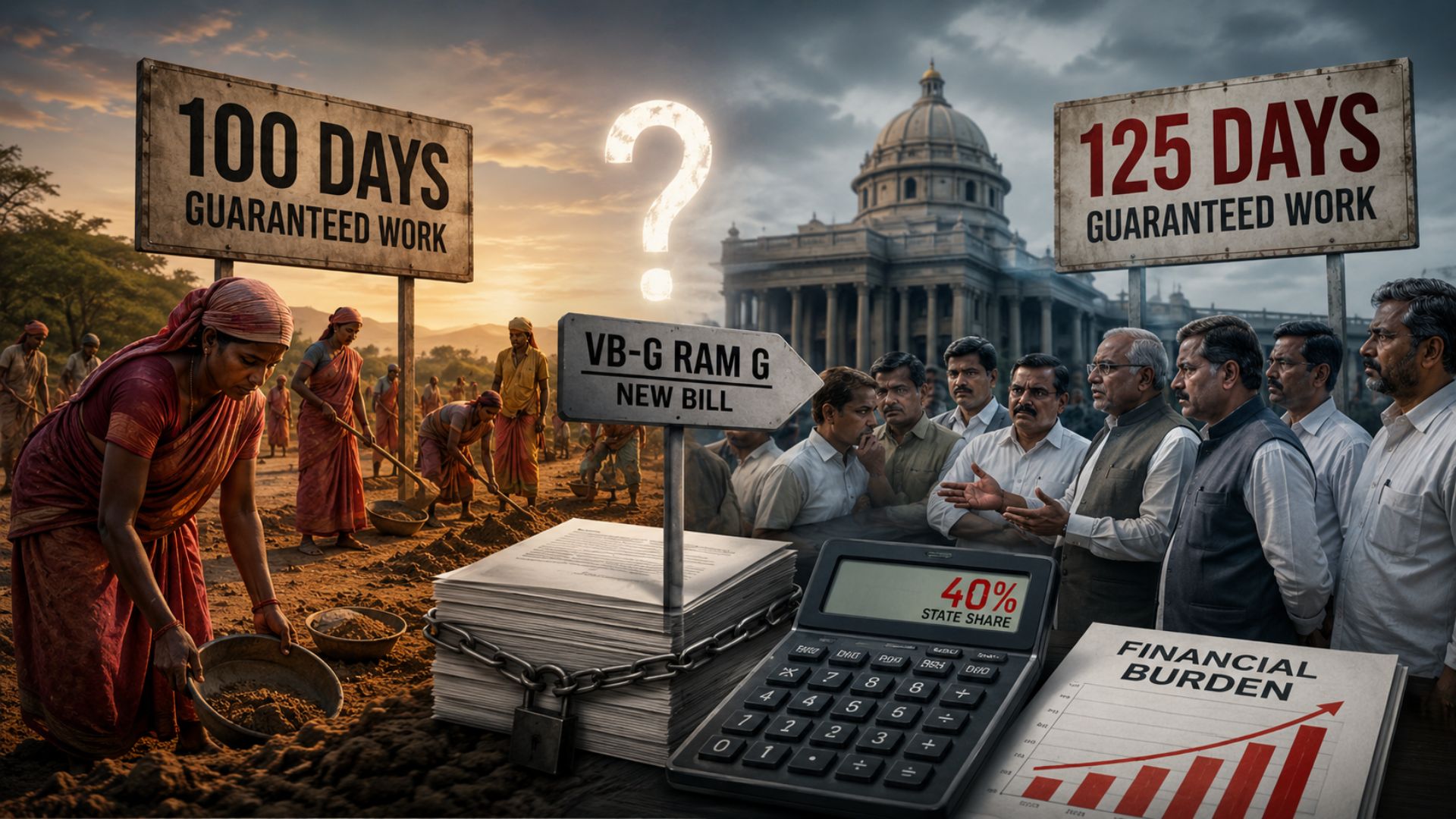
From July 1, the Viksit Bharat Guarantee for Rozgar and Ajeevika Mission (Gramin) [VB-G RAM G] replaces the Mahatma Gandhi National Rural Employment Guarantee Act (MGNREGA), marking a significant shift in India's rural employment policy. While the new scheme increases guaranteed employment from 100 to 125 days, it also introduces structural changes in funding, implementation and Centre-State relations, prompting concerns from several States.


Major Shift in the New Scheme

The most fundamental change is the transition from a demand-driven programme to a supply-driven model.

MGNREGAVB-G RAM G
Demand-driven; employment provided on demandSupply-driven; work limited by annual budget allocation
Universal rural coverageRural areas notified by the Centre
100 days of guaranteed employment125 days of guaranteed employment
Centre bore nearly 90% of expenditureStates' share increased to about 40%
No blackout periodWork may be suspended during peak agricultural seasons

This represents a shift from a rights-based entitlement towards a budget-based welfare programme.


Changes in Financial Sharing

One of the most debated provisions concerns the financing pattern.

AspectMGNREGAVB-G RAM G
Labour wages100% CentreShared with States
Material cost75% CentreIncreased State responsibility
Overall expenditureApprox. 90:10 (Centre:State)Approx. 60:40 (Centre:State)

The increased financial burden has drawn objections from several State governments.


Why are States concerned?

Several States, including Madhya Pradesh, Bihar and Jharkhand, questioned the revised funding pattern.

Major concerns include:

  • Sharp increase in States' financial contribution.
  • Delays in wage and material payments by the Centre.
  • Wage rates not matching local market conditions.
  • Provision allowing 60 non-working (blackout) days during peak agricultural seasons.
Examples of State Demands

Bihar
₹255 → ₹413 per day

Jammu & Kashmir
₹272 → ₹311 per day

Jharkhand & Punjab
Market-linked wages

Uttarakhand
Higher wages considering difficult terrain

Several States also demanded timely release of pending wage and material payments before implementing the new framework.


Blackout Period: A New Provision

Unlike MGNREGA, the new scheme permits suspension of employment during peak agricultural seasons.

Rationale

  • Ensure adequate labour availability for agricultural operations.

Concerns

  • May reduce income security for landless labourers.
  • Weakens the guarantee nature of rural employment.
  • Limits workers' ability to seek employment when required.

States such as Punjab, Karnataka and Telangana have sought reconsideration of this provision.


Greater Role of the Union Government

Another major change is the expansion of Central discretion in implementation.

Funding Allocation

The Centre will distribute funds among States using objective parameters based on recommendations of the 16th Finance Commission for horizontal devolution.

However, the methodology for applying these parameters remains at the Centre's discretion, raising concerns regarding transparency and federal balance.


Performance-Based Funding

From the second year onwards, a part of each State's allocation will depend upon performance indicators.

These include:

  • Timely wage payments.
  • Compliance with social audit guidelines.
  • Percentage of physical works completed.
  • Other performance indicators notified by the Central Government.
Performance-linked Allocation

↓

Timely wage payments

↓

Social audits

↓

Completion of works

↓

Other indicators specified by the Centre

↓

Future funding allocation

Academics and civil society organisations argue that these provisions provide the Centre with considerable administrative discretion over resource allocation.


Key Issues Emerging

  • Shift from rights-based to budget-driven employment guarantee.
  • Increased fiscal burden on States.
  • Reduced universality through selective notification of rural areas.
  • Blackout period may affect livelihood security.
  • Persistent delays in wage payments.
  • Greater Central discretion over funding and performance evaluation.
  • Concerns regarding the federal balance in implementation.

Way Forward

  • Ensure predictable and timely wage payments to workers.
  • Maintain adequate financial support from the Centre to reduce pressure on fiscally weaker States.
  • Periodically revise wage rates in line with inflation, regional costs and market wages.
  • Make performance indicators transparent, objective and consultative.
  • Limit discretionary powers through clearly defined statutory guidelines.
  • Preserve the employment guarantee character while improving efficiency and accountability.
  • Strengthen Centre-State cooperation and institutional dialogue for smoother implementation.

Conclusion

VB-G RAM G seeks to expand rural employment by increasing guaranteed workdays and introducing performance-based governance. However, its shift from a demand-driven entitlement to a supply-driven framework, coupled with higher State financial responsibility and greater Central discretion, has generated important debates on federalism, fiscal sustainability and livelihood security. The success of the new programme will ultimately depend on balancing administrative efficiency with the original objective of providing a reliable employment safety net for rural households.

Attribution

Original content sources and authors

Sobhana K. Nair Author Sobhana K. Nair The Hindu Source The Hindu

Syllabus classification

How this article maps to GS papers

Main syllabus

GS2Government Policies

Also covers

GS3Jobs & Inclusive Growth

Quick Q&A

What are the major structural changes introduced through the Viksit Bharat Guarantee for Rozgar and Ajeevika Mission (Gramin), and how does it fundamentally differ from MGNREGA in terms of objectives, financing, and implementation framework?
The Viksit Bharat Guarantee for Rozgar and Ajeevika Mission (Gramin) (VB-G RAM G), scheduled to become operational from July 1, replaces the Mahatma Gandhi National Rural Employment Guarantee Act (MGNREGA), marking one of the most significant shifts in India's rural employment policy since the enactment of MGNREGA in 2005. While MGNREGA was a rights-based, demand-driven employment guarantee programme backed by legislation, VB-G RAM G introduces a supply-driven framework where expenditure is limited by annual budgetary allocations determined by the Union government. Although the guaranteed employment has been increased from 100 to 125 days, the financing pattern has changed substantially. Under MGNREGA, the Centre bore nearly the entire labour wage component, resulting in an approximate 90:10 Centre-State expenditure ratio. Under the new scheme, States will bear nearly 40% of the total expenditure, increasing their fiscal responsibility considerably. Another major difference is the selective implementation of the programme, as the Union government can notify specific rural areas rather than extending universal coverage across all eligible rural regions. The scheme also introduces a blackout period during peak agricultural seasons to facilitate labour availability for farming activities. Additionally, inter-State fund allocation will be linked to Finance Commission parameters and performance indicators such as timely wage payments, social audits, and project completion rates. For UPSC, the topic is highly relevant to GS Paper II (Governance and Welfare Schemes), GS Paper III (Inclusive Growth and Rural Development), and federalism debates. It also raises broader questions regarding welfare delivery, fiscal decentralisation, cooperative federalism, and balancing efficiency with social protection.
Why has the proposed replacement of MGNREGA with VB-G RAM G generated significant concerns among States, academics, and civil society organisations despite promising additional employment days?
The proposed transition from MGNREGA to VB-G RAM G has generated widespread debate because many stakeholders believe that the institutional changes outweigh the benefit of increasing guaranteed employment from 100 to 125 days. The foremost concern relates to fiscal federalism. States such as Bihar, Madhya Pradesh, and Jharkhand have objected to the revised cost-sharing formula, under which they would finance approximately 40% of total expenditure instead of contributing only a limited share under the earlier arrangement. Poorer States fear that this increased financial burden may reduce their capacity to provide employment during periods of rural distress. Another major issue is the shift from a demand-driven legal entitlement to a supply-driven budget-based model. Under MGNREGA, any eligible household demanding work was legally entitled to employment or unemployment allowance. Under VB-G RAM G, employment availability may become constrained by fixed budgetary allocations, potentially weakening the rights-based character of rural employment. States have also objected to the proposed blackout period during peak agricultural seasons, arguing that labour demand among vulnerable households may persist irrespective of agricultural cycles. Wage adequacy has emerged as another contentious issue. Bihar demanded an increase from ₹255 to ₹413 per day, Jammu and Kashmir proposed ₹311 instead of ₹272, while Punjab and Jharkhand sought wages aligned with prevailing market rates. Delayed wage payments under MGNREGA have also been highlighted, with States demanding institutional safeguards for timely payments. Academics have expressed concerns that enhanced discretionary powers vested in the Union government over fund allocation and performance metrics may undermine cooperative federalism. For UPSC aspirants, this issue connects constitutional principles, Centre-State relations, welfare governance, public finance, and evidence-based policymaking under GS Papers II and III.
How could the transition from a demand-driven rural employment guarantee to a supply-driven model influence rural livelihoods, labour markets, and the implementation of social welfare programmes in India?
The transition from a demand-driven to a supply-driven rural employment model has important implications for employment security, labour markets, and poverty alleviation. Under the demand-driven approach of MGNREGA, eligible households could legally demand employment whenever livelihood opportunities declined due to drought, economic slowdown, or seasonal unemployment. The new supply-driven framework introduces expenditure ceilings determined by budget allocations, which could potentially restrict employment availability even when rural demand remains high. This may reduce the programme's effectiveness as a social safety net during crises. Labour markets may also experience mixed effects. The proposed blackout period aims to ensure labour availability during peak agricultural seasons, potentially reducing labour shortages for farmers. However, many economists argue that rural households require diversified income sources throughout the year, and restricting employment opportunities may adversely affect vulnerable populations such as landless labourers, marginal farmers, women, Scheduled Castes, and Scheduled Tribes. Increased State financial responsibility may also lead to variations in implementation across States depending on fiscal capacity. Wealthier States may sustain employment generation more effectively than poorer States, creating regional disparities. Performance-linked allocations based on timely payments, social audits, and work completion could improve administrative efficiency and accountability if implemented transparently. However, excessive central discretion may reduce flexibility for States facing unique local challenges. Historically, MGNREGA has contributed to rural asset creation, drought resilience, groundwater conservation, and women's workforce participation. Therefore, any changes affecting accessibility, funding, or implementation will influence broader rural development outcomes. From the UPSC perspective, the issue illustrates the intersection of governance reforms, social justice, labour economics, sustainable development, disaster resilience, and inclusive growth under GS Papers II, III, and Essay.
Critically analyse whether the enhanced role of the Union government under VB-G RAM G strengthens administrative efficiency or weakens the principles of cooperative federalism in India.
The enhanced role assigned to the Union government under VB-G RAM G has generated an important constitutional and governance debate regarding the balance between administrative efficiency and cooperative federalism. Supporters argue that greater central oversight can improve accountability, reduce leakages, standardise implementation, and ensure that public funds are linked to measurable outcomes. The proposal to allocate a portion of funds based on objective parameters recommended by the Sixteenth Finance Commission and performance indicators such as timely wage payments, compliance with social audit norms, and completion of physical works could incentivise better governance. Such reforms align with principles of results-based public administration. However, critics contend that the draft rules provide substantial discretionary powers to the Union government regarding allocation methodology, selection of notified rural areas, and determination of future performance criteria. This concentration of authority may reduce State autonomy despite rural development being an area requiring significant State participation. States possess better knowledge of local labour demand, geographical conditions, migration patterns, and agricultural cycles. Uniform performance metrics may not adequately account for these regional differences. Furthermore, increased fiscal obligations without corresponding decision-making authority could strain State finances and weaken the spirit of cooperative federalism envisaged by the Constitution. Delays in wage payments under previous implementation have also led States to question whether greater central control necessarily translates into better service delivery. A balanced approach would require transparent allocation formulas, independent monitoring mechanisms, regular consultation through intergovernmental forums, and flexibility for States to adapt implementation according to local conditions. For UPSC interviews, candidates should appreciate both administrative efficiency and constitutional federalism rather than adopting extreme positions. The issue relates directly to GS Paper II topics including federalism, governance reforms, Finance Commission recommendations, decentralisation, and accountability in welfare administration.
What lessons can be drawn from the responses of different States to the draft VB-G RAM G framework regarding rural employment policy, fiscal capacity, and governance reforms in India?
The feedback submitted by various States on the draft VB-G RAM G framework provides an important case study in public policy, cooperative federalism, and evidence-based governance. Although States differ politically and economically, several concerns have emerged across party lines, demonstrating that implementation challenges often transcend ideological divisions. Bihar requested a significant increase in wage rates from ₹255 to ₹413 per day, reflecting concerns about inflation and the need for wages that remain competitive with local labour markets. Jammu and Kashmir similarly sought higher wages to account for regional conditions, while Uttarakhand emphasised compensation for difficult mountainous terrain. Punjab and Jharkhand argued that wages should reflect prevailing market realities to maintain worker participation. Several States, including Karnataka, Telangana, and Punjab, expressed reservations regarding the proposed 60-day blackout period during peak agricultural seasons, arguing that livelihood security should not be compromised through uniform restrictions. Almost all States highlighted persistent delays in wage and material payments under the existing system and recommended stronger institutional mechanisms for timely fund release under the new programme. These responses illustrate that successful welfare implementation depends not only on legislative design but also on administrative efficiency, fiscal sustainability, and sensitivity to local socio-economic conditions. They also highlight the diversity of India's rural economy, where labour demand, agricultural practices, and fiscal capacities vary considerably across regions. For UPSC aspirants, this case study demonstrates how policy consultation strengthens democratic governance by incorporating stakeholder feedback before implementation. It also provides valuable insights into public finance, rural development, labour economics, decentralisation, and Centre-State relations. The broader lesson is that welfare reforms should balance fiscal discipline with inclusiveness, administrative efficiency with flexibility, and national objectives with local realities.

Practice questions

2 questions for mains preparation

Discuss the implications of the VB-G RAM G Bill on the fiscal federalism of India. What are the potential impacts on state budgets and rural welfare?

10 marks · 150 words · 8 mins

Employment guarantee programmes are an important instrument of inclusive development and social security in rural India. Analyse the significance of such programmes in promoting livelihood security while examining the challenges of balancing fiscal sustainability and cooperative federalism in their implementation.

10 marks · 150 words · 8 mins
