What is the illicit liquor or hooch problem in India, and why has it emerged as a recurring public health and governance challenge?
Illicit liquor, commonly known as hooch, refers to illegally manufactured, distributed, or sold alcoholic beverages that often evade regulatory oversight and taxation. A major danger associated with illicit liquor is the use of methanol, an industrial alcohol that is highly toxic to humans. Consumption of methanol-contaminated liquor can cause blindness, organ failure, and death. India has witnessed numerous hooch tragedies across states such as Tamil Nadu, Gujarat, Bihar, Maharashtra, Punjab, Assam, and Uttar Pradesh. Incidents such as the 2015 Malwani tragedy in Mumbai, which claimed more than 100 lives, and the recent Pune-Pimpri-Chinchwad deaths demonstrate the recurring nature of the problem.
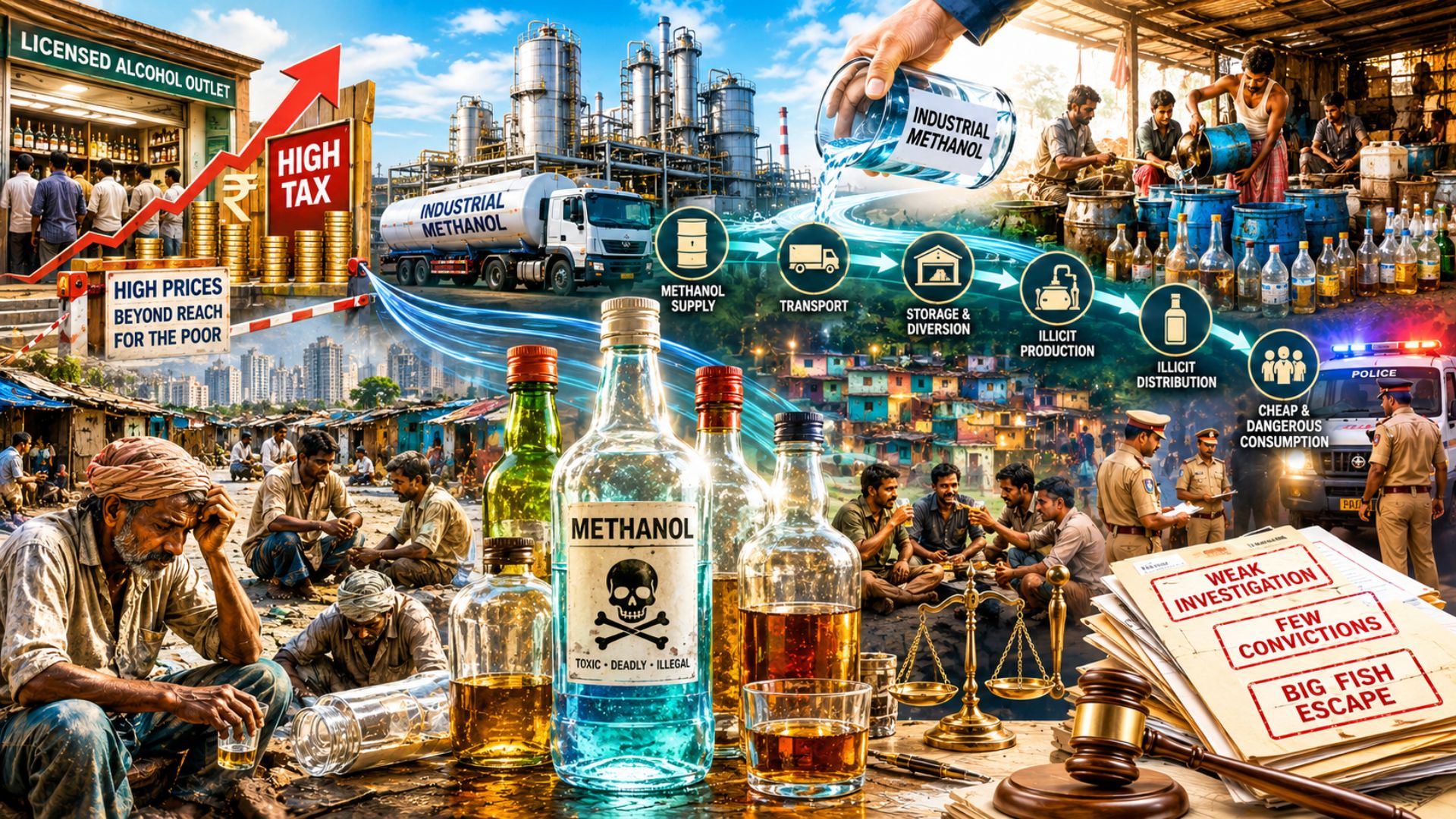
The issue is not merely a law-and-order concern but a multidimensional challenge involving public health, poverty, governance, and regulation. High taxes on legal alcohol often make licensed products unaffordable for economically weaker sections, encouraging demand for cheaper illicit alternatives. Simultaneously, illegal manufacturers increase profits by mixing ethanol with industrial methanol, creating highly dangerous products.
The problem also exposes weaknesses in supply-chain monitoring, especially regarding the diversion and pilferage of industrial methanol. Investigations frequently focus on retail sellers while failing to identify larger criminal networks and suppliers. Furthermore, victims often belong to marginalized and working-class communities, resulting in limited public attention and inadequate long-term policy responses.
For UPSC preparation, the issue intersects with GS-II (Governance and Public Policy), GS-III (Internal Security and Economic Crimes), GS-II (Public Health), and GS-I (Social Issues). It illustrates how regulatory failures, socio-economic vulnerabilities, and weak enforcement can combine to create a persistent public health crisis.
Why do illicit liquor tragedies continue to recur in India despite repeated enforcement drives, investigations, and promises of reform?
The persistence of illicit liquor tragedies in India can be explained through a combination of economic, social, administrative, and political factors. While governments often announce strict action after major incidents, systemic reforms frequently remain incomplete or poorly implemented. Consequently, the underlying drivers of the problem continue to exist.
A major reason is economic demand. Public health analyses indicate that high prices of legal alcohol, driven by substantial state taxation, push low-income consumers toward cheaper illicit alternatives. Estimates suggest that illicit alcohol accounts for nearly 40% of alcohol consumption in India. Daily-wage laborers and economically vulnerable populations often seek affordable intoxicants despite the associated risks.
On the supply side, criminal operators earn large profits by using industrial methanol, which is inexpensive and easily diverted from legitimate industrial channels. Weak tracking mechanisms and inadequate downstream monitoring facilitate such diversion. Regulatory agencies frequently struggle to maintain comprehensive oversight over the production, transportation, and use of industrial alcohol.
Another factor is weak enforcement. Investigations often target local vendors rather than the financiers, suppliers, and kingpins who manage larger networks. Conviction rates remain low, reducing deterrence. Allegations of local-level corruption, political protection, and administrative complicity further weaken accountability.
Social marginalization also plays an important role. Victims often belong to poorer communities with limited political influence. As a result, public outrage may be temporary, and sustained reform efforts lose momentum over time.
For UPSC aspirants, this issue highlights the limitations of reactive governance. It demonstrates that enforcement alone is insufficient without addressing poverty, addiction, regulatory loopholes, institutional accountability, and public health concerns. The topic is relevant to debates on governance reforms, social justice, criminal economics, and evidence-based policymaking.
How do regulatory loopholes, methanol diversion, and enforcement weaknesses contribute to the illicit liquor supply chain in India?
The illicit liquor supply chain in India operates through a combination of regulatory gaps, economic incentives, and weak enforcement mechanisms. Understanding this chain is essential for designing effective policy interventions. One of the most critical components is the diversion of industrial methanol, a toxic chemical used in manufacturing processes. Although methanol has legitimate industrial applications, inadequate tracking and accounting systems make it vulnerable to pilferage and illegal resale.
Once diverted, methanol is mixed with ethanol or other substances to increase the volume of liquor batches at minimal cost. This significantly raises profit margins for illegal manufacturers. Because methanol resembles ethanol in appearance, consumers often cannot distinguish between safe and dangerous products. Even small quantities can be fatal.
The distribution network typically involves multiple intermediaries, including suppliers, transporters, local manufacturers, wholesalers, and retail vendors. However, law enforcement actions often focus on the lowest levels of the chain. Retail sellers are easier to identify and arrest, while investigations into upstream suppliers and criminal organizers frequently remain incomplete.
Administrative weaknesses further compound the problem. Inadequate inter-state coordination, poor digital monitoring of industrial chemicals, insufficient forensic capacity, and allegations of corruption create opportunities for illegal operators. Areas with weak governance may allow these activities to function as semi-visible local economies.
The issue demonstrates broader governance challenges, including regulatory capture, implementation deficits, and fragmented accountability structures. From a UPSC perspective, it is relevant to GS-II governance, GS-III internal security, public administration, and regulatory policy. It also provides an example of how supply-chain management, technology-enabled monitoring, and institutional reforms can improve public safety and reduce organized criminal activity.
Critically analyze the relationship between alcohol prohibition policies, high taxation on legal liquor, and the growth of illicit alcohol markets in India.
The relationship between alcohol prohibition, taxation, and illicit alcohol markets is a complex policy issue that requires a balanced assessment. Advocates of prohibition and high taxation argue that these measures reduce alcohol consumption, improve public health, decrease domestic violence, and lower social costs associated with alcoholism. States such as Bihar and Gujarat have implemented prohibition policies with these objectives in mind.
However, critics argue that such measures can produce unintended consequences. When legal alcohol becomes unavailable or unaffordable, demand does not necessarily disappear. Instead, consumers may shift toward illicit markets. Public health experts have observed that high legal alcohol prices can disproportionately affect low-income consumers, increasing their reliance on unregulated alternatives. Criminal syndicates often exploit this demand by producing cheaper illicit liquor with little regard for quality or safety.
The experience of several states suggests that prohibition may sometimes strengthen underground networks, increase smuggling, and complicate enforcement efforts. Moreover, illicit markets operate outside regulatory oversight, making it impossible to ensure product safety. This creates significant risks of methanol poisoning and mass fatalities.
Nevertheless, attributing hooch tragedies solely to prohibition would be simplistic. Weak governance, poor enforcement, corruption, addiction, poverty, and inadequate public awareness also contribute significantly. Therefore, policy responses must be multifaceted rather than ideological.
A balanced approach may involve stronger regulation, affordable legal alternatives, addiction treatment services, public awareness campaigns, and improved monitoring of industrial alcohol. For UPSC preparation, this debate is relevant to GS-II governance, GS-III economics and public policy, and ethics in policymaking. It highlights the challenge of balancing public health objectives with practical implementation realities and unintended policy outcomes.
What socio-economic factors make marginalized communities particularly vulnerable to the consumption of illicit liquor in India?
Marginalized communities are disproportionately affected by illicit liquor consumption due to a combination of economic hardship, occupational stress, limited access to healthcare, and social exclusion. Most victims of hooch tragedies are daily-wage laborers, informal-sector workers, and individuals living in economically vulnerable conditions. These groups often face intense physical labor, unstable incomes, and financial insecurity.
Scholars have argued that the physical strain associated with manual labor creates demand for inexpensive forms of relief and recreation. Legal alcohol, however, may be financially inaccessible because of high taxation and pricing. Consequently, cheaper illicit alternatives become attractive despite known health risks. Economic necessity often outweighs concerns about product safety.
Addiction and lack of awareness further increase vulnerability. Many consumers may not fully understand the dangers associated with methanol contamination. Limited access to quality healthcare also means that early symptoms of poisoning are not always treated promptly, increasing mortality rates.
Social exclusion plays a critical role. Communities with weaker political representation often receive less sustained policy attention. As a result, reforms following major tragedies may not be pursued with sufficient urgency. Poor living conditions, lower educational attainment, and inadequate public health infrastructure further contribute to the cycle.
The issue also reflects broader structural inequalities in Indian society. It raises questions about social justice, inclusive development, and equitable access to healthcare and social protection systems. Addressing illicit liquor consumption therefore requires more than criminal enforcement. It demands poverty reduction, employment security, addiction counseling, public health interventions, and community-based awareness programs.
For UPSC aspirants, this topic is relevant to GS-I society, GS-II welfare policies, GS-II public health, and GS-III inclusive development. It demonstrates how socio-economic vulnerabilities can interact with governance failures to produce recurring human tragedies.
What lessons can policymakers and administrators learn from recurring hooch tragedies such as the Malwani and Pune-Pimpri-Chinchwad incidents?
Recurring hooch tragedies provide important case studies for understanding failures in governance, regulation, and public health administration. The 2015 Malwani tragedy, which killed more than 100 people, and the more recent Pune-Pimpri-Chinchwad incident demonstrate that despite repeated warnings, systemic vulnerabilities remain unresolved.
One key lesson is that reactive responses are insufficient. Governments often announce crackdowns immediately after major incidents, but long-term reforms are rarely implemented effectively. Sustainable solutions require institutional changes rather than temporary enforcement drives.
A second lesson concerns supply-chain accountability. Investigations frequently focus on local vendors while failing to identify upstream suppliers, transporters, financiers, and organized criminal networks. Policymakers must strengthen end-to-end monitoring of industrial methanol and improve inter-agency coordination.
Third, public health considerations must be integrated into alcohol policy. Excessive emphasis on enforcement without addressing addiction, affordability, and consumer behavior may not reduce demand. Awareness campaigns, rehabilitation services, and community outreach programs are necessary complements to policing.
Fourth, technology can improve oversight. Digital tracking systems, real-time inventory monitoring, forensic audits, and data-sharing mechanisms can help detect methanol diversion before it reaches consumers. Enhanced accountability mechanisms can also reduce opportunities for corruption.
Finally, the tragedies highlight the importance of inclusive governance. Victims often belong to marginalized communities whose concerns receive limited attention. Effective policymaking requires sustained political commitment even after media attention declines.
For UPSC candidates, these case studies demonstrate the importance of evidence-based administration, preventive governance, public health management, and institutional accountability. They also provide practical examples relevant to ethics, disaster management, governance reforms, and public policy implementation.
How can India develop a comprehensive policy framework to address illicit liquor as a public health, governance, and criminal justice issue?
A comprehensive strategy to address illicit liquor must recognize that the issue extends beyond criminal law enforcement. It is simultaneously a public health challenge, a governance problem, a socio-economic issue, and a criminal justice concern. Therefore, a multi-dimensional policy framework is required.
First, regulatory oversight of industrial methanol must be strengthened. Authorities should establish robust tracking systems covering production, transportation, storage, and end-use verification. Digital monitoring and periodic audits can reduce opportunities for diversion.
Second, law enforcement agencies should focus on dismantling entire criminal networks rather than merely arresting retail vendors. Specialized investigations, financial intelligence, and inter-state coordination can help identify major suppliers and syndicate leaders. Faster prosecution and higher conviction rates would improve deterrence.
Third, public health interventions are essential. Governments should expand addiction treatment programs, community counseling services, and awareness campaigns regarding the dangers of methanol poisoning. Emergency medical response systems should also be strengthened in vulnerable regions.
Fourth, policymakers must address economic drivers. Affordable and regulated alternatives, combined with rational taxation policies, may reduce incentives for consumers to seek illicit products. At the same time, livelihood support and social welfare measures can reduce economic vulnerability among high-risk populations.
Fifth, accountability mechanisms should ensure transparency in enforcement. Independent investigations into allegations of official complicity and corruption can strengthen public trust.
From a UPSC perspective, the issue cuts across GS-II governance, GS-II health, GS-III internal security, GS-III economy, and ethics in public administration. A successful policy framework would combine preventive regulation, social welfare, public health measures, technological innovation, and effective criminal justice reforms. Such an integrated approach is necessary to break the recurring cycle of hooch-related tragedies in India.
 Dhinesh Balasubramanian
