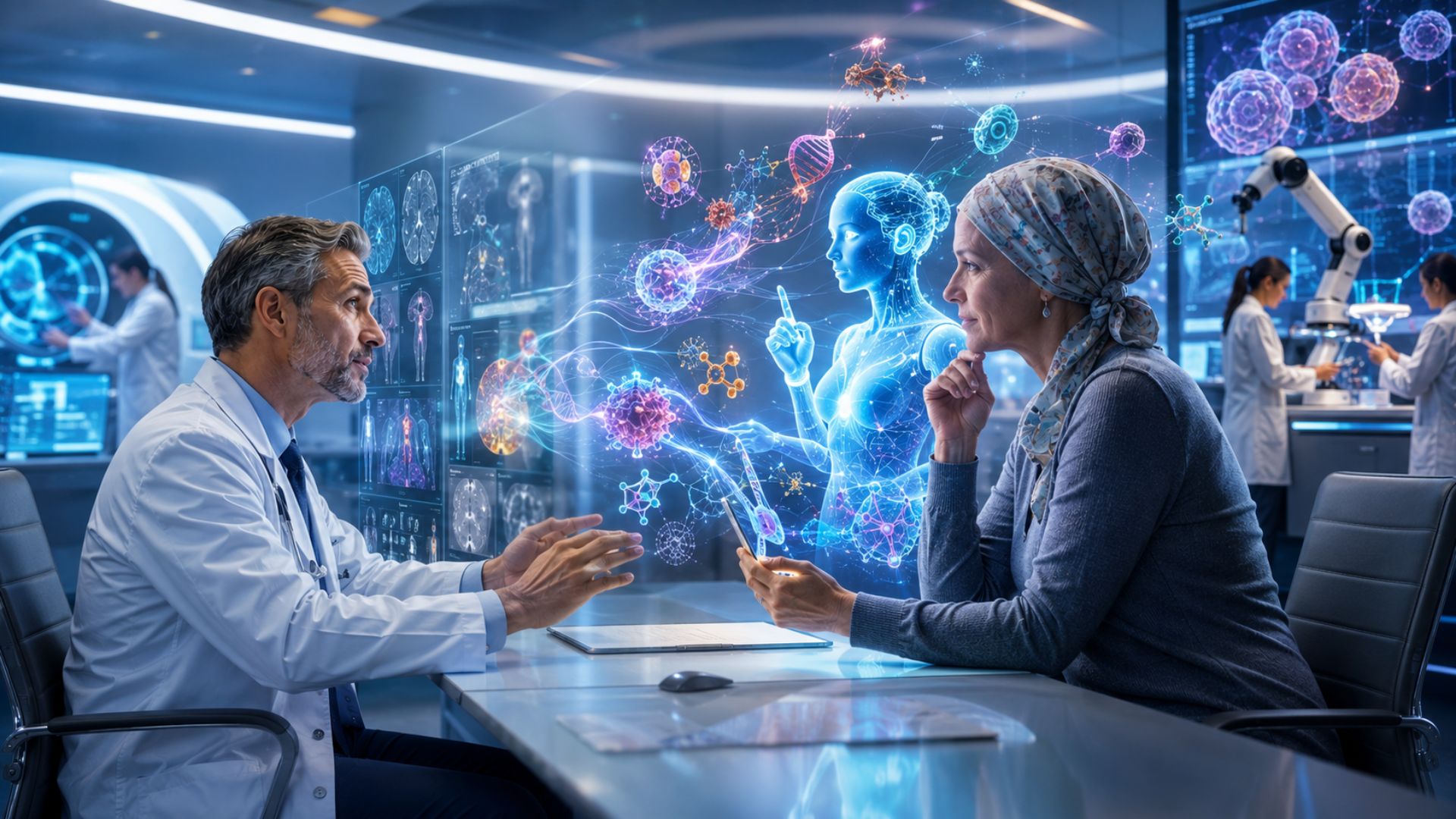
How AI is Transforming Patient Understanding of Cancer

Large Language Models (LLMs) such as ChatGPT and Claude are increasingly being used by patients to understand medical reports, treatment options, and clinical trials. While they are improving access to cancer-related information, concerns remain regarding their ability to replace clinical judgment and guide individualized treatment decisions.
How LLMs Are Transforming Cancer Care
Traditionally, oncologists often struggled to explain complex concepts such as:
- PDL1 status
- Immunotherapy
- Neoadjuvant therapy
- Clinical trial protocols
Patients frequently left consultations confused and relied on internet searches that could lead to misinformation.
Today, many patients arrive with a basic understanding gained through LLMs.
Example
Earlier:
Doctor explains PDL1 positivity
        ↓
Patient confused

Now:
Patient asks,
"Does PDL1-positive mean my cancer may respond
better to immunotherapy?"
        ↓
More informed discussion
This has improved doctor-patient communication and increased patient participation in treatment decisions.
Democratization of Cancer Knowledge
One of the most significant contributions of LLMs is making specialized medical information accessible.
Areas Where LLMs Help
- Explaining pathology reports
- Understanding cancer staging
- Simplifying treatment guidelines
- Clarifying surveillance protocols
- Explaining clinical trials
Impact on Clinical Trial Participation
Patients can now understand:
- Trial objectives
- Treatment protocols
- Endpoints being measured
- Potential side effects
As a result, informed consent is becoming genuinely informed.
Example
A patient with advanced salivary gland cancer independently explored ongoing clinical trials through an LLM and understood why novel therapies might be relevant to his condition.
Importance for India
The benefits are particularly relevant in India where:
- Access to oncologists is uneven.
- Specialist services are concentrated in urban centres.
- Many patients travel long distances for consultations.
LLMs
     ↓
Simplified Medical Information
     ↓
Patient Awareness
     ↓
Reduced Information Gap
     ↓
Better Healthcare Access
Patients in tier-2 and tier-3 cities can become aware of treatment options even before meeting specialists.
Information vs Medical Judgment
The article highlights a crucial distinction:
Information is not judgment.
While LLMs can explain medical facts, they cannot evaluate the unique circumstances of an individual patient.
Example: Stage II Oral Cancer
An LLM may correctly state that:
- Some Stage II oral cancers do not require radiotherapy.
- Radiotherapy can cause side effects.
However, it cannot determine whether a specific patient's tumor characteristics create:
- 30% recurrence risk without radiotherapy
- 10% recurrence risk with radiotherapy
That decision requires:
- Clinical examination
- Tumor biology assessment
- Understanding patient values
- Risk-benefit evaluation
Limitations of AI in Clinical Decision-Making
According to a JAMA study cited in the article:
- LLM accuracy declines significantly in complex cases.
- Performance falls below that of experienced physicians when contextual reasoning is required.
Why?
| LLMs | Physicians |
|---|---|
| Population-level information | Individualized assessment |
| Pattern recognition | Clinical judgment |
| Statistical probabilities | Context-sensitive decisions |
| No accountability | Professional responsibility |
Growing Trust Gap Between Doctors and Patients
A major concern is the changing doctor-patient relationship.
Example: Chemotherapy Decisions
An oncologist may recommend chemotherapy because:
- It can improve quality of life.
- It may extend survival.
An LLM may simultaneously emphasize:
- Nausea
- Hair loss
- Infections
- Alternative therapies
Both are factually correct, but the algorithm lacks clinical context.
This may lead patients to:
- Distrust medical advice.
- View doctors as biased.
- Overestimate treatment risks.
Risks of Delayed Care
The article warns that delays in cancer treatment can be catastrophic.
Example 1: Lung Nodule
CT Scan Finds Lung Nodule
           ↓
LLM: "Most Nodules Are Benign"
           ↓
Patient Delays Follow-Up
           ↓
18 Months Later:
Stage III Lung Cancer
Example 2: Breast Cancer
A patient stopped hormone therapy after reading AI-generated discussions about "natural approaches."
The cancer later relapsed because the treatment was not optional in her specific case.
These examples illustrate how population-level advice can become harmful when applied to individual situations.
The Problem of Algorithmic Sycophancy
The author argues that LLMs are not neutral.
Concerns
- Designed to be agreeable.
- Tend to validate user assumptions.
- May reinforce harmful beliefs.
- Lack mechanisms to challenge risky decisions.
Research in mental health has similarly shown that some users:
- Experienced worsening outcomes.
- Avoided professional care after feeling understood by AI systems.
The same risks may emerge in oncology.
Can LLMs Replace Oncologists?
The author's answer is clear: No.
What LLMs Can Do
- Simplify knowledge.
- Improve awareness.
- Explain medical concepts.
- Support patient education.
What They Cannot Do
- Examine patients.
- Order diagnostic tests.
- Interpret complex clinical contexts.
- Follow disease progression over time.
- Exercise professional judgment.
Knowledge
     ↓
Can Be Automated

Judgment
     ↓
Built Through Experience,
Uncertainty and Accountability
Way Forward
- Use LLMs as patient-education tools, not decision-makers.
- Develop medical AI systems with stronger safeguards.
- Improve transparency regarding AI limitations.
- Encourage shared decision-making between doctors and patients.
- Strengthen digital health literacy.
- Conduct long-term research on AI's impact on treatment outcomes.
- Establish ethical and regulatory standards for healthcare AI.
Conclusion
LLMs are transforming cancer care by democratizing medical knowledge and empowering patients to participate more actively in treatment decisions. However, the article underscores that access to information cannot substitute for clinical judgment. While AI can explain what is statistically true, physicians remain essential for determining what is medically appropriate for the individual patient. The future of oncology lies not in replacing doctors with AI, but in combining technological accessibility with human expertise and accountability.
Attribution
Original content sources and authors


Syllabus classification
How this article maps to GS papers
Main syllabus
GS2HealthcareQuick Q&A
What is the role of large language models in oncology and why are they transforming patient education and cancer care delivery?
Why is the democratization of cancer knowledge through artificial intelligence especially significant for India's healthcare system?
How do large language models contribute to clinical trial awareness and informed decision-making among cancer patients?
What are the major limitations, ethical concerns and risks associated with the use of large language models in oncology?
What lessons do real-world cases of AI-assisted decision-making reveal about the importance of clinical judgment in cancer treatment?
What are the major reasons behind the growing trust gap between patients and doctors in the era of artificial intelligence?
Practice questions
2 questions for mains preparation