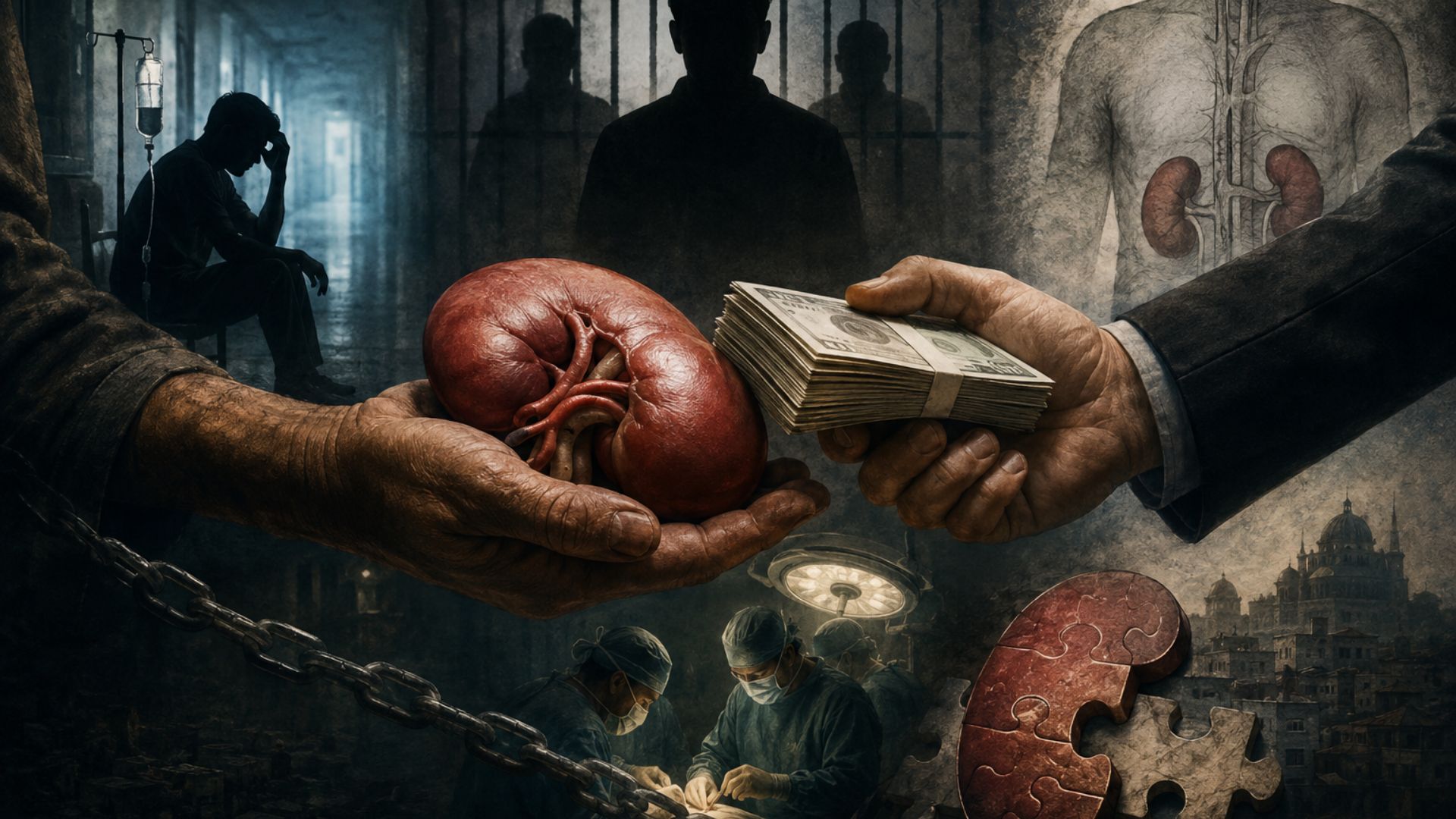
Unraveling the Shadows: Kerala’s Organ Trade Exposed

The Trigger
Six months ago, a shabbily dressed man walked into the Superintendent of Police's office in Aluva with a rehearsed story — he had met a weeping patient in a hospital corridor and was moved to donate his kidney. The alert officer sensed something was off, but had no legal basis to deny the police clearance certificate. That instinct proved right.
On May 8, 2026, coordinated raids across Kerala — initially targeting fake document centres — unravelled a three-year-old organ trafficking network. Nine people have been arrested so far, five cases registered, and around 25 kidney transplants traced through seized documents.
The Network
The suspected kingpin is Muhammed Najeeb, 53, who carries approximately 12 prior criminal cases including a 2017 murder case in Mangaluru. His wife Rasheeda, two DTP centre operators (Sunny and Sini Varghese), a photo studio owner, field agents, and a middleman named Debin Joseph — who specifically targeted financially vulnerable people — form the core of the arrested group.
The network operated as a "money chain": recipients found agents through previous transplant patients; donors were recruited through previously paid donors. Each link in the chain referred the next.
Najeeb charged recipient:    ~₹20 lakh
Donor paid:                   ₹5–10 lakh + medical expenses
Najeeb's profit per case:    ₹3–5 lakh
Transplants were conducted across private hospitals in different parts of Kerala.
What the Law Says — And How It Was Gamed
The Transplantation of Human Organs and Tissues Act (THOTA) was built with specific safeguards to prevent exactly this kind of exploitation:
1. Preference for related donors The law prioritises donations from close relatives to reduce commercial incentive.
2. Non-suitability certificate If the donor is unrelated, the recipient must prove that close family members are medically incompatible, unwilling for legitimate reasons, or simply unavailable.
3. Certificate of altruism The unrelated donor must prove the donation is entirely voluntary — motivated by affection or humanitarian concern, not money.
4. District-level Authorisation Committee All unrelated donor applications go before a panel of medical professionals who interview applicants and scrutinise documents before approving the transplant.
The racket systematically forged all of these — fabricating non-suitability certificates, manufacturing altruism certificates, and coaching donors to present emotionally convincing stories of compassion. Forged letterheads of MPs, MLAs, and prominent hospitals were recovered from Najeeb's residence and two shops in Kunnathunad. Fake seals and lab reports completed the documentation package.
Why the System Failed to Catch It
The failure is not one of intent but of institutional design:
-
Medical panels cannot verify everything: Donors arrived "well-tutored," their stories sounding entirely genuine. Authorisation committees can cross-check documents with issuing authorities — including police — but this does not happen consistently.
-
Police verification is not mandatory: For unrelated donors, police verification is not a statutory requirement at the authorisation stage. The Aluva officer's instinct was sharp — but his clearance was procedurally routine.
-
Cumbersome documentation creates demand for middlemen: The very complexity of the legal process — meant as a safeguard — ends up pushing even genuine donors toward agents who "know the system."
"The so-called agents might be exploiting loopholes in the existing system." — Dr. Unmesh A.K., Head of Forensic Medicine, Government Medical College, Kottayam
The Demand That Feeds the Racket
As of May 12, 2026, 3,462 patients were on Kerala's organ transplant waitlist — 2,566 of them awaiting kidneys alone. Cadaver donation remains limited. In this gap between desperate demand and scarce legitimate supply, illegal operators find their operating space. Hospitals, investigators note, may also come under scrutiny as the probe deepens — the City Police Commissioner has explicitly flagged this.
Way Forward
- Mandatory police verification for all unrelated donor applications — Dr. Unmesh specifically recommends this as medical panels cannot independently authenticate identities or documents
- Simplify documentation: Legislative intervention needed to make the process transparent and accessible without compromising scrutiny — complexity currently drives people toward agents
- Cadaver donation as the structural fix: Both Dr. Unmesh and the Liver Foundation of Kerala (which is planning a statewide 'Athmanalam' campaign) argue this is the only sustainable solution — once cadaver donation is normalised, the living-donor vulnerability disappears
- Regulate agents within hospital premises: Agents actively operate from hospitals, reaching out to patients in corridors — this access must be formally monitored
- Strengthen Authorisation Committees: Cross-verification with document-issuing authorities must be made mandatory, not discretionary
Conclusion
Kerala's organ trade racket exposes a fundamental irony: the law's strictness became its own vulnerability. By making unrelated donation procedurally onerous, THOTA inadvertently created a market for those who could navigate — or fabricate — the paperwork. The recipients who paid ₹20 lakh were not criminals by instinct; they were terminally ill people running out of time. The donors who sold kidneys for ₹5 lakh were not willing participants in a racket; they were financially desperate individuals recruited through trust networks. The real architecture of exploitation sits between them — and dismantling it requires both tighter enforcement and a cadaver donation culture robust enough to make living-donor desperation unnecessary.
Attribution
Original content sources and authors
_.jpeg)

Syllabus classification
How this article maps to GS papers
Main syllabus
GS2HealthcareQuick Q&A
What does the Kerala organ trade case reveal about the challenges in regulating organ transplantation in India?
The Transplantation of Human Organs and Tissues Act (THOTA) was designed to prevent such commercialization by permitting unrelated donations only under strict scrutiny. However, forged non-suitability certificates, false relationship claims, and fake certificates of altruism weakened these safeguards. This reveals that documentation-based regulation alone is insufficient when verification systems are weak.
Broader implications:
- Organ shortage creates desperation among recipients.
- Poverty pushes vulnerable individuals into selling organs.
- Middlemen exploit loopholes in medical and legal procedures.
- Institutional coordination between hospitals, police, and authorization committees remains inadequate.
The case underscores that organ regulation is not merely a medical issue but intersects with law enforcement, ethics, and social justice. UPSC candidates should recognize that such rackets are symptoms of structural deficits in healthcare accessibility and governance.
Why does organ trafficking continue despite stringent legal safeguards under the Transplantation of Human Organs and Tissues Act?
The legal safeguards under THOTA are strict, but enforcement often depends heavily on documentary proof. Criminals exploit this by forging certificates of altruism, medical incompatibility records, and relationship documents. Since verification is often fragmented across hospitals, district committees, and police, forged documents may evade scrutiny.
Reasons for persistence:
- Economic vulnerability: Poor individuals may see organ sale as financial relief.
- Medical desperation: Patients facing life-threatening illness accept illegal options.
- Administrative overload: Authorities may lack resources for detailed verification.
- Professional collusion: Potential involvement of document centers or hospital-linked intermediaries.
This reflects a classic governance challenge: laws can exist on paper, but unless implementation capacity and social awareness improve, illegal markets flourish.
Critically analyze the ethical dilemmas associated with living organ donation in India.
The Kerala case illustrates this complexity. Donors often rehearsed stories of compassion, making it difficult for medical committees to distinguish genuine humanitarian acts from paid transactions. Doctors face a moral conflict: rejecting a suspicious donor may deny a patient life-saving treatment, while approving the donor may enable exploitation.
Ethical concerns include:
- Consent: Is the donor acting voluntarily or under financial pressure?
- Justice: Does poverty convert consent into coercion?
- Medical fairness: Are rich recipients indirectly buying survival?
- Institutional trust: Repeated scandals undermine faith in hospitals.
A sustainable ethical solution lies in promoting cadaver donation, improving transparency, and ensuring independent verification mechanisms. Ethical governance must balance patient rights with protection of vulnerable citizens.
How can India strengthen its organ donation system to prevent illegal rackets while improving patient access?
A stronger system should involve mandatory digital verification of certificates through centralized databases linked to hospitals, district committees, and police. This would make forged documents easier to detect. Police verification for unrelated donors should be mandatory nationwide, especially in high-risk cases.
Key reforms:
- Promote cadaver donation: Reduce dependence on living donors.
- Digital tracking: Link donor-recipient approvals to secure online systems.
- Stronger hospital audits: Periodic review of transplant cases.
- Public campaigns: Normalize posthumous organ donation.
Countries like Spain have improved donation rates through robust cadaver donation systems and institutional trust. India can adopt similar models while tailoring them to local social realities.
As a district administrator, how would you respond if an organ trafficking racket was uncovered in your jurisdiction?
Second, the authorization committees must be reviewed to identify procedural failures. This includes verifying whether forged documents passed unnoticed due to negligence or systemic gaps. Coordination with health departments, forensic experts, and legal authorities becomes essential.
Administrative response:
- Immediate: Launch special investigation and freeze suspect records.
- Institutional: Review authorization committee decisions.
- Preventive: Introduce stricter police verification.
- Social: Expand awareness campaigns on cadaver donation.
As a governance lesson, the administrator must balance enforcement with empathy. Recipients are often victims of desperation, while poor donors may be victims of exploitation. Policy must target agents and criminal profiteers, not merely the vulnerable participants.
What larger socio-economic issues does the organ trade expose in Indian society?
This creates an informal market where survival becomes transactional. The Kerala case shows how agents exploit both ends: vulnerable donors and desperate recipients. Such rackets are therefore not isolated crimes but manifestations of wider inequality.
Key socio-economic dimensions:
- Poverty: Drives individuals to commodify their bodies.
- Healthcare shortage: Long waiting lists intensify demand.
- Weak social security: Lack of financial support pushes risky choices.
- Governance deficits: Criminal networks exploit institutional loopholes.
The issue should be viewed as a development challenge. Strengthening healthcare access, expanding public insurance, and promoting cadaver donation can reduce the structural conditions that sustain organ trafficking.
Practice questions
2 questions for mains preparation