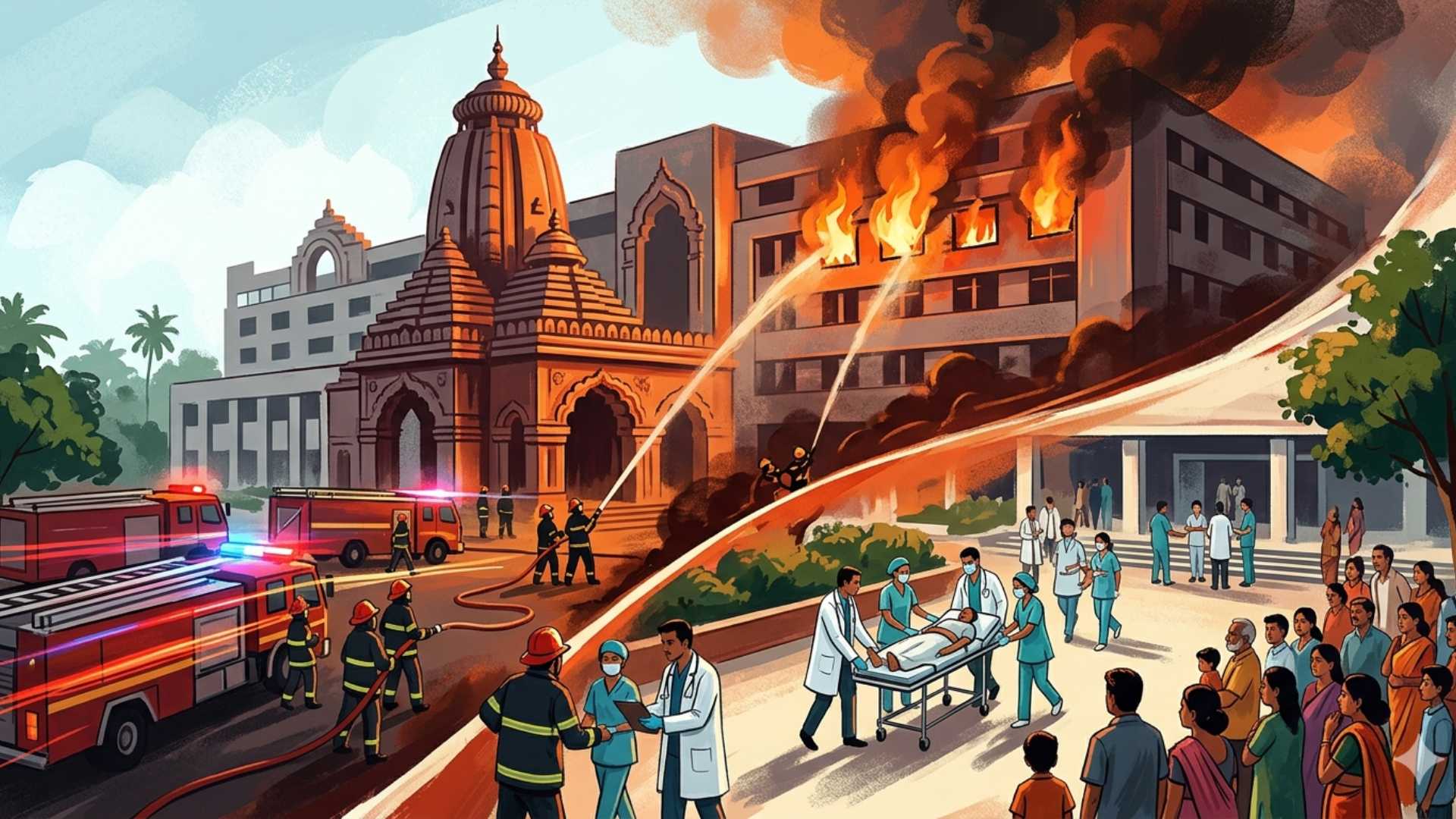
Fire Safety in Hospitals: A Critical Patient Safety Concern
Introduction
- Hospital fires remain a recurring public safety crisis in India, with multiple fatal incidents reported across States.
- NCRB data and media reports indicate dozens of major hospital fires in the past decade, many in ICUs where vulnerability is highest.
- Globally, WHO emphasises that safe health facilities are integral to universal health coverage (UHC).
- The recent Cuttack ICU fire (2026), causing 12 deaths, highlights persistent gaps despite policy measures and funding allocations.
BACKGROUND AND CONTEXT
- Repeated incidents: Bhubaneswar (2016), Maharashtra (2021), Jhansi (2024), Rajasthan (2025), Cuttack (2026).
- Post-2016 reforms mandated fire safety audits, yet compliance remains weak.
- Odisha allocated ₹320 crore for fire safety upgrades, indicating resource availability but poor outcomes.
INTRINSIC RISKS IN ICU ENVIRONMENTS
Oxygen-rich atmosphere
-
High oxygen concentration accelerates combustion, turning minor sparks into major fires. High electrical load
-
Multiple life-support devices (ventilators, monitors) increase circuit stress. Patient vulnerability
-
Sedated and immobile patients make evacuation difficult. Complex equipment
-
Advanced electronics introduce new types of electrical hazards.
KEY TECHNICAL CONCEPTS
Harmonic Currents
- Generated by modern medical equipment (e.g., ventilators with variable frequency drives).
- Cause overheating and insulation damage.
- Not detected by conventional safety devices like circuit breakers.
Electrical Load Mismatch
- Occurs when wiring systems are not upgraded to match increased equipment load.
- Identified as a leading cause of electrical fires in India.
CAUSES OF ICU FIRES: A SYNTHESIS
| Category | Specific Issues |
|---|---|
| Electrical faults | Short circuits, exposed wiring, poor earthing |
| Infrastructure gaps | Outdated wiring, lack of load assessment |
| Human factors | Poor training, delayed response |
| Safety equipment failure | Non-functional hydrants, lack of CO₂ extinguishers |
| Governance lapses | Weak enforcement of audits and norms |
GOVERNANCE AND IMPLEMENTATION FAILURES
Compliance vs. Accountability
-
Fire audits often reduced to paperwork rather than real safety checks. Delayed emergency response
-
In Cuttack, firefighting personnel were not alerted in time. Skill deficit
-
Staff unable to operate fire hydrants or use appropriate extinguishing methods. Regulatory gaps
-
Lack of periodic re-evaluation when new equipment is added.
CASE STUDY: SCB MEDICAL COLLEGE, CUTTACK (2026)
-
Fire likely caused by short circuit or ventilator malfunction.
-
12 out of 23 ICU patients died.
-
Key failures:
- Delay in alerting fire unit
- Inability to operate hydrants
- Inappropriate fire response methods for electrical fires
IMPLICATIONS
Public Health
-
Undermines trust in healthcare systems.
-
Disproportionate impact on critical patients. Governance
-
Reflects weak enforcement and regulatory oversight. Economic
-
Loss of expensive medical infrastructure and human capital. Ethical
-
Raises questions of negligence and duty of care.
BEST PRACTICES AND SAFETY MEASURES
| Area | Recommended Measures |
|---|---|
| Electrical safety | Periodic load audits, upgrade wiring systems |
| Fire response | Use of CO₂ extinguishers for electrical fires |
| Training | Regular staff drills for ICU evacuation |
| Infrastructure | Installation of automated fire detection systems |
| Regulation | Third-party safety audits with strict penalties |
EXPERT INSIGHT
- WHO: “Patient safety is a fundamental principle of healthcare and must include safe infrastructure.”
- National Building Code (NBC) of India mandates strict fire safety norms for hospitals, but enforcement remains inconsistent.
WAY FORWARD
Shift to criminal accountability
-
Fix responsibility for negligence leading to deaths. Real-time monitoring
-
Use IoT-based fire and electrical safety systems. Capacity building
-
Mandatory certification and training for hospital staff. Infrastructure modernisation
-
Upgrade legacy hospitals before adding advanced equipment. Independent audits
-
Third-party inspections with public disclosure.
CONCLUSION
- ICU fires in India are not isolated accidents but systemic failures of governance, infrastructure, and accountability.
- Ensuring hospital safety requires a shift from procedural compliance to outcome-based regulation, integrating technology, training, and strict enforcement.
- Protecting vulnerable patients is not merely a technical issue but a test of the State’s commitment to human dignity and right to life under Article 21.
UPSC MAINS QUESTION (15 MARKS, 250 WORDS)
- “Recurring hospital ICU fires in India reflect systemic governance and infrastructure failures rather than isolated accidents.” Critically examine. Suggest measures to enhance fire safety in healthcare institutions.
Attribution
Original content sources and authors
Syllabus classification
How this article maps to GS papers
Main syllabus
GS2HealthcareQuick Q&A
What are the key structural and operational factors that make Intensive Care Units (ICUs) highly vulnerable to fire accidents?
Key structural and operational risks include:
- Oxygen-rich environment: ICUs maintain high oxygen levels for patient care, which can rapidly accelerate combustion even from a minor spark.
- High electrical load: Equipment such as ventilators, monitors, and infusion pumps operate continuously, often exceeding the designed electrical capacity.
- Complex wiring systems: Frequent addition of advanced medical devices without upgrading infrastructure leads to overloaded circuits.
Another major risk factor is the presence of harmonic currents, generated by modern medical equipment with variable frequency drives. These currents cause silent overheating and insulation degradation, which are not easily detected by conventional safety devices like circuit breakers.
Operational challenges further exacerbate risks. Staff may lack adequate training in handling electrical fires or using specialised firefighting equipment such as carbon dioxide extinguishers. Additionally, patients in ICUs are often immobile or dependent on life-support systems, making evacuation extremely difficult. Thus, ICUs represent a convergence of technological complexity and human vulnerability, requiring stringent safety protocols.
Why do hospital fire incidents in India continue to occur despite regulations and safety audits?
Key reasons include:
- Compliance mindset: Fire safety audits are often treated as bureaucratic formalities rather than genuine risk assessments.
- Lack of accountability: Even after repeated incidents, criminal liability is rarely fixed on responsible अधिकारियों or institutions.
- Poor maintenance: Equipment like fire hydrants and extinguishers may exist but are often non-functional or inaccessible.
Case studies illustrate this pattern. The 2016 Bhubaneswar hospital fire, the Jhansi neonatal ICU tragedy, and the recent Cuttack incident all point to repeated lapses such as faulty wiring, delayed emergency response, and lack of trained personnel. Despite financial allocations, such as Odisha’s ₹320 crore for fire safety, outcomes remain inadequate.
Ultimately, the issue lies in a governance deficit where safety norms are not internalised as critical public health priorities. Without strict enforcement, regular training, and real consequences for negligence, these preventable tragedies are likely to continue.
How can electrical hazards in hospital ICUs be effectively managed to prevent fire accidents?
Key preventive strategies include:
- Load assessment: Every addition of equipment, such as ventilators, must be accompanied by a reassessment of wiring and load capacity.
- Upgraded infrastructure: Older hospitals must modernise their electrical systems before installing advanced devices.
- Harmonic filters: These can mitigate the effects of harmonic currents that cause overheating and insulation damage.
In addition, regular safety audits should focus on technical parameters such as earthing, circuit design, and insulation quality rather than mere documentation. Smart monitoring systems can detect abnormal heat or current flow in real time.
Human factors are equally important. Staff must be trained to identify early warning signs and use appropriate firefighting techniques, such as carbon dioxide extinguishers for electrical fires. A combination of engineering controls and capacity building can significantly reduce the risk of ICU fires.
What are the underlying causes behind repeated ICU fire accidents in India, and how do they reflect systemic governance issues?
Underlying causes include:
- Infrastructure deficits: Hospitals often operate with outdated electrical systems that are incompatible with modern equipment.
- Training gaps: Medical and support staff are not adequately trained in fire safety or emergency evacuation protocols.
- Coordination failures: Delayed response, as seen in Cuttack where firefighting personnel were not alerted in time, exacerbates damage.
These factors reflect systemic governance challenges such as poor regulatory oversight, fragmented accountability, and underinvestment in maintenance. The recurrence of similar incidents across states—Odisha, Uttar Pradesh, Rajasthan, and Maharashtra—indicates that the problem is nationwide rather than localised.
Moreover, the lack of criminal accountability creates a culture of impunity. When negligence does not lead to consequences, institutions have little incentive to prioritise safety. Addressing these root causes requires reforms in governance, including stricter enforcement, transparent audits, and a shift towards a safety-first institutional culture.
What lessons can be drawn from recent ICU fire incidents in India, such as the Cuttack tragedy, for improving hospital safety?
Key lessons include:
- Importance of timely response: In Cuttack, delays in alerting the firefighting unit significantly worsened the outcome.
- Need for functional equipment: Fire hydrants and extinguishers must not only be present but also operational and accessible.
- Electrical safety priority: Short circuits and faulty equipment, such as ventilators, are major triggers of fires.
Comparative examples from Jhansi and Rajasthan further underline the importance of proper wiring, load management, and adherence to safety norms. These cases demonstrate that financial investment alone is insufficient without effective implementation.
Ultimately, the key takeaway is the need for a holistic approach combining infrastructure upgrades, staff training, and strict accountability. Hospitals must transition from reactive responses to proactive risk management to ensure patient safety.
Critically analyse the effectiveness of current fire safety regulations in Indian hospitals.
Strengths of the current framework include:
- Mandatory audits: Hospitals are required to undergo periodic fire safety inspections.
- Defined standards: Guidelines exist for electrical systems, firefighting equipment, and emergency exits.
However, significant limitations persist:
- Poor enforcement: नियमों का पालन अक्सर कागजी कार्यवाही तक सीमित रहता है.
- Lack of accountability: Violations rarely result in strict penalties or criminal action.
- Inadequate training: Staff are often unprepared to handle emergencies despite regulatory requirements.
Critically, the regulatory approach is reactive rather than preventive. Audits are conducted after incidents rather than as continuous monitoring mechanisms. Moreover, there is little emphasis on adapting regulations to technological advancements such as harmonic currents.
Therefore, while the framework is necessary, it is not sufficient. Strengthening enforcement, integrating technology, and ensuring accountability are essential to make these regulations truly effective.
As a district administrator, how would you design a comprehensive strategy to prevent hospital fire accidents in your jurisdiction?
Key components of the strategy would include:
- Strict enforcement: Ensure all hospitals obtain and renew fire safety clearances, with surprise inspections to verify compliance.
- Infrastructure audit: Conduct detailed electrical audits focusing on load capacity, wiring quality, and harmonic risks.
- Capacity building: Organise regular training programs for hospital staff on fire safety and emergency evacuation.
Additionally, technology can play a crucial role. Installing automated fire detection and suppression systems, along with real-time monitoring of electrical parameters, can provide early warnings.
Community and institutional coordination is equally important. Fire departments, hospital management, and local authorities must establish clear communication protocols to ensure rapid response.
Ultimately, the approach should shift from reactive crisis management to proactive risk prevention, with a strong emphasis on accountability. Making hospital safety a governance priority can significantly reduce the likelihood of such tragedies.
Practice questions
1 question for mains preparation