GS2 Healthcare

ICMR Reforms Driving India’s Health Innovation and Research Transformation

ICMR's Vision 2047: Transforming India's Health Ecosystem

Exploring ICMR's reforms for a future-ready health system focusing on digital health, collaboration, and sustainable development.
Gopi Gopi
4 mins read

“The future of healthcare lies not merely in treating diseases but in building systems that anticipate, prevent, and respond effectively.”

India’s journey towards Viksit Bharat 2047 requires a health system that is anticipatory, equitable, technology-driven, and evidence-based. Drawing lessons from the COVID-19 pandemic, the Indian Council of Medical Research (ICMR) has initiated major reforms aimed at transforming biomedical research into a direct instrument of public health improvement.

Why is ICMR Reforming?

The changing disease burden, emerging technologies, and growing public health challenges demand a new research architecture.

Key Drivers

  • Rise of non-communicable diseases (NCDs).
  • Threat of pandemics and antimicrobial resistance (AMR).
  • Need for real-time data-driven decision-making.
  • Expanding role of AI, genomics, and digital health.

Strategic Reorientation of ICMR

1. Restructuring Institutional Architecture

ICMR institutes are being transformed from narrowly focused entities into interdisciplinary research hubs.

Emerging Focus AreasPurpose
Digital Health & Data ScienceData-driven healthcare solutions
Child HealthAddressing child morbidity and mortality
Women’s HealthImproving gender-sensitive healthcare
Genomics & AIPrecision medicine and disease surveillance

2. Regional National Institutes of Health Research

A nationwide network of institutes is being established from Dibrugarh to Jodhpur.

Objectives

  • Conduct operational research with State and district health systems.
  • Generate region-specific evidence.
  • Ensure research findings are translated into field-level action.

3. Building a Connected Research Ecosystem

Instead of isolated functioning, institutes are envisioned as:

  • National resource centres.
  • Contributors to common public health goals.
  • Platforms for sharing evidence across regions.

This is particularly important for challenges such as:

  • Antimicrobial resistance.
  • Tuberculosis.
  • Pandemics.
  • Non-communicable diseases.

Redesigning Research Funding

The focus is shifting from merely funding projects to supporting end-to-end solutions.

National Health Research Programme (NHRP)

The programme identifies 13 priority research areas, including:

  • Antimicrobial resistance.
  • Tuberculosis.
  • Mental health.
  • Nutrition.
  • Emergency care.
  • Other critical public health challenges.

This approach creates a continuum from: Research → Innovation → Implementation → Public Impact

Technology as a Force Multiplier

Technology is helping bridge longstanding healthcare gaps, especially in underserved regions.

Major Innovations

InitiativeImpact
AI-based TB ScreeningEarly diagnosis and treatment
AI-enabled Diabetic Retinopathy DetectionPreventing avoidable blindness
AI Nutritional MonitoringBetter programme delivery
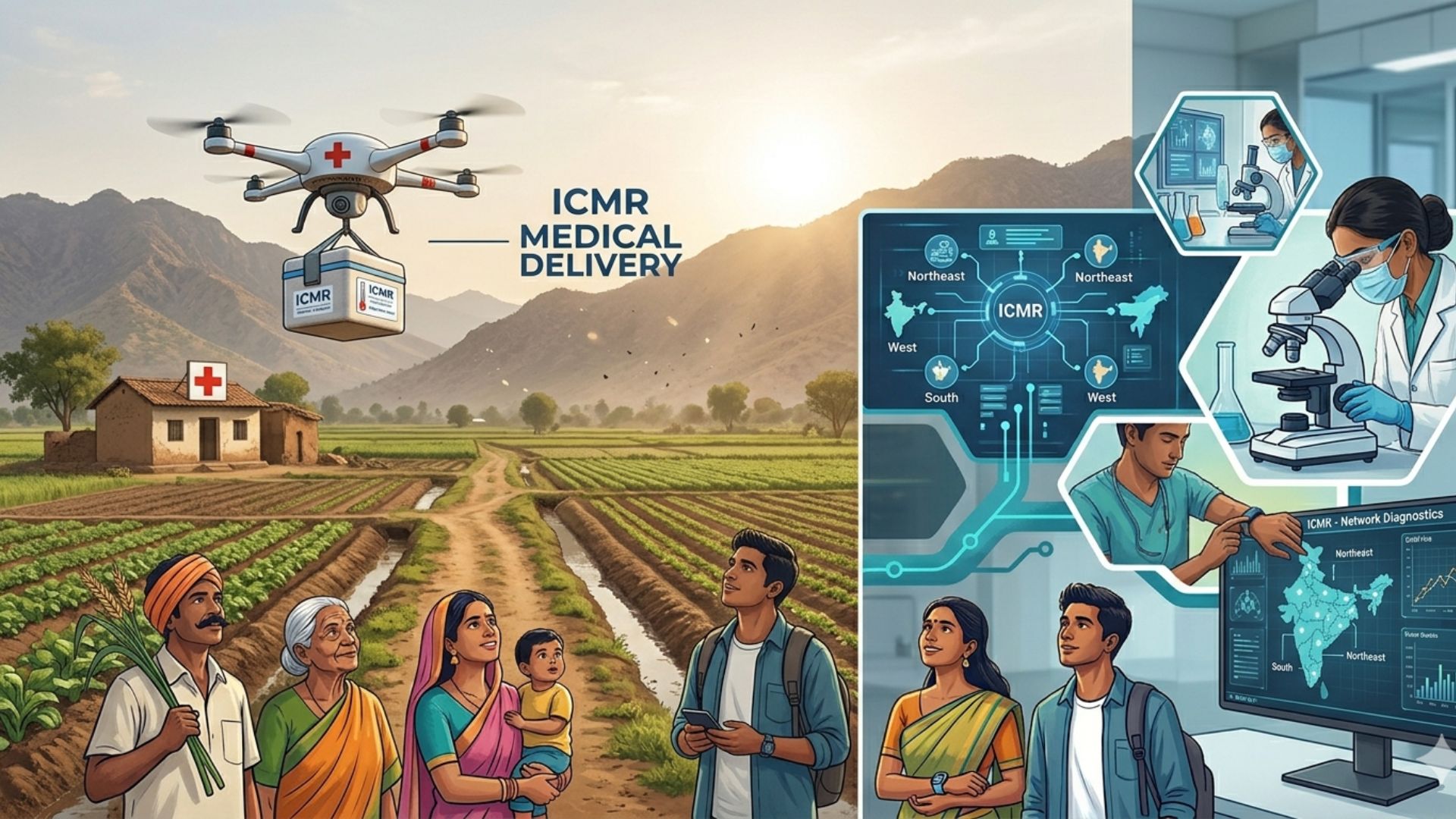
i-Drone InitiativeDelivery of vaccines and medical supplies to remote areas
Example:
A frontline health worker in a remote village can use
AI-enabled diagnostic tools for screening diseases,
while critical medicines or samples can be transported
rapidly through drones, reducing geographical barriers.

Promoting Indigenous Innovation

ICMR is encouraging the development of:

  • Medical devices.
  • Diagnostics.
  • Next-generation vaccines.
  • Therapeutics.

Key Innovation Platforms

  • First in the World Challenge
  • MedTechMitra
  • Medical Innovations–Patent Mitra Initiative

These initiatives aim to:

  • Accelerate commercialization of research.
  • Promote affordable healthcare technologies.
  • Convert publicly funded science into societal benefits.

Impact on Public Health

The success of reforms is ultimately measured through health outcomes.

Notable Initiatives

India Hypertension Control Initiative

  • Improved chronic disease management.
  • Demonstrated scalability of evidence-based interventions.

Emergency Care Mission Programmes

  • Mobile stroke units.
  • Rapid cardiac response systems.

Expanded Diagnostic Networks

  • Strengthened early detection of:

    • Cancer.
    • Infectious diseases.
    • Emerging outbreaks.

These efforts closely align with the objectives of the National Health Policy 2017, particularly:

  • Preventive healthcare.
  • Promotive healthcare.
  • Universal access.
  • Quality healthcare delivery.

Way Forward

  • Deepen integration of AI, genomics, and digital health platforms.
  • Strengthen regional research institutions and capacity building.
  • Expand bio-manufacturing and indigenous health technologies.
  • Enhance collaboration among researchers, clinicians, policymakers, and industry.
  • Promote global partnerships while addressing local health priorities.
  • Ensure rapid translation of research findings into policy and practice.

Conclusion

ICMR’s ongoing transformation reflects a shift from knowledge generation to solution-oriented public health research. By creating interconnected institutions, leveraging emerging technologies, promoting indigenous innovation, and strengthening evidence-based policymaking, India is laying the foundation for a resilient and inclusive health ecosystem. Such reforms will be critical in ensuring that scientific progress directly contributes to better health outcomes and supports the broader vision of Viksit Bharat 2047.

Attribution

Original content sources and authors

Rajiv Bahl Author Rajiv Bahl The Hindu Source The Hindu

Syllabus classification

How this article maps to GS papers

Main syllabus

GS2Healthcare

Quick Q&A

What is the significance of the Indian Council of Medical Research reforms in building a future-ready healthcare system for Viksit Bharat 2047?
The Indian Council of Medical Research (ICMR), India's apex biomedical research institution established in 1911, has undertaken major reforms aimed at creating an anticipatory, equitable and innovation-driven healthcare ecosystem. These reforms represent a shift from isolated research projects to integrated, solution-oriented and institute-led scientific approaches aligned with national priorities. The significance of these reforms lies in their attempt to connect scientific research with public health outcomes. Learning from the COVID-19 pandemic, the ICMR has expanded the mandates of several institutes and transformed them into interdisciplinary centres focusing on areas such as digital health, child health, women's health and data science. Regional National Institutes of Health Research are also being established across the country, from Dibrugarh to Jodhpur, to facilitate operational research in collaboration with State and district health systems. The reforms align closely with the objectives of the National Health Policy 2017, which emphasizes universal health coverage, preventive healthcare and quality services. They also support the vision of Viksit Bharat 2047 by integrating technologies such as artificial intelligence, genomics and real-time surveillance systems into healthcare delivery. From a UPSC perspective, the topic is relevant to GS Paper II (Health and Governance), GS Paper III (Science and Technology) and Essay papers. The reforms also reflect broader themes such as digital governance, public policy, innovation and sustainable development. Their importance lies in ensuring that scientific advances translate into affordable, accessible and equitable healthcare for India's population.
Why are integrated and evidence-based healthcare reforms becoming increasingly important for India's public health governance framework?
Integrated and evidence-based healthcare reforms have become essential because modern health challenges are multidimensional and interconnected. India faces a dual burden of communicable diseases such as tuberculosis and emerging infections alongside non-communicable diseases including diabetes, hypertension and cardiovascular disorders. Furthermore, antimicrobial resistance and future pandemics pose additional threats. Historically, healthcare delivery in India suffered from fragmented institutions and compartmentalized research mechanisms. The COVID-19 pandemic exposed these weaknesses and demonstrated the importance of scientific coordination, real-time data systems and policy responsiveness. Consequently, institutions such as the ICMR have shifted towards creating an integrated national research ecosystem. The National Health Research Programme (NHRP) has identified 13 priority areas including tuberculosis, mental health, nutrition, antimicrobial resistance and emergency care. This represents a movement from merely funding research projects to generating practical solutions for public health challenges. Evidence-based approaches have already produced successful outcomes. The India Hypertension Control Initiative has demonstrated how scientific protocols and standardized treatment methods can improve chronic disease management. Similarly, indigenous technologies and expanded diagnostic networks have enhanced disease surveillance and early detection. For UPSC aspirants, the topic has significance for GS Paper II, which covers health governance and welfare policies. It also relates to GS Paper III themes such as biotechnology and innovation. The reforms illustrate how governance increasingly depends upon data-driven decision-making and scientific evidence. Ultimately, integrated healthcare systems contribute to universal health coverage, improve equity and strengthen India's preparedness against future health emergencies.
How are digital technologies and artificial intelligence transforming healthcare delivery and reducing inequalities in India?
Digital technologies and artificial intelligence (AI) are revolutionizing healthcare delivery by improving diagnosis, surveillance, accessibility and efficiency. AI refers to the ability of machines and algorithms to perform tasks that normally require human intelligence, including pattern recognition, prediction and decision-making. India has increasingly incorporated AI-based tools into healthcare systems. Under the reforms initiated by the ICMR, AI is being integrated into diagnostics, surveillance mechanisms and programme implementation. AI-enabled screening tools for tuberculosis and diabetic retinopathy are supporting frontline healthcare workers and improving early detection. Similarly, AI-driven nutritional monitoring systems are helping ensure better programme delivery and resource allocation. One significant innovation is the i-Drone initiative. Initially designed for vaccine delivery, it has expanded to transport critical medical supplies to remote and inaccessible regions. This innovation helps bridge geographical barriers and strengthens healthcare equity. Digital health technologies also support real-time data systems, genomics and predictive analytics, thereby enabling proactive public health interventions. Such developments are particularly valuable in rural and underserved regions where shortages of specialists and infrastructure remain a challenge. From the perspective of GS Paper II and GS Paper III, these advancements highlight the intersection of governance, healthcare and science and technology. However, concerns regarding digital literacy, cybersecurity, ethical use of AI and data privacy continue to generate debates. Bridging the digital divide remains crucial. Therefore, technology and AI are transforming healthcare by making it more efficient, patient-centric and accessible, while also supporting the broader objective of achieving universal and equitable healthcare under the vision of Viksit Bharat 2047.
What are the major reasons behind the restructuring of ICMR institutions and the creation of regional health research networks across India?
The restructuring of ICMR institutions and the creation of regional National Institutes of Health Research represent a strategic response to India's evolving healthcare needs. Several factors have contributed to this transformation. First, India's disease profile has undergone a transition. While infectious diseases continue to persist, non-communicable diseases such as hypertension, diabetes and cancer have emerged as major causes of mortality. This changing burden requires interdisciplinary research and region-specific solutions. Second, the COVID-19 pandemic highlighted the importance of institutional preparedness, coordination and scientific innovation. The experience demonstrated that research must be rapidly translated into policy and healthcare interventions. Third, technological advancements in areas such as artificial intelligence, genomics and digital health have opened new possibilities for personalized and predictive healthcare. Therefore, traditional institutional structures needed modernization. Fourth, healthcare challenges vary across regions. Establishing regional institutes from Dibrugarh in the Northeast to Jodhpur in western India allows operational research to be conducted in collaboration with State and district health systems. This facilitates localized solutions and better implementation. Another reason is the need to strengthen India's innovation ecosystem. Programmes such as MedTechMitra, Medical Innovations-Patent Mitra and First in the World Challenge seek to promote commercialization of research and encourage indigenous technologies. For UPSC preparation, this issue is linked to GS Paper II topics relating to governance and social sector policies, and GS Paper III themes concerning science and technology. The reforms indicate a transition from fragmented institutions to interconnected knowledge ecosystems. Such changes are expected to improve efficiency, responsiveness and resilience within India's healthcare framework.
What are the opportunities and challenges associated with India's transition towards technology-driven and innovation-based healthcare systems?
India's transition toward technology-driven healthcare offers significant opportunities but also raises several challenges. On the positive side, innovations in artificial intelligence, genomics, diagnostics and medical devices are improving healthcare accessibility and efficiency. Indigenous technologies and digital health platforms have enhanced disease detection, surveillance and treatment outcomes. Initiatives such as AI-based tuberculosis screening, i-Drone medical delivery systems and mobile stroke units demonstrate the transformative potential of innovation. Schemes such as MedTechMitra and the Medical Innovations-Patent Mitra initiative are accelerating the translation of scientific discoveries into affordable technologies. These developments support the goals of Atmanirbhar Bharat and Viksit Bharat 2047. However, the transition is accompanied by several challenges. Digital inequalities between urban and rural areas may widen disparities if infrastructure and digital literacy remain inadequate. Ethical concerns relating to artificial intelligence, privacy and cybersecurity have become increasingly important. Questions regarding algorithmic bias and accountability also require careful regulation. Another challenge is ensuring affordability and accessibility. Technological advances often benefit urban populations more rapidly, leaving vulnerable groups behind. Furthermore, healthcare systems require trained manpower and institutional capacity to effectively utilize new technologies. From the perspective of GS Paper II and GS Paper III, the debate reflects the balance between innovation and social justice. Supporters emphasize efficiency and improved outcomes, whereas critics warn against excessive dependence on technology without addressing structural inequalities. Therefore, technology-driven healthcare should be guided by principles of equity, ethics and inclusiveness. Scientific innovation must complement, rather than replace, human-centered healthcare systems to ensure that progress benefits all sections of society.
What lessons can be derived from recent ICMR initiatives and public health programmes for strengthening universal healthcare in India?
Recent initiatives undertaken by the ICMR provide valuable lessons regarding the importance of evidence-based and inclusive healthcare systems. Programmes such as the India Hypertension Control Initiative, mobile stroke units and rapid cardiac response systems demonstrate how scientific research can directly improve health outcomes. The India Hypertension Control Initiative serves as an important case study. Hypertension is one of the leading contributors to cardiovascular diseases in India. Through standardized treatment protocols, regular monitoring and capacity building, the programme has improved disease management and reduced risks associated with heart disease and stroke. Similarly, mission-mode interventions in emergency care have transformed outcomes in life-threatening situations. Mobile stroke units and rapid cardiac response systems emphasize the importance of timely medical intervention. Expanded diagnostic networks and indigenous technologies have also enhanced the detection of infectious diseases and cancers. Another important lesson is the role of collaboration. The ICMR increasingly acts as a catalyst bringing together researchers, clinicians, policymakers and industry stakeholders. Such partnerships strengthen innovation and facilitate commercialization of public-funded research. These initiatives are aligned with the National Health Policy 2017, which advocates preventive healthcare, universal access and quality services. They also contribute to achieving Sustainable Development Goal 3 relating to good health and well-being. For UPSC aspirants, these examples are relevant to GS Paper II and Essay papers. They illustrate that healthcare reforms are most effective when they combine technology, institutional capacity, scientific evidence and social inclusion. The broader lesson is that universal healthcare requires not only increased spending but also innovation, coordination and sustained policy commitment.

Practice questions

1 question for mains preparation

India's health challenges increasingly require evidence-based policymaking and technology-driven interventions. Examine how the recent reforms in the Indian Council of Medical Research (ICMR) can contribute to achieving the goals of preventive healthcare and universal health coverage in India.

10 marks · 150 words · 8 mins
