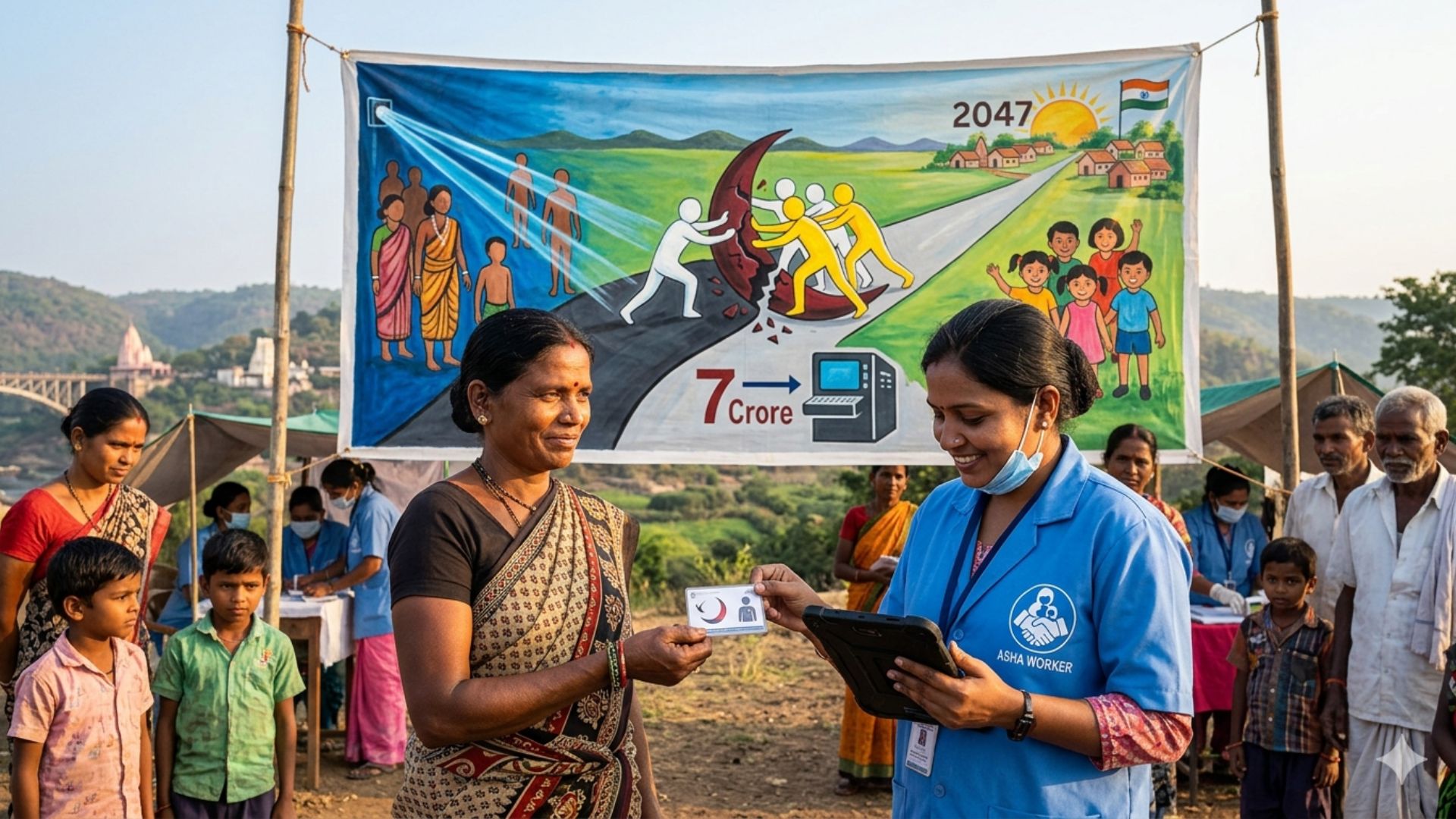
India Aims to Eradicate Sickle Cell Anaemia Before 2047

"Through collective strength and active participation of all States, India would achieve its national goal of eliminating sickle cell-related diseases well before 2047." — President Droupadi Murmu
Why is the Mission Significant?
The National Sickle Cell Anaemia Elimination Mission (NSCAEM), launched in 2023, aims to eliminate sickle cell disease (SCD) as a public health challenge by 2047.
The mission is particularly important because:
- Sickle cell disease is an inherited genetic disorder.
- It disproportionately affects tribal populations.
- Early identification and counselling can prevent transmission across generations.
- It combines public health, genetics, tribal welfare and digital governance.
What is Sickle Cell Anaemia?
Sickle cell disease is a genetic blood disorder in which red blood cells become sickle-shaped instead of their normal round shape.
Consequences
- Reduced oxygen transport.
- Recurrent pain episodes.
- Organ damage.
- Increased risk of infections.
- Reduced quality of life.
Normal RBC
     ↓
Carries oxygen efficiently

Sickle-shaped RBC
     ↓
Blocks blood vessels
     ↓
Pain, anaemia and complications
Since the disease is inherited, it can pass from one generation to another.
National Sickle Cell Anaemia Elimination Mission (2023)
The mission was launched by Prime Minister Narendra Modi from Shahdol, Madhya Pradesh, in 2023.
Unique Feature
It is the first national programme implemented through a joint model involving:
| Ministry | Role |
|---|---|
| Ministry of Health & Family Welfare | Public health interventions |
| Ministry of Tribal Affairs | Tribal outreach and inclusion |
This integrated approach combines:
- Public health
- Tribal welfare
- Genetic science
- Digital monitoring
Major Achievements So Far
According to the President, several targets have been achieved ahead of schedule.
National Progress
| Indicator | Achievement |
|---|---|
| Population screened | 7 crore people |
| Age group covered | 0–40 years |
| Patients identified | ~2.5 lakh |
| Carriers identified | >20 lakh |
The screening programme is regarded as:
"One of the largest genetic disease screening initiatives in the world."
Role of Digital Monitoring
The mission employs large-scale screening linked with digital tracking systems.
Significance
- Early identification of patients.
- Detection of carriers.
- Better disease surveillance.
- Targeted healthcare delivery.
- Improved follow-up and counselling.
Population Screening
         ↓
Digital Registration
         ↓
Patient / Carrier Identification
         ↓
Counselling & Follow-up
         ↓
Disease Prevention
This is among the first nationwide efforts in India to combine genetic screening with digital monitoring at such scale.
Focus on Tribal Communities
Scientific studies indicate that sickle cell disease prevalence is significantly higher among tribal communities than in the general population.
Why Tribal Focus Matters
- Higher disease burden.
- Limited healthcare access.
- Greater need for awareness.
- Importance of genetic counselling.
The mission seeks to address these vulnerabilities through targeted interventions.
Madhya Pradesh as a Leading Example
Madhya Pradesh has emerged as a key contributor to the mission.
State Achievements
| Indicator | Achievement |
|---|---|
| People screened | 1.25 crore |
| Genetic counselling cards | Issued to most screened individuals |
Screening
      ↓
Carrier Identified
      ↓
Genetic Counselling Card
      ↓
Informed Family Decisions
      ↓
Reduced Future Disease Burden
The State's performance demonstrates the importance of proactive implementation at the grassroots level.
Why Early Detection Matters
The President emphasised that the disease should not be taken lightly because:
- It is hereditary.
- It affects future generations.
- Early intervention is possible.
- Treatment options are available.
- Scientific evidence increasingly suggests that elimination is achievable.
Thus, prevention through awareness and counselling becomes as important as treatment.
Importance of Cooperative Federalism
The mission depends on coordinated efforts across States.
Current Status
- 17 States are actively participating.
- States contribute to screening, awareness and implementation.
- Success requires sustained cooperation between Union and State governments.
The mission illustrates how health challenges can be addressed through collaborative governance.
Way Forward
- Expand screening coverage in vulnerable regions.
- Strengthen genetic counselling services.
- Increase awareness among tribal communities.
- Improve access to treatment and follow-up care.
- Enhance digital disease-tracking systems.
- Promote research on prevention and cure strategies.
- Encourage greater participation by all States.
Conclusion
The National Sickle Cell Anaemia Elimination Mission represents a landmark convergence of public health, tribal welfare, genetic science and digital governance. With large-scale screening already underway and millions identified for counselling and treatment, India has made substantial progress toward eliminating the disease. Sustained awareness, early detection, cooperative federalism and community participation will be crucial to achieving the goal of a sickle cell disease-free India well before 2047.
Attribution
Original content sources and authors


Syllabus classification
How this article maps to GS papers
Main syllabus
GS2HealthcareQuick Q&A
What is sickle cell anaemia, and what is the significance of the National Sickle Cell Anaemia Elimination Mission launched by India?
Why is the elimination of sickle cell disease particularly important for tribal communities and inclusive development in India?
How does the National Sickle Cell Anaemia Elimination Mission integrate health, technology, and governance for effective disease management?
Critically examine the opportunities and challenges associated with India's mission to eliminate sickle cell disease by 2047.
How does the National Sickle Cell Anaemia Elimination Mission serve as a case study of cooperative federalism and integrated public health governance?
What lessons can be drawn from India's large-scale genetic screening initiative for strengthening public health and preventive medicine?
Practice questions
2 questions for mains preparation