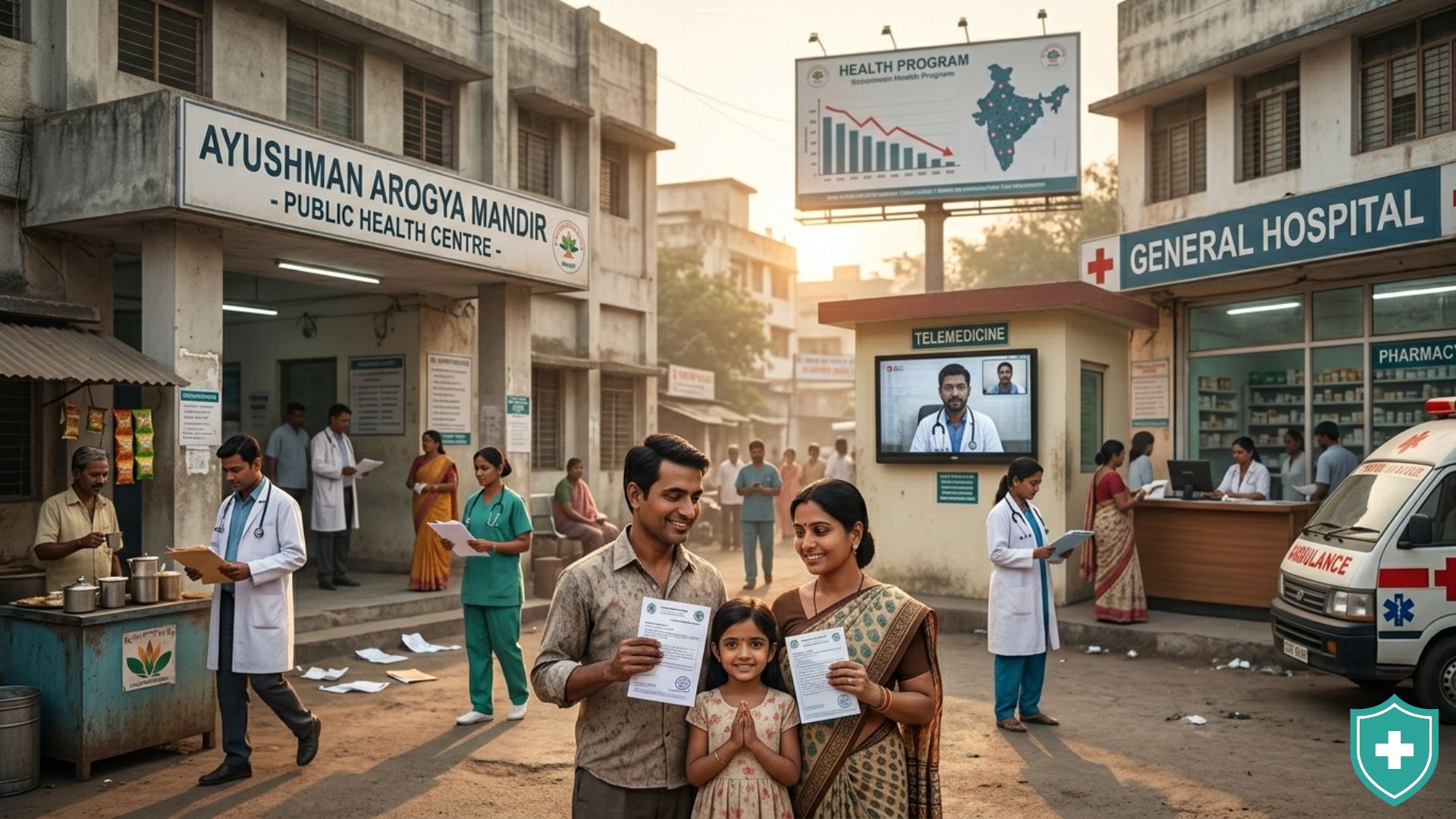
Declining Out-of-Pocket Expenditure on Health in India

-
The National Health Accounts (NHA) estimates for India 2022-23, released by the Union Health Ministry on May 27, 2026, signal a structural shift in how healthcare is financed in India.
-
Concurrent with rising government health expenditure, the out-of-pocket expenditure (OOPE) share in total health expenditure has declined by 21% from 2013-14 till date—a marker of growing financial protection for households.
"This declining trend of OOPE indicates the improved access to health services, leading to reduced financial burden on the households."
The Headline Shift: Falling Out-of-Pocket Expenditure
OOPE—money spent directly by households at the point of care—is a key indicator of financial hardship. The fall is striking:
OOPE AS SHARE OF TOTAL HEALTH EXPENDITURE
  2013-14  →  64.2%
  2022-23  →  43.4%
  (declined to 39.4% in 2021-22, COVID year)
According to the Ministry, this is partly the impact of operationalising more than 1.8 lakh Ayushman Arogya Mandir wellness centres, providing preventive and curative care closer to the community. These centres offer free services across 12 expanded packages:
- Reproductive and child health.
- Communicable and non-communicable diseases.
- Free drugs and diagnostics services.
- Teleconsultations.
- Preventive care through wellness sessions.
Such measures, the Ministry noted, have reduced episodes of sickness. Yet an in-depth analysis revealed a notable residual driver:
- The purchase of pharmaceuticals—including health supplements, vitamins, protein and other supplements—is now the main driver of remaining OOPE.
About the Report
The NHA 2022-23 is the 10th report on health expenditure estimates, prepared by the National Health Accounts Technical Secretariat (NHATS) under the National Health Systems Resource Centre, Ministry of Health and Family Welfare, using the System of Health Accounts (2011) framework.
Rising Government Commitment
The report shows the government steadily expanding its role in health financing:
GOVERNMENT HEALTH EXPENDITURE (GHE)
Share in GDP            1.15% → 1.43%
Share in govt spending  3.78% → 4.89%
Per capita GHE          ₹1,042 → ₹2,786 (≈2.7x rise)
(2013-14 → 2022-23)
The COVID-19 pandemic produced a one-time spike:
- The government raised health expenditure to 1.84% of GDP in 2021-22 to manage the pandemic.
- This additional spending pushed OOPE down to 39.4% during that period.
Healthier Financing Patterns
Inter-temporal comparisons reveal positive trends in the composition of health spending:
- Social security expenditure rose substantially from 6% (2013-14) to 9.9% (2022-23).
- Private health insurance share increased from 3.4% to 9.2%—reflecting improved health-seeking behaviour driven by awareness and rising purchasing power.
Way Forward
The gains are real, but the journey is incomplete. India's OOPE at 43.4% remains high by global standards, and the analysis points to clear priorities:
- Tackle the pharmaceutical driver: Since medicines and supplements now dominate residual OOPE, strengthening free-drug provision and generic medicine access (e.g., Jan Aushadhi) is critical.
- Deepen primary care: Sustain and expand the Ayushman Arogya Mandir network to reduce the disease burden at its source.
- Broaden risk-pooling: Build on the momentum in social security and insurance to move further from out-of-pocket payments toward pooled financing.
- Sustain public investment: Maintain the upward trajectory in government health spending toward the National Health Policy target of 2.5% of GDP.
Conclusion
The NHA 2022-23 estimates capture a meaningful transition: as the government's footprint in health financing widens, the burden borne directly by households is steadily shrinking. The shift from out-of-pocket payments toward pooled and government financing is the essence of moving towards Universal Health Coverage. The task ahead is to convert this trend into a durable reality—where access to healthcare is determined not by a household's ability to pay at the hospital door, but by the strength of a financing system designed to protect every citizen.
Attribution
Original content sources and authors


Syllabus classification
How this article maps to GS papers
Main syllabus
GS2HealthcareQuick Q&A
What is Out-of-Pocket Expenditure (OOPE) in healthcare, and what does its decline signify for India’s public health system?
This decline signifies an important structural improvement in India’s healthcare financing system. It reflects increased government spending, expansion of public healthcare infrastructure, and wider access to affordable medical services. The operationalisation of over 1.8 lakh Ayushman Arogya Mandirs has played a major role in improving accessibility to preventive and curative healthcare services at the grassroots level.
From a socio-economic perspective, lower OOPE reduces catastrophic health expenditure, which often pushes vulnerable families into poverty. In India, healthcare costs historically contributed to indebtedness among poor households. Reduced OOPE therefore strengthens social protection and promotes inclusive development.
However, challenges remain. The Health Ministry noted that expenditure on pharmaceuticals, supplements, and diagnostics continues to drive OOPE. This indicates gaps in medicine affordability and supply chain efficiency. Furthermore, disparities between urban and rural healthcare access still persist.
In the broader policy context, declining OOPE aligns with India’s commitment towards achieving Universal Health Coverage (UHC) under Sustainable Development Goal-3. It also reflects a gradual shift from a predominantly private expenditure-driven healthcare system to a more publicly supported framework.
Why is the increase in government health expenditure significant for India’s developmental trajectory?
A healthier population contributes to higher labour productivity, lower absenteeism, and better educational outcomes. Public investment in healthcare is therefore not merely a welfare measure but also an economic strategy. Countries with stronger healthcare systems generally demonstrate better developmental indicators such as life expectancy, workforce participation, and social stability.
The COVID-19 pandemic demonstrated the strategic importance of public health infrastructure. During 2021-22, government health expenditure rose to 1.84% of GDP to manage the emergency situation. This expansion helped improve hospital infrastructure, vaccination capacity, testing facilities, and disease surveillance systems.
From a governance perspective, increased public spending enhances equity. Private healthcare in India often remains unaffordable for marginalized communities. Government expenditure enables free or subsidized access to healthcare services through schemes such as Ayushman Bharat and public hospitals.
However, India still spends less on health compared to many developing and developed countries. The National Health Policy 2017 envisaged increasing public health expenditure to 2.5% of GDP. Achieving this target remains essential for strengthening primary healthcare, addressing regional disparities, and improving healthcare quality.
Therefore, increased health expenditure should be viewed as an investment in nation-building. Sustainable growth requires healthy citizens, resilient institutions, and equitable healthcare access.
How have Ayushman Arogya Mandirs contributed to improving healthcare accessibility and reducing financial burden in India?
These centres provide free services across 12 expanded healthcare packages, including reproductive and child healthcare, management of communicable and non-communicable diseases, mental healthcare, free drugs and diagnostics, teleconsultation services, and preventive wellness programmes. By decentralising healthcare delivery, these centres reduce dependence on expensive tertiary hospitals.
The reduction in OOPE is closely linked to these interventions. Earlier, patients often travelled long distances and incurred high expenditure on consultations, medicines, and diagnostics. Availability of free services at local wellness centres has reduced such financial burdens.
An important aspect is the shift from curative to preventive healthcare. Wellness sessions, screening programmes, and early diagnosis help reduce disease severity and healthcare costs in the long run. For example, early detection of diabetes or hypertension prevents complications that require expensive hospitalization later.
Technology integration through teleconsultation services has also improved healthcare outreach. Remote and rural populations can now access specialist advice without physically visiting urban hospitals. This strengthens healthcare inclusion and reduces regional inequalities.
Nevertheless, challenges persist. Many centres face shortages of trained personnel, inadequate digital infrastructure, and uneven service quality across States. Sustained investment, capacity building, and stronger coordination between Centre and States are necessary to maximize their effectiveness.
Overall, Ayushman Arogya Mandirs reflect India’s attempt to create a preventive, affordable, and accessible healthcare ecosystem rooted in primary healthcare principles.
Critically analyse whether declining OOPE alone is sufficient to assess the success of India’s healthcare system.
One major limitation is that lower OOPE does not automatically imply better healthcare outcomes. Citizens may still face challenges such as poor quality treatment, shortage of doctors, overcrowded hospitals, and delayed medical attention. Accessibility without quality may fail to improve overall public health indicators.
Regional disparities also complicate the picture. Southern and western States generally possess stronger healthcare infrastructure compared to several northern and eastern States. Therefore, aggregate national data may conceal inequalities in healthcare access and outcomes.
Another concern relates to hidden expenditure. Even if consultations become affordable, households may continue spending heavily on medicines, nutrition supplements, diagnostics, and transportation. The article itself notes that pharmaceutical purchases remain a major driver of OOPE.
Additionally, healthcare success should include preventive care, disease burden reduction, and public health preparedness. The COVID-19 pandemic exposed systemic gaps such as inadequate ICU infrastructure, uneven rural healthcare capacity, and dependence on private healthcare providers.
From a governance perspective, sustainability is equally important. Temporary increases in public spending during emergencies may not translate into long-term institutional strengthening unless backed by consistent policy commitment and resource allocation.
Therefore, a holistic evaluation of India’s healthcare system should include indicators such as life expectancy, infant mortality rate, healthcare quality, insurance penetration, doctor-patient ratio, nutrition outcomes, and health equity. Declining OOPE is an important milestone, but it is only one dimension of a complex healthcare ecosystem.
What are the major reasons behind the growth of social security and private health insurance expenditure in India?
One major reason is increased government intervention in healthcare financing. Schemes such as Ayushman Bharat-Pradhan Mantri Jan Arogya Yojana (PM-JAY), Employees’ State Insurance, and various State-sponsored health insurance programmes have expanded financial protection coverage for vulnerable populations.
Another important factor is rising health awareness after the COVID-19 pandemic. Citizens increasingly recognize the financial risks associated with hospitalization and critical illnesses. As a result, demand for private health insurance has expanded among middle-income households.
Economic growth and rising purchasing power have also contributed. As disposable incomes increase, households are more willing to invest in preventive healthcare and insurance coverage. Urbanization and lifestyle diseases such as diabetes, obesity, and cardiovascular disorders have further strengthened the demand for health security mechanisms.
Digitalization and fintech innovations have made insurance more accessible. Online platforms, simplified policy structures, and faster claim settlement processes have improved insurance penetration, especially among younger populations.
However, challenges remain in ensuring equitable insurance coverage. Many informal sector workers and rural populations remain outside comprehensive insurance protection. Additionally, issues such as claim rejection, rising premiums, and limited awareness continue to affect trust in private insurance systems.
Therefore, the rise in social security and insurance expenditure indicates a gradual transition toward risk-sharing healthcare financing. It reflects both increased state support and changing societal attitudes towards health and financial preparedness.
Suppose you are a district administrator in a rural district where OOPE remains high despite government schemes. What measures would you adopt to improve healthcare accessibility and affordability?
Strengthening primary healthcare infrastructure would be the top priority. Functional Ayushman Arogya Mandirs should be equipped with adequate medical staff, diagnostic facilities, and essential medicines. Many households incur high expenditure because local facilities lack basic treatment capacity, forcing patients to depend on private clinics.
Awareness campaigns are equally important. A large section of rural populations remains unaware of entitlements under schemes such as PM-JAY or free diagnostic services. Community outreach through ASHA workers, self-help groups, and Panchayati Raj Institutions can improve awareness and utilization.
Special focus should be placed on medicine affordability. Since pharmaceuticals remain a major contributor to OOPE, Jan Aushadhi Kendras and free medicine distribution systems should be expanded. Ensuring uninterrupted medicine supply chains would significantly reduce household expenditure.
Technology can also play a transformative role. Telemedicine facilities can connect rural patients with urban specialists, reducing travel costs and delays. Mobile medical units may be deployed in remote habitations with poor healthcare access.
Monitoring and accountability mechanisms are essential. Regular audits, grievance redressal systems, and citizen feedback platforms can help identify corruption, absenteeism, or inefficiencies in healthcare delivery.
Finally, healthcare improvement should adopt a multi-sectoral approach. Better sanitation, nutrition, drinking water, and public awareness reduce disease burden and long-term healthcare expenditure. Therefore, reducing OOPE requires both medical interventions and broader social development measures.
Practice questions
1 question for mains preparation