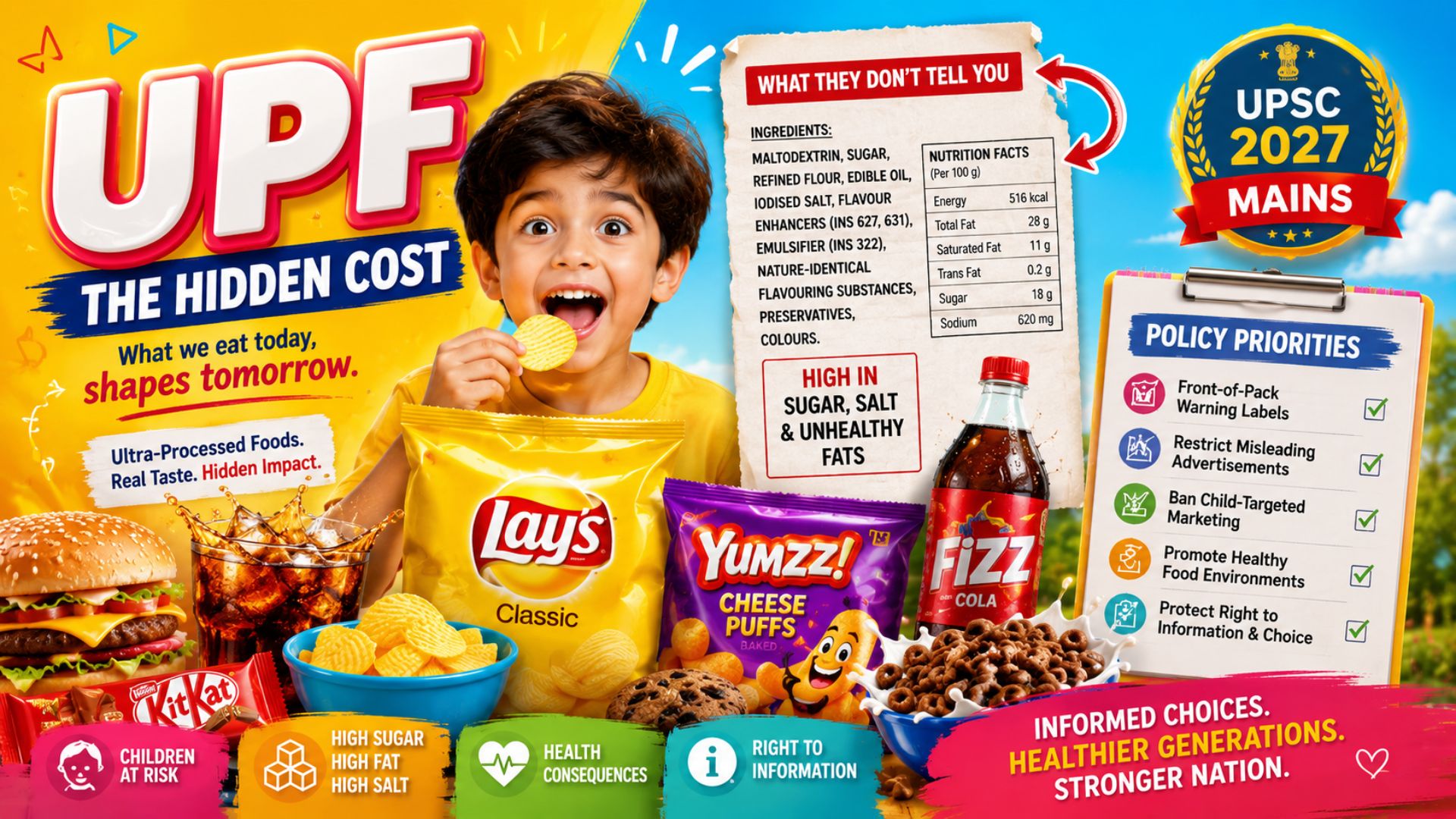
GS2 Healthcare

Pressure mounts to regulate junk food advertising in India.

Regulating Ultra-Processed Food Advertising: A Public Health Imperative

Restricting the advertising of unhealthy foods is vital for public health, especially for children and young adults.
Gopi Gopi
4 mins read

“Advertising does not merely reflect demand; it helps create it.”

India's food environment is increasingly dominated by advertisements for ultra-processed foods (UPFs) and foods high in fat, sugar and sodium (HFSS). Despite policy commitments to restrict such promotions, unhealthy food products continue to be aggressively marketed across television, social media, newspapers, sports broadcasts and digital platforms. Growing scientific evidence linking UPFs to obesity, diabetes and other non-communicable diseases (NCDs) has strengthened calls for stricter regulation of their advertising.

The Problem with UPF Advertising

Many advertisements selectively highlight attractive features such as "baked", "multigrain" or "no maida", while omitting critical nutritional information.

A baked chips advertisement emphasized
"crunchiness" and flavours but did not disclose
high salt, fat content, refined carbohydrates
and additives such as flavour enhancers,
emulsifiers and acidity regulators.
Breakfast cereals marketed as "12-grain"
or "multigrain" are often high in sugar,
while celebrity-endorsed biscuits may
contain excessive fat, sugar or salt.

Such selective disclosures create a misleading perception of healthfulness and undermine consumers' ability to make informed choices, especially among children and adolescents.

Why UPF Advertising Matters

Research increasingly links UPF consumption to:

  • Obesity
  • Type-2 diabetes
  • Hypertension
  • Cardiovascular diseases
  • Poor overall diet quality
  • Displacement of traditional and minimally processed foods

How Advertising Influences Consumption

MechanismImpact
Celebrity endorsementsBuilds trust and aspirational appeal
Child-focused messagingCreates early brand loyalty
Health-related claimsMasks unhealthy nutritional profile
Digital and influencer marketingExpands reach among youth
Emotional advertisingEncourages impulse consumption

"What people eat cannot be separated from what they are persuaded to desire."

Scale of the Advertising Ecosystem

The influence of food advertising is immense.

IndicatorData
Advertising spend by 3 major global food corporations (2024)$13.2 billion
Junk food advertisements in India (one month)Over 2 lakh
Associated advertising expenditureAbout ₹170 crore

Evidence suggests that UPFs are engineered to be highly palatable and may encourage overconsumption through mechanisms resembling addiction science.

India has already acknowledged the problem.

Key Developments

InitiativeSignificance
National Multisectoral Action Plan (2017-22)Proposed restrictions on HFSS advertising
Supreme Court observations (2024 & 2026)Linked misleading food advertisements to public health concerns and supported front-of-pack labelling
Economic Survey 2025-26Called attention to unhealthy diets and UPFs
Parliamentary discussionsDemand for warning labels, advertising restrictions and taxation

The central concern is whether existing laws adequately protect public health and consumer rights.

Global Developments

The issue is receiving international attention.

The City of San Francisco filed a lawsuit
against major UPF manufacturers alleging
child-targeted marketing, addictive product
design and inadequate disclosure of health risks.

Evidence from The Lancet Series (2025)

The Lancet's three papers on UPFs and human health concluded that:

  • UPFs are associated with poorer diet quality.
  • They displace real and traditional foods.
  • They increase the risk of obesity and NCDs.
  • Policy action should not wait for further evidence.

Many public health experts now advocate precautionary regulation rather than delayed intervention.

The Policy Gap

Children and adolescents are exposed daily to UPF advertisements through:

  • Television
  • Social media platforms
  • Influencer content
  • Sports sponsorships
  • Cinema halls
  • Schools and public spaces

Experts argue that nutrition education alone cannot succeed when unhealthy foods are promoted through sophisticated and continuous marketing campaigns.

The issue also raises a constitutional concern: the state's obligation to protect the right to health, particularly for vulnerable populations such as children.

Way Forward

  • Enact legally enforceable restrictions on UPF and HFSS advertising.
  • Introduce clear front-of-pack warning labels.
  • Strengthen regulation of influencer and celebrity endorsements.
  • Restrict child-targeted marketing across media platforms.
  • Develop UPF-free school food environments through binding regulations.
  • Encourage reformulation and promotion of minimally processed foods.
  • Consider fiscal measures such as taxation of unhealthy products.
  • Improve consumer awareness through transparent nutrition disclosures.

Conclusion

The debate over UPF advertising is fundamentally a public health issue rather than an anti-industry agenda. Evidence increasingly shows that aggressive marketing shapes dietary behaviour, particularly among children. As obesity and lifestyle diseases rise, relying solely on consumer choice or voluntary industry self-regulation may prove inadequate. Stronger legal safeguards, transparent food labelling and responsible advertising practices are essential to creating healthier food environments and protecting the constitutional right to health.

Attribution

Original content sources and authors

Arun Gupta Author Arun Gupta The Hindu Source The Hindu

Syllabus classification

How this article maps to GS papers

Main syllabus

GS2Healthcare

Quick Q&A

What are ultra-processed foods and HFSS foods, and why have they emerged as a major public health concern in India?
Ultra-processed foods (UPFs) are industrially formulated products manufactured using refined ingredients, additives, preservatives, flavour enhancers, emulsifiers, colours, and sweeteners. HFSS foods refer to foods high in fat, sugar, and sodium. These products are designed to be highly palatable, convenient, and often addictive, encouraging repeated consumption. Examples include packaged chips, instant noodles, sweetened beverages, chocolates, breakfast cereals, and biscuits. Historically, the expansion of food processing industries and changing lifestyles since the economic liberalisation of the 1990s have contributed to increased consumption of packaged foods in India. However, scientific evidence has increasingly linked UPF consumption to obesity, hypertension, cardiovascular diseases, type-2 diabetes, and other non-communicable diseases (NCDs). The Lancet Series on Ultra-Processed Foods and Human Health, published in November 2025, highlighted that UPFs displace traditional diets and contribute to poor nutritional outcomes. India is witnessing rising obesity and diabetes rates alongside increased consumption of processed foods. Advertising expenditure and celebrity endorsements have amplified their popularity, particularly among children and adolescents. The issue has implications beyond healthcare, affecting productivity, human capital, and economic growth. From the UPSC GS-II perspective, this topic relates to public health policy, consumer rights, constitutional obligations under Article 21 (Right to Life), and governance. It also overlaps with GS-III themes concerning nutrition, economic development, and social sectors. Therefore, UPFs represent not merely a dietary issue but a broader challenge involving healthcare systems, regulatory frameworks, and equitable access to healthy food environments.
Why is regulating the advertising of unhealthy food products considered necessary for protecting public health and consumer rights?
Regulation of unhealthy food advertising is increasingly viewed as a public health necessity because advertising influences consumption patterns and shapes consumer preferences, particularly among vulnerable groups such as children and adolescents. Advertising does not merely reflect demand; it actively creates it through emotional messaging, celebrity endorsements, and selective presentation of nutritional information. In India, more than two lakh junk food advertisements in a month have reportedly been supported by advertising expenditure of around ₹170 crore. Globally, three major transnational corporations spent approximately $13.2 billion on advertising in 2024. Such campaigns often portray products as healthy by emphasizing labels such as 'multigrain', 'baked', or 'no maida', while concealing high levels of sugar, fat, and sodium. The Government of India's National Multisectoral Action Plan (2017-2022) recognized this issue and proposed restrictions on HFSS food advertising. In 2026, the Supreme Court observed that front-of-pack labeling is necessary to safeguard the right to health. The Economic Survey 2025-26 also emphasized stronger regulation. From a constitutional perspective, Article 21 guarantees the right to life and health, imposing a duty on the State to prevent foreseeable harm. Consumer protection principles also require informed choice and truthful advertising. International experiences from Chile and Mexico demonstrate that legally enforceable restrictions are more effective than voluntary self-regulation. Therefore, regulating unhealthy food advertisements is not anti-industry but a measure aimed at balancing commercial interests with public health, consumer rights, and social welfare.
How do aggressive marketing strategies and digital advertising influence dietary habits and food environments among children and adolescents?
Aggressive marketing strategies influence dietary habits by creating emotional associations, brand loyalty, and perceptions of healthfulness around ultra-processed foods. Children and adolescents are particularly vulnerable because they are less capable of critically evaluating persuasive advertising techniques. Food companies employ celebrity endorsements, child actors, cartoon characters, influencers, sports sponsorships, and social media campaigns to normalize unhealthy consumption. Modern digital platforms such as YouTube, Instagram, and streaming services have significantly expanded the reach of food advertisements. Children encounter such promotions in schools, homes, cinema halls, and workplaces, making exposure almost unavoidable. These advertisements frequently emphasize selective characteristics like 'baked', 'high-fibre', or 'multigrain', while omitting information about excessive sugar, sodium, and unhealthy fats. Scientific evidence increasingly suggests that UPFs are engineered to maximize taste and encourage overconsumption through mechanisms resembling addiction. Experts associated with The Lancet Series have argued that nutrition education alone cannot succeed when individuals are constantly exposed to powerful commercial influences. The consequences are profound. Early exposure builds lifelong consumption patterns and contributes to obesity, diabetes, cardiovascular diseases, and poor dietary diversity. Such health burdens impose substantial economic costs and strain healthcare systems. From the UPSC GS-II perspective, the issue involves governance, social justice, public health, and the rights of children. It also intersects with GS-I topics related to vulnerable sections and GS-III themes concerning human resource development. Therefore, reforming food environments requires comprehensive regulation, digital governance, and community-based interventions rather than relying solely on individual behavior change.
What is a critical analysis of voluntary self-regulation versus statutory regulation in controlling unhealthy food advertisements?
The debate between voluntary self-regulation and statutory regulation has become central to public health policy concerning unhealthy food advertising. Industry bodies often argue that self-regulation provides flexibility, minimizes compliance costs, and allows innovation without excessive government intervention. Companies contend that consumers have freedom of choice and that education rather than restrictions should guide dietary behavior. However, evidence from several countries indicates that voluntary mechanisms have limited effectiveness. Commercial incentives often conflict with public health objectives. Companies may continue to use misleading labels and emotional appeals that encourage consumption, particularly among children. The persistence of extensive UPF advertising despite India's commitments under the National Multisectoral Action Plan illustrates these limitations. International experiences provide useful lessons. Chile introduced mandatory warning labels and restrictions on child-targeted marketing, leading to measurable changes in consumer behavior. Mexico adopted regulatory measures on advertising and food labeling. Brazil recently emphasized stronger policy direction regarding school food environments. These examples suggest that legally enforceable regulations are generally more effective than voluntary codes. Critics of statutory regulation argue that excessive restrictions could affect industry revenues and consumer freedom. However, public health experts emphasize that Article 21 of the Constitution obligates the State to protect citizens from foreseeable harm. From the UPSC perspective, this debate reflects broader themes of balancing economic freedom with social welfare. It involves governance, regulatory institutions, consumer protection, and constitutional morality. A balanced approach combining legal standards, transparency, front-of-pack labeling, and accountability mechanisms may offer the most sustainable solution.
What national and international case studies illustrate the growing legal and policy responses to unhealthy food marketing?
Several national and international developments demonstrate increasing recognition of the dangers associated with unhealthy food marketing. In India, the National Multisectoral Action Plan for Prevention and Control of Non-Communicable Diseases (2017-2022) proposed restrictions on the advertising of HFSS foods. Although implementation remains incomplete, the initiative represented an important policy milestone. Judicial interventions have also become significant. In 2024, the Supreme Court observed that misleading advertisements promoting unhealthy foods could adversely affect children, pregnant women, and elderly people. In February 2026, while hearing a Public Interest Litigation concerning warning labels, the Court emphasized that front-of-pack labeling was necessary to protect the right to health. Internationally, San Francisco initiated legal proceedings against ten major UPF manufacturers. The lawsuit alleged child-targeted marketing, addictive product design, and inadequate disclosure of health risks such as obesity and diabetes. It sought corrective measures and restrictions on deceptive advertising practices. Chile has emerged as a pioneering example by introducing mandatory warning labels and strict controls on child-focused advertising. Mexico adopted similar measures to combat obesity and improve dietary awareness. Brazil strengthened school food policies and sought clearer regulatory guidance. These examples reveal that legal interventions are increasingly replacing voluntary industry codes. They also demonstrate that food regulation is becoming a component of broader health governance. From a UPSC GS-II perspective, these case studies illustrate the interaction between judiciary, executive policy, public health institutions, and international best practices. They underscore the importance of evidence-based policymaking and comparative learning in addressing emerging healthcare challenges.
What are the major reasons behind the increasing consumption of ultra-processed foods and rising non-communicable diseases in India?
The rise in ultra-processed food consumption in India can be attributed to multiple economic, social, and cultural factors. Urbanization, changing lifestyles, increasing disposable incomes, and the expansion of organized retail have altered food consumption patterns over the last three decades. Busy schedules and convenience have made packaged foods attractive to households across income groups. Aggressive marketing and celebrity endorsements further contribute to this trend. Food companies often market products as healthy through claims such as 'multigrain', 'baked', or 'no maida', creating misleading perceptions. Social media influencers and digital platforms have expanded the reach of such messaging, particularly among youth. Globalization and the entry of multinational corporations have accelerated dietary transitions away from traditional foods toward industrially processed alternatives. The displacement of local culinary traditions has resulted in reduced dietary diversity and increased consumption of sugar, salt, and unhealthy fats. Another important factor is inadequate regulation. Weak labeling standards and insufficient restrictions on advertising allow companies to shape consumer preferences. Public awareness regarding nutritional risks also remains limited. The consequences are reflected in rising rates of obesity, diabetes, hypertension, and cardiovascular diseases. According to evidence presented in The Lancet Series of 2025, UPFs are associated with poorer diet quality and elevated risks of multiple non-communicable diseases. For UPSC preparation, the issue connects GS-II themes of healthcare and governance with GS-III aspects of economic development and human capital. Addressing this challenge requires regulatory reforms, nutrition literacy, and strengthening traditional and sustainable food systems.

Practice questions

2 questions for mains preparation

Examine how misleading advertising practices can undermine consumers' right to information and informed choice. In the context of increasing promotion of ultra-processed foods, discuss the need for stronger regulatory safeguards to protect consumer interests, particularly those of children and adolescents.

10 marks · 150 words · 8 mins

Evaluate the impact of junk food advertising on public health in India and propose measures to mitigate its effects. How can regulatory frameworks be strengthened in this context?

10 marks · 150 words · 8 mins
