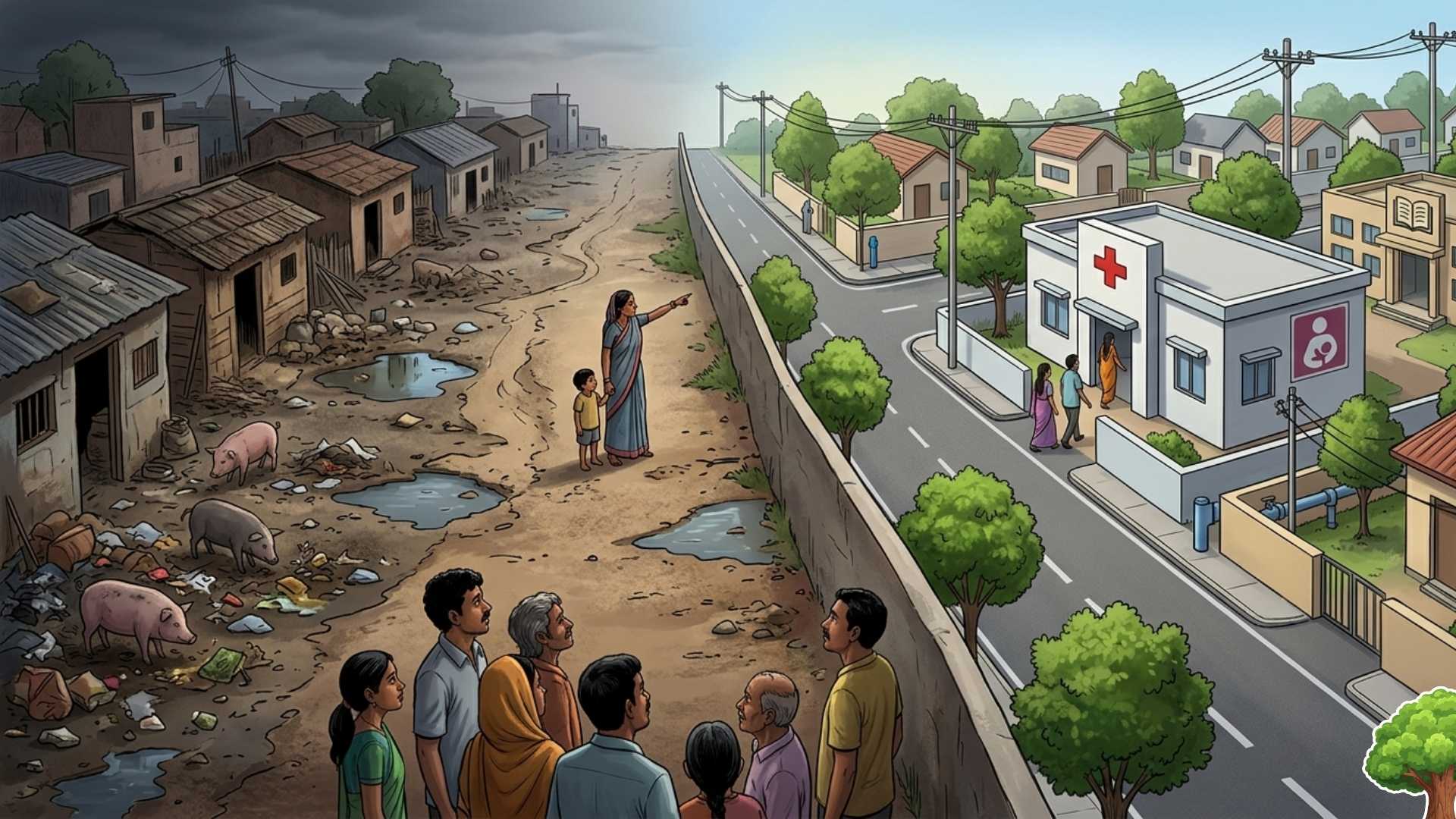
Residential Segregation & Healthcare Inequality in India
Understanding how the spatial separation of communities affects their access to essential healthcare services and overall health outcomes.
3 mins read

Introduction
- India's spatial inequality is not accidental — it is caste and religion-encoded, with over 15 lakh neighbourhoods studied revealing systemic exclusion of SCs and Muslims from basic public services (Asher et al., Working Paper). Add this as a second bullet (before the statistics):
- Residential segregation is the physical separation of communities by caste or religion — not by choice, but by social coercion; e.g., Dalit settlements in India are routinely located beyond the last row of dominant-caste houses, with no paved roads, no streetlights, and no public services — invisible to both the state and policy.
- Urban segregation indices range from 0.52 (Muslims) to 0.59 (SCs) — meaning over half would need to relocate for full integration; nearly 1 in 4 urban Muslims lives in neighbourhoods that are 80%+ Muslim.
"Inequality in India is not only widespread; it is spatially organised and hidden in plain sight." — Asher et al.
Key Concepts
| Term | Meaning |
|---|---|
| Residential Segregation | Systematic spatial separation of communities based on caste/religion |
| Segregation Index | Measures proportion needing relocation for full integration (0–1 scale) |
| Ghettoisation | Concentration of marginalised communities in under-serviced, isolated zones |
| Social Determinants of Health | Non-medical factors (location, caste, income) shaping health outcomes |
How Segregation Excludes Healthcare Access
Infrastructure Placement Bias:
- Anganwadis, PHCs, and schools are placed in "central" areas — which default to dominant-caste localities.
- Dalit settlements at village margins are excluded by the logic of connectivity and centrality itself.
Social Barriers Beyond Physical Distance:
- Health camps held in temples/community halls — spaces where Dalits may be unwelcome or unsafe.
- Village Health Committees dominated by upper-caste men shape where services are placed.
- Case (Tamil Nadu): A malnourished child's mother refused Anganwadi access — not from ignorance, but loss of dignity from repeated humiliation.
Institutionalised Exclusion:
- Odisha case: A clinic in an upper-caste area allowed Dalit patients only on specific days and fixed hours — displayed on a board.
- Emergency care effectively inaccessible outside those windows.
Muslim Neighbourhoods:
- Urban Muslim-majority areas have weaker infrastructure, understaffed PHCs, and fewer amenities.
- Healthcare workers carry implicit biases — e.g., assuming higher disability rates due to consanguineous marriages without data support.
- Residents adapt by seeking private care — deepening economic burden.
Policy Failures & Reinforcement of Segregation
| Policy/Law | Intended Purpose | Actual Effect |
|---|---|---|
| Gujarat Disturbed Areas Act | Prevent distress property sales in riot-hit areas | Restricts Muslims from buying homes in Hindu-majority areas — deepens segregation |
| Rajasthan administrative directions | Regulate inter-community land transactions | Formalises residential segregation |
| Assam eviction drives | Land administration | Disproportionately displaces minority communities |
| Sachar Committee Report (2006) | Documented Muslim segregation and under-service | Recommendations largely unimplemented |
Core policy gap: Most welfare programmes assume equal intra-village/district access — ignoring that spatial location and social identity determine who can actually enter service points.
Public Health Implications
- Higher disease burden, delayed treatment, worse outcomes in segregated neighbourhoods.
- Preventive care (immunisation, nutrition, maternal health) disproportionately misses marginalised settlements.
- Compounding effect: Poor sanitation + poor healthcare access + social humiliation = structural health poverty.
Way Forward
- Neighbourhood-level mapping of service access gaps — move beyond district-level data.
- Satellite/mobile health units to actively redistribute care to margin settlements.
- Reform Village Health Committee composition to mandatorily include SC/ST/minority representation.
- Sensitivity training for frontline health workers to address implicit bias.
- Repeal/review laws like the Gujarat Disturbed Areas Act that institutionalise segregation.
- Implement Sachar Committee recommendations on spatial equity in service delivery.
Conclusion
- Residential segregation is India's hidden multiplier of inequality — converting social exclusion into health exclusion.
- Constitutional guarantees of equality remain unrealised when geography itself is weaponised by caste and communal logic.
- Public health policy must shift from universal coverage on paper to equitable access in practice — by recognising space, caste, and dignity as determinants of health.
Attribution
Original content sources and authors


Syllabus classification
How this article maps to GS papers
Main syllabus
GS2HealthcareQuick Q&A
What is residential segregation, and how does it manifest in the Indian socio-spatial context?
Residential segregation refers to the physical separation of communities based on social identities such as caste, religion, or ethnicity, resulting in unequal access to resources and opportunities. In India, this phenomenon is deeply rooted in historical caste hierarchies and socio-religious divisions, leading to the spatial isolation of Scheduled Castes, Muslims, and other marginalised groups.
This segregation is not merely geographic but reflects entrenched social exclusion. For instance, Dalit settlements are often located at the peripheries of villages, lacking basic infrastructure such as sanitation, clean water, and healthcare facilities. Similarly, urban Muslim neighbourhoods tend to be clustered in underdeveloped areas with limited public services. Research shows that a significant proportion of these communities live in highly homogeneous neighbourhoods, reinforcing social isolation.
Key manifestations:
This segregation is not merely geographic but reflects entrenched social exclusion. For instance, Dalit settlements are often located at the peripheries of villages, lacking basic infrastructure such as sanitation, clean water, and healthcare facilities. Similarly, urban Muslim neighbourhoods tend to be clustered in underdeveloped areas with limited public services. Research shows that a significant proportion of these communities live in highly homogeneous neighbourhoods, reinforcing social isolation.
Key manifestations:
- Peripheral location of marginalised communities
- Poor access to public services like schools and health centres
- Informal barriers to mobility and service access
Why is residential segregation a critical issue for public health outcomes in India?
Residential segregation significantly impacts public health outcomes by creating unequal access to healthcare services and infrastructure. Marginalised communities living in segregated areas often face inadequate sanitation, poor living conditions, and limited availability of healthcare facilities, which increase their vulnerability to diseases and adverse health conditions.
The placement of healthcare infrastructure typically follows principles of centrality and connectivity, often favouring dominant caste or affluent areas. As a result, Dalit and Muslim communities residing in segregated localities may find it physically difficult or socially unsafe to access these services. For example, instances where Dalit women avoid Anganwadi centres due to humiliation highlight how social barriers translate into health risks.
Public health implications:
The placement of healthcare infrastructure typically follows principles of centrality and connectivity, often favouring dominant caste or affluent areas. As a result, Dalit and Muslim communities residing in segregated localities may find it physically difficult or socially unsafe to access these services. For example, instances where Dalit women avoid Anganwadi centres due to humiliation highlight how social barriers translate into health risks.
Public health implications:
- Delayed or denied access to healthcare services
- Higher prevalence of communicable and lifestyle diseases
- Increased maternal and child health risks
How does the spatial placement of public services reinforce inequality in segregated communities?
The spatial placement of public services such as schools, Anganwadis, and primary health centres often reinforces existing inequalities in segregated communities. These facilities are usually located in areas that are easily accessible in terms of infrastructure, such as roads and transport, which tend to coincide with dominant caste or economically better-off localities.
In caste-segregated villages, this results in the exclusion of marginalised communities who live on the outskirts. Even when services are technically available within a village, social barriers such as discrimination, humiliation, and fear of violence prevent access. For example, health camps held in temples or dominant caste spaces may be inaccessible to Dalits due to social norms and restrictions.
Mechanisms of exclusion:
In caste-segregated villages, this results in the exclusion of marginalised communities who live on the outskirts. Even when services are technically available within a village, social barriers such as discrimination, humiliation, and fear of violence prevent access. For example, health camps held in temples or dominant caste spaces may be inaccessible to Dalits due to social norms and restrictions.
Mechanisms of exclusion:
- Geographical distance and poor connectivity
- Social discrimination and stigma
- Institutional bias in planning and governance
Critically analyze the role of public policy in addressing or reinforcing residential segregation in India.
Public policy in India has played a dual role in relation to residential segregation—while constitutional provisions guarantee equality and prohibit discrimination, certain policies and practices have inadvertently reinforced spatial divides. Welfare schemes often assume uniform access within administrative units like villages or districts, ignoring intra-locality disparities caused by segregation.
Moreover, specific laws and administrative measures have contributed to the persistence of segregation. For instance, the Gujarat Disturbed Areas Act, originally intended to prevent distress property sales, has been used to restrict inter-community property transactions, thereby reinforcing ghettoisation. Similar trends in Rajasthan and Assam highlight how policy can shape settlement patterns in exclusionary ways.
Critical evaluation:
Moreover, specific laws and administrative measures have contributed to the persistence of segregation. For instance, the Gujarat Disturbed Areas Act, originally intended to prevent distress property sales, has been used to restrict inter-community property transactions, thereby reinforcing ghettoisation. Similar trends in Rajasthan and Assam highlight how policy can shape settlement patterns in exclusionary ways.
Critical evaluation:
- Positive: Constitutional safeguards and targeted welfare programmes
- Negative: Lack of recognition of spatial inequality in policy design
- Concern: Legal and administrative measures reinforcing segregation
Illustrate with examples how social identity influences healthcare access in India.
Social identity, particularly caste and religion, plays a significant role in determining access to healthcare in India. For instance, Dalit communities often face discrimination when accessing public health facilities located in dominant caste areas. A case highlighted in the article describes a Dalit mother refusing to take her malnourished child to an Anganwadi centre due to repeated humiliation, demonstrating how dignity and social barriers can override health needs.
Similarly, in parts of Odisha, Dalit residents were allowed to access a clinic only during specific hours to avoid interaction with upper-caste individuals. In urban contexts, Muslim-majority neighbourhoods often suffer from under-resourced healthcare facilities, forcing residents to travel longer distances for quality care.
Key observations:
Similarly, in parts of Odisha, Dalit residents were allowed to access a clinic only during specific hours to avoid interaction with upper-caste individuals. In urban contexts, Muslim-majority neighbourhoods often suffer from under-resourced healthcare facilities, forcing residents to travel longer distances for quality care.
Key observations:
- Discrimination in service delivery and access
- Restricted timings and informal barriers
- Unequal distribution of healthcare infrastructure
What are the underlying reasons for the persistence of spatial inequality in access to public services in India?
The persistence of spatial inequality in India can be attributed to a combination of historical, social, and institutional factors. Historically, caste-based segregation has dictated settlement patterns, with marginalised communities being relegated to less desirable areas lacking infrastructure and resources.
Institutionally, public service planning often prioritises efficiency and centrality, without accounting for social barriers. This results in the placement of facilities in areas that are technically accessible but socially exclusionary. Additionally, biases among service providers and local governance structures dominated by upper-caste groups further exacerbate disparities.
Key reasons:
Institutionally, public service planning often prioritises efficiency and centrality, without accounting for social barriers. This results in the placement of facilities in areas that are technically accessible but socially exclusionary. Additionally, biases among service providers and local governance structures dominated by upper-caste groups further exacerbate disparities.
Key reasons:
- Historical caste and religious segregation
- Policy blind spots تجاه intra-locality disparities
- Social discrimination and institutional bias
As a public health administrator, how would you design interventions to overcome barriers created by residential segregation?
As a public health administrator, addressing barriers created by residential segregation would require a targeted and inclusive approach that recognises spatial and social inequalities. The first step would be to map underserved neighbourhoods at a micro level, identifying gaps in healthcare access and infrastructure.
Interventions should focus on decentralising healthcare delivery by establishing mobile clinics, satellite health centres, and community-based outreach programmes directly within marginalised settlements. Additionally, recruiting and training healthcare workers from within these communities can help build trust and reduce social barriers.
Policy measures:
Interventions should focus on decentralising healthcare delivery by establishing mobile clinics, satellite health centres, and community-based outreach programmes directly within marginalised settlements. Additionally, recruiting and training healthcare workers from within these communities can help build trust and reduce social barriers.
Policy measures:
- Establish health facilities within marginalised localities
- Conduct inclusive health camps in neutral spaces
- Strengthen community participation in planning
Practice questions
2 questions for mains preparation