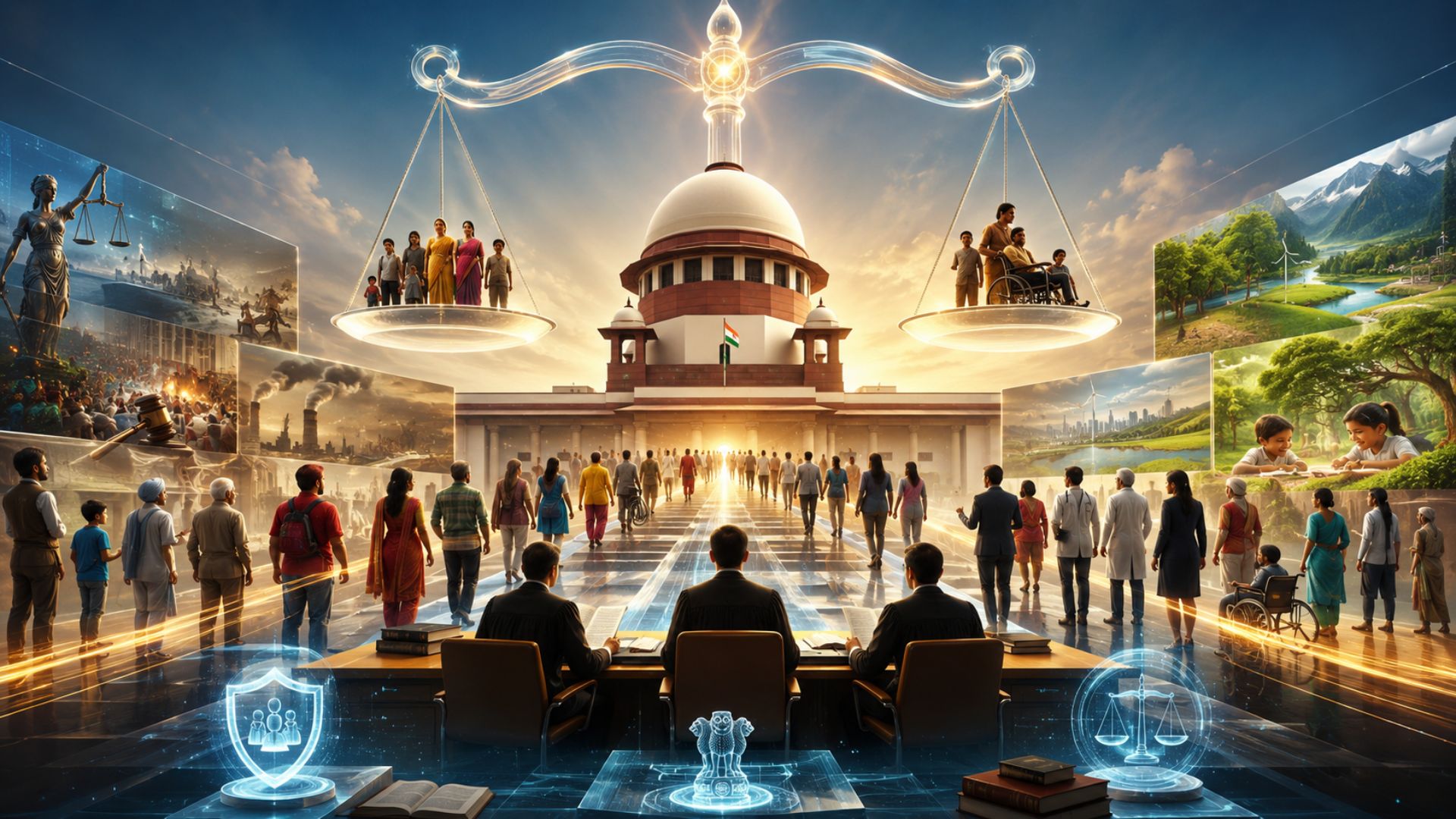
Article 142 and the Right to Safe Travel: Complete Justice as a Constitutional Imperative
The Supreme Court's elevation of safe travel on National Highways to a fundamental right under Article 21 is more than a judicial response to road accidents — it is a reaffirmation of a deeper constitutional philosophy: that justice, by its very nature, must be complete, and that the state's obligation to citizens cannot be reduced to mere policy intent.
The Road Safety Crisis: Numbers That Compelled the Court
The factual backdrop to this judgment is stark:
- National Highways constitute only 2% of India's total roads yet account for 30% of all road fatalities
- In the first six months of 2025 alone, 26,770 deaths were recorded on National Highways
- Despite an 11% decline in fatalities compared to 2024, the numbers remain constitutionally unacceptable
- The government's target is a 50% reduction in road accidents by 2030, anchored in the 4E framework — Education, Engineering, Enforcement, and Emergency Medical Services
Taking suo motu cognisance of two accidents in November 2025 that claimed 34 lives, the Court in In Re: Phalodi Accident vs. NHAI (2025) declared that safe, well-maintained, and motorable roads are no longer a policy aspiration — they are a constitutional obligation.
Article 142: The Architecture of Complete Justice
The Court's intervention rests on Article 142, which empowers the Supreme Court to pass any order necessary for complete justice — even where existing law is silent, inadequate, or procedurally restrictive.
This power is inherent, not statutory. It flows from the Supreme Court's role as the custodian of the Constitution and operates on two conditions:
- The law is silent or incapable of redressing the grievance
- Non-exercise would result in a manifest error or travesty of justice
"The power to do complete justice is entirely of a different level and of a different quality. Any restrictions contained in ordinary laws cannot act as a limitation on the constitutional power of the Court." — Delhi Judicial Service Association vs. State of Gujarat (1991)
Article 142 functions as a constitutional safety valve — filling legal gaps where substantive justice would otherwise be denied. Crucially, the Constitution gives precedence to natural justice over strict legal procedure. As held in Canara Bank vs. Debasis Das (2003):
"Where legal justice is incapable of removing injustice, the principles of natural justice must be followed."
The power is residuary and extraordinary — and precisely because of this, the Court in Hitesh Bhatnagar vs. Deepa Bhatnagar (2011) emphasised that extraordinary care and caution must govern its exercise.
Can High Courts Deliver Complete Justice?
The answer is yes — but within circumscribed limits. In Anil Kumar Jain vs. Maya Jain (2009), the Supreme Court held that High Court powers under Article 226 are not at par with Article 142. However, justice as a concept is inherently complete — High Courts may deliver it, albeit in a more constrained manner, without access to the Supreme Court's inherent override jurisdiction.
The Judicial Overreach Debate
Critics argue that Article 142 enables the judiciary to bypass established law, encroach on executive and legislative domains, and upset the separation of powers. This critique, while structurally coherent, misunderstands constitutional intent.
Judicial activism — of which Article 142 is an instrument — is not about replacing the legislature but about ensuring that evolving social realities do not fall through legal gaps. Issues like live-in relationships, rights of LGBTQ+ individuals, or road safety governance represent precisely those moments where established law proves inadequate and the Court must proactively ensure that the constitutional promise of justice is not hollowed out by procedural inertia.
Way Forward
- Statutory reinforcement — Supreme Court directives under Article 142 should be followed by legislative action to institutionalise road safety obligations, reducing dependence on judicial intervention
- NHAI accountability architecture — A permanent, independent road safety audit mechanism must be established with enforceable timelines and public reporting
- 4E framework operationalisation — Emergency Medical Services on highways, in particular, remain critically underdeveloped; the 2030 target requires front-loaded investment here
- Judicial restraint norms — While Article 142 is necessary, the Court must develop clearer self-imposed criteria for its invocation to prevent unpredictability in its application
- High Court empowerment — State-level highway safety can be better monitored if High Courts are given clearer mandates to act, reducing the burden on the apex court
Conclusion
The Phalodi judgment does two things simultaneously: it saves lives by forcing state accountability on road safety, and it deepens constitutional jurisprudence by anchoring that accountability in Article 21. Article 142, at its best, is not judicial overreach — it is the Constitution's own acknowledgment that justice cannot always wait for the legislature to act. In a rapidly changing society, the Supreme Court's inherent powers serve as the living connective tissue between constitutional promise and everyday reality.
Attribution
Original content sources and authors
Syllabus classification
How this article maps to GS papers
Main syllabus
GS2Indian ConstitutionQuick Q&A
What is the significance of the Supreme Court recognizing the Right to Safe Travel on National Highways as part of Article 21 of the Constitution?
The judgment gains importance because India faces an alarming number of road fatalities, especially on National Highways. Although National Highways constitute only around 2% of the road network, they account for nearly 30% of road deaths. The Court took suo motu cognisance after two accidents caused the loss of 34 lives. This indicates judicial concern over systemic negligence in road engineering, maintenance, enforcement, and emergency response mechanisms. The judgment therefore reinforces the doctrine that governance failures affecting public safety can amount to violations of fundamental rights.
The constitutional significance of this decision lies in strengthening the accountability of public authorities such as the National Highways Authority of India (NHAI), State agencies, and transport departments. The Court has effectively stated that citizens are entitled not merely to roads, but to roads that are scientifically designed, properly maintained, and safe for travel. This may lead to stricter compliance standards, improved audits, and enhanced liability for negligence.
From a governance perspective, the decision also reflects the evolving role of the judiciary in addressing modern developmental challenges. Safe infrastructure is now linked to human dignity, economic productivity, and social welfare. The ruling may further encourage policy reforms in road engineering, driver education, emergency medical care, and technology-based traffic monitoring. Thus, the judgment elevates road safety into a constitutional and human rights issue rather than treating it as only a transport-sector concern.
Why is Article 142 often described as a ‘constitutional safety valve’ in the Indian judicial system?
The article highlights that these powers are inherent to the Supreme Court’s constitutional role as the guardian of the Constitution. In cases where ordinary laws are silent, insufficient, or incapable of addressing grievances effectively, the Court can invoke Article 142 to ensure fairness and substantive justice. For instance, in Delhi Judicial Service Association vs. State of Gujarat (1991), the Court emphasized that the power under Article 142 is of a different quality and cannot be limited by ordinary statutory restrictions.
The importance of Article 142 becomes more evident in rapidly changing social and technological contexts. Issues such as live-in relationships, environmental degradation, road safety, digital privacy, or rights of marginalized groups often evolve faster than legislative reforms. In such situations, waiting indefinitely for statutory amendments may lead to injustice. Article 142 allows the Court to proactively protect constitutional values and fundamental rights.
However, the provision also requires caution. Since the power is extraordinary in nature, the Court itself has acknowledged the need for restraint. In Hitesh Bhatnagar vs. Deepa Bhatnagar (2011), the Supreme Court observed that such powers must be exercised with extraordinary care and caution. The objective is not to replace legislation, but to ensure that justice is not defeated due to procedural limitations.
Thus, Article 142 serves as a balancing mechanism between constitutional morality and legal formalism. It enables the judiciary to uphold substantive justice, natural justice, and fairness in exceptional circumstances while preserving the larger constitutional vision of justice, liberty, and dignity.
How does the concept of ‘complete justice’ reflect the relationship between legal justice and natural justice in the Indian constitutional framework?
The article explains that Article 142 empowers the Supreme Court to fill legal gaps when existing statutes or procedures are incapable of addressing injustice adequately. This demonstrates that the constitutional framework recognizes the limitations of purely procedural justice. In Canara Bank vs. Debasis Das (2003), the Supreme Court clarified that the Constitution intends to deliver substantive justice and that where legal justice fails, principles of natural justice must prevail. This reflects the constitutional philosophy that fairness and equity are central to the rule of law.
The principle of natural justice includes concepts such as fairness in decision-making, absence of bias, and the right to be heard. These principles are essential in ensuring public confidence in the judiciary. For example, in cases involving environmental protection, human rights, or gender justice, strict legal procedures may not always provide effective remedies. In such circumstances, courts have relied on constitutional principles and natural justice to protect vulnerable groups and uphold human dignity.
At the same time, the judiciary recognizes that extraordinary powers must not become arbitrary powers. The Supreme Court has repeatedly stressed that Article 142 should be exercised cautiously and only when necessary to prevent grave injustice. This ensures that judicial discretion remains guided by constitutional morality and not subjective preferences.
Therefore, the idea of complete justice represents a constitutional synthesis between law and equity. It ensures that justice is not reduced to mere procedural compliance but remains aligned with the broader constitutional goals of fairness, dignity, and social transformation. This balance is essential in a diverse and evolving democracy like India.
Critically analyze the debate surrounding judicial activism and judicial overreach in the context of Article 142.
Supporters of Article 142 argue that the provision is essential for delivering substantive justice in exceptional circumstances. India’s social realities often evolve faster than legislative reforms. Issues such as environmental degradation, road safety, prison reforms, LGBTQ+ rights, and governance failures may require urgent intervention when existing laws prove inadequate. In such cases, judicial activism helps uphold constitutional morality and fundamental rights. The Supreme Court’s recent recognition of safe travel as part of Article 21 is an example where judicial intervention sought to address systemic governance failures affecting public safety.
Critics, however, argue that excessive use of Article 142 can weaken the doctrine of separation of powers. They contend that policy formulation and administrative decision-making primarily belong to elected governments and legislatures. If courts frequently bypass statutory frameworks or issue detailed governance directives, it may reduce democratic accountability and create institutional imbalance. Some critics also fear that expansive judicial powers may lead to unpredictability in governance and law.
Despite these concerns, the Supreme Court has consistently maintained that Article 142 is meant for exceptional situations and must be exercised with restraint. The Court has emphasized that the objective is not to legislate but to ensure that justice is not denied due to procedural or legal inadequacies. Furthermore, judicial activism has historically played a transformative role in India through Public Interest Litigation (PIL), expansion of Article 21 rights, and protection of marginalized communities.
Therefore, the real challenge lies in maintaining institutional balance. Judicial activism becomes legitimate when it protects constitutional values and fills governance gaps without permanently encroaching upon legislative or executive functions. The debate ultimately reflects the dynamic nature of constitutional democracy, where institutions must cooperate while respecting their respective boundaries.
What are the major reasons behind the high number of fatalities on National Highways in India despite policy interventions?
One major reason is poor road engineering and maintenance. Defective road design, inadequate signage, absence of crash barriers, poorly lit highways, and unsafe intersections significantly increase accident risks. Rapid highway expansion has not always been accompanied by corresponding investments in safety audits and maintenance systems. In several cases, construction zones are poorly managed, creating hazardous conditions for commuters.
Another important factor is weak enforcement of traffic laws. Overspeeding, drunk driving, overloading of vehicles, fatigue among commercial drivers, and low compliance with helmet and seatbelt regulations continue to contribute heavily to road accidents. While technology-based enforcement systems are expanding, implementation remains inconsistent across States. Driver education and awareness regarding road discipline also remain inadequate.
Emergency medical response systems constitute another area of concern. The “golden hour” immediately after an accident is crucial for saving lives, but delays in ambulance services, trauma care facilities, and coordination between agencies often increase fatalities. Rural stretches of highways are particularly vulnerable due to limited access to advanced healthcare facilities.
The article also highlights governance challenges. Despite policy initiatives based on the “4Es” — Education, Engineering, Enforcement, and Emergency Medical Services — implementation gaps remain substantial. Institutional coordination among transport authorities, police, health departments, and highway agencies is often weak. Additionally, accountability mechanisms for negligence in road construction and maintenance are not sufficiently stringent.
Therefore, reducing fatalities requires a holistic strategy. India must adopt scientific road design standards, strengthen enforcement through technology, improve driver training, and expand emergency medical infrastructure. Public awareness campaigns and stricter accountability for contractors and authorities are equally important. The Supreme Court’s intervention underscores that road safety is not merely a developmental issue but a constitutional responsibility linked to the Right to Life.
Suppose a State government repeatedly fails to repair a dangerous National Highway stretch despite repeated accidents and public complaints. How can constitutional remedies and judicial intervention address this issue?
The first step may involve administrative and statutory remedies. Citizens, civil society groups, or affected families can file complaints before highway authorities, transport departments, or human rights institutions. Public Interest Litigation (PIL) may also be filed before the High Court under Article 226 or before the Supreme Court under Article 32, seeking judicial directions for immediate corrective action.
Courts can issue several types of directions. These may include ordering road safety audits, mandating repair timelines, appointing expert committees, fixing accountability of contractors or officials, and directing compensation for victims. If the issue demonstrates systemic negligence affecting public safety, the Supreme Court may invoke Article 142 to deliver “complete justice.” Such intervention could include nationwide safety guidelines or mandatory compliance mechanisms for highway authorities.
The judiciary’s role in such cases is not limited to punitive action. Courts may also encourage structural reforms by emphasizing the “4E” strategy of Education, Engineering, Enforcement, and Emergency Medical Services. For example, they may direct installation of surveillance systems, better signage, trauma care centres, and stricter enforcement measures.
However, judicial intervention must remain balanced. Courts generally avoid directly administering infrastructure projects, as governance and execution primarily belong to the Executive. Their role is to ensure constitutional accountability and prevent violation of fundamental rights. Through continuous monitoring and constitutional oversight, the judiciary can compel authorities to fulfil their obligations while preserving institutional balance.
This scenario illustrates the importance of constitutional governance. In a welfare state, infrastructure safety is not merely a policy objective but an essential component of human dignity and the Right to Life. Judicial remedies therefore act as safeguards when executive inaction threatens public welfare and constitutional rights.
Practice questions
1 question for mains preparation