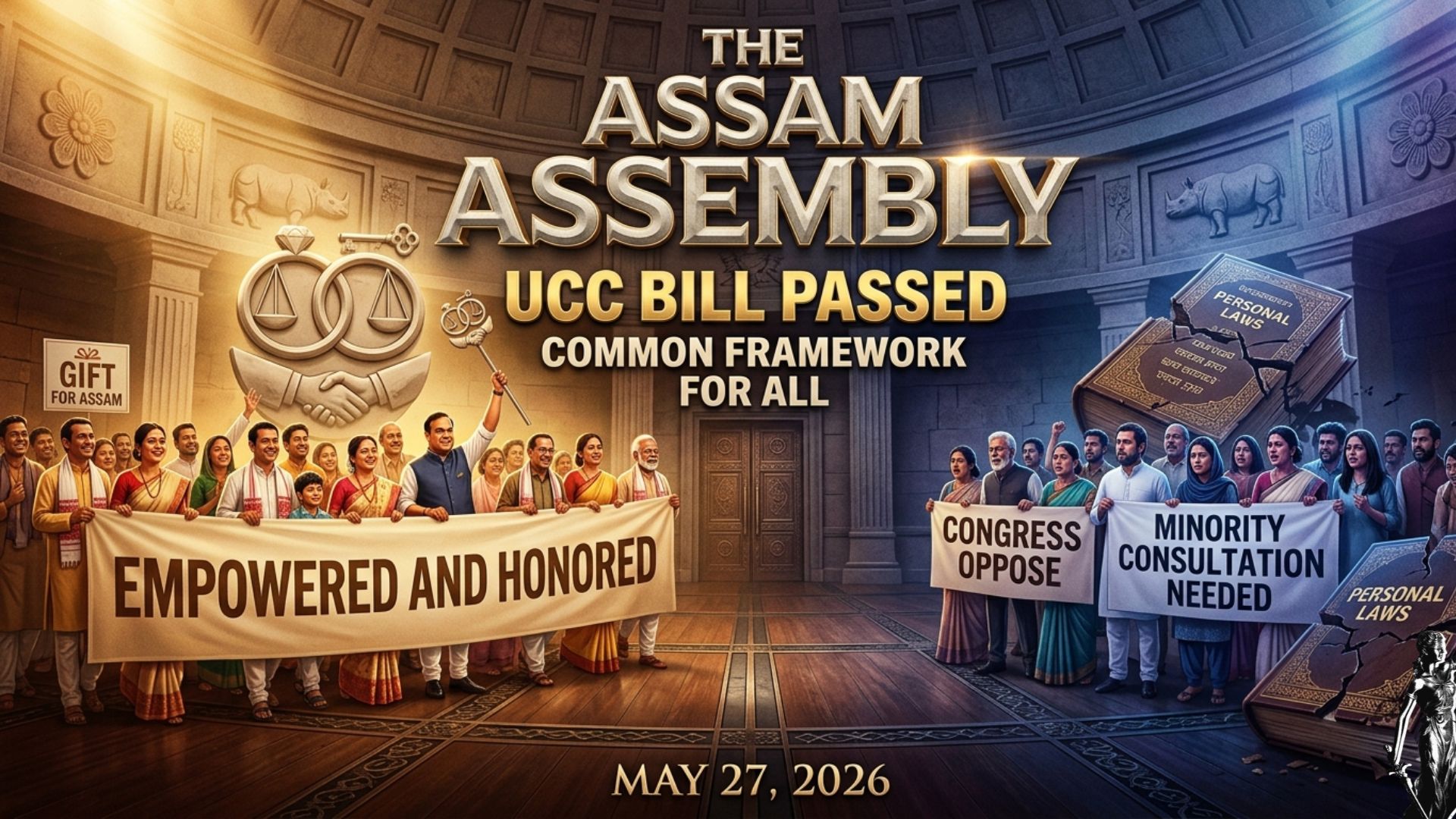
Assam's Uniform Civil Code Bill, 2026: Gender Justice or Contested Uniformity?

On May 27, 2026, the 126-member Assam Assembly passed The Uniform Civil Code (UCC) Bill, 2026, proposing a common civil framework governing marriage, divorce, inheritance, and live-in relationships in the State. Assam becomes the third State to enact such a law, after Uttarakhand and Gujarat, reviving one of the most enduring debates in Indian constitutional life—the tension between a uniform civil code and the protection of personal laws.
"The passing of this law in Assam will be a big step towards gender justice." — CM Himanta Biswa Sarma
How the Bill Was Passed
The legislation cleared the House along sharp partisan lines:
- Passed by voice vote with support from the ruling BJP and its allies.
- Opposed by three parties—Congress, Raijor Dal, and Trinamool Congress.
- It draws constitutional backing from Article 44 (Directive Principles of State Policy), which advocates a UCC.
What the Bill Provides
The law introduces a uniform set of civil rules cutting across communities:
KEY PROVISIONS OF THE UCC BILL, 2026
• Mandatory registration of all marriages, divorces
  and live-in relationships
• Ban on polygamy
• Equal succession rights for sons and daughters
• Succession rights for elderly parents
• Safeguards against coercion/deception in marriage
  and live-in relationships (the 'love jihad' clause)
The Tribal Exclusion
A defining feature—and a key flashpoint—is that the Bill excludes Scheduled Tribes (STs), who form 12.45% of Assam's population (2011 Census). The Chief Minister offered two justifications:
- Exclusion was made as a mark of respect for their identity.
- Their age-old customary laws already contain rules similar to the UCC—applying it to them would be "akin to treating people who have no ailments."
The Opposition turned this into its central critique: excluding STs meant the code was not truly "uniform."
The Government's Case
Defending the Bill, CM Himanta Biswa Sarma framed it as fulfilment of an electoral promise and a step toward gender justice:
- He invoked historical precedent—Goa has had a UCC since 1961, dating to Portuguese rule.
- He claimed the Congress had supported such legislation twice before independence, in 1925 and in 1937, through a committee headed by Jawaharlal Nehru.
- He accused the Congress of selective concern, alleging it worried about practices under the Quran and Shariat but never mentioned the Bhagavad Gita or Ramayana—"indicating that the party represents just one community."
The Opposition's Objections
Opponents raised concerns spanning procedure, rights, and privacy:
OPPOSITION'S KEY ARGUMENTS
• Wazed Ali Choudhury (Congress): UCC infringes
  personal liberties; existing laws already ensure
  women's empowerment; risks social/religious tension.
• Mazibur Rahman (AIUDF): Violates fundamental rights
  and provisions guaranteed to all citizens, including
  Assam's 34.22% Muslims.
• Sherman Ali Ahmed (TMC): Triple-talaq ban and
  live-in registration acceptable, but controlling
  'whom one should marry' violates Quranic guidelines
  and fundamental rights — alleges malicious intent.
• Akhil Gogoi (Raijor Dal): Scope for surveillance of
  private lives and harassment by authorities.
The Opposition also argued the Bill was introduced without consulting minority organisations and demanded it be referred to a Select Committee for detailed examination.
The Underlying Tensions
The debate surfaces three enduring fault lines in the UCC question:
- Uniformity vs diversity: Can a code that exempts a major demographic group genuinely claim to be "uniform"?
- Gender justice vs religious freedom: The clash between reforming discriminatory practices and protecting the right to practise one's faith.
- State reform vs individual privacy: Mandatory registration of live-in relationships raises concerns over State intrusion into private life.
Way Forward
The contested passage points to the conditions under which such reform can command legitimacy:
- Broad-based consultation: Engaging affected communities and minority organisations before enactment builds consensus and reduces the perception of imposition.
- Reconciling uniformity with pluralism: Reform should distinguish between practices that genuinely harm rights (polygamy, gender-unequal succession) and benign cultural diversity, avoiding blanket homogenisation.
- Safeguarding privacy: Provisions like live-in registration must be designed with strong data-protection and anti-harassment safeguards.
- A reformed, not merely uniform, code: The aim should be to advance gender justice and individual dignity, not to standardise for its own sake.
Conclusion
Assam's UCC Bill crystallises the central dilemma of Article 44: the pursuit of a common civil framework in a society defined by deep religious and cultural plurality. Its champions present it as a charter for gender justice and equality; its critics see a threat to personal liberty, minority rights, and privacy. The exclusion of tribal communities only sharpens the question of what "uniform" truly means. Ultimately, the legitimacy of any civil code will rest not on the speed of its passage, but on whether it is built through dialogue and directed at genuine justice rather than uniformity for its own sake.
Attribution
Original content sources and authors


Syllabus classification
How this article maps to GS papers
Main syllabus
GS2Indian ConstitutionQuick Q&A
What is the Uniform Civil Code (UCC), and what are the major features of the Assam UCC Bill, 2026?
The Assam UCC Bill, 2026 seeks to establish a common civil framework applicable across the State in matters relating to marriage, divorce, inheritance, and live-in relationships. Key provisions include mandatory registration of marriages, divorces, and live-in relationships, prohibition of polygamy, equal succession rights for sons and daughters, and legal safeguards for elderly parents. The legislation also claims to prevent coercive or deceptive interfaith relationships by introducing stricter verification mechanisms.
An important feature of the Bill is the exclusion of Scheduled Tribes (STs) from its purview. The State government justified this exclusion by arguing that tribal customary laws already contain mechanisms similar to several UCC provisions and deserve constitutional respect. However, critics argue that excluding STs weakens the very idea of “uniformity.”
The Bill has both legal and socio-political significance. Supporters claim it promotes gender justice, equality before law, and legal uniformity. Opponents argue that it interferes with religious freedom and personal laws protected under Articles 25 and 26 of the Constitution.
Historically, Goa has followed a version of the UCC since Portuguese rule, and Uttarakhand and Gujarat have recently enacted similar laws. Assam’s legislation therefore represents another step in the evolving national debate regarding the balance between secularism, diversity, and legal reform in India.
Why is the debate on the Uniform Civil Code considered significant in the context of constitutional morality and social diversity?
Supporters of the UCC argue that separate personal laws create unequal treatment among citizens, particularly affecting women in matters such as inheritance, divorce, maintenance, and polygamy. They contend that a common civil framework would strengthen constitutional morality by ensuring equal rights irrespective of religious identity. In the Assam Bill, provisions banning polygamy and ensuring equal succession rights are projected as measures promoting gender justice.
Opponents, however, argue that India’s diversity requires legal pluralism rather than uniformity. India is home to numerous religious, tribal, and customary traditions. Imposing a common code without broad social consensus may generate alienation and social tensions. Critics also fear that majoritarian cultural values may dominate the formulation of such laws.
The exclusion of Scheduled Tribes in Assam illustrates this complexity. While the government described it as respect for tribal customs, critics argued that selective application undermines the principle of uniformity itself. This demonstrates the practical challenge of balancing constitutional integration with cultural autonomy.
The UCC debate also reflects competing models of secularism. The Western model emphasizes strict separation between religion and law, whereas Indian secularism accommodates religious diversity while pursuing reform gradually.
Ultimately, the significance of the UCC debate lies not merely in legal reform but in defining the nature of Indian democracy. The central question is whether national integration should be pursued through legal uniformity or through coexistence of diverse traditions within a constitutional framework.
How does the Assam UCC Bill attempt to promote gender justice, and what limitations may affect its effectiveness?
Mandatory registration of marriages is particularly significant because it strengthens legal recognition and documentation of marital relationships. This can help women claim maintenance, inheritance, and legal protection in cases of abandonment or domestic disputes. Similarly, equal inheritance provisions reflect constitutional principles under Articles 14 and 15 promoting equality and non-discrimination.
The Bill also addresses concerns regarding coercion and deception in relationships. By regulating live-in relationships and scrutinizing marriages involving alleged coercion, the government claims it is protecting vulnerable individuals, especially women. Supporters argue that these provisions may reduce exploitation and forced conversions.
However, several limitations and concerns remain. Critics argue that women’s empowerment cannot be achieved solely through legal uniformity. Social practices, patriarchal attitudes, economic dependency, and lack of awareness continue to restrict women’s autonomy even where progressive laws exist.
Another concern is selective reform. Excluding Scheduled Tribes from the law creates inconsistency in the application of gender justice principles. Moreover, opponents argue that certain provisions regulating live-in relationships may enable state intrusion into private life rather than empowering women.
Implementation challenges are equally important. Legal literacy, administrative efficiency, and access to justice determine whether reforms actually benefit women at the grassroots level. For example, despite laws against child marriage and domestic violence, implementation gaps persist in many regions.
Therefore, while the Assam UCC Bill represents an attempt to align personal laws with constitutional equality, genuine gender justice requires broader social reform, education, economic empowerment, and institutional sensitivity alongside legislative intervention.
Critically analyse the constitutional and social concerns raised against the Assam Uniform Civil Code Bill, 2026.
One major constitutional concern relates to religious freedom. Articles 25 and 26 guarantee citizens the right to freely practice and manage religious affairs. Opponents argue that personal laws are deeply connected to religious identity and cultural autonomy. Therefore, imposing a uniform framework may interfere with constitutionally protected practices.
Another concern involves privacy and state surveillance. Critics such as Raijor Dal MLA Akhil Gogoi argued that mandatory registration of live-in relationships could allow unnecessary state intrusion into personal relationships. This concern gains significance after the Supreme Court’s recognition of privacy as a fundamental right in the Puttaswamy judgment (2017).
The issue of selective application further complicates the debate. Scheduled Tribes were excluded from the law in recognition of customary traditions. However, opposition parties argued that such exclusion weakens the principle of “uniformity” itself. This raises questions regarding consistency and equal application of legal reform.
There are also fears of majoritarianism. Minority groups argue that the UCC debate often becomes politically charged, creating perceptions that reforms are targeted primarily at specific religious communities. Statements made during the Assembly debate intensified concerns regarding communal polarization.
Supporters, however, argue that constitutional morality must prevail over discriminatory customs. They emphasize that practices such as polygamy or unequal inheritance violate gender equality and should be reformed irrespective of religious justification.
Therefore, the challenge lies in balancing reform with consensus-building. A successful civil code in a diverse democracy requires extensive consultation, legal safeguards, and sensitivity toward cultural pluralism. Without social trust and participatory dialogue, even well-intentioned reforms may face legitimacy deficits.
What are the constitutional arguments both in favour of and against implementing a Uniform Civil Code in India?
Arguments in favour of the UCC are primarily based on Articles 14, 15, and 44. Article 14 guarantees equality before law, while Article 15 prohibits discrimination on grounds of religion, sex, caste, or place of birth. Supporters argue that multiple personal laws create unequal legal standards for citizens based on religion, especially affecting women’s rights.
Article 44, a Directive Principle of State Policy, explicitly encourages the State to secure a Uniform Civil Code. Advocates argue that although Directive Principles are non-justiciable, they represent constitutional aspirations aimed at promoting national integration and social reform.
Opponents, however, rely on Articles 25 and 26. These provisions guarantee freedom of religion and the right of religious denominations to manage their own affairs. Critics argue that personal laws are closely linked to cultural and religious identity, and imposing uniformity may undermine India’s pluralistic ethos.
Another constitutional argument concerns federalism and diversity. India’s social fabric includes numerous tribal, customary, and regional practices. A rigid nationwide framework may fail to accommodate this diversity. The Assam Bill’s exclusion of Scheduled Tribes reflects the practical difficulty of creating absolute uniformity.
The judiciary has adopted a nuanced approach. In cases such as Shah Bano and Sarla Mudgal, the Supreme Court supported the idea of reform and emphasized gender justice. At the same time, courts have generally avoided imposing a judicially crafted UCC, leaving the matter to legislative and political processes.
Thus, the constitutional debate is not merely legal but philosophical. It concerns how India balances secularism, cultural autonomy, gender equality, and national unity within a democratic framework.
Suppose you are a member of a Parliamentary Committee examining a proposed nationwide Uniform Civil Code. What principles and safeguards would you recommend to ensure both reform and social harmony?
A broad-based consultative approach would be essential. The committee should engage religious organizations, women’s groups, tribal representatives, legal experts, civil society institutions, and State governments. Inclusive consultation would improve legitimacy and reduce fears of unilateral imposition.
Gradual and issue-based reform may be more practical than sudden comprehensive codification. Areas where broad consensus already exists—such as banning child marriage, ensuring equal inheritance rights, and compulsory marriage registration—could be prioritized first. Incremental reform is often more socially sustainable in plural societies.
Protection of tribal and customary practices requires careful attention. Certain indigenous traditions may need constitutional accommodation, especially where they do not violate fundamental rights. However, exemptions should be clearly justified to avoid inconsistency and legal ambiguity.
Strong procedural safeguards must also be incorporated. Provisions affecting personal relationships, live-in arrangements, or marriage verification should avoid excessive state surveillance. Privacy protections consistent with the Supreme Court’s Puttaswamy judgment must be maintained.
Gender justice should remain the core objective. The code should ensure equality in inheritance, maintenance, guardianship, divorce, and adoption across communities. Simultaneously, legal literacy campaigns and institutional support systems should accompany reform so that citizens can effectively exercise their rights.
Federal flexibility may also be considered. States with distinct social conditions could adopt phased implementation models. Lessons from Goa, Uttarakhand, Gujarat, and Assam can help identify best practices and administrative challenges.
Ultimately, a successful UCC must emerge through democratic consensus rather than political confrontation. In a diverse country like India, sustainable reform depends as much on social trust and constitutional sensitivity as on legislative authority.
Practice questions
4 questions for mains preparation