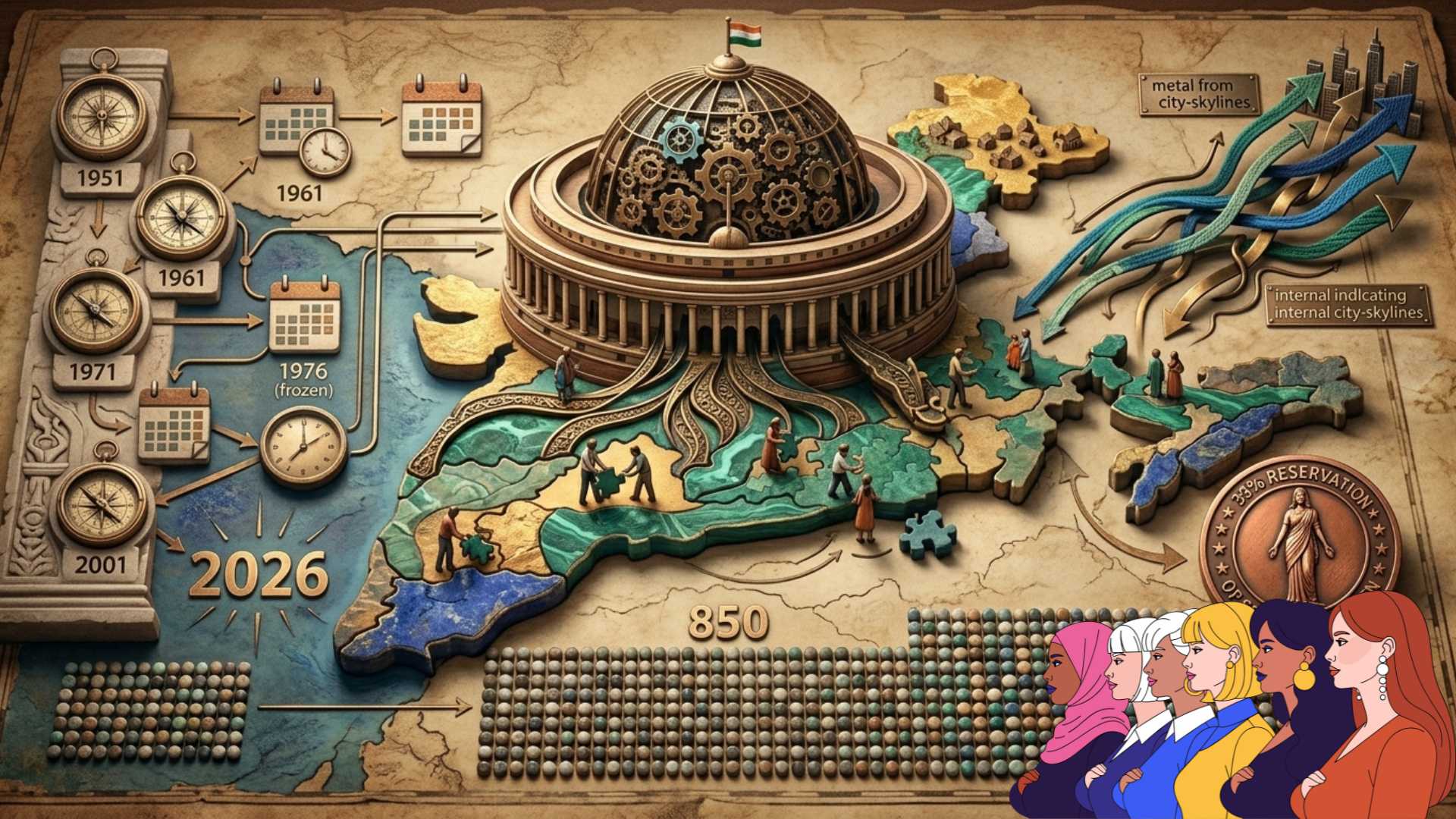
Delimitation: Analyzing Representation and Electoral Equity
"Strong component States will only strengthen the Union — there may be scope to incorporate additional parameters alongside population in seat allocation."
India's proposed Delimitation Bill, 2026 — tabled in a special Parliamentary session alongside the Constitution (131st Amendment) Bill — seeks to increase Lok Sabha seats to 850 and redraw constituency boundaries based on 2011 Census data. It has reignited one of India's most consequential federal tensions: whether population alone should determine parliamentary representation, or whether other markers of statehood must be considered.
| Parameter | Data |
|---|---|
| Current Lok Sabha seats | 543 |
| Proposed Lok Sabha seats | 850 |
| Census data to be used | 2011 (15 years old at time of use) |
| Constitutional provisions | Articles 81(2), 82, 170(3) |
| Last delimitation based on | 1971 Census (completed 1976) |
| Freeze introduced by | 42nd Amendment, 1976 |
| Freeze extended until | First Census after 2026 (84th Amendment, 2001) |
Constitutional Framework
Article 81(2): Each State shall be allotted Lok Sabha seats such that the ratio of seats to population remains the same across all States — as far as practicable.
Articles 82 and 170(3): Mandate readjustment of Lok Sabha and Assembly seats — both number and boundaries — after every Census.
Delimitation Commission: A statutory body constituted to carry out the delimitation exercise with binding recommendations — its orders cannot be questioned in any court.
Historical Timeline of Delimitation
1950–51
→ First delimitation by Election Commission
→ Based on estimated population (March 1, 1950)
→ Could not await 1951 Census — elections urgent
        ↓
Post-1951
→ Fresh delimitation based on actual 1951 Census
        ↓
1961 and 1971
→ Delimitation carried out after each Census
→ 1971 Census delimitation completed 1976
        ↓
1976 — 42nd Amendment
→ Freeze on further delimitation
→ Reason: Protect States successfully
  controlling population from losing seats
→ States with lower growth should not
  be penalised; higher growth States
  should not be rewarded
        ↓
2001 — 84th Amendment
→ Freeze on seat numbers extended to 2026
→ Boundaries redrawn on 2001 Census data
→ Reason: Continue incentive for
  population stabilisation under
  National Population Policy
        ↓
2026
→ Delimitation Bill introduced
→ Seat numbers to be revised
→ Based on 2011 Census data
→ Total Lok Sabha seats proposed: 850
The Core Federal Tension
The Population-Representation Problem
Southern States
(Tamil Nadu, Kerala, Karnataka, Andhra Pradesh)
        ↓
Successfully implemented family planning
→ Lower population growth since 1971
→ Under population-based delimitation:
  LOSE seats relative to northern States
        ↓
Northern States
(Uttar Pradesh, Bihar, Madhya Pradesh, Rajasthan)
        ↓
Higher population growth since 1971
→ Under population-based delimitation:
  GAIN seats significantly
        ↓
Result: States rewarded for higher population
States penalised for policy compliance
→ Perverse incentive for population control
→ Federal imbalance in parliamentary representation
Why 2011 Census Data Is Problematic
2011 Census data
        ↓
Already 15 years old when used
        ↓
Large-scale rural → urban migration
has continued since 2011
        ↓
Population density in constituencies
will have shifted significantly
        ↓
Constituencies carved out will show
real-time disparities almost immediately
        ↓
Defeats the stated objective of
achieving population parity among constituencies
Key Issues in the Delimitation Bill, 2026
1. Women's Reservation Linkage
The Constitution (131st Amendment) Bill links implementation of women's reservation (33%) in Lok Sabha and State Assemblies to the completion of fresh delimitation — a linkage first established in the Constitution (106th Amendment) Act, 2023. This effectively delays women's reservation until after delimitation is complete and a fresh Census published.
2. Timing and Political Context
The special session was convened during peak electioneering for West Bengal and Tamil Nadu Assembly elections — States most apprehensive about losing seats. Opposition parties argued this timing was politically motivated and designed to create pressure rather than enable genuine legislative deliberation.
3. Seat Increase Magnitude
Earlier delimitation exercises involved relatively modest seat increases. An expansion from 543 to 850 seats is a qualitative shift — one that amplifies the distributional stakes enormously and strengthens the case for incorporating parameters beyond raw population.
Beyond Population — The Constitutional Case
Article 81(2) explicitly uses population as the criterion "as far as practicable." This qualification — not absolute — creates constitutional space for incorporating additional parameters:
| Possible Additional Parameter | Rationale |
|---|---|
| Voter turnout and democratic participation | Representation should reflect engaged electorate |
| Development indicators (HDI, per capita income) | Compensate States that invested in human capital |
| — Area and geographic diversity | Ensure remote and sparsely populated regions have voice |
| Historical contribution to federal finances | States contributing more to central taxes retain leverage |
| Population stabilisation achievement | Reward compliance with national population policy |
Delimitation and Federalism
India's federalism rests on a compact between Union and States. States are the constituent units of the Union — their political weight in Parliament directly shapes the federal balance of power. A delimitation exercise that systematically shifts parliamentary representation toward high-population States alters this balance in ways that:
- Weaken southern and northeastern States' voice in Parliament
- Reduce incentives for States to pursue population stabilisation
- Create a perception that governance quality and policy compliance are electorally punished
- Potentially strain the cooperative federalism framework underlying GST, finance commission transfers, and centrally sponsored schemes
Way Forward
- Multi-parameter seat allocation formula — incorporate population alongside development indicators, area, and population stabilisation performance
- Use latest Census data — the ongoing Census (delayed from 2021) should be completed and its data used before delimitation is finalised
- Delink women's reservation from delimitation — implement reservation immediately through a separate mechanism rather than conditional linkage
- Broad political consensus — delimitation of this magnitude requires all-party agreement, not majoritarian legislation during State election campaigns
- Strengthen Delimitation Commission independence — insulate the process from executive influence through transparent, judicially overseen proceedings
Conclusion
Delimitation is constitutionally mandated and democratically necessary — constituencies frozen in 1971 population realities cannot justly represent India in 2026. But the how matters as much as the whether. A delimitation exercise that uses 15-year-old data, rewards population growth, penalises States that implemented national policy, and links women's representation to a delayed process — all while being legislated during an ongoing election — risks producing an outcome that is constitutionally valid but federally corrosive. India's constitutional framers built the federation on the understanding that strong States make a strong Union. Delimitation must reflect that wisdom.
Attribution
Original content sources and authors
Syllabus classification
How this article maps to GS papers
Main syllabus
GS2Indian ConstitutionQuick Q&A
What is delimitation, and what constitutional provisions govern it in India?
Constitutional Provisions: Delimitation in India is governed by Articles 82 and 170(3) of the Constitution. These provisions mandate readjustment of seats and boundaries after every Census. Additionally, Article 81(2) emphasizes that the ratio of population to seats should be uniform across States as far as practicable.
Historical Evolution: Delimitation exercises were conducted after the 1951, 1961, and 1971 Censuses. However, the 42nd Constitutional Amendment (1976) froze delimitation to promote population control, and this freeze was later extended by the 84th Amendment (2001) until after 2026.
Conclusion: Delimitation is a crucial democratic exercise aimed at ensuring fair representation, but its implementation must balance population dynamics with federal considerations.
Why was the process of delimitation frozen in India, and what are the implications of lifting this freeze after 2026?
Extension and Policy Logic: The 84th Amendment (2001) extended this freeze until 2026, based on the assumption that population growth would stabilise across States. It allowed only boundary readjustments without changing the number of seats, maintaining political balance.
Implications of Lifting the Freeze:
- States with higher population growth may gain more representation
- States that successfully controlled population may feel disadvantaged
- Potential political and federal tensions could arise
Conclusion: While lifting the freeze is constitutionally mandated, it raises complex questions about equity, federalism, and the balance between demographic realities and policy incentives.
How does the proposed Delimitation Bill, 2026 aim to address population disparities, and what are its limitations?
Mechanism: The Bill intends to use 2011 Census data to ensure parity in population across constituencies. It acknowledges issues such as rural-urban migration and uneven population density.
Limitations:
- Reliance on outdated 2011 data may not reflect current realities
- Migration patterns have continued to evolve post-2011
- Potential mismatch between constituency population and actual electorate
Conclusion: While the Bill attempts to address representation imbalances, its reliance on outdated data may undermine its effectiveness, necessitating more updated and dynamic approaches.
What are the key reasons behind disparities in representation across constituencies in India?
Migration Patterns: Large-scale rural-to-urban migration has altered population distribution within States, creating densely populated urban constituencies and relatively sparse rural ones.
Delayed Census and Data Gaps: The delay in conducting the 2021 Census has further complicated the situation, as policymaking relies on outdated data.
Conclusion: These factors collectively contribute to disparities in representation, highlighting the need for timely data and adaptive policy mechanisms.
Critically analyze the challenges of using population as the sole criterion for delimitation in a federal polity like India.
Challenges in a Federal Context:
- Penalizes States that have successfully controlled population growth
- May lead to regional imbalances in political power
- Ignores other factors like geography, development levels, and administrative convenience
Alternative Approaches: There is a growing argument for incorporating additional parameters such as human development indicators, geographic size, or economic contribution.
Conclusion: While population is a fundamental criterion, a nuanced approach balancing demographic and federal considerations is essential for equitable representation.
Can you provide examples from India’s past delimitation exercises to highlight their impact on electoral representation?
Impact of the Freeze: The freeze post-1976 ensured stability in representation but also led to distortions over time due to population changes and migration. Urban constituencies became overpopulated compared to rural ones.
Recent Developments: The 2001-based readjustment focused only on boundary changes without altering seat numbers, addressing intra-State disparities to some extent.
Conclusion: These examples demonstrate that delimitation has a profound impact on political representation and must be carefully designed to reflect evolving demographic realities.
As a policymaker, how would you design a fair and effective delimitation framework for India post-2026?
Policy Measures:
- Incorporate multiple criteria beyond population, such as development indices
- Ensure transparency and independence of the Delimitation Commission
- Engage stakeholders, including States and civil society
- Use technology for data analysis and mapping
Addressing Federal Concerns: Mechanisms such as weighted representation or safeguards for States with lower population growth can help maintain balance.
Conclusion: A holistic and inclusive approach is essential to ensure that delimitation strengthens democracy while preserving the federal structure of India.
Practice questions
1 question for mains preparation