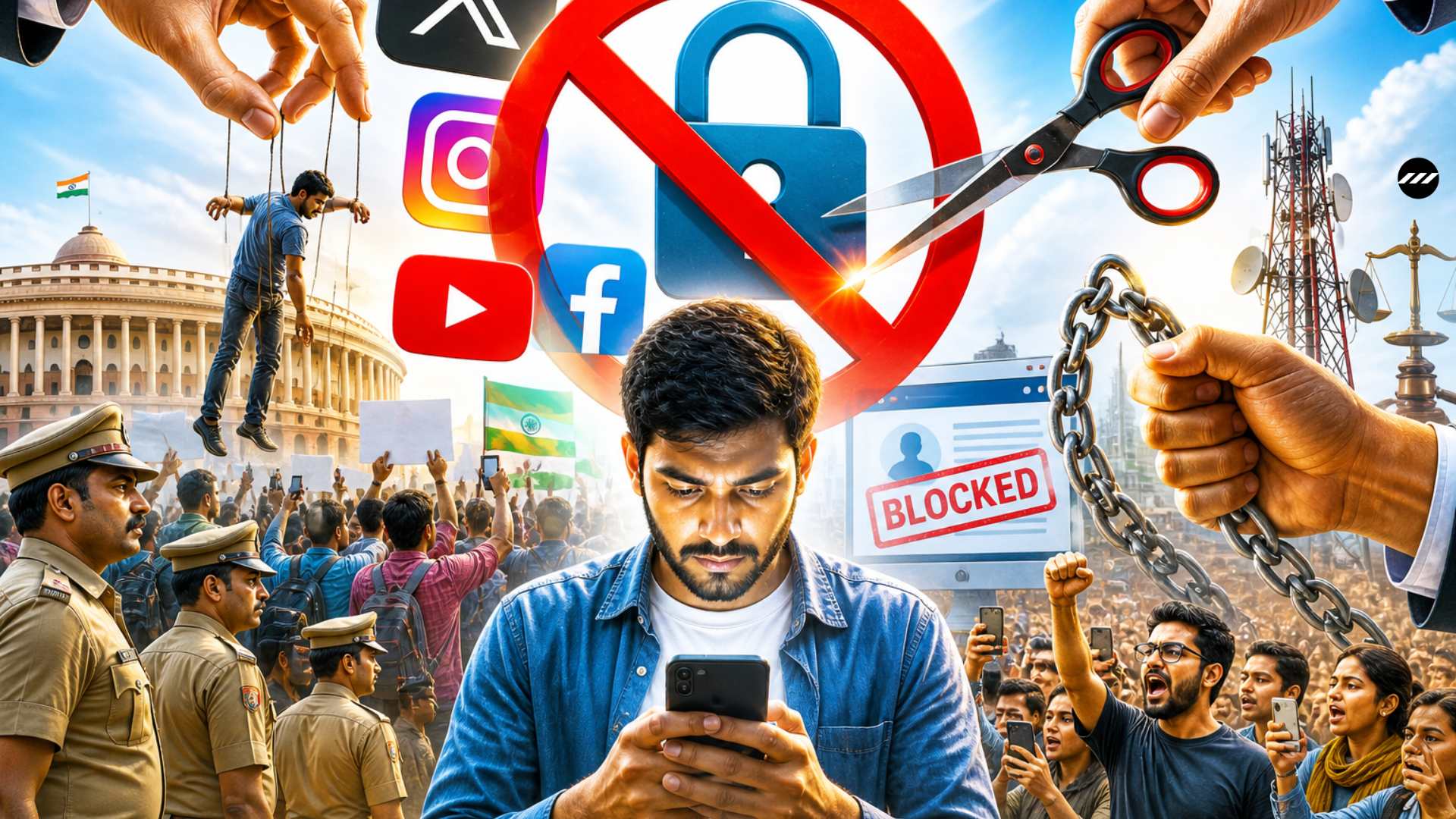
Digital Free Speech, Content Regulation & Intermediary Liability

Introduction
India ranks among the world's top governments in issuing content takedown requests to social media platforms. With over 900 million internet users and social media emerging as the primary public discourse space, the tension between Article 19(1)(a) (freedom of speech) and Article 19(2) (reasonable restrictions) has entered a new, unresolved digital frontier. Recent mass content removals across platforms signal that online speech regulation has become a critical governance and civil liberties question.
"This kind of takedown makes you think twice about posting about the government." — Sandeep Singh, Dalit activist and blocked X account holder, 2026
Constitutional Framework
Article 19(1)(a) guarantees freedom of speech and expression to all citizens. However, this right is not absolute.
Article 19(2) permits the State to impose reasonable restrictions on grounds of:
- Sovereignty and integrity of India
- Security of the State
- Friendly relations with foreign states
- Public order, decency, morality
- Contempt of court, defamation, incitement to offence
Key judicial threshold: Restrictions must be reasonable — not arbitrary, not disproportionate, and subject to judicial review. The Supreme Court in Shreya Singhal v. Union of India (2015) struck down Section 66A of the IT Act as unconstitutional, affirming that vague and overbroad restrictions on speech fail the reasonableness test.
Key Legal Framework
| Law/Rule | Purpose | Key Provision |
|---|---|---|
| IT Act, 2000 — Section 69A | Government blocking of online content | Sovereignty, security, public order grounds |
| IT Act, 2000 — Section 79(3)(b) | Removes 'safe harbour' if platforms ignore takedown notices | Intermediary liability |
| IT Rules, 2009 | Procedural safeguards for blocking — committee review, hearing | Due process |
| IT (Intermediary Guidelines) Rules, 2021 | Regulates social media intermediaries | Safe harbour conditions, grievance redressal |
| Sahyog Portal (MHA) | Centralised rapid content flagging | 1 lakh+ pieces flagged within one year |
Key Concepts
Safe Harbour Legal protection granted to social media platforms exempting them from liability for user-generated content, provided they act on "actual knowledge" of illegal content. Shreya Singhal defined actual knowledge narrowly as a court order or Section 69A order — not informal government communication.
The Expanding Definition of 'Actual Knowledge' IT Rules 2021 created an alternative interpretation: government messages or police communications could constitute actual knowledge. Platforms ignoring these risk losing safe harbour. The February 2026 amendment reduced the compliance deadline from 36 hours to 3 hours — severely compressing the window for platforms to verify legitimacy before acting.
The Chilling Effect When individuals self-censor out of fear of legal consequences — even without a direct order — free speech is effectively curtailed without formal restriction. The Supreme Court itself used the phrase "chilling assault on journalistic independence" when the government blocked a news channel during the India-Pakistan conflict.
Streisand Effect The paradox where attempts to suppress information result in its wider dissemination. Observed when blocked content was reposted by Opposition politicians and content creators, amplifying its reach beyond its original audience.
Structural Concerns
1. Lack of Transparency
- Government does not disclose blocking orders
- Platforms disclose takedown data only biannually in bulk
- Affected users receive no copy of the legal order, no specific reason, no prior warning
2. Due Process Erosion IT Rules 2009 mandate a review committee and an opportunity to be heard before blocking. In practice, accounts are blocked first; hearings — if granted at all — come post-facto, reversing the procedural intent.
3. Partisan Pattern Across Party Lines
| State | Ruling Party | Nature of Action |
|---|---|---|
| Uttar Pradesh | BJP | Press accreditation denial, channel blocking |
| Tamil Nadu | DMK | Notices for NEET-related posts, political cartoons |
| West Bengal | TMC | Section 79(3)(b) notices on CM-related content |
| Punjab | AAP | Notices against independent media |
This cross-party pattern reveals that digital censorship is a structural governance tendency, not an ideological aberration confined to one party.
4. Platform Asymmetry
- Meta (Facebook/Instagram): Now immediately complies with Section 79(3)(b) notices — no independent verification
- X (formerly Twitter): Notifies users but complies selectively — government flagged this non-compliance in Delhi High Court
- This asymmetry creates inconsistent speech rights depending on which platform a citizen uses
5. Definitional Overreach — The 'Deepfake' Problem
"The word deepfakes is being used as a blanket term to describe any content you don't like, and that becomes a pretext for content being taken down." — Rajneil Kamath, Trusted Information Alliance
Legitimate satirical content, political criticism, and comedy are being conflated with harmful deepfakes — a conflation that lacks both legal precision and democratic legitimacy.
Implications for Democracy & Governance
Press Freedom India ranked 151 out of 180 in the RSF World Press Freedom Index 2024. Digital platforms had emerged as an alternative to captured mainstream media — systematic takedowns threaten this last independent space.
Accountability Deficit When critics, activists, and independent journalists are disproportionately targeted, the watchdog function of media — essential to democratic accountability — is structurally weakened.
Regulatory Uncertainty for Platforms
"There are duplications, there is ambiguity, and there is a great deal of confusion regarding the obligations being introduced." — Vertika Misra, Director of Public Policy, Nasscom
Rapid, opaque regulatory changes undermine platform planning and create compliance-driven over-censorship — platforms remove content preemptively to avoid liability.
Judicial Interventions
| Case | Court | Significance |
|---|---|---|
| Shreya Singhal v. UoI (2015) | Supreme Court | Struck down Section 66A; narrowed 'actual knowledge' |
| 4PM News blocking (Operation Sindoor) | Supreme Court | Called blocking a "chilling assault on journalistic independence"; order withdrawn |
| ActivistSandeep & others (2026) | Delhi High Court | Ordered accounts unfrozen; compelled disclosure of specific posts |
Way Forward
- Mandatory pre-blocking notice and hearing except in genuine national security emergencies — restoring the IT Rules 2009 intent
- Judicial or independent oversight of all Section 69A and Section 79(3)(b) orders before enforcement
- Transparent disclosure of blocking orders in a public registry, similar to practices in democratic nations
- Proportionality test codified in law — restrictions must be the least restrictive means necessary
- Statutory definition of deepfakes to prevent misuse as a catch-all censorship pretext
- Platform accountability — uniform compliance standards across all intermediaries to prevent arbitrary speech rights based on platform choice
Conclusion
The regulation of digital speech sits at the intersection of constitutional rights, democratic accountability, and national security — three imperatives that cannot be resolved by privileging one absolutely. India's constitutional design, through Articles 19(1)(a) and 19(2), already provides a balanced framework — the challenge is ensuring its procedural integrity is not hollowed out by administrative shortcuts and regulatory ambiguity. A democracy's health is measured not by how efficiently it silences dissent, but by how robustly it protects the right to disagree. Strengthening transparent, judicially supervised content governance is not a constraint on the State — it is the foundation of its legitimacy.
Attribution
Original content sources and authors
.jpeg)

Syllabus classification
How this article maps to GS papers
Main syllabus
GS2Indian ConstitutionQuick Q&A
What is the legal framework governing online content regulation in India, particularly under the IT Act and IT Rules?
The concept of ‘actual knowledge’ was clarified in the landmark Shreya Singhal v. Union of India (2015) case, which restricted it to court orders or government notifications under Section 69A. However, the IT Rules, 2021, have expanded this interpretation, allowing government agencies and even police officers to issue takedown requests. This creates a parallel mechanism where platforms may act preemptively to avoid losing safe harbour protection.
Further, recent amendments have tightened timelines for compliance, reducing the takedown window from 36 hours to as little as 3 hours in certain cases. Platforms like Meta have responded by immediately removing flagged content, while others like X have adopted a more selective approach. This evolving regulatory framework reflects the tension between state control and digital freedoms in India’s online ecosystem.
Why has the issue of content takedown and digital censorship become a significant concern in recent times?
From a constitutional perspective, this trend is significant because it directly impacts freedom of speech and expression under Article 19(1)(a). Although reasonable restrictions exist under Article 19(2), critics argue that broad interpretations of terms like ‘public order’ or ‘national security’ may lead to overreach. The Supreme Court’s observation that blocking content can be a “chilling assault on journalistic independence” underscores the gravity of the issue.
Moreover, the rise of digital platforms as primary spaces for political discourse makes them critical to democracy. When content critical of governments is disproportionately targeted, it risks undermining pluralism and accountability. Thus, the debate is not merely about regulation but about safeguarding democratic values in the digital age.
How do safe harbour provisions influence the behaviour of social media platforms in India?
As a result, platforms often adopt a risk-averse approach. For instance, companies like Meta have reportedly begun removing content immediately upon receiving notices under Section 79(3)(b), even without judicial scrutiny. This is particularly evident after recent amendments shortened compliance timelines, making it operationally challenging for platforms to verify the legality of each request.
On the other hand, platforms like X have taken a more cautious stance, selectively complying with takedown notices and sometimes challenging them in court. This divergence highlights the ambiguity in the regulatory framework. Ultimately, safe harbour provisions create a situation where platforms may prioritize compliance over user rights, leading to concerns about over-censorship and lack of due process.
What are the reasons behind the increasing use of Section 69A and Section 79(3)(b) for content takedowns across States?
Another reason is the decentralization of enforcement powers. Not only central agencies but also State police departments are now actively issuing takedown notices. The creation of platforms like the Sahyog portal has further streamlined this process, enabling large-scale monitoring and reporting of online content. However, this has also led to inconsistencies in enforcement and varying standards across States.
Additionally, there is a political dimension to the use of these provisions. Critics argue that content critical of governments or political leaders is more likely to be targeted, as seen in cases involving journalists and activists. The broad and vague language of legal provisions allows for discretionary interpretation, which can be misused. These factors collectively explain the growing reliance on these sections for digital content regulation.
Provide examples illustrating the impact of content takedown mechanisms on journalists and civil society actors.
Another example involves social media activists like Sandeep Singh, whose account was withheld without prior notice under Section 69A. He was not informed about the specific content that led to the action, reflecting a lack of transparency. It was only after approaching the Delhi High Court that his account was restored. Such cases demonstrate the procedural challenges faced by individuals in contesting takedown orders.
Additionally, incidents across States—such as police notices in Tamil Nadu, Kerala, and West Bengal—show that the issue is not confined to one political regime. Political parties, comedians, and ordinary users have all been affected. These examples collectively reveal that while content regulation aims to address legitimate concerns, its implementation often raises questions about fairness, accountability, and freedom of expression.
Critically analyse the balance between national security and freedom of expression in India’s digital governance framework.
However, the implementation of these provisions often raises concerns about overreach. The lack of transparency in blocking orders, absence of prior notice, and limited avenues for redressal can undermine procedural fairness. Critics argue that vague terms like ‘public order’ or ‘friendly relations with foreign states’ allow for subjective interpretation, potentially leading to suppression of dissent.
A balanced approach would require greater transparency, judicial oversight, and accountability. Mechanisms such as independent review committees, clear guidelines for takedowns, and protection for journalistic activities can help maintain this balance. Ultimately, safeguarding national security should not come at the cost of eroding democratic freedoms, and policy frameworks must strive to uphold both objectives simultaneously.
As a policymaker, how would you design a framework to ensure accountable and transparent content regulation while protecting free speech?
Second, I would establish an independent oversight mechanism, such as a judicial or quasi-judicial body, to review takedown requests. This would reduce the risk of arbitrary decisions by executive authorities. Additionally, clear and narrow definitions of terms like ‘harmful content’ should be provided to minimize ambiguity and misuse.
Finally, the framework should promote platform accountability and user rights. Social media companies must adopt transparent moderation policies and provide grievance redressal mechanisms. Public awareness campaigns can also help users understand their rights and responsibilities. By integrating these measures, the framework can ensure that content regulation is both effective and consistent with democratic values.
Practice questions
3 questions for mains preparation