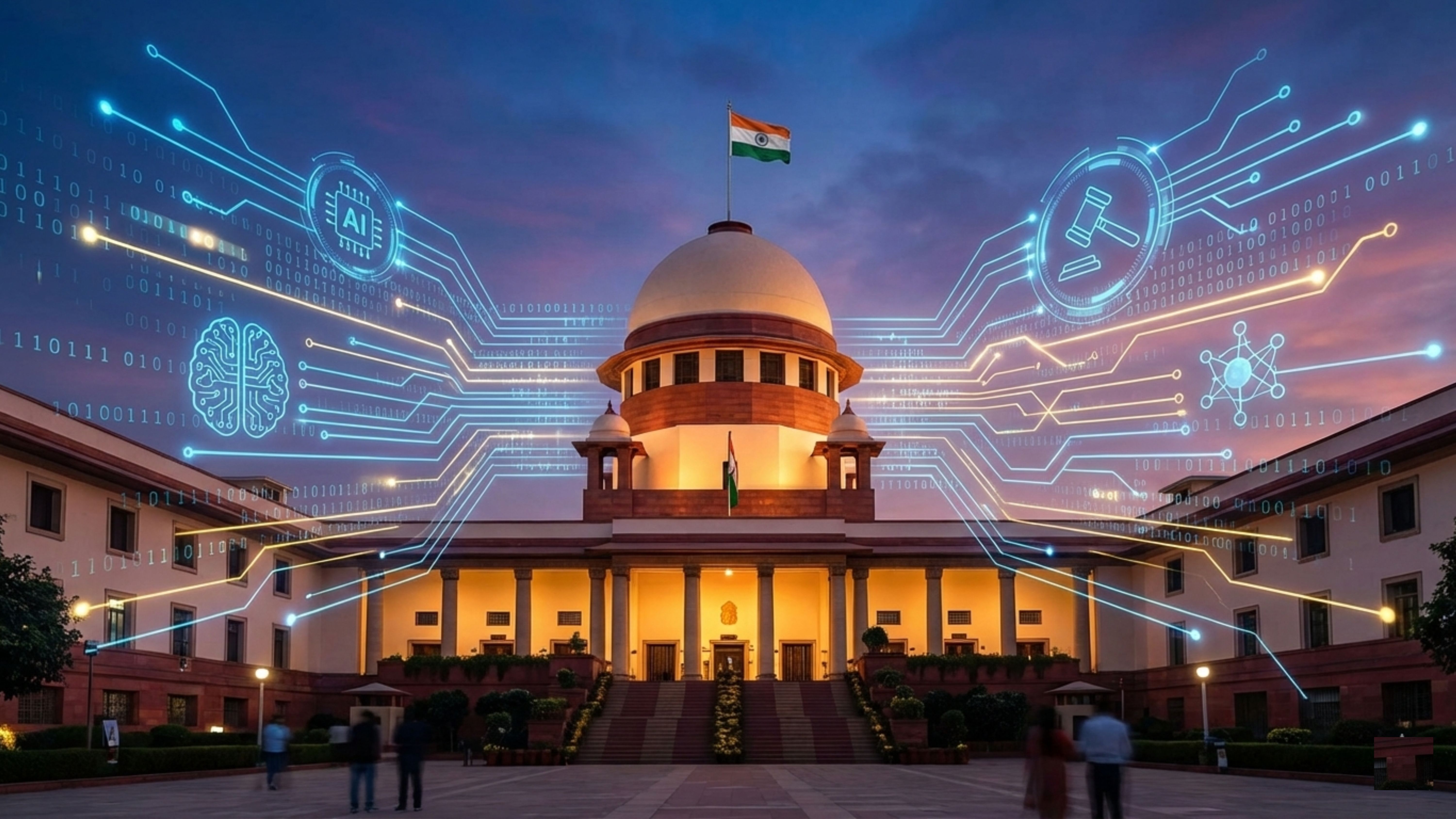
Digitising India's Judiciary: Promise, Peril, and the Path Ahead

The Supreme Court of India has taken a significant step in its long-standing judicial digitisation effort. Chief Justice Surya Kant announced two initiatives from the Bench — 'One Case, One Data' (OCOD), a unified judicial data platform, and 'Su-Sahayak', an AI-powered chatbot integrated into the Supreme Court website. Both promise to improve access to justice — but both carry risks that demand careful scrutiny.
What the Initiatives Promise
OCOD aims to create a unified digital trail for every dispute as it moves through India's court hierarchy. Its key features:
- A single digital fingerprint tracking a case across district, High Court, and Supreme Court levels
- Linkages between court records and litigant actions such as appeals
- Easier document access and lower need for manual verification
- Reciprocal data access for High Courts and subordinate courts
- More accurate judicial statistics enabling data-based administration
This is significant given the wide variation in software practices and records quality across India's thousands of district and subordinate courts. Standardised data could help administrators identify where cases are held up and ease procedural bottlenecks — a long-standing demand of judicial reformers.
Su-Sahayak is integrated into the Court's website front-end, helping users navigate:
Case status → Cause lists → Orders and judgments
       ↓
e-Services → Frequently asked questions
It follows earlier AI tools — SUVAS (judgment translation) and SUPACE (facts and legal precedent processing) — continuing the judiciary's cautious but expanding embrace of artificial intelligence.
The Structural Risks of OCOD
As with any major state-backed technology rollout in India, OCOD faces well-documented implementation challenges:
- Interoperability across courts running different legacy software systems
- Integrity of legacy records — digitising decades of paper-based, inconsistently maintained files
- Data privacy — restricting access to sensitive litigant information
- Staff skilling — training thousands of court personnel across subordinate courts
- Risk of misuse — a centralised digital case fingerprint, if inadequately secured, becomes a high-value target
The Digital Divide: Who Gets Left Behind
The CJI's stated goal is improving "access to justice" — but the reforms risk deepening the very divide they seek to bridge.
For lawyers:
- OCOD may require digital scanners, cloud backup, and updated software
- Metropolitan corporate law firms can absorb these costs easily
- Independent practitioners at district and taluka levels lack the capital to comply
For litigants:
- Those unable to navigate e-filing portals may turn to digital middlemen — creating a new, unregulated layer of costs outside formal court processes
- Su-Sahayak is primarily text-based, excluding users uncomfortable with typing or navigating complex website menus
- Voice-first interfaces like the government's Jan Sahayak demonstrate what inclusive design looks like — Su-Sahayak has not yet adopted this approach
The AI Bias Question
A concern that cuts deeper than interface design — the risk of algorithmic bias. If Su-Sahayak or future AI tools are trained on historical judicial data, they inherit the biases embedded in that data. India's marginalised communities were historically disproportionately arrested, denied bail, and underrepresented in favourable outcomes. An AI model trained on such records risks encoding historical injustice as neutral fact.
India's judiciary has so far drawn a clear line:
AI for assistance — yes. AI for substantive reasoning — no.
This distinction must hold. SUVAS translates. SUPACE processes. Su-Sahayak navigates. None decide. As more powerful AI tools enter legal practice globally — with documented cases of practitioners misusing them — the judiciary's restraint is not conservatism. It is constitutional prudence.
Conclusion
OCOD and Su-Sahayak represent genuine institutional ambition. A unified data trail across India's fragmented court system, if executed well, could transform judicial administration. But technology does not neutralise inequality — it amplifies existing asymmetries unless equity is designed into the system from the outset. The state and the judiciary must ensure that in digitising justice, they do not inadvertently price out or exclude the very citizens who need it most.
Attribution
Original content sources and authors

Syllabus classification
How this article maps to GS papers
Main syllabus
GS2Indian ConstitutionQuick Q&A
What is the significance of ‘One Case, One Data’ (OCOD) in the digital transformation of India’s judiciary?
OCOD can improve transparency and efficiency by reducing duplication of records, manual verification, and inconsistent case histories. A unified data trail can help identify delays, streamline filing, and improve access to judgments and case documents. It also strengthens judicial administration by allowing evidence-based assessment of pendency and case movement.
Key benefits:
- Unified digital case tracking
- Improved court interoperability
- Reduction in procedural delays
- Better judicial statistics
Why is judicial digitisation important for improving access to justice in India?
For a country with over four crore pending cases, digital tools can significantly improve administrative efficiency. Platforms such as e-filing, digital case records, and AI-based assistance can help litigants track proceedings in real time. This supports constitutional values under Article 39A relating to equal access to justice.
Importance:
- Reduces transaction costs
- Enhances transparency
- Speeds procedural communication
- Improves accountability
How can AI tools such as ‘Su-Sahayak’ assist the judiciary without replacing judicial reasoning?
AI can improve efficiency in research, document retrieval, and translation. Previous tools like SUVAS translated judgments, while SUPACE assisted judges with legal research. Such tools save time and improve information retrieval, enabling judges to focus on substantive reasoning and adjudication.
Appropriate AI use:
- Administrative assistance
- Legal document search
- Language translation
- Case information dissemination
What are the major reasons why judicial digitisation may deepen the digital divide in India?
Litigants themselves may face barriers due to low digital literacy, language limitations, and poor internet access. Text-based AI systems such as Su-Sahayak may be inaccessible for users unfamiliar with typing or navigating websites. This may create new intermediaries who charge for digital assistance, increasing hidden costs.
Main causes:
- Digital literacy gap
- Infrastructure disparity
- Language barriers
- Emergence of digital middlemen
Critically analyse the opportunities and risks of centralised judicial data systems such as OCOD.
However, centralisation raises concerns about privacy, surveillance, and misuse. A single digital fingerprint for each case may expose sensitive personal information if cybersecurity safeguards are weak. Data profiling could also enable inappropriate monitoring of litigants, lawyers, or vulnerable communities.
Advantages:
- Better transparency
- Administrative efficiency
- Inter-court coordination
- Data breaches
- Privacy violations
- Potential profiling
What lessons can India draw from global experiences in digitising judicial systems?
The key lesson is that technology must be accompanied by strong institutional capacity and legal safeguards. Merely digitising records without improving workflows can reproduce inefficiencies. User training, multilingual access, and cybersecurity are essential.
Lessons:
- Interoperability across institutions
- Strong data protection laws
- User-centred design
- Continuous training
How should India balance technological innovation with constitutional safeguards in the judiciary?
A balanced approach requires clear boundaries: AI can support administration, translation, and search but should not influence substantive adjudication. Independent audits, public oversight, and inclusive design are essential. Judicial staff and lawyers also require capacity-building to ensure equal adoption.
Way forward:
- Human oversight over AI
- Data protection safeguards
- Inclusive multilingual access
- Regular audits
Practice questions
1 question for mains preparation