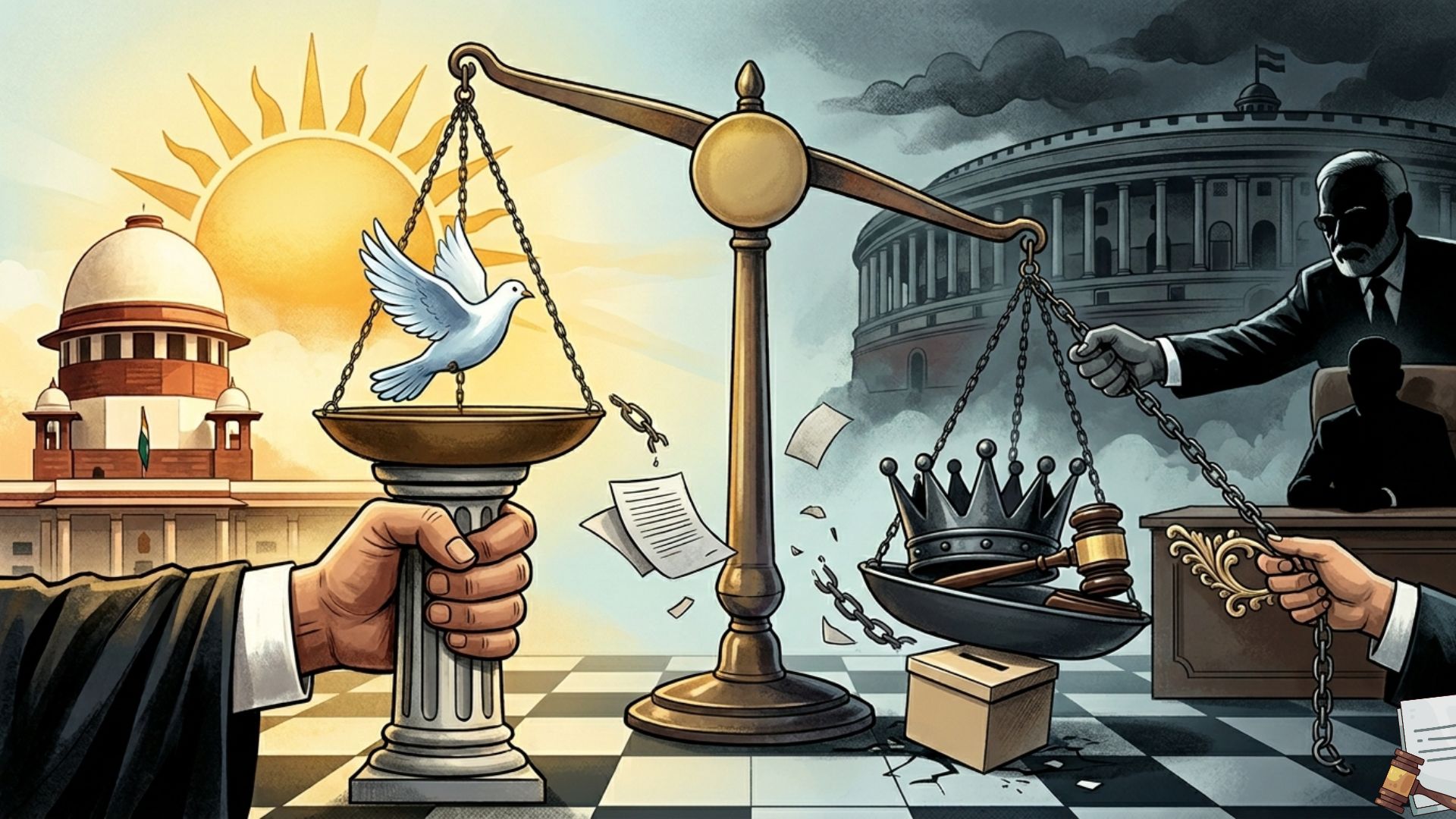
Supreme Court Stresses Need for Independent Election Commissioners

Election Commission Independence: The Appointment Controversy
"It is not enough for the Election Commission to be independent — it should also appear to be independent."— Justice Dipankar Datta
The Trigger
The Supreme Court (May 14, 2026) is hearing petitions challenging the Chief Election Commissioner and other Election Commissioners (Appointment, Conditions of Service, and Term of Office) Act, 2023 — a law that fundamentally altered how India's election commissioners are appointed.
The Timeline: How We Got Here
Pre-2023:
→ No statutory framework for EC appointments
→ Executive had unfettered discretion

Anoop Baranwal vs Union of India (SC judgment):
→ Constitution Bench intervened
→ Created a selection panel:
     - Prime Minister
     - Leader of Opposition (Lok Sabha)
     - Chief Justice of India
→ Described by current court as "classic example of judicial
  restraint and statesmanship"

2023 Act (passed within months of judgment):
→ Replaced Chief Justice of India with a Cabinet Minister
  nominated by the Prime Minister
→ Restored effective Executive dominance over appointments
The Supreme Court's Core Concerns
1. No neutral member on the panel:
- PM chairs the committee
- Cabinet Minister is nominated by the PM — cannot be expected to defy him
- Leader of Opposition's presence may be merely "ornamental" — appointments can be made without a unanimous vote
2. Executive "calling the shots":
Court's observation:
→ SC judgments since 1950 are clear — Executive cannot
  control elections
→ Free and fair elections = basic structure of Constitution
→ Basic structure requires independent Election Commission
→ Independent EC requires independent Commissioners
→ 2023 Act undermines all three links in this chain
3. Appearance of independence matters:
- Justice Datta drew a critical distinction — it is not sufficient that the EC is independent; it must also appear independent to the public
- Institutional legitimacy rests on perceived neutrality, not just actual neutrality
4. Election law occupies pride of place:
"After the Constitution, which law occupies the prime place? I would say, the election laws. Without democracy, there is nothing." — Justice Datta
The Government's Defence
Attorney-General Venkataramani made three arguments:
| Argument | Essence |
|---|---|
| "Taste the pudding" | Cannot assume subservience unless actual lapse occurs on ground |
| Parliament's sovereignty | SC cannot become a "second chamber of Parliament" |
| Article 141 argument | Anoop Baranwal judgment made no binding law — only a stop-gap arrangement until Parliament acted under Article 324(2) |
The AG's position: Parliament was not bound to mirror the court's vision in legislation — it could enact its own framework as long as it was constitutionally valid.
The Constitutional Architecture at Stake
- Article 324 — vests superintendence, direction, and control of elections in the Election Commission
- Article 324(2) — Parliament may by law regulate the conditions of service and tenure of ECs
- Article 141 — law declared by Supreme Court is binding on all courts
- Article 145(3) — substantial questions of law require Constitution Bench of minimum five judges
The current Division Bench has suggested referring the matter to a Constitution Bench — petitioners opposed this, arguing the challenge is conventional statutory validity, not a substantial constitutional question.
Way Forward
- Restore a genuinely neutral third member on the selection panel — the Chief Justice or an equivalent independent constitutional authority
- Unanimous or supermajority requirement for appointments — to make the Opposition's presence substantive, not ornamental
- Security of tenure and service conditions must be insulated from Executive influence — not just appointment
- Broader principle: Constitutional bodies whose independence is foundational to democracy — EC, CAG, CBI — need statutory appointment frameworks that structurally prevent Executive capture
- A Constitution Bench ruling would provide lasting clarity and prevent repeated legislative circumvention of SC directions
Conclusion
The 2023 Act is not merely a procedural change — it is a structural question about who controls the gatekeepers of Indian democracy. The Supreme Court's discomfort is well-founded: a selection panel where every member either is the Executive or is appointed by it cannot produce the institutional independence that free and fair elections demand. The Anoop Baranwal judgment had found a workable middle path. Replacing the Chief Justice with a Cabinet Minister undid that balance in a single legislative stroke. At stake is not just the appointment of two officials — it is the credibility of every election that follows.
Attribution
Original content sources and authors


Syllabus classification
How this article maps to GS papers
Main syllabus
GS2Indian ConstitutionQuick Q&A
What is the constitutional significance of the Election Commission of India, and why is its independence considered part of the basic structure doctrine?
The Supreme Court has repeatedly held that free and fair elections form part of the basic structure doctrine, meaning Parliament cannot enact laws that undermine this principle. If the Election Commission lacks institutional independence, the electoral process may be influenced by executive interests, affecting democratic representation. This was emphasized in the present case where the court noted that the ECI must not only be independent but must also appear independent to the public.
Key constitutional roles:
- Conducting impartial elections.
- Ensuring a level playing field among political parties.
- Enforcing the Model Code of Conduct.
- Advising on disqualification of legislators.
Why has the Supreme Court raised concerns over the composition of the selection committee for appointing Election Commissioners under the 2023 Act?
The court specifically noted the absence of a neutral constitutional authority, such as the Chief Justice of India, who had been included in the interim arrangement prescribed in the Anoop Baranwal judgment. The judges expressed apprehension that the Leader of the Opposition’s role could become merely symbolic if decisions are made by majority vote, allowing the executive to dominate appointments.
Concerns include:
- Concentration of power in the executive branch.
- Reduced institutional checks on politically sensitive appointments.
- Potential erosion of public trust in electoral neutrality.
How does the Anoop Baranwal judgment illustrate judicial intervention in protecting constitutional institutions?
This reflected the doctrine of constitutional necessity. The Court did not permanently legislate but provided a temporary arrangement to preserve electoral independence until Parliament acted. Justice Datta’s remarks that the judgment was a “classic example of judicial restraint” indicate that the Court consciously limited itself while protecting constitutional values.
Judicial role in such cases:
- Filling legislative vacuums to preserve constitutional governance.
- Preventing arbitrary executive action.
- Ensuring constitutional morality and democratic safeguards.
Critically analyse the tension between parliamentary supremacy and judicial review in the context of the Election Commissioners’ appointment law.
However, judicial review empowers the Court to strike down laws violating constitutional principles such as free and fair elections. The issue is not whether Parliament can legislate, but whether the legislation undermines institutional independence and democratic integrity. This tension reflects the delicate balance between legislative sovereignty and constitutional supremacy.
Critical perspectives:
- Parliament’s view: Democratic legitimacy lies in elected lawmakers framing policy.
- Judiciary’s view: Laws must conform to constitutional basic structure.
- Challenge: Preventing judicial overreach while preserving institutional autonomy.
Why is the perception of independence as important as actual independence for constitutional institutions like the Election Commission?
In democracies, institutions derive authority from both constitutional mandate and public perception. If voters perceive that commissioners are chosen primarily by the ruling government, they may question the neutrality of election decisions, including scheduling, enforcement of the Model Code, and vote counting.
Importance of perception:
- Strengthens public trust in electoral outcomes.
- Prevents allegations of partisan manipulation.
- Enhances democratic legitimacy and acceptance of results.
What broader lessons does this case offer regarding the independence of constitutional bodies in India?
The controversy demonstrates that legal safeguards must extend beyond formal provisions to institutional design. If appointment mechanisms are controlled by one branch of government, constitutional checks may weaken. The debate also shows how institutional erosion can occur subtly through legislation rather than direct constitutional amendments.
Key lessons:
- Appointment mechanisms shape institutional independence.
- Checks and balances are essential for democratic accountability.
- Judicial oversight remains crucial when core constitutional values are at stake.
Practice questions
2 questions for mains preparation