GS2 Indian Constitution

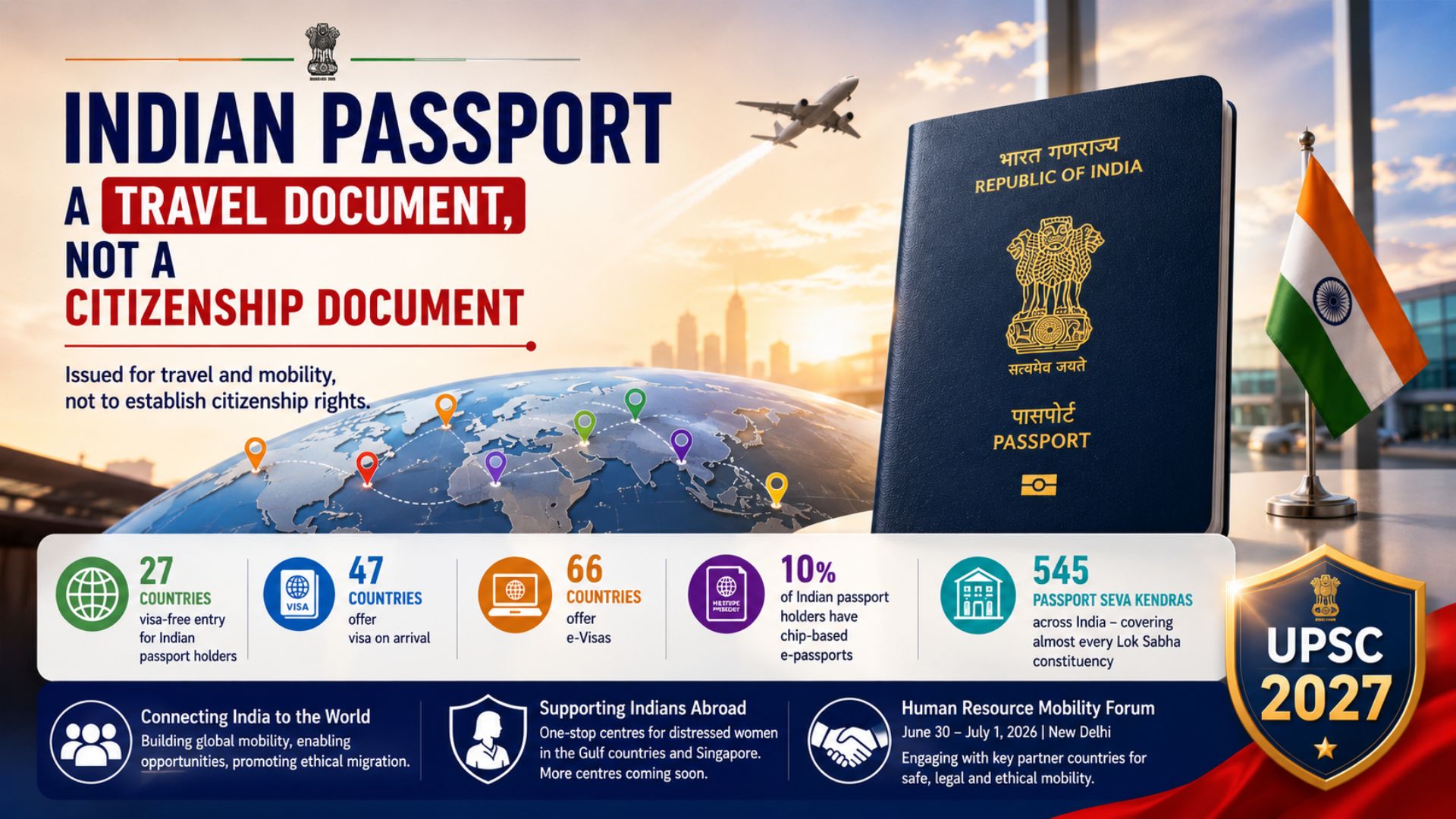
Indian Passport: A Travel Document, Not Proof of Citizenship

Indian Passport: A Travel Document, Mobility Enabler and Instrument of Global Engagement

A senior MEA official clarifies why passports are travel documents, not citizenship documents, amidst voter exclusion discussions.
Gopi Gopi
4 mins read

"A passport facilitates international mobility; citizenship determines constitutional rights."

The Ministry of External Affairs (MEA) has clarified that the Indian passport is a travel document, not a citizenship document. While it certifies an individual's nationality for international travel, it cannot be treated as conclusive proof of citizenship for domestic constitutional or electoral purposes. At the same time, India's expanding passport ecosystem is emerging as a key facilitator of global mobility, employment and diaspora welfare.

Passport vs Citizenship: Understanding the Difference

PassportCitizenship
Travel document for international movementLegal status defining membership of the State
Certifies nationality during foreign travelConfers constitutional and legal rights
Issued by the MEAGoverned by citizenship laws
Enables entry and exit across international bordersDetermines rights such as voting and political participation

The MEA clarified that although a passport reflects an individual's nationality abroad, it is not a standalone document establishing citizenship.

Due Diligence in Passport Issuance

Passport issuance involves extensive verification.

The process includes:

  • Verification through multiple government databases.

  • Cross-checking documents such as:

    • Aadhaar
    • PAN
    • Other official records
  • Detailed identity verification before issuance.

Thus, while rigorous scrutiny is followed, the passport primarily serves the purpose of facilitating international travel.

Example:
An Indian passport enables a citizen
to travel internationally and establishes
their nationality before foreign authorities,
but questions relating to electoral rolls
or citizenship status are governed
by separate constitutional and legal procedures.

Passport as a Tool for Global Mobility

The MEA views passports as instruments connecting India's workforce with global employment opportunities.

Current priorities include:

  • Expanding labour mobility partnerships.

  • Facilitating safe overseas employment.

  • Enhancing cooperation with industrialised economies such as:

    • Germany
    • Italy
    • Japan
    • Denmark
    • Russia

These initiatives support India's growing role as a global supplier of skilled human resources.

Promoting Ethical Migration

The proposed Human Resource Mobility Forum aims to strengthen safe and legal migration.

Major objectives include:

  • Encouraging ethical overseas recruitment.
  • Creating awareness about legal migration pathways.
  • Preventing exploitation by fraudulent recruitment agents.
  • Discouraging illegal migration to conflict-prone or high-risk regions.
  • Promoting transparent international labour mobility.

Safe migration protects both migrant workers and India's international reputation.

Expanding Global Travel Access

India's passport has witnessed improving international acceptance.

FacilityNumber of Countries
Visa-free entry27
Visa on Arrival47
Electronic Visa (e-Visa)66

Growing international mobility reflects expanding diplomatic engagement and stronger global connectivity.

Modernisation of Passport Services

India has significantly strengthened its passport infrastructure.

InitiativeStatus
Passport Seva Kendras (PSKs)545 centres
CoverageNearly every Lok Sabha constituency
e-PassportsAround 10% of passport holders possess chip-enabled passports

Modernisation has focused on:

  • Faster service delivery.
  • Greater transparency.
  • Wider accessibility.
  • Secure chip-enabled travel documents.
Example:
A chip-enabled e-passport
stores encrypted personal information,
enhancing security,
reducing document fraud
and facilitating faster immigration clearance.

Supporting the Indian Diaspora

The MEA has expanded welfare measures for overseas Indians.

Important initiatives include:

  • One-stop support centres for distressed Indian women.

  • Centres currently operating in:

    • Gulf countries
    • Singapore
  • Community-supported assistance for victims of:

    • Domestic violence
    • Abuse
    • Other emergencies

More such centres are planned in other countries with large Indian diaspora populations.

Way Forward

  • Continue expanding labour mobility agreements with developed economies.
  • Strengthen ethical recruitment mechanisms and migrant awareness.
  • Accelerate nationwide rollout of chip-enabled e-passports.
  • Improve digital integration and accessibility of passport services.
  • Enhance protection and welfare mechanisms for overseas Indians.
  • Deepen international cooperation to increase visa-free and simplified travel arrangements.
  • Ensure secure, transparent and citizen-friendly passport administration.

Conclusion

The Indian passport is more than a travel document; it is an important instrument of global mobility, economic opportunity and international engagement. However, its role must be clearly distinguished from legal citizenship, which remains governed by constitutional and statutory provisions. As India strengthens its global workforce presence and diaspora outreach, efficient passport services, ethical migration and robust citizen protection will become central pillars of its external engagement strategy.

Attribution

Original content sources and authors

Kallol Bhattacherjee Author Kallol Bhattacherjee The Hindu Source The Hindu

Syllabus classification

How this article maps to GS papers

Main syllabus

GS2Indian Constitution

Also covers

GS1Population

Quick Q&A

What is the constitutional distinction between an Indian passport as a travel document and citizenship as a legal status under the Constitution of India?
An Indian passport is a sovereign travel document issued by the Government of India primarily to facilitate international travel and establish the holder's nationality before foreign governments. However, it is not, in itself, conclusive proof of Indian citizenship. This distinction was reiterated by the Ministry of External Affairs (MEA) during Passport Seva Divas 2026, when officials clarified that a passport serves the limited legal purpose of enabling overseas travel and should not be equated with a citizenship document. Constitutionally, citizenship is governed by Articles 5 to 11 of the Constitution, while Parliament exercises legislative authority through the Citizenship Act, 1955. Citizenship determines political and civil rights such as voting, contesting elections, eligibility for constitutional offices, and access to certain public benefits. A passport, on the other hand, is governed primarily by the Passports Act, 1967, and is issued after due verification using multiple documents and databases. While possession of a passport generally indicates that the government has recognized the holder's nationality for international travel, it does not override constitutional or statutory processes determining citizenship. This distinction becomes particularly relevant in legal disputes involving electoral rolls, citizenship verification, or applications under the Citizenship (Amendment) Act, 2019. For UPSC aspirants, the issue connects GS-II topics relating to the Constitution, Citizenship, Governance, and Fundamental Rights. It also illustrates the difference between identity documents, travel documents, and legal evidence in administrative law. Comparative examples from countries such as the United Kingdom and the United States also demonstrate that passports facilitate travel but do not independently determine citizenship in judicial or electoral disputes.
Why is understanding the distinction between nationality, citizenship, identity documents, and passports important for constitutional governance and UPSC preparation?
The distinction between nationality, citizenship, identity documents, and passports is fundamental to constitutional governance because each serves a different legal and administrative purpose. Nationality represents an individual's legal bond with a sovereign State in the international sphere, whereas citizenship determines the bundle of political, civil, and constitutional rights enjoyed within that State. Identity documents such as Aadhaar primarily establish identity for welfare delivery and authentication, PAN is designed for taxation, voter identity cards establish electoral registration, and passports facilitate international travel. Confusing these distinct legal functions can create misconceptions regarding constitutional rights and administrative procedures. The MEA's clarification in 2026 that passports are travel documents rather than citizenship documents gained significance in the context of public discussions surrounding electoral roll revisions and citizenship verification. For UPSC aspirants, this issue has direct relevance to GS-II topics covering the Constitution, Citizenship, Representation of the People, Governance, and Public Administration. It also intersects with current affairs relating to the Citizenship (Amendment) Act, 2019, the National Register of Citizens, passport reforms, and digital governance. Understanding these distinctions enables candidates to analyse legal controversies objectively without conflating separate statutory frameworks. From a policy perspective, maintaining separate legal functions for different documents improves administrative efficiency, reduces fraud, and preserves the integrity of electoral and citizenship processes. At the same time, governments must ensure that documentation systems remain accessible, transparent, and inclusive so that genuine citizens are not disadvantaged. Thus, the issue highlights the broader constitutional principles of rule of law, due process, equality before law under Article 14, and accountable governance.
How does the passport issuance system in India balance national security, citizen mobility, administrative efficiency, and constitutional safeguards?
India's passport issuance system seeks to balance the competing objectives of facilitating legitimate international mobility while protecting national security and ensuring administrative integrity. The system operates under the Passports Act, 1967, and is administered by the Ministry of External Affairs through an extensive network of Passport Seva Kendras (PSKs). According to official data released during Passport Seva Divas 2026, India has 545 Passport Seva Kendras covering nearly every Lok Sabha constituency, thereby improving accessibility and reducing regional disparities in service delivery. Passport applications undergo multiple stages of verification, including identity verification, address verification, police verification where applicable, and scrutiny of supporting documents issued by other government agencies. The MEA has also introduced chip-enabled e-passports, with around 10% of passport holders already possessing them, to enhance security against forgery and facilitate faster immigration processing. Digital platforms have significantly improved transparency, online appointment systems, status tracking, and grievance redressal, reflecting the broader Digital India initiative. From a governance perspective, the passport system demonstrates how technology can improve public service delivery without compromising security. However, authorities must simultaneously safeguard privacy, ensure data protection, prevent identity theft, and maintain procedural fairness. UPSC aspirants should relate this issue to GS-II topics on e-governance, citizen-centric administration, and public service delivery, as well as GS-III themes concerning cybersecurity and technology. International best practices such as biometric passports and secure border management further illustrate how modern States increasingly integrate digital technologies with constitutional safeguards to facilitate mobility while preventing fraud, illegal migration, and transnational crime.
Critically analyse the role of ethical migration policies in promoting safe international labour mobility while preventing exploitation of Indian workers abroad.
Ethical migration refers to a framework in which international labour mobility takes place through legal, transparent, and rights-based mechanisms that protect migrant workers from exploitation, trafficking, fraud, and unsafe employment conditions. The Ministry of External Affairs' emphasis on ethical migration during the Human Resource Mobility Forum 2026 reflects India's growing recognition that labour mobility is both an economic opportunity and a governance challenge. Industrialised countries such as Germany, Japan, Italy, Denmark, and others increasingly require skilled and semi-skilled workers due to demographic ageing and labour shortages. India, with its young workforce, is well positioned to benefit from these opportunities. However, irregular migration through unscrupulous recruitment agents often exposes migrants to debt bondage, unsafe working conditions, trafficking, conflict zones, and legal vulnerabilities. Ethical migration policies therefore involve regulated recruitment agencies, pre-departure orientation, transparent employment contracts, grievance redressal mechanisms, bilateral labour mobility agreements, and consular support abroad. The establishment of one-stop centres for distressed women in Gulf countries and Singapore represents an important welfare measure for vulnerable sections of the Indian diaspora. Critics, however, argue that migration governance must also address domestic skill development, language training, recognition of qualifications, and reintegration of returning migrants. From a UPSC perspective, this issue links GS-II topics on international relations and governance with GS-III themes concerning employment, economic development, and human resource management. It also relates to SDG 8 on decent work and economic growth and the Global Compact for Safe, Orderly and Regular Migration. Ethical migration ultimately strengthens India's global reputation, protects its citizens overseas, and enhances the developmental impact of remittances and international workforce mobility.
Using India's passport reforms as a case study, explain how governance innovations can improve public service delivery while strengthening constitutional values and global mobility.
India's passport reforms over the past decade provide an important case study of governance innovation combining technology, administrative reforms, decentralisation, and citizen-centric service delivery. The Ministry of External Affairs has significantly expanded passport infrastructure through 545 Passport Seva Kendras, ensuring that passport services are available across almost every parliamentary constituency. Digitalisation has enabled online applications, appointment scheduling, document uploads, payment systems, application tracking, and grievance redressal, thereby reducing delays and enhancing transparency. The introduction of chip-enabled e-passports represents another major reform aimed at strengthening document security, reducing forgery, and facilitating seamless international travel. During Passport Seva Divas 2026, the government also highlighted that Indian passport holders enjoy visa-free access to 27 countries, visa-on-arrival facilities in 47 countries, and e-visa access in 66 countries, demonstrating gradual improvements in international mobility. Beyond service delivery, passport reforms have supported broader national objectives by facilitating overseas education, tourism, trade, skilled migration, and employment opportunities. Welfare measures such as assistance centres for distressed women in parts of the Indian diaspora further demonstrate the integration of consular protection with public administration. Nevertheless, challenges remain, including ensuring universal accessibility, safeguarding personal data, improving passport processing in remote areas, and strengthening international mobility agreements. For UPSC aspirants, this case illustrates themes under GS-II relating to e-governance, citizen-centric administration, transparency, accountability, and constitutional governance, while also connecting to GS-III discussions on technology and human capital. The broader lesson is that governance reforms become sustainable when technological innovation is accompanied by institutional accountability, legal safeguards, inclusiveness, and continuous improvement in public service delivery.

Practice questions

1 question for mains preparation

Examine the distinction between citizenship and a passport in the Indian constitutional and legal framework. Discuss the role of passports in facilitating international mobility while distinguishing them from documents that establish citizenship.

10 marks ยท 150 words ยท 8 mins
