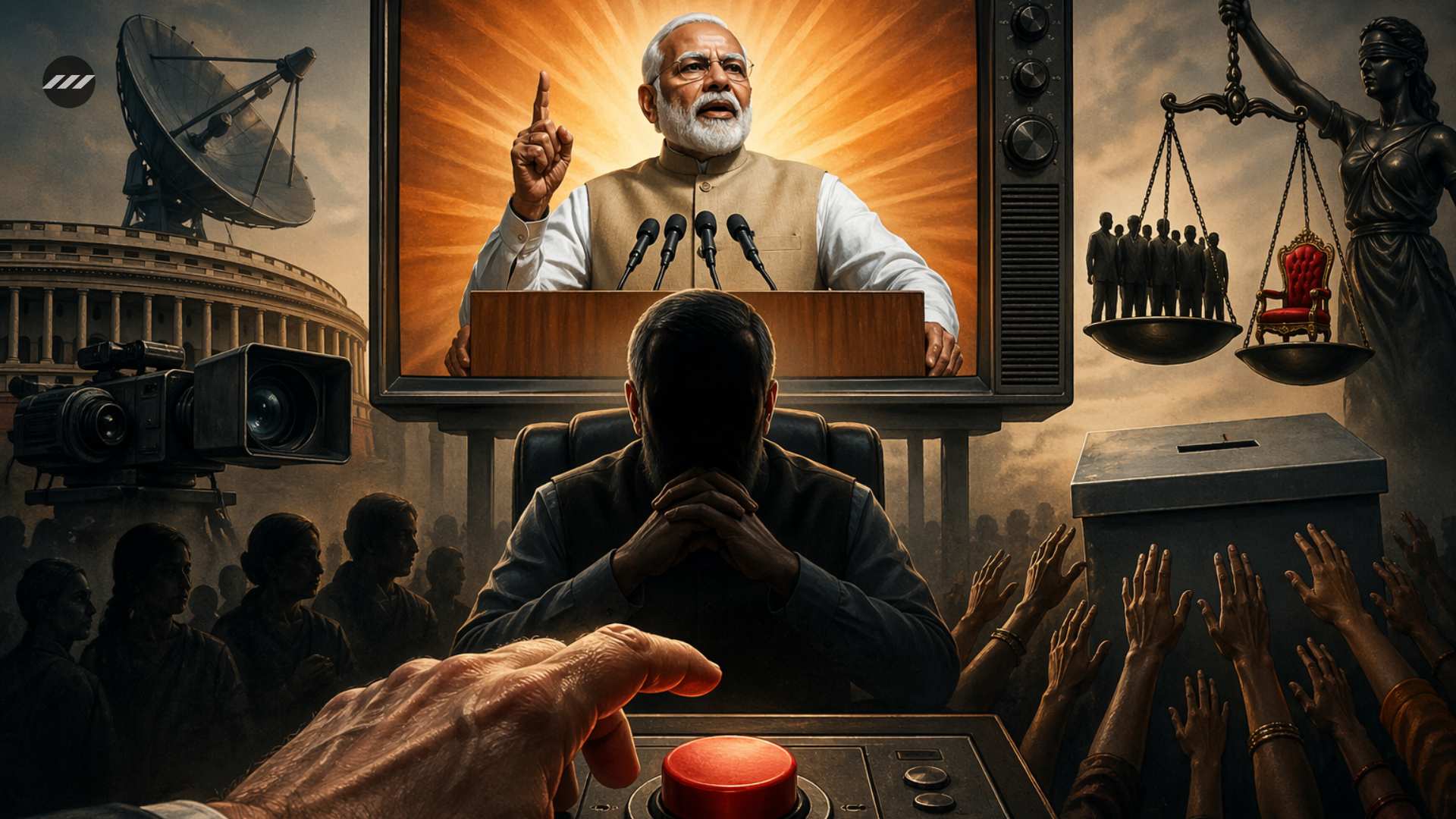
Concerns Over PM’s Speech and Election Commission's Inaction

"Free and fair elections are the cornerstone of democracy — an Election Commission that hesitates to act impartially is a democracy that hesitates to trust itself." — Justice T.S. Thakur, Supreme Court of India
India's Election Commission, established under Article 324 of the Constitution, is mandated to ensure free and fair elections. Yet repeated allegations of selective enforcement of the Model Code of Conduct — particularly against the ruling dispensation — raise serious questions about institutional autonomy, constitutional morality, and democratic integrity.
Background / Context
The Model Code of Conduct activates automatically upon election schedule announcement. It prohibits use of government machinery, public platforms, and official media for partisan purposes. Doordarshan and Sansad TV are public-funded broadcasters — their use for partisan political speeches during MCC period is a direct violation of the code's spirit and letter.
The ECI has historically acted swiftly against Opposition parties while demonstrating consistent reluctance to sanction the ruling party leadership — a pattern now spanning 2015, 2017, 2019, and 2024.
Key Concepts / Definitions
Model Code of Conduct (MCC)
- Voluntary but binding convention; activated on poll schedule announcement
- Prohibits: use of govt machinery, communal appeals, voter inducement
- No statutory backing — enforced purely through ECI's moral and constitutional authority
Article 324
- Vests superintendence, direction and control of elections in the ECI
- ECI draws power directly from the Constitution — not Parliament
- Designed to insulate it from executive pressure
Chief Election Commissioner & Other Election Commissioners Act, 2023
- Changed appointment process — CEC now appointed by PM-led committee
- Critics argue: undermines independence guaranteed by constitutional design
Pattern of ECI Inaction — Timeline
| Year | Incident | ECI Response |
|---|---|---|
| 2015, 2017 | PM's Mann Ki Baat continued during State polls | Allowed to continue |
| 2019 | Anti-satellite missile test speech during MCC | Refused to sanction |
| 2019 | NaMo TV aired during elections | Approved after content review |
| 2024 | Controversial Rajasthan speech | Notice sent to BJP president, not PM |
| 2026 | Doordarshan/Sansad TV speech accusing Opposition | No response as of writing |
Analysis / Significance
Multi-Dimensional Impact
Constitutional: ECI's selective enforcement hollows out Article 324 — the institution retains form but loses substance as an independent constitutional body.
Democratic: Ruling party's access to state broadcasters during elections = unequal playing field. Opposition parties lack equivalent reach — structural asymmetry in electoral competition.
Institutional: Each instance of inaction creates precedent. The "official announcement loophole" — framing partisan content as government communication — is now an established workaround.
Federal: Tamil Nadu and West Bengal elections on April 23 make the delay particularly consequential — voters in those states are directly affected by uninvestigated MCC violations.
MCC VIOLATION LOGIC CHAIN
━━━━━━━━━━━━━━━━━━━━━━━━━━━━━━━━━━

IF speech delivered without ECI approval:
→ Clear MCC violation → Sanction mandatory

IF speech delivered with ECI approval:
→ ECI must explain why privilege granted
→ Investigate contents → Remove from platforms → Sanction

EITHER WAY → ECI accountability is non-negotiable

ECI Inaction → Loophole institutionalised
           → Partisan character reinforced
           → Electoral fairness undermined
Challenges / Issues
- No Statutory Backing for MCC → ECI cannot prosecute; can only censure — toothless against defiant actors
- Appointment Process → Post-2023 Act, CEC appointed by PM-led panel → structural conflict of interest
- "Official vs Political" Blurring → Ruling party increasingly uses govt platforms, infrastructure as campaign tools
- Asymmetric Enforcement → Opposition parties face swift notices; ruling party leadership faces delays or redirection
- Credibility Erosion → Repeated inaction = ECI perceived as partisan → citizens lose faith in electoral process itself
Government / Institutional Measures (Existing Framework)
| Mechanism | Purpose |
|---|---|
| Article 324 | Constitutional autonomy of ECI |
| MCC Guidelines | Conduct norms during election period |
| RPA 1951 (S.123) | Corrupt practices — communal appeals as ground |
| Supreme Court oversight | Judicial review of ECI decisions available |
| 2nd ARC Recommendations | Strengthening ECI independence, fixed tenure |
Way Forward
SHORT-TERM  → Statutory backing for MCC via amendment to RPA 1951
MEDIUM-TERM → Restore pre-2023 appointment process (collegium-style)
              OR Supreme Court-supervised appointment as directed in Anoop Baranwal case
LONG-TERM   → ECI to publish enforcement data publicly — action taken register
              → Civil society oversight via Parliamentary Committee on Elections
STRUCTURAL  → Separate Doordarshan/Sansad TV from government control
              → Independent public broadcaster model (BBC/Prasar Bharati reform)
The ECI's legitimacy rests not on its constitutional text but on its demonstrated conduct. Institutional credibility, once eroded through perceived partisanship, is difficult to restore. Electoral reforms must move from recommendation to legislation — beginning with giving the MCC statutory teeth and insulating the ECI's appointment process from executive influence.
Attribution
Original content sources and authors


Syllabus classification
How this article maps to GS papers
Main syllabus
GS2Indian ConstitutionQuick Q&A
What is the Model Code of Conduct (MCC) and what is its significance in ensuring free and fair elections in India?
The MCC prohibits the misuse of official machinery, public resources, and media for electoral advantage. It also restricts announcements of new schemes, use of inflammatory language, and appeals based on caste or religion. In the context of the article, broadcasting a Prime Minister’s speech on state-run media during the MCC period raises concerns about unfair advantage and violation of neutrality.
Significance of MCC:
- Ensures equality among political competitors
- Prevents misuse of state power for electoral gain
- Maintains integrity and credibility of elections
Why is the neutrality of the Election Commission of India (ECI) crucial for democratic governance?
When the ECI is perceived as biased or inactive in cases of alleged violations—such as delayed action against prominent leaders—it undermines the principle of electoral fairness. In the article, the ECI’s inaction in addressing alleged MCC violations by the Prime Minister raises concerns about selective enforcement. Such perceptions can erode voter confidence and weaken democratic legitimacy.
Implications of compromised neutrality:
- Unequal playing field for political parties
- Erosion of public trust in democratic institutions
- Potential increase in electoral malpractices
How can the use of state-controlled media during elections influence electoral outcomes?
Such exposure can shape public opinion by highlighting government achievements or framing political narratives in a favorable light. In the article, the Prime Minister’s speech—aired during the MCC period—contained political messaging that could influence voters in states going to polls. This raises concerns about the misuse of public platforms for partisan purposes.
Key concerns include:
- Violation of the principle of equal opportunity in campaigning
- Blurring of lines between official communication and political प्रचार
- Potential manipulation of voter sentiment
What are the reasons behind the criticism of the ECI’s delayed or selective enforcement of the MCC?
Another reason is the lack of transparency in decision-making. For example, if a speech is broadcast during the MCC period, it is unclear whether prior approval was sought or granted. The absence of clear explanations from the ECI fuels speculation about bias or political pressure.
Underlying factors include:
- Institutional dependence on executive for appointments
- Lack of enforceable legal backing for MCC provisions
- Ambiguities in distinguishing official and political communication
These factors contribute to the perception that the ECI’s enforcement is not always consistent or impartial, which can weaken its authority and the credibility of the electoral process.
Critically analyse the implications of ECI inaction on the fairness of elections and democratic institutions.
Such inaction can distort the electoral process by allowing incumbents to leverage state resources and media for political gain. This undermines the principle of a level playing field, which is central to democratic elections. Over time, repeated instances of perceived bias can erode public trust in the ECI, leading to cynicism and reduced voter participation.
Critical evaluation:
- Risks: Institutional credibility loss, लोकतांत्रिक erosion, normalization of violations
- Counterpoint: Need for due process and avoidance of arbitrary कार्रवाई
Ultimately, the ECI must strike a balance between restraint and assertiveness. Strengthening transparency, accountability, and legal backing for the MCC can help restore confidence in its role as an impartial arbiter.
Examine the recurring controversies involving the ECI as a case study of institutional challenges in electoral governance.
These cases reveal structural issues, including the lack of statutory backing for the MCC and the dependence of the ECI on the executive for appointments and resources. They also highlight the difficulty in distinguishing between official government communication and political campaigning, especially when incumbents hold dual roles as administrators and political leaders.
Lessons from the case study:
- Need for legal codification of the MCC to ensure enforceability
- Importance of institutional independence and transparent decision-making
- Role of civil society and judiciary in holding institutions accountable
This case study underscores that the strength of democratic institutions depends not only on constitutional provisions but also on their consistent and impartial functioning in practice.
Practice questions
1 question for mains preparation