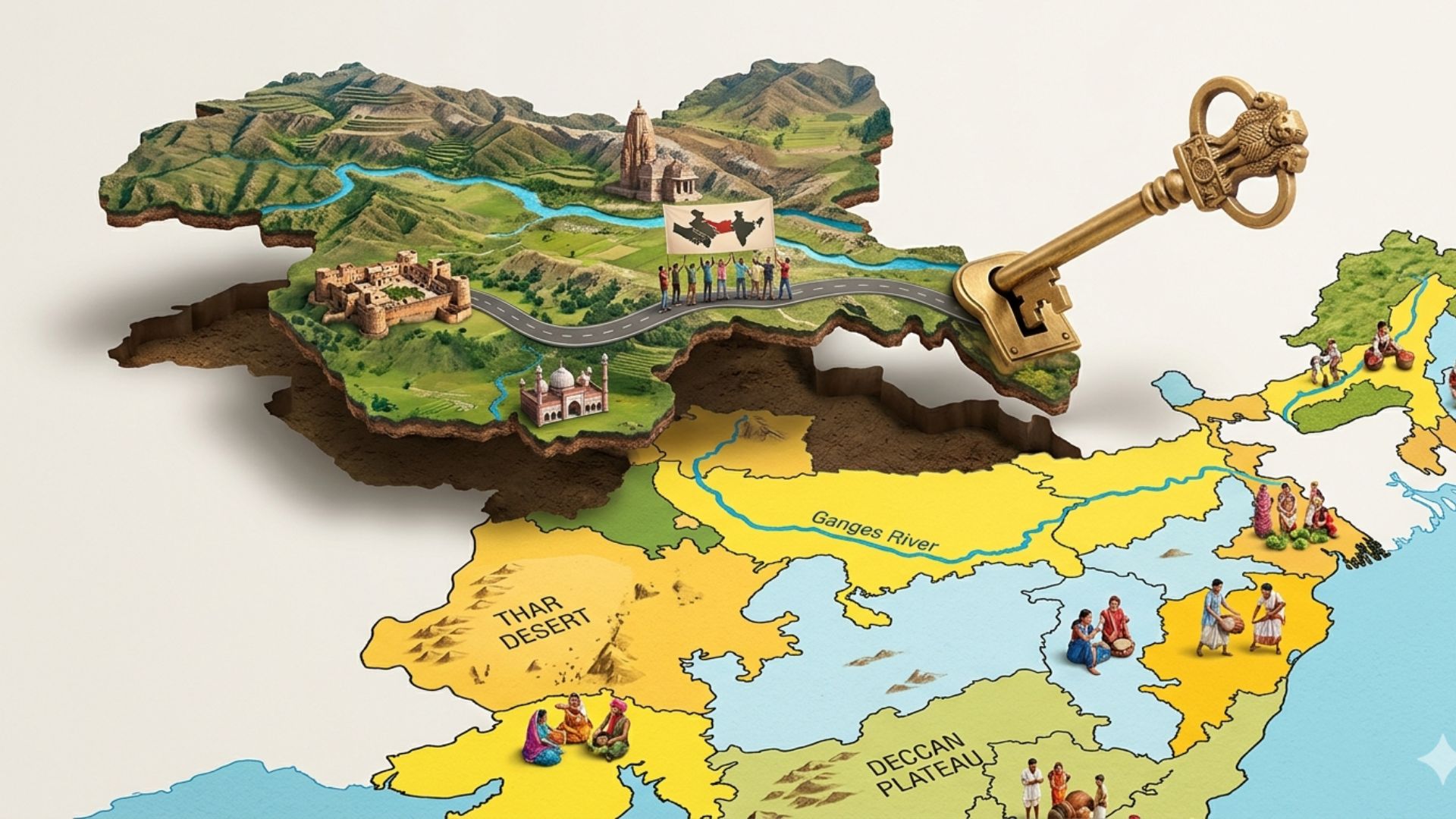
Jammu & Kashmir After Article 370: Statehood, Federalism and the Future of Democratic Governance

“The clauses in Article 370 were never a cause of lack of development in Jammu & Kashmir.” — Omar Abdullah
At The Hindu Huddle 2026, Jammu & Kashmir Chief Minister Omar Abdullah revisited the debate surrounding Article 370, statehood, federalism, and democratic representation. His remarks highlighted continuing political questions regarding the constitutional status and governance of Jammu & Kashmir after the changes introduced in 2019.
The Article 370 Debate
Omar Abdullah described the abrogation of Article 370 as:
“The biggest policy mistake made by the Indian government.”
According to him:
- Development and Article 370 were unrelated issues.
- The region's developmental challenges stemmed primarily from decades of violence and instability.
- Jammu & Kashmir suffered from perceptions of insecurity rather than constitutional constraints.
His Core Argument
Violence & Instability
          ↓
Lower Investment
          ↓
Reduced Tourism
          ↓
Development Challenges

(Not Article 370)
He argued that the removal of Article 370 was justified politically through the claim that one nation should not have different constitutional arrangements, but noted that several regions across India continue to enjoy special administrative provisions.
Federal Diversity in India
A key aspect of the discussion concerned India's federal structure.
Abdullah's Position
- India already accommodates regional variations.
- Different States and regions have distinct legal and administrative provisions.
- Restrictions on land ownership and special protections exist elsewhere as well.
Broader Federal Principle
| Feature | Significance |
|---|---|
| Asymmetrical Federalism | Accommodates regional diversity |
| Special Constitutional Provisions | Protect local identities and interests |
| Decentralized Governance | Enhances regional representation |
The debate therefore extends beyond Jammu & Kashmir to larger questions of federalism and constitutional diversity.
The Demand for Statehood
A major issue raised was the restoration of statehood to Jammu & Kashmir.
Concerns Expressed
According to Abdullah:
- Statehood was publicly promised after delimitation and elections.
- No clear timeline has been announced.
- Criteria for restoration remain undefined.
“We don't know when the appropriate time will be.”
Sequence Referred To
Delimitation
      ↓
Assembly Elections
      ↓
Restoration of Statehood
While elections have been conducted, the final stage remains pending, leading to political debate regarding the fulfillment of earlier commitments.
Jammu & Kashmir in Geopolitics
The discussion also touched upon Kashmir's broader strategic significance.
Why Kashmir Matters
- Located at the intersection of South Asia and Central Asia.
- Shares proximity with sensitive international borders.
- Influenced by developments in neighbouring regions.
- Holds significance in India's national security framework.
Issues in West Asia, regional security dynamics, and great-power competition continue to shape discussions surrounding the region.
Debate on One Nation, One Election
Abdullah expressed reservations about the proposal for simultaneous elections.
Key Concerns
- Different State governments face different political realities.
- Governments may lose majority before completing their term.
- Diverse federal conditions make synchronization difficult.
Practical Challenge
Government Falls Mid-Term
           ↓
Fresh Election Required
           ↓
Breaks Simultaneous Election Cycle
He questioned how simultaneous elections could function effectively unless constitutional mechanisms governing confidence motions and government stability are significantly altered.
Tourism and Cultural Integration
Abdullah also highlighted tourism as a bridge between regions.
Observations
- Visitor numbers from southern India remain relatively limited.
- Film industries significantly influence tourism patterns.
- Cinema can help strengthen cultural connections.
Example
Yash Chopra Films
        ↓
Global Visibility of Switzerland
        ↓
Tourism Growth

Similar Potential for Kashmir
through South Indian Cinema
He expressed hope that more South Indian films would choose Kashmir as a filming destination, contributing to tourism and economic activity.
Key Issues Emerging from the Discussion
| Issue | Central Question |
|---|---|
| Article 370 | Impact on governance and development |
| Statehood | Timeline and conditions for restoration |
| Federalism | Scope of regional autonomy |
| One Nation, One Election | Practical feasibility in a diverse federation |
| Tourism | Leveraging culture and cinema for growth |
Way Forward
- Establish greater clarity regarding statehood restoration.
- Strengthen democratic institutions and local governance.
- Promote cooperative federalism and dialogue.
- Encourage investment and tourism through improved connectivity and security.
- Use cultural exchanges and cinema to deepen national integration.
Conclusion
The debate on Jammu & Kashmir has evolved beyond Article 370 to encompass broader questions of federalism, democratic representation, statehood, and national integration. As the region moves through a new political phase, balancing constitutional governance, regional aspirations, security concerns, and economic development will remain central to its future trajectory.
Attribution
Original content sources and authors


Syllabus classification
How this article maps to GS papers
Main syllabus
GS2Indian ConstitutionQuick Q&A
What are the constitutional and political arguments surrounding the abrogation of Article 370 and its impact on federalism in India?
Why is the demand for restoration of statehood to Jammu and Kashmir significant for India’s federal and democratic framework?
How does the debate on One Nation One Election relate to India’s federal structure and challenges of political diversity?
What are the key historical and socio-political reasons behind the prolonged instability in Jammu and Kashmir region?
What examples from Indian federal practices demonstrate asymmetry and differential treatment of states within the Constitution?
What lessons can be drawn from Jammu and Kashmir governance experience for strengthening Centre–State relations in conflict-affected regions?
Practice questions
1 question for mains preparation