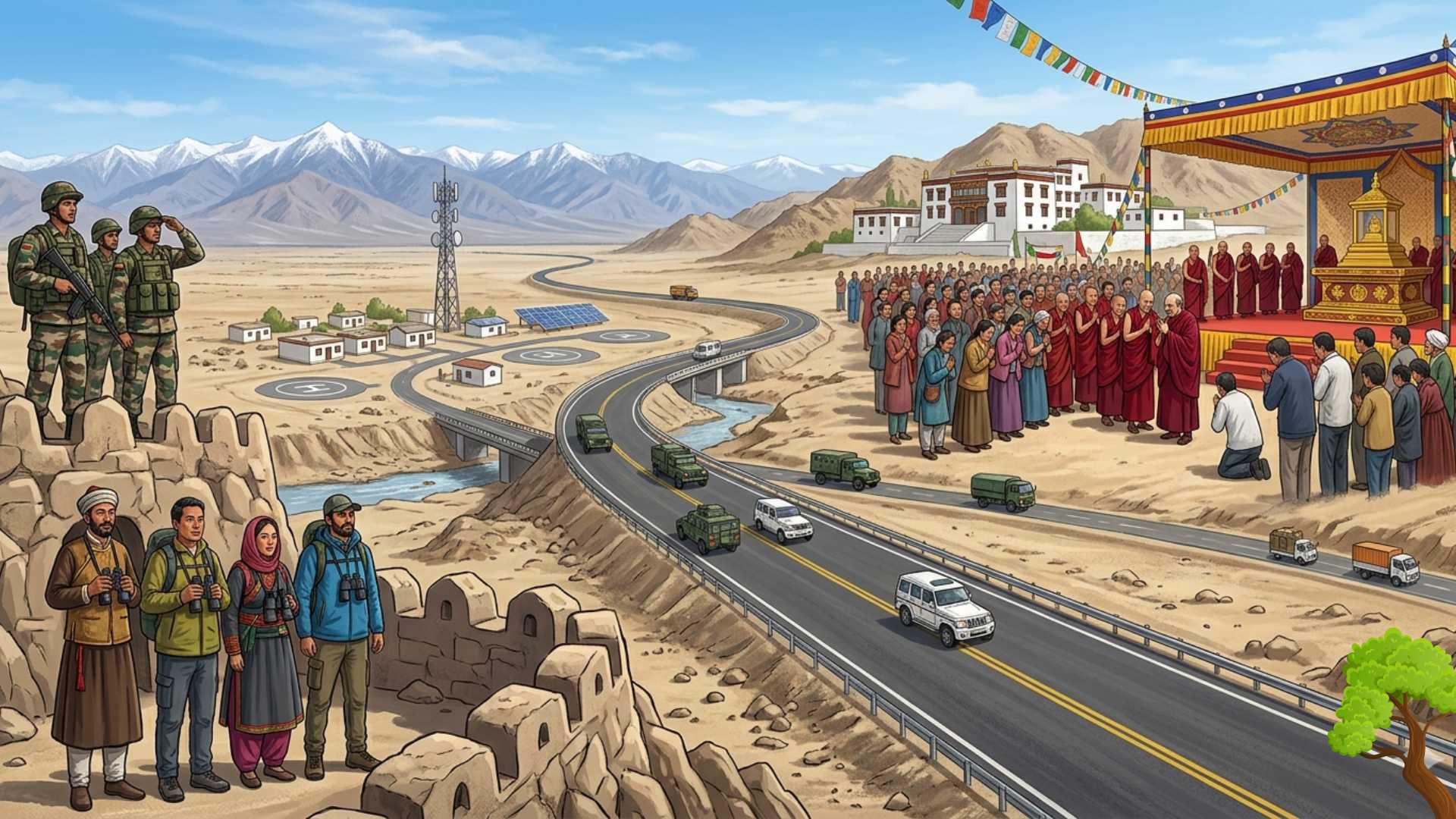
Ladakh: UT Governance, Border Development & Tribal Aspirations

Introduction
-
Ladakh's reorganisation as a Union Territory without legislature on October 31, 2019 — under the Jammu & Kashmir Reorganisation Act — marked a historic shift in India's federal map, separating it from J&K and bringing it under direct Central administration.
-
Seven years on, the region presents a paradox: measurable infrastructure leap alongside unresolved political aspirations — Statehood, Sixth Schedule protection, and democratic representation — that turned violent in September 2025, leaving four dead in Leh.
"Roads are the arteries of national integration — where roads reach, the nation reaches." — Atal Bihari Vajpayee
Development Metrics (2019 → 2026)
| Indicator | 2019 | 2026 |
|---|---|---|
| Road network | 1,800 km | 4,040 km |
| Bridges | 19 | 72 |
| Mobile towers | 344 | 653 |
| Helipads | 7 | 41 |
| Snow clearance machines | 60 | 200+ |
| Annual budget | ₹1,000 crore | ₹6,000 crore |
| Zojila closure days | 127 days | 19 days |
| Kargil-Zanskar closure days | 175 days | 11 days |
Background & Context
Why UT Status in 2019? The bifurcation of J&K was executed via Article 370 abrogation and the J&K Reorganisation Act. Ladakh's UT status was justified on grounds of:
- Decades of developmental neglect under J&K's State administration
- Strategic border sensitivity (China + Pakistan)
- Distinct ethnic, cultural, and Buddhist identity
Administrative Structure As a UT without legislature, Ladakh is governed through two Hill Development Councils — Leh and Kargil — under a Lieutenant Governor. All legislative and executive power flows from the Centre, with no elected assembly — a key democratic deficit that drives the Statehood demand.
Key Concepts
Sixth Schedule — The Core Demand The Sixth Schedule of the Constitution provides autonomous district councils with legislative, judicial, and executive powers over tribal areas — currently applicable to Assam, Meghalaya, Tripura, and Mizoram. Ladakh's tribal communities (predominantly Buddhist and Muslim) seek Sixth Schedule inclusion to:
- Protect land and cultural rights from outside settlers
- Gain legislative autonomy within the UT framework
- Secure a constitutional safeguard equivalent to what Statehood would otherwise provide
UT Without Legislature vs UT With Legislature
- Without legislature (Ladakh, Chandigarh): Centre governs directly via LG; no elected assembly
- With legislature (Delhi, Puducherry): Elected assembly with limited powers; LG role contentious
Ladakh's demand for Statehood seeks to restore democratic representation lost in 2019.
Border Area Development Ladakh sits on India's most sensitive strategic frontier — Line of Actual Control (LAC) with China and Line of Control (LoC) with Pakistan. Infrastructure development here carries a dual dividend: civilian connectivity and military logistics. Road, tunnel, and helipad expansion directly enhances strategic depth and rapid force deployment capability.
Key Initiatives (May 2026)
- 10 TLPD Dairy Plant, Kargil — cold chain infrastructure for pastoral communities
- Bulk Milk Cooler + Android-based AMCS — digital procurement transparency for farmers
- Zojila Tunnel — under construction; will provide all-weather connectivity
- Shinkula Tunnel — construction begun; connects Lahaul-Spiti to Zanskar
- Sindhu Central University — higher education anchor for the region
- 230 Smart Classes + 24 Atal Tinkering Labs — digital education infrastructure
- 5 new districts — Nubra, Sham, Changthang, Zanskar, Drass
- 193 Panchayats — grassroots democratic units
- Bodhi and Purgi recognised as official languages alongside Urdu, Hindi, English
Unresolved Political Aspirations
Despite infrastructure gains, three core demands remain unaddressed:
| Demand | Status | Significance |
|---|---|---|
| Statehood | Unmet | Democratic representation, legislative autonomy |
| Sixth Schedule | Unmet | Tribal land & cultural protection |
| Public Service Commission | Unmet | Local employment in government jobs |
The September 2025 protests — 4 dead, 80 injured in Leh — signal that development metrics alone cannot substitute for political rights and constitutional safeguards. The Leh Apex Body and Kargil Democratic Alliance have jointly led these demands, representing a rare Hindu-Buddhist-Muslim consensus across Ladakh's religious communities.
Buddhist Heritage & Soft Power Dimension
Historical Silk Route Significance Ladakh served as a civilisational corridor — Buddhist teachings, manuscripts, monks, and artistic traditions flowed from India to China, Tibet, and Central Asia through Leh-Yarkand-Khotan routes. This positions Ladakh as an asset in India's Buddhist diplomacy with East and Southeast Asian nations.
Sacred Relics Exposition (Buddha Purnima 2026) The 75-year return of Buddha's sacred relics to Ladakh carries both spiritual and diplomatic significance — reinforcing India's identity as the birthplace of Buddhism at a time of active Act East Policy engagement with Buddhist-majority nations (Sri Lanka, Myanmar, Thailand, Japan).
Challenges
- Democratic deficit — no elected legislature; LG-administered governance limits local accountability
- Ecological fragility — rapid infrastructure development in a high-altitude, glacier-dependent ecosystem risks environmental degradation
- Depopulation risk — youth migration to cities despite development investments
- Security-development balance — infrastructure priorities driven by strategic needs may not align with local livelihood priorities
- Climate vulnerability — glacial retreat threatens water security for agriculture and civilian use
Way Forward
- Expedite Sixth Schedule notification — provides constitutional protection without requiring full Statehood
- Strengthen Hill Development Councils — devolve more financial and administrative powers
- Eco-sensitive infrastructure norms — mandatory environmental impact assessments for all border road projects
- Climate adaptation fund for Ladakh — dedicated support for glacier-dependent water systems
- Local recruitment priority in UT administration — address unemployment through preferential hiring
Conclusion
-
Ladakh's post-2019 trajectory encapsulates India's broader governance challenge: development without democracy is incomplete. The infrastructure leap — roads, tunnels, connectivity, education — is real and significant.
-
But the September 2025 violence is an equally real signal that constitutional rights, cultural protection, and political representation cannot be deferred indefinitely in exchange for developmental delivery.
-
A region that serves as India's first line of strategic defence deserves to be treated as a full partner in its constitutional democracy — not merely a beneficiary of Central largesse.
Attribution
Original content sources and authors


Syllabus classification
How this article maps to GS papers
Main syllabus
GS2Indian ConstitutionQuick Q&A
What is the strategic and geopolitical significance of Ladakh in India’s national security framework?
Key aspects of its significance include:
- First line of defence: As highlighted in the article, Ladakhis have historically acted as the first responders during external threats, supporting armed forces.
- Military infrastructure: Presence of strategic roads, airstrips, and advanced logistics ensures rapid troop deployment.
- Buffer zone: It acts as a buffer against geopolitical tensions, particularly with China.
For example, during the Galwan Valley crisis (2020), Ladakh’s terrain and local support played a crucial role in India’s defensive strategy. The Ladakh Scouts, known as the “Snow Warriors,” exemplify local participation in national security.
Thus, Ladakh is not merely a geographical entity but a strategic asset that integrates military preparedness, local participation, and geopolitical stability in India’s security architecture.
Why was the Union Territory (UT) status granted to Ladakh in 2019, and why is it considered important for regional development?
Importance of UT status includes:
- Direct central governance: Enables better allocation of resources and focused policy implementation.
- Infrastructure development: Significant improvements in roads, connectivity, and public services.
- Cultural recognition: Regional languages like Bodhi and Purgi were given official status.
For instance, the region’s budget increased from ₹1,000 crore to ₹6,000 crore, and road infrastructure expanded significantly. These changes indicate enhanced state capacity and targeted development.
However, the demand for statehood and Sixth Schedule protections reflects ongoing concerns about political representation and cultural safeguards. Thus, while UT status has accelerated development, it also raises questions about balancing administrative efficiency with democratic aspirations.
How has infrastructure development in Ladakh post-2019 contributed to economic growth and strategic stability?
Key contributions include:
- Improved connectivity: Road length increased from 1,800 km to over 4,000 km, reducing isolation.
- Enhanced defence readiness: Better infrastructure enables faster troop movement and supply chain efficiency.
- Economic opportunities: Growth in tourism, agriculture (e.g., dairy projects), and local enterprises.
For example, reduced closure days of critical routes like the Zojila Pass demonstrate improved all-weather connectivity, which is vital for both civilian life and military logistics.
Additionally, digital infrastructure such as mobile towers and smart classrooms has boosted education and governance. Thus, infrastructure acts as a dual enabler—strengthening national security while fostering inclusive economic development in a remote region.
What are the reasons behind continued demands for statehood and Sixth Schedule status in Ladakh despite developmental progress?
Key reasons include:
- Lack of legislative autonomy: As a UT without a legislature, Ladakhis have limited control over local governance.
- Cultural and environmental concerns: Rapid development raises fears of ecological degradation and loss of indigenous identity.
- Land and employment safeguards: Absence of constitutional protections increases vulnerability to external influence.
For instance, protests in Leh in 2025 highlighted dissatisfaction with the current administrative framework. The Sixth Schedule, which provides autonomy to tribal regions, is seen as a mechanism to safeguard local interests.
Thus, the issue reflects a classic development paradox: while economic indicators improve, aspirations for self-governance and identity protection intensify. Addressing these demands requires a balanced approach that integrates development with democratic empowerment.
Critically analyze the role of cultural diplomacy and Buddhism in enhancing India’s soft power through Ladakh.
Positive aspects include:
- Cultural connectivity: Strengthens ties with Buddhist-majority countries like Japan, Sri Lanka, and Southeast Asian nations.
- Tourism and economy: धार्मिक tourism boosts local livelihoods.
- Global peace narrative: Promotes India’s image as a proponent of peace and coexistence.
However, there are limitations. Over-commercialization of cultural assets may dilute their authenticity, and geopolitical tensions can overshadow cultural initiatives. Additionally, local communities must be active stakeholders to ensure sustainable cultural preservation.
For example, the use of Buddhist diplomacy in India’s Act East Policy demonstrates its strategic value. Thus, while Ladakh enhances India’s soft power, its effectiveness depends on balancing cultural promotion with local participation and geopolitical realities.
Using Ladakh’s post-2019 development as a case study, how can remote border regions be integrated into national development while preserving local identity?
Key strategies include:
- Targeted infrastructure investment: Roads, tunnels, and digital connectivity reduce isolation.
- Decentralized governance: Empowering local institutions like panchayats ensures participatory development.
- Cultural preservation: Recognition of local languages and traditions strengthens identity.
For instance, initiatives like dairy plants, smart classrooms, and Atal Tinkering Labs demonstrate how development can be tailored to local needs while promoting innovation.
However, challenges remain in balancing rapid development with ecological sustainability and cultural integrity. The Ladakh case underscores the need for a holistic approach that combines economic growth, strategic importance, and socio-cultural sensitivity. This model can guide policy for other border regions like the Northeast.
Practice questions
1 question for mains preparation