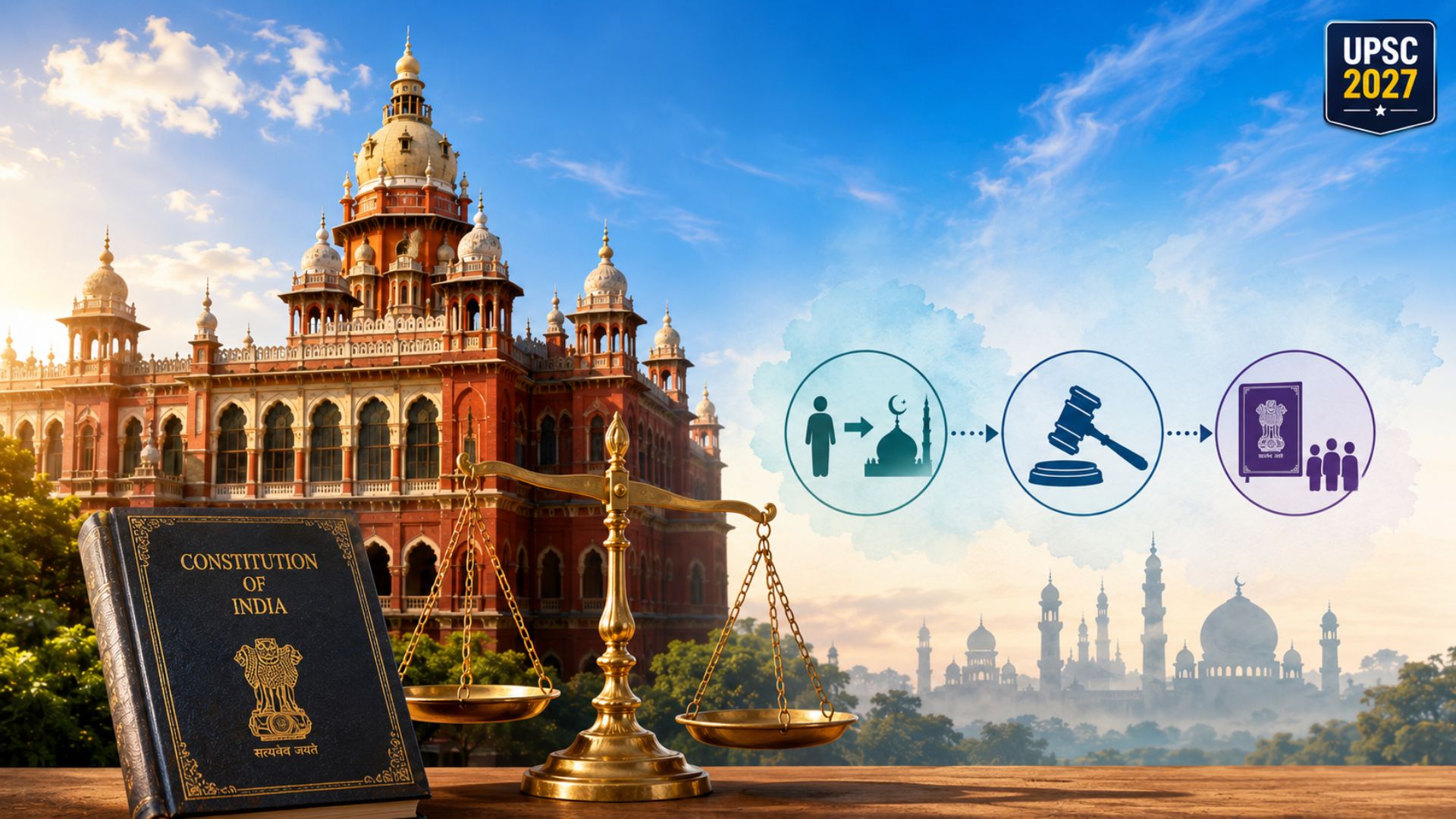
Madras High Court Verdict on Reservation for Converts to Islam

The Madras High Court has declared unconstitutional a 2024 Tamil Nadu Government Order (G.O.) that allowed certain converts to Islam to claim the status of Backward Class (Muslim) for reservation benefits. The judgment raises important constitutional questions relating to reservation policy, equality, religious conversion and separation of powers.
What was the case about?
The petitioner, originally born to Hindu parents in Thoothukudi district, embraced Islam in 2015 and sought a community certificate identifying him as Muslim Lebbai.
His application was rejected by the Tahsildar, following which he approached the Madras High Court.
Meanwhile, the State Government issued a 2024 G.O. permitting certain converts to claim BC (Muslim) status.
What did the 2024 Government Order provide?
The Government Order sought to protect reservation benefits after conversion.
| Provision | Details |
|---|---|
| Eligible persons | Converts to Islam from BC, MBC, DNC and SC communities |
| Benefit | Eligible to receive BC (Muslim) community certificate |
| Condition | Certificate could be issued under any of the seven notified Muslim Backward Class sects |
| Exclusion | Converts from Forward Communities were not eligible |
The State argued that the objective was merely to ensure that beneficiaries did not lose reservation solely because of religious conversion.
What was the High Court's reasoning?
The Court relied on a 1951 Madras High Court judgment, subsequently approved by the Supreme Court.
The principle laid down was:
Upon conversion to Islam, a person becomes only a Muslim, and cannot automatically acquire membership of any Muslim sect determined by birth.
According to the Court:
- Muslim communities such as Rowther, Marakkayar or Deccani are birth-based identities.
- Conversion changes religion, not birth-based community identity.
- Therefore, a convert cannot claim to belong to any particular Muslim sect merely by conversion.
Equality in Islam and social reality
The Court observed that both Islamic teachings and Christian missionary traditions have historically emphasised social equality.
"Islam seeks to establish an egalitarian society. Everyone is equal in the eye of God."
At the same time, the Bench acknowledged an important sociological reality.
It observed that:
- Muslim society has, over time, developed community-based stratification.
- These communities function in many ways similar to caste groups.
- However, membership in such communities is determined by birth, not by conversion.
Thus, while social stratification exists, it cannot be the basis for assigning a convert to a birth-based Muslim community.
Constitutional principles emphasised by the Court
The judgment also focused on the doctrine of separation of powers.
| Constitutional Principle | Court's Observation |
|---|---|
| Separation of Powers | Executive cannot nullify binding judicial decisions through a Government Order. |
| Rule of Law | Final court judgments remain binding unless modified by a higher court or valid legislation. |
| Reservation Policy | Distinct constitutional categories cannot be merged arbitrarily. |
"The legislature cannot declare any decision of a court of law to be void or of no effect."
According to the Court, the G.O. effectively attempted to override settled judicial precedent.
Why was the G.O. held unconstitutional?
The Court identified multiple flaws.
- It recognised conversion into one of the seven notified Muslim BC sects, although those identities are birth-based.
- It clubbed BC, MBC, DNC and SC converts into a single category despite constitutional distinctions between OBCs and Scheduled Castes.
- The classification was considered arbitrary and inconsistent with earlier judicial decisions.
Religion Changed
        ↓
Religious Identity Changes

Birth-based Community
        ↓
Does Not Automatically Change

Therefore,
Conversion ≠ Membership in a Birth-based Muslim Sect
The Court concluded that the Government Order was designed primarily to preserve reservation benefits after conversion rather than being constitutionally sustainable.
Broader constitutional significance
The judgment highlights important issues relating to:
- Equality before law
- Reservation based on social and educational backwardness
- Religious conversion and community identity
- Judicial supremacy in interpreting constitutional principles
- Limits on executive policymaking
Way Forward
- Ensure reservation policies remain consistent with constitutional principles and judicial precedents.
- Base affirmative action on objective evidence of social and educational backwardness.
- Clearly distinguish between religious identity and birth-based community status in administrative procedures.
- Promote periodic review of reservation policies through constitutional mechanisms and Backward Classes Commissions.
- Strengthen coordination between the executive and judiciary while framing socially sensitive policies.
Conclusion
The Madras High Court's ruling reaffirms that while individuals enjoy the constitutional freedom to profess and practise any religion, religious conversion alone does not alter birth-based community identity for reservation purposes. The judgment also reinforces the principles of equality, separation of powers and adherence to judicial precedent in the formulation of public policy.
Attribution
Original content sources and authors

Syllabus classification
How this article maps to GS papers
Main syllabus
GS2Indian ConstitutionQuick Q&A
What is the importance of a multidisciplinary approach in understanding general issues and why is it significant for UPSC Mains and interview preparation?
Why is conceptual clarity on general topics considered more important than memorization for success in UPSC Mains and the Personality Test?
How should UPSC aspirants systematically analyze any general issue from multiple dimensions to write balanced Mains answers and perform well in interviews?
What are the major challenges and common mistakes in approaching general issues during UPSC Mains and interview preparation, and how can they be overcome?
What practical examples and contemporary case studies demonstrate the integrated nature of general issues commonly discussed in UPSC Mains and interviews?
Practice questions
1 question for mains preparation