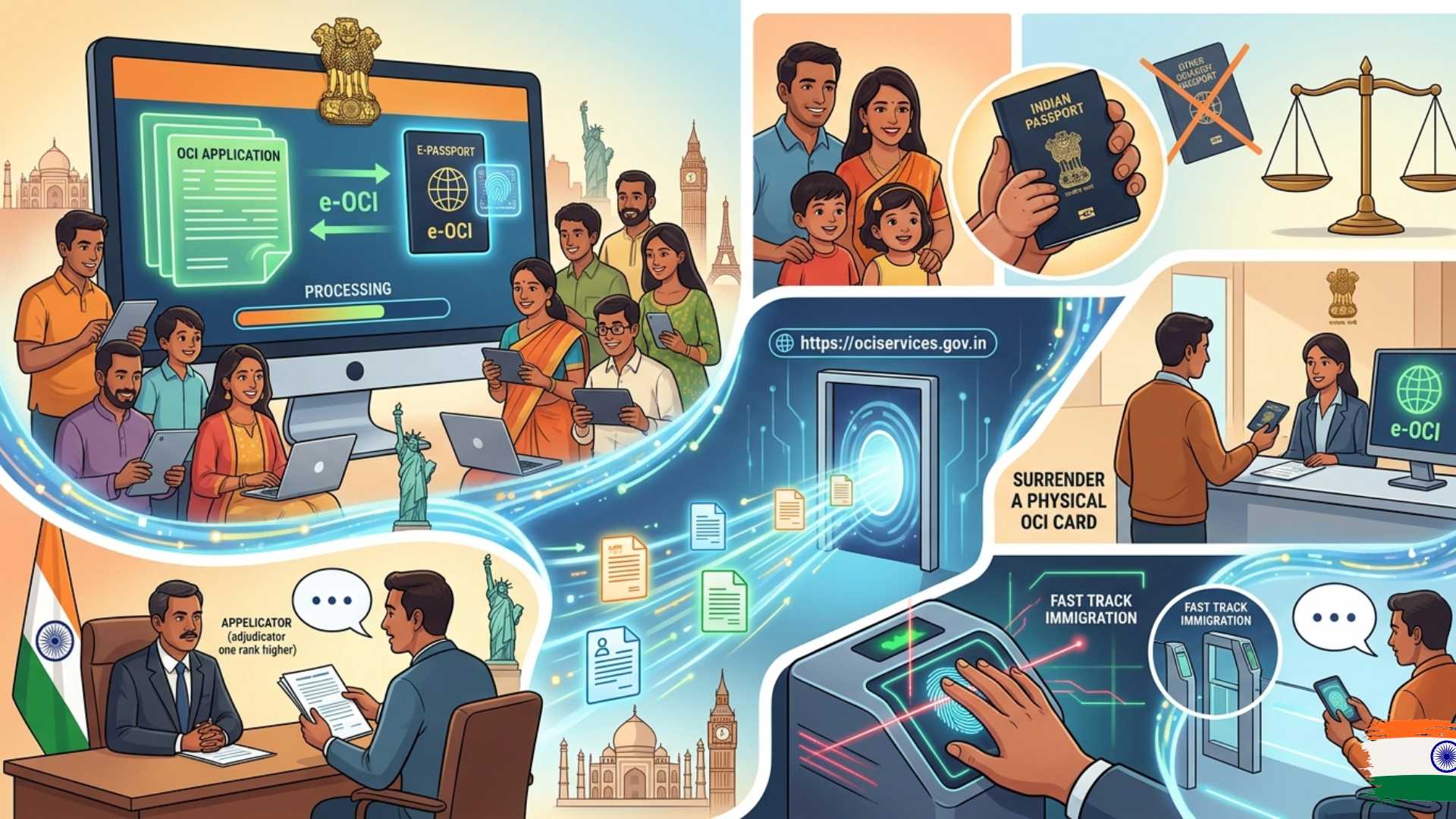
OCI Framework, Citizenship Rules & Diaspora Governance

Introduction
-
India has one of the world's largest diasporas — over 32 million Non-Resident Indians and Persons of Indian Origin across 180+ countries, contributing over $125 billion in remittances in 2023 (World Bank).
-
The Citizenship (Amendment) Rules, 2026 — notified April 30, 2026 — represent a significant digital and procedural overhaul of the OCI framework, reflecting India's evolving approach to diaspora engagement, dual allegiance management, and e-governance.
"The Indian diaspora is a bridge between India and the world — its strength lies not in numbers but in the depth of its civilisational roots." — Manmohan Singh
Key Changes — 2026 Amendment at a Glance
| Area | Old Rule | New Rule |
|---|---|---|
| Application process | Paper/ink, documents in duplicate | Fully electronic via ociservices.gov.in |
| OCI card format | Physical card only | Physical or e-OCI (digital registration) |
| Official OCI register | Physical | Digital |
| Renunciation process | Paper-based | Online application + physical card surrender |
| Appeal mechanism | Unspecified | Authority one rank higher than deciding authority |
| Right to be heard | Not explicitly guaranteed | Explicitly introduced for revision/review cases |
| Biometric consent | Not present | New opt-in consent for Fast Track Immigration |
| Minor child passport | Declaration of no foreign passport | Cannot hold foreign passport simultaneously with Indian passport |
Background & Context
OCI Scheme — Origin Introduced via amendment to the Citizenship Act, 1955 in 2005, OCI provides a lifelong visa and multiple entry rights to Persons of Indian Origin — without full citizenship. It merged the earlier PIO (Person of Indian Origin) card scheme in 2015.
Eligibility Framework OCI is available to anyone who was a citizen of India on or after January 26, 1950, or was eligible to become one — subject to key exclusions.
Ineligibility — Pakistan/Bangladesh Clause Persons who are, have been, or whose parent, grandparent, or great-grandparent was a citizen of Pakistan or Bangladesh are explicitly excluded. This reflects India's partition-era citizenship policy — a deliberate constitutional choice codified in Articles 5–11 and carried forward into the OCI framework.
Key Concepts
OCI vs NRI vs PIO
| Category | Definition | Key Right |
|---|---|---|
| NRI | Indian citizen residing abroad | Full citizenship rights |
| OCI | Foreign national of Indian origin (post-2005) | Lifelong visa, no voting/property rights in some states |
| PIO (discontinued) | Earlier card scheme, merged into OCI in 2015 | Limited rights, now subsumed |
OCI is NOT dual citizenship — a common misconception. OCI holders cannot vote, hold constitutional offices, or own agricultural/plantation land in India. The Supreme Court has consistently upheld this distinction.
Fast Track Immigration (FTI) Programme A biometric-linked system allowing pre-cleared OCI holders expedited entry at Indian airports. The 2026 rules make biometric consent opt-in during OCI registration — integrating diaspora management with border security infrastructure.
Minor Child Passport Rule The new proviso that a minor child cannot simultaneously hold a foreign passport and an Indian passport tightens the dual nationality loophole. Previously, only a declaration was required — now it is a hard prohibition, strengthening the principle that Indian citizenship is singular and exclusive.
Procedural Justice Improvements
Two significant due process additions in the 2026 rules:
1. Right to be Heard Explicitly introduced for all revision/review cases before a final decision. Previously, OCI rejections could be made without giving applicants an opportunity to present their case — a gap now remedied.
2. One Rank Higher Appeal Challenges to rejected OCI or citizenship applications now go to an authority one rank higher than the original deciding authority — introducing a structured internal appellate hierarchy within the executive framework.
Both changes align with natural justice principles — audi alteram partem (hear the other side) — which the Supreme Court has held as a constitutional requirement in administrative decisions affecting rights.
Significance & Implications
Diaspora Engagement Streamlined digital processes reduce barriers for the Indian diaspora to maintain OCI status — supporting India's soft power projection and remittance inflows. Easier OCI management strengthens the emotional and economic connect of the diaspora with India.
E-Governance Dividend Elimination of duplicate documents, paper forms, and physical-only cards reflects Digital India principles applied to citizenship administration — reducing processing time, corruption potential, and geographic barriers for overseas applicants.
Security Architecture Biometric integration via FTI consent and digital OCI registers strengthens India's border management and identity verification infrastructure — aligning diaspora policy with national security imperatives.
Citizenship Integrity The minor child passport prohibition closes a potential loophole where children could informally hold dual nationality during minority. It reinforces Article 9 of the Constitution — which provides that a person voluntarily acquiring foreign citizenship ceases to be an Indian citizen.
Limitations & Concerns
- Pakistan/Bangladesh exclusion remains broad — extends to great-grandparents, potentially excluding communities with historical cross-border roots who have no contemporary connection to those states
- No legislative oversight — citizenship rules are amended by executive notification, bypassing Parliamentary scrutiny
- Digital divide — fully online OCI process may disadvantage elderly diaspora members in countries with limited digital infrastructure
- OCI cancellation powers remain wide — government can cancel OCI status on broad grounds; the new appeal mechanism, while welcome, operates within the executive branch without judicial pre-clearance
Relevant Constitutional & Legal Framework
| Provision | Relevance |
|---|---|
| Articles 5–11 | Citizenship at Constitution's commencement; foundational framework |
| Article 9 | Voluntary acquisition of foreign citizenship = loss of Indian citizenship |
| Article 11 | Parliament's power to regulate citizenship by law |
| Citizenship Act, 1955 | Primary legislation; OCI introduced via 2005 amendment |
| Citizenship Rules, 2009 | Procedural framework; now amended by 2026 rules |
| Section 7A | OCI registration provision |
| Section 15A | Citizenship by naturalisation review |
Way Forward
- Statutory basis for OCI rights — codify OCI entitlements in primary legislation rather than rules, ensuring Parliamentary oversight
- Independent appellate authority — move OCI appeals beyond executive hierarchy to a quasi-judicial body
- Review Pakistan/Bangladesh exclusion — consider time-limiting the generational exclusion to parents rather than great-grandparents
- OCI voting rights debate — several democracies (France, Italy) allow diaspora voting; India could explore limited representation
- Digital accessibility support — embassy-level assistance for elderly or digitally excluded OCI applicants
Conclusion
-
The Citizenship (Amendment) Rules, 2026 represent a maturation of India's diaspora governance architecture — moving from paper-based administration to a digitally integrated, procedurally fairer, and security-conscious framework.
-
Yet the deeper questions — OCI's quasi-citizenship status, the breadth of exclusions, and the absence of legislative oversight over citizenship rules — remain unaddressed.
-
As India's diaspora grows in economic and geopolitical significance, the citizenship framework must evolve from a transactional convenience mechanism into a rights-based, democratically accountable structure that honours the full depth of the Indian diaspora's connection to the nation.
Attribution
Original content sources and authors


Syllabus classification
How this article maps to GS papers
Main syllabus
GS2Indian ConstitutionQuick Q&A
What are the key features of the Citizenship (Amendment) Rules, 2026, particularly with respect to OCI cardholders?
Another important feature is the introduction of electronic OCI (e-OCI), allowing applicants to receive either a physical card or a digital registration. Additionally, the government will maintain a digital register of OCI holders, enhancing administrative efficiency and transparency. The rules also remove redundant requirements such as submission of documents in duplicate, thereby reducing bureaucratic hurdles.
Further, the rules introduce biometric data collection for applicants opting into the Fast Track Immigration Programme, and mandate the surrender of physical OCI cards upon renunciation or cancellation. Overall, these changes reflect a move toward ease of doing business, transparency, and modernization of citizenship administration, aligning with India's broader Digital India initiative.
Why is the shift towards digital processing in citizenship and OCI-related services significant for governance?
From an administrative perspective, digitisation enables real-time data management and better record-keeping. The creation of a digital OCI register ensures easy retrieval of information and facilitates coordination between different agencies, such as immigration authorities and foreign missions. For instance, countries like Estonia have demonstrated how digital governance can drastically improve public service delivery.
Moreover, digital systems enhance accessibility for the Indian diaspora, allowing applicants from across the globe to apply without physically visiting consulates. However, challenges such as the digital divide, cybersecurity concerns, and data privacy must also be addressed. Overall, the shift represents a balance between administrative efficiency and global service outreach.
How do the new rules address procedural fairness and accountability in citizenship and OCI application processes?
Additionally, the rules explicitly guarantee the right to be heard, ensuring that applicants are given a reasonable opportunity to present their case before a final decision is made. This aligns with the principles of natural justice, which are fundamental to administrative law in India. For example, the Supreme Court has consistently upheld the importance of fair hearing in cases involving individual rights.
Furthermore, provisions related to review under Section 15A (naturalisation) reinforce transparency in decision-making. These measures collectively strengthen citizen trust in governance and ensure that administrative actions are not only efficient but also just and accountable.
What is the rationale behind the rule prohibiting minor children from holding both Indian and foreign passports simultaneously?
From a legal standpoint, citizenship determines rights such as political participation, legal protection, and taxation obligations. Dual passport holding could lead to conflicts in jurisdiction, especially in cases involving legal disputes or international travel. For instance, issues related to extradition or consular protection may become complicated if dual nationality is implied.
Therefore, the rule ensures clarity and consistency in citizenship laws. It also aligns with global practices, as many countries impose restrictions on dual nationality for minors. This provision ultimately strengthens the integrity of India's citizenship framework while preventing misuse or confusion.
Critically analyze the implications of biometric data collection and the Fast Track Immigration Programme for OCI applicants.
However, this move also raises important concerns related to data privacy and surveillance. The collection and sharing of biometric information require robust safeguards to prevent misuse or unauthorized access. India currently lacks a comprehensive data protection regime comparable to the EU’s GDPR, which could make such systems vulnerable.
From a broader perspective, while the programme promotes ease of travel and administrative efficiency, it must be balanced with strong legal and technological safeguards. Transparency in data usage, informed consent, and accountability mechanisms will be critical to ensure that the benefits do not come at the cost of individual rights.
How does the OCI scheme function as a tool of diaspora engagement, and what are some real-world implications?
For example, OCI cardholders can invest in India, participate in educational opportunities, and contribute to sectors like technology and healthcare. The success of India's IT sector, which has benefited from diaspora connections in countries like the United States, highlights the importance of such engagement.
However, the scheme also has limitations, such as restrictions on political rights and certain government jobs. Despite this, it remains a strategic soft power tool, enhancing India’s global influence. By modernizing the OCI framework through digital reforms, the government aims to make diaspora engagement more efficient and accessible.
As a policymaker, how would you balance ease of access and national security concerns in implementing digital citizenship systems?
Secondly, I would establish a comprehensive data protection framework to regulate the collection, storage, and use of personal and biometric information. Lessons can be drawn from global examples such as Estonia’s e-governance model, which combines efficiency with strong cybersecurity measures.
Finally, I would promote transparency and accountability by clearly defining the roles of various authorities and providing grievance redressal mechanisms. Regular audits and public awareness campaigns would further strengthen trust. The goal would be to create a system that is user-friendly yet resilient against security threats, ensuring both administrative efficiency and national interest.
Practice questions
2 questions for mains preparation