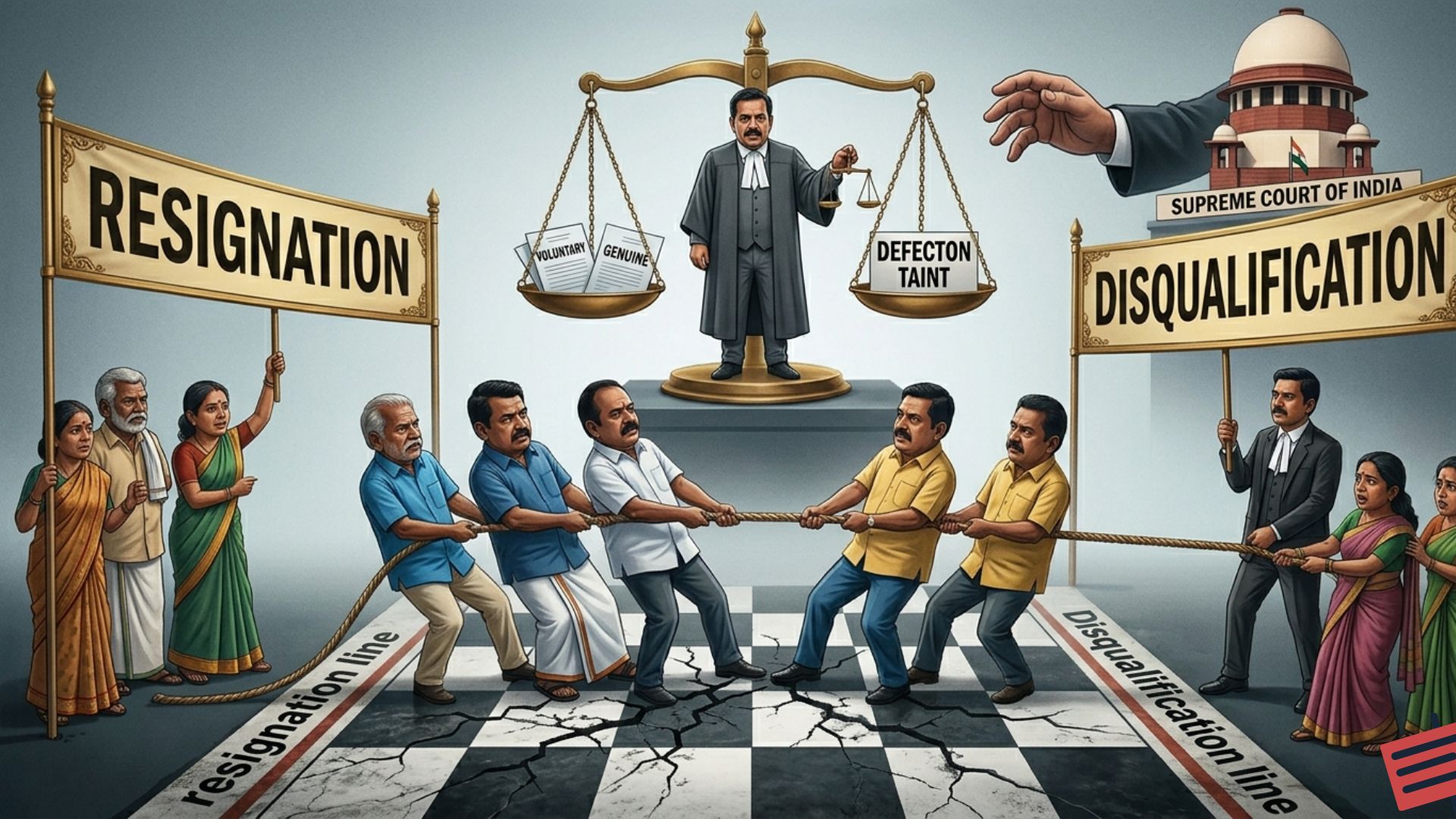
Resignation vs. Disqualification: The Constitutional Interplay Under the 10th Schedule
Can a Speaker accept the resignation of an MLA while a disqualification petition against them is pending? The Tamil Nadu Assembly episode has brought this precise constitutional question to the fore — and the answer, drawn from Supreme Court jurisprudence, reveals a nuanced but consequential legal architecture governing the relationship between resignation and defection.
The Tamil Nadu Trigger
The sequence of events:
- 25 AIADMK MLAs voted in favour of the ruling TVK government during a confidence motion — directly violating their party's direction to oppose it
- The AIADMK leadership filed disqualification petitions against them under the 10th Schedule for "voluntarily giving up membership of their party"
- 4 of these MLAs submitted resignations, which Tamil Nadu Assembly Speaker J.C.D. Prabhakar accepted
- All four subsequently joined the TVK — the ruling party
- The AIADMK has now appealed to the Speaker to revoke the acceptance of their resignations and adjudicate the disqualification petitions instead
The core constitutional question: does acceptance of resignation render pending disqualification proceedings infructuous?
The Governing Precedent: Karnataka 2019
The Supreme Court's judgment in Shrimanth Balasaheb Patel vs. Speaker, Karnataka Assembly (2019) is directly applicable. In that case, a group of MLAs — apparently seeking to topple the JD(S)-Congress coalition government — acted against party directions, avoided party meetings, and absented themselves from Assembly sittings. Anticipating disqualification under the 10th Schedule, many submitted resignations. The Karnataka Speaker did not accept them immediately. The MLAs were subsequently disqualified.
The Supreme Court upheld their disqualification but set aside the Speaker's order barring them for the remainder of the Assembly's term. In doing so, it laid down three critical conclusions:
Conclusion 1: The Speaker's Limited Role in Accepting Resignations
The Speaker's jurisdiction when considering a resignation is narrow and defined:
- Ascertain whether the resignation is "voluntary" — out of free will, not under duress
- Ascertain whether it is "genuine" — authentic, not fabricated
"Once it is demonstrated that a member is willing to resign out of his free will, the Speaker has no option but to accept the resignation."
Crucially, the Speaker cannot delve into motive. Extraneous factors — including pending disqualification proceedings — are constitutionally impermissible considerations. The Speaker's satisfaction on voluntariness and genuineness is, however, subject to judicial review.
Conclusion 2: Resignation Does Not Erase the Taint of Disqualification
This is the most consequential legal principle. The Court held that the taint of disqualification does not "vaporise" merely because a member submitted a resignation before adjudication:
- Defection relates back to the date the member incurred disqualification
- Submission of a resignation letter does not render pending or impending disqualification action infructuous
This distinction — between submission and acceptance of resignation — is critical:
- Submission alone does not close a disqualification complaint
- Acceptance of the resignation may bring disqualification proceedings to an end
Conclusion 3: The Second Consequence of Defection
Beyond loss of membership, the Constitution bars a disqualified member from holding a Minister's post or any remunerative political office until the end of the Assembly's term or until re-elected — whichever is earlier.
This means:
- A defector cannot join a Ministry formed on the back of defection without facing a by-election
- The fate of a disqualification proceeding — and whether the Speaker accepts or rejects a resignation — therefore directly determines whether defectors can access ministerial office
This was the live stakes in Karnataka 2019: the defecting MLAs were keen on joining an alternative government. The same logic applies in Tamil Nadu — the four MLAs have joined TVK, the ruling party.
The Court notably declined to rule on whether a Speaker retains jurisdiction to decide a disqualification petition after the member has already quit — since in Karnataka, the defection preceded the resignation, and the Court restricted itself to the facts before it.
The Harmonised Legal Picture
Reading all three conclusions together, the law operates as follows:
- The Speaker must accept a voluntary and genuine resignation — motive is irrelevant
- But acceptance does not automatically extinguish disqualification liability if defection preceded resignation
- The submission of resignation is not a ground to close a disqualification complaint
- The acceptance of resignation may close it — but that decision itself remains open to judicial review
- A disqualified member faces a constitutional bar on ministerial office — making the Speaker's decision on resignation a matter of direct political consequence
Way Forward
- Judicial clarity is overdue on the specific question the Supreme Court left open in 2019: does a Speaker retain jurisdiction to adjudicate disqualification after accepting a resignation? The Tamil Nadu case may finally force this question before the Court
- Timelines for disqualification adjudication must be constitutionally mandated — delay by Speakers in deciding petitions has consistently been used as a political instrument across states
- Separation of the Speaker's role from party affiliation must be structurally addressed — the conflict of interest inherent in a ruling-party Speaker adjudicating defection cases from the opposition is a systemic flaw
- The Election Commission's role in recognising post-resignation party memberships must be examined in light of disqualification jurisprudence to prevent institutional arbitrage between two separate processes
Conclusion
The Tamil Nadu episode exposes a deliberate or inadvertent exploitation of the gap between resignation and disqualification — a gap the Supreme Court acknowledged but did not fully close in 2019. The constitutional design of the 10th Schedule was built to protect the integrity of the party mandate. When resignation becomes a tactical instrument to escape disqualification and simultaneously enable defection to the ruling party, that design is being gamed rather than honoured. Judicial intervention — and eventually legislative precision — is necessary to ensure that the anti-defection law cannot be rendered infructuous by the mechanical acceptance of a resignation letter.
Attribution
Original content sources and authors
Syllabus classification
How this article maps to GS papers
Main syllabus
GS2Indian ConstitutionQuick Q&A
What is the constitutional issue involved when a Speaker accepts the resignation of MLAs while disqualification petitions are pending under the Tenth Schedule?
Under Article 190, the Speaker is empowered to accept the resignation of a member if it is found to be voluntary and genuine. Simultaneously, the Tenth Schedule seeks to preserve political stability and party discipline by disqualifying legislators who defect from their parties. The tension between these two provisions became particularly visible in cases such as the 2019 Karnataka political crisis and now in the Tamil Nadu Assembly controversy involving AIADMK legislators who joined the TVK government.
The Supreme Court in Shrimanth Balasaheb Patel v. Speaker, Karnataka Assembly (2019) attempted to harmonise these constitutional principles. The Court clarified that the Speaker cannot reject a resignation merely because the member may face disqualification. However, it also held that resignation does not erase the “taint” of defection if the act constituting defection occurred before resignation. Thus, resignation and disqualification are treated as legally distinct but interconnected processes.
The broader constitutional concern relates to democratic morality and legislative ethics. If legislators are allowed to defect and resign freely without facing consequences, governments may become unstable and anti-defection provisions may lose effectiveness. On the other hand, giving the Speaker excessive discretion to delay resignations could undermine the constitutional freedom of elected representatives. Therefore, the issue reflects a larger debate on balancing individual legislative autonomy, party discipline, and constitutional governance.
Why is the Supreme Court’s judgment in the Karnataka MLAs case significant for understanding the Speaker’s powers?
First, the judgment narrowed the scope of the Speaker’s inquiry while accepting resignations. The Court held that the Speaker’s role is limited to determining whether the resignation is “voluntary” and “genuine.” The Speaker cannot investigate political motives or reject a resignation merely because the member may be attempting to avoid disqualification. This interpretation protects legislators from arbitrary exercise of power by the presiding officer and reinforces constitutional safeguards against partisan conduct.
Second, the Court simultaneously strengthened the anti-defection framework. It ruled that resignation does not automatically wipe out disqualification proceedings. If the act constituting defection occurred before resignation, the Speaker can still adjudicate the matter. This is crucial because disqualification under the Tenth Schedule carries an additional consequence under Article 164(1B): the disqualified member cannot become a Minister or hold remunerative political office until re-election or expiry of the Assembly term.
The judgment is also institutionally important because it subjects the Speaker’s decision to judicial review. Historically, Speakers have often been accused of acting in a partisan manner. By allowing courts to examine whether constitutional standards were followed, the judiciary attempted to ensure neutrality and accountability. The ruling therefore represents a balance between legislative autonomy, constitutional morality, and judicial oversight.
In the Tamil Nadu context, the judgment provides the guiding framework for assessing whether the acceptance of resignations by the Speaker was constitutionally proper despite pending disqualification petitions.
How does the anti-defection law attempt to balance political stability with democratic freedom of legislators?
The law balances political stability by imposing disqualification on legislators who voluntarily give up party membership or violate party whips. This discourages opportunistic defections motivated by office, money, or political bargaining. In coalition governments especially, anti-defection provisions help prevent instability caused by shifting loyalties. The Karnataka crisis of 2019 and the recent Tamil Nadu developments demonstrate how defections can significantly alter legislative majorities and government survival.
At the same time, democratic freedom is protected through constitutional safeguards. Legislators are still allowed to resign voluntarily under Article 190. The Speaker cannot reject resignations based on political considerations. Moreover, judicial review acts as a check against arbitrary decisions by the Speaker. The Supreme Court has repeatedly emphasised that constitutional procedures must not be manipulated for partisan advantage.
However, critics argue that the anti-defection law excessively restricts freedom of speech and conscience of legislators. Since party whips often apply even to ordinary legislative matters, MLAs and MPs may be reduced to mere numbers rather than independent representatives. Committees such as the Dinesh Goswami Committee and scholars of constitutional law have suggested limiting whips only to confidence motions and money bills.
Thus, the anti-defection framework reflects an ongoing constitutional balancing exercise. While political stability is essential for governance, democratic systems must also preserve deliberation, dissent, and accountability within political parties. The challenge lies in ensuring that anti-defection provisions prevent unethical defections without undermining representative democracy.
Critically analyse whether the Speaker should have discretionary power in matters relating to resignation and disqualification of legislators.
Supporters of the current arrangement argue that the Speaker is best placed to decide such matters because of institutional familiarity with legislative functioning. The Constitution envisages the Speaker as an impartial authority capable of safeguarding legislative dignity. Quick decision-making by the Speaker can prevent prolonged uncertainty and constitutional paralysis. The Supreme Court in several judgments has also recognised the constitutional importance of legislative autonomy.
However, critics highlight the dangers of partisan misuse. Since Speakers are generally elected from ruling parties, decisions on resignation and disqualification often appear politically motivated. Delays in deciding petitions or selective acceptance of resignations may alter legislative majorities and influence government formation. Examples from Karnataka, Maharashtra, Manipur, and now Tamil Nadu indicate that Speakers may sometimes act strategically rather than neutrally.
Another concern relates to constitutional morality. If Speakers delay resignations to facilitate disqualification, or quickly accept resignations to protect defectors, the democratic process may be distorted. This weakens public trust in institutions and undermines the anti-defection law’s objective of promoting ethical politics.
Several reform proposals have therefore emerged. The Dinesh Goswami Committee and various constitutional experts have suggested transferring disqualification powers to an independent tribunal or the Election Commission. Others recommend imposing strict timelines for decisions and enhancing judicial oversight.
In conclusion, while the Speaker’s office remains central to parliamentary democracy, unchecked discretion can create constitutional distortions. The solution lies not necessarily in removing the Speaker’s role entirely, but in strengthening institutional safeguards, transparency, and accountability to ensure fairness and neutrality.
What lessons can Indian democracy learn from repeated political crises involving defections and resignations?
One major lesson is the need to strengthen internal party democracy. Many defections occur because legislators feel excluded from decision-making or are dissatisfied with leadership structures. Political parties in India are often highly centralised, with limited transparency in candidate selection and policy formulation. Encouraging internal debate and democratic functioning within parties may reduce opportunistic political migration.
Another lesson concerns the importance of institutional neutrality. Constitutional authorities such as the Speaker must be perceived as impartial. Delays or selective decisions regarding resignations and disqualifications create suspicion that constitutional offices are being used for political advantage. The judiciary’s intervention in such cases reflects the need for stronger procedural safeguards and timely adjudication.
These crises also expose limitations of the anti-defection law itself. While the law has reduced open floor-crossing, political actors have discovered alternative strategies such as coordinated resignations. This suggests that legal provisions alone cannot ensure ethical politics unless accompanied by strong political culture and voter accountability.
Furthermore, such episodes affect public trust in democracy. Voters elect representatives based on party manifestos and ideological commitments. When elected legislators switch loyalties without seeking a fresh mandate, citizens may perceive it as a betrayal of electoral trust. Frequent instability can also weaken governance and policy continuity.
The way forward requires comprehensive reform. Possible measures include fixed timelines for Speaker decisions, greater transparency in proceedings, strengthening ethics within political parties, and revisiting provisions of the Tenth Schedule. Ultimately, democratic stability depends not only on constitutional text but also on adherence to constitutional morality and public accountability.
Suppose a group of MLAs resign after voting against their party whip but before the Speaker decides on disqualification petitions. How should the constitutional framework address such a situation?
First, the Speaker must determine whether the resignations are voluntary and genuine. Under Article 190(3)(b), if the resignations are authentic and not submitted under coercion, the Speaker ordinarily has no option but to accept them. The Speaker cannot reject resignations merely because political motives are suspected. This protects constitutional freedoms and prevents arbitrary exercise of authority.
Second, the Speaker must independently examine whether acts amounting to defection occurred prior to resignation. If legislators violated a party whip or voluntarily gave up party membership before resigning, disqualification proceedings do not automatically lapse. According to the Supreme Court, the “taint” of disqualification survives resignation because constitutional consequences relate back to the date of defection.
This distinction is important because disqualification carries additional constitutional consequences. Under Article 164(1B), a disqualified legislator cannot become a Minister or hold political office until re-election or expiry of the legislative term. Without such safeguards, legislators could defect, resign, and immediately secure positions in an alternative government, thereby undermining democratic ethics.
Judicial review also plays a crucial role in such cases. If the Speaker acts in a partisan or arbitrary manner, courts may intervene to examine whether constitutional procedures were properly followed. This judicial oversight is essential because resignation-disqualification disputes often influence government stability and majority formation.
Therefore, the constitutional approach should ensure both procedural fairness and substantive accountability. Genuine resignations should not be blocked arbitrarily, but anti-defection provisions must continue to operate effectively so that legislators cannot evade constitutional consequences through tactical resignations.
Practice questions
2 questions for mains preparation