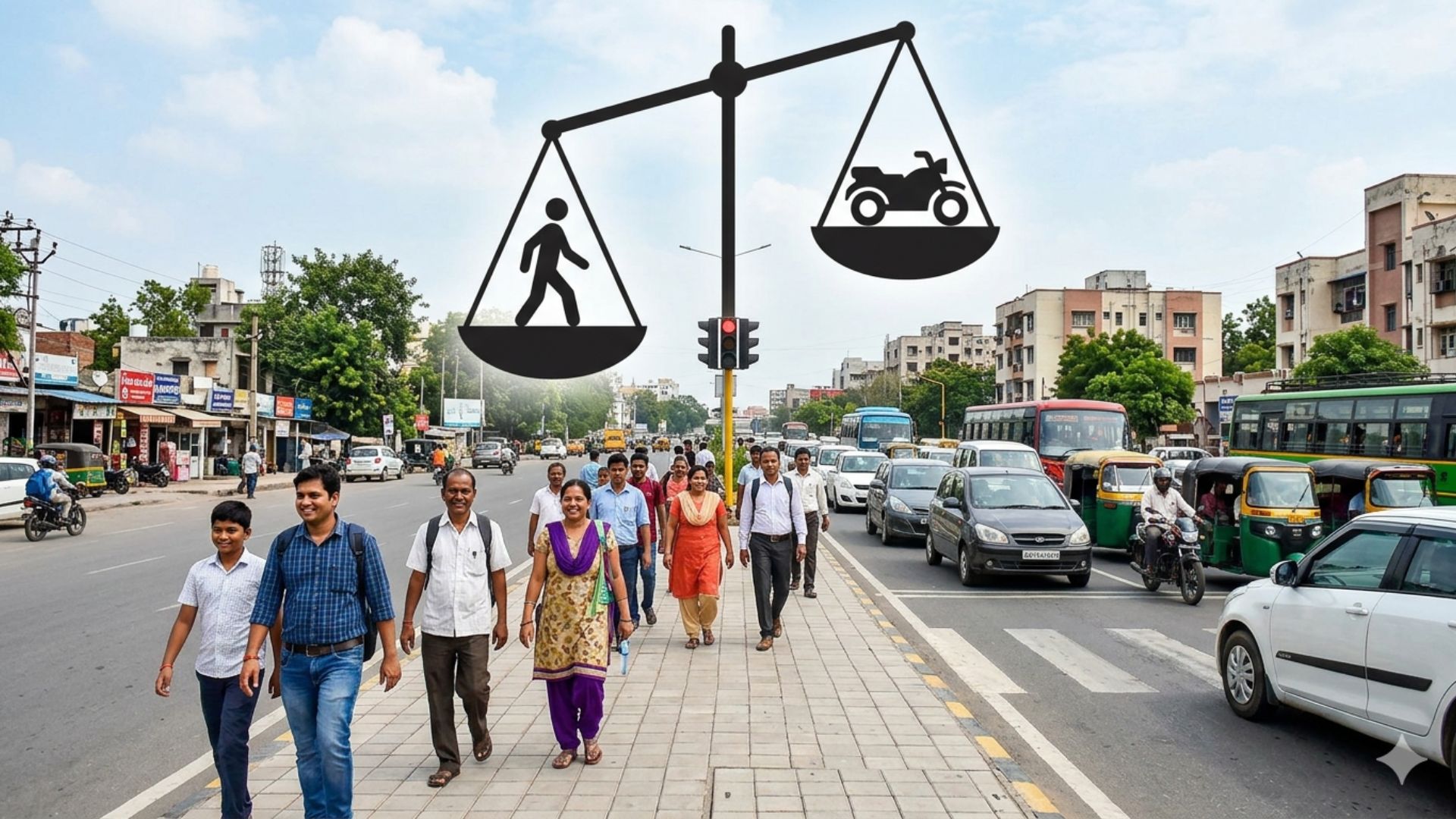
GS2 Indian Constitution

Right to Walk: Supreme Court Puts Pedestrians First

Right to Walk: Supreme Court Expands the Scope of Article 21

Apex court emphasizes the importance of footpaths in freedom and safety, urging the government to ensure pedestrian rights.
Gopi Gopi
4 mins read

"The fundamental right to walk on demarcated footpaths shall override the privilege of a motorised vehicle." — Justice P.S. Narasimha

Why is the Judgment Significant?

The Supreme Court has declared the right to walk safely on demarcated and well-maintained footpaths as a fundamental right, further expanding the scope of Article 21 (Right to Life and Personal Liberty).

The judgment arose from the tragic death of a five-year-old boy who was crushed by a truck while walking to school with his father.

The Court held that wherever a road exists, authorities have an enforceable duty to provide and maintain footpaths.


Constitutional Basis of the Right to Walk

The Court derived this right from multiple constitutional provisions.

Constitutional ProvisionRelevance
Article 21Right to life with dignity and safety
Article 19(1)(d)Freedom to move freely throughout India
Article 19(1)(a)Freedom of expression
Article 19(1)(b)Freedom of assembly
Article 19(1)(c)Freedom of association

The Court observed that walking is not merely physical movement but also facilitates social interaction, political participation and democratic engagement.


Walking in India's Historical and Cultural Context

Justice Narasimha highlighted the deeper significance of walking.

Walking has historically served as:

  • A means of livelihood for ordinary citizens.
  • A form of meditation and self-reflection.
  • A tool of social reform and political mobilisation.
  • An instrument of resistance during the freedom struggle.
Dandi March (1930)

A simple act of walking became
a powerful political statement
against colonial rule.

Thus, walking carries social, cultural and democratic value beyond transportation.


How Urbanisation Marginalised Pedestrians

The Court noted that economic growth and rapid urbanisation have prioritised motorised transport over pedestrians.

  • Expansion of highways and expressways.
  • Road design centred on vehicles.
  • Shrinking pedestrian spaces.
  • Increasing pedestrian fatalities.

"Walkers are often treated as a nuisance by motorists."

As cheaper motor vehicles became widespread, roads increasingly became spaces dominated by machines rather than people.


Present Challenges Faced by Pedestrians

Infrastructure Deficits

Most cities suffer from:

  • Absence of continuous footpaths.
  • Encroachments by parked vehicles.
  • Street vendors occupying pavements.
  • Utility installations and debris.
  • Road-widening pressures.
Road exists
      ↓
No footpath available
      ↓
Pedestrians forced onto carriageway
      ↓
Higher accident risk

There is no comprehensive national law governing pedestrian rights.

Currently, responsibility is scattered across:

  • Municipal laws
  • Town-planning statutes
  • Street design guidelines

As a result, pedestrian safety remains poorly enforced.


Court's Critique of Existing Laws

The Court criticised the Motor Vehicles Act, 1988 for being primarily vehicle-centric.

Current FocusNeglected Aspect
VehiclesPedestrians
Traffic managementWalking rights
Road usagePedestrian infrastructure

The Court observed that human interests are treated only as interests that vehicles should avoid harming rather than rights deserving independent protection.


Need for a Dedicated Statutory Framework

The Supreme Court recommended:

New Legislation

To:

  • Recognise the right to walk.
  • Clearly identify duty-bearers.
  • Provide remedies for violations.
  • Ensure accountability.

Dedicated Regulator

The Court suggested establishing a specialised regulatory authority for:

  • Planning pedestrian infrastructure.
  • Monitoring compliance.
  • Enforcing standards.
  • Resolving grievances.

The judgment was forwarded to:

  • Ministry of Housing and Urban Affairs
  • Ministry of Rural Development
  • Ministry of Road Transport and Highways
  • Law Commission of India

for examination of an appropriate legal framework.


Challenges in Translating Rights into Reality

India's experience with rights-based legislation offers important lessons.

LawKey Challenge
Street Vendors Act, 2014Weak implementation by urban local bodies
COTPA, 2003Success depended on social messaging and enforcement
Swachh Bharat initiativesCitizens' duties often exceeded state capacity
Right to Walk Declared
          ↓
No footpaths constructed
          ↓
Right remains symbolic

Merely recognising a right may not ensure effective implementation.


Potential Concerns

  • Conflicts with existing street vending arrangements.
  • Possibility of eviction drives in the name of pedestrian rights.
  • Gentrification of public spaces.
  • Criminalisation of informal livelihoods.

A pedestrian-friendly city must balance:

  • Safety,
  • Accessibility,
  • Livelihood concerns, and
  • Inclusive urban planning.

Way Forward

  • Enact a dedicated pedestrian rights legislation.
  • Allocate greater public funding for footpath infrastructure.
  • Integrate pedestrian planning into urban development.
  • Ensure unobstructed and accessible walkways.
  • Harmonise pedestrian rights with street-vendor protections.
  • Strengthen accountability of local authorities.

Conclusion

The Supreme Court's recognition of the right to walk marks an important expansion of constitutional rights under Article 21. However, the success of this constitutional promise will depend not merely on legal recognition but on sustained public investment, institutional accountability and a cultural shift that places pedestrians at the centre of urban planning. A truly inclusive city is one where roads serve people first and vehicles second.

Attribution

Original content sources and authors
Krishnadas Rajagopal Author Krishnadas Rajagopal The Hindu Source The Hindu

Syllabus classification

How this article maps to GS papers

Main syllabus

GS2Indian Constitution

Quick Q&A

What is the significance of the Supreme Court’s recognition of the right to walk on demarcated footpaths as a fundamental right under the Constitution of India?
The Supreme Court’s June 2026 judgment recognising the right to walk on demarcated and well-maintained footpaths as a fundamental right represents an important expansion of Article 21 and Article 19 of the Constitution. The Bench comprising Justices P.S. Narasimha and Atul S. Chandurkar held that the freedom to walk safely has priority over the privilege of motorised vehicles. The ruling emerged from a tragic case involving the death of a five-year-old boy in Karnataka who was crushed by a tanker while walking to school. The Court linked walking with Article 19(1)(d), which guarantees freedom of movement, and further connected it with the freedoms of expression, assembly and association under Articles 19(1)(a), 19(1)(b) and 19(1)(c). The judgment forms part of the broader judicial expansion of Article 21 since the 1970s, which has previously recognised rights relating to dignity, environment, livelihood and privacy. Historically, rapid urbanisation and automobile-centric planning have relegated pedestrians to the margins. According to the Court, roads and expressways have become symbols of growth, while pedestrian infrastructure has been neglected. The judgment has significance for governance, urban planning and public health. It transforms pedestrian safety from a welfare concern into an enforceable constitutional obligation. Municipal authorities are now expected to provide continuous and accessible footpaths. For UPSC, the issue connects with GS-II (Polity and Governance), GS-III (Infrastructure and Urban Development), ethics concerning human dignity, and current debates on inclusive and sustainable cities.
Why is the recognition of pedestrian rights and walkable urban spaces important for governance, social justice and sustainable development in India?
Recognition of pedestrian rights is important because walking is the most basic, affordable and universally accessible mode of mobility. In India, a large proportion of citizens, especially children, senior citizens, women, migrant workers and economically weaker sections, depend on walking for daily activities. Therefore, protecting pedestrians is closely linked to social justice and inclusive development. From a governance perspective, walkability contributes to safer roads, healthier lifestyles and environmentally sustainable cities. According to global urban planning principles and Sustainable Development Goal 11, cities should be inclusive, safe and sustainable. Pedestrian-friendly infrastructure reduces traffic congestion, lowers carbon emissions and encourages active mobility. The Supreme Court observed that motorised transport has overshadowed human-centric planning. Pedestrians are often treated as obstacles rather than legitimate users of public spaces. This imbalance reflects structural inequalities and historical biases in infrastructure investment. The issue also has economic implications. Safe pedestrian infrastructure can reduce accidents, healthcare costs and productivity losses. Furthermore, walkable cities support local commerce and public interaction. For UPSC aspirants, the topic is relevant to GS-I (Urbanisation), GS-II (Governance and Constitutional Rights), GS-III (Infrastructure and Environment) and essay topics related to sustainable development. Current debates revolve around balancing pedestrian rights with street vending activities, road widening projects and commercial interests. Ultimately, pedestrian rights reinforce the constitutional ideals of dignity, equality and accessibility. They represent a shift from vehicle-centric development to people-centric governance, aligning infrastructure policies with the broader objective of improving the quality of life for citizens.
How does the Supreme Court judgment seek to reshape India’s legal and institutional framework relating to pedestrian safety and urban mobility?
The Supreme Court judgment seeks to bring about structural reforms by transforming pedestrian safety from a fragmented administrative concern into a constitutional responsibility. Justice P.S. Narasimha pointed out that the Motor Vehicles Act, 1988 primarily focuses on vehicles rather than human beings and does not adequately recognise pedestrians as rights-bearing citizens. At present, responsibility for pedestrian safety is dispersed across municipal laws, town-planning statutes and design guidelines. Such fragmentation has resulted in weak accountability and inconsistent implementation. Footpaths are frequently obstructed by illegal parking, construction debris, utilities and encroachments. To address these issues, the Court proposed a comprehensive statutory framework that would clearly identify duty-bearers and provide remedies for violations. It recommended establishing a full-time regulatory authority staffed with experts capable of planning, enforcing and monitoring pedestrian rights. The Court also directed its Registry to send copies of the judgment to the Ministries of Housing and Urban Affairs, Rural Development and Road Transport and Highways, along with the Law Commission of India, to examine the need for legislative action. The proposed framework would strengthen accountability and ensure that citizens have access to compensation and restitution in cases of violations. Such institutional mechanisms could function similarly to regulators in sectors like telecommunications or environmental protection. For UPSC, this topic is significant for GS-II topics relating to judiciary, constitutional governance and institutional reforms. It also relates to cooperative federalism, as implementation would require coordination among Union ministries, State governments and urban local bodies. The judgment highlights the evolving role of constitutional courts in advancing rights-based governance.
What are the major challenges, controversies and limitations associated with implementing the constitutional right to walk in India?
Although the recognition of the right to walk is a progressive development, several practical and legal challenges could limit its effectiveness. One major issue is the gap between judicial declarations and administrative implementation. Rights-based legislation in India has often produced mixed outcomes due to institutional weaknesses. The experience of the Street Vendors (Protection of Livelihood and Regulation of Street Vending) Act, 2014 illustrates this challenge. Despite providing legal protection to vendors under Article 19(1)(g), delays in surveys and demarcation of vending zones have resulted in poor implementation and frequent eviction drives. Another example is the Cigarettes and Other Tobacco Products Act, 2003, which succeeded largely through continuous awareness campaigns and small penalties rather than merely through legal declarations. Similarly, Swachh Bharat initiatives have struggled because the burden of responsibility has often been shifted to citizens while state agencies failed to ensure efficient waste collection. Critics argue that excessive reliance on compensation after accidents may not lead to meaningful structural reforms. There are also concerns that pedestrian rights could be misused by authorities to remove informal commercial activities, leading to gentrification and the marginalisation of the urban poor. Financial constraints and competing demands for road expansion further complicate implementation. Municipal bodies often suffer from limited resources and technical capacity. For UPSC, this issue provides scope for balanced analysis under GS-II and GS-III. It demonstrates that constitutional rights require adequate institutions, funding and public participation to succeed. Sustainable change will depend not only on judicial activism but also on cultural acceptance, administrative commitment and investment in pedestrian infrastructure.
What practical examples and case studies demonstrate the relationship between constitutional rights, public culture and successful policy implementation in India?
Several examples from India demonstrate that constitutional rights and legislation are effective only when supported by institutions, public awareness and administrative commitment. The Supreme Court’s right-to-walk judgment itself emerged from the tragic death of a five-year-old boy in Karnataka, illustrating how individual cases can lead to broader constitutional developments. One important case study is the Street Vendors Act, 2014. The legislation sought to protect the livelihoods of informal vendors while regulating public spaces. However, implementation has been uneven because many urban local bodies delayed surveys and failed to establish Town Vending Committees. Consequently, conflicts between vendors and municipal authorities continue. Another example is the Cigarettes and Other Tobacco Products Act (COTPA), 2003. Public smoking has declined considerably due to awareness campaigns, warning labels and immediate penalties. This demonstrates that behavioural change often requires social messaging in addition to legal provisions. The Swachh Bharat Mission provides another lesson. Although laws and campaigns encouraged cleanliness and waste segregation, inadequate waste management systems in several cities reduced effectiveness. This highlighted the importance of state responsibility alongside citizen duties. International examples such as Copenhagen and Singapore show how sustained investment in pedestrian infrastructure, cycling lanes and urban planning can create walkable cities and improve public health. For UPSC aspirants, these examples are useful for GS-II, GS-III and Ethics papers. They demonstrate that public policy succeeds when constitutional principles are backed by institutions, finances and cultural acceptance. The right to walk can become meaningful only if governments prioritise pedestrian infrastructure and citizens internalise the idea that roads are shared public spaces rather than domains exclusively meant for vehicles.
What are the historical and structural reasons behind the marginalisation of pedestrians and the dominance of motorised transport in India?
The marginalisation of pedestrians in India is rooted in historical, economic and urban planning factors. According to the Supreme Court, the expansion of motorised transport gradually transformed roads into spaces primarily designed for vehicles rather than people. Initially, automobiles were symbols of wealth and elitism, but with economic growth and cheaper vehicles, motorisation spread across society. Rapid urbanisation after independence further intensified this trend. Development policies often equated economic progress with highways, flyovers and expressways. As a result, investments focused on vehicle mobility rather than pedestrian infrastructure. Urban local bodies frequently prioritised road widening projects while neglecting footpaths and public spaces. Institutionally, pedestrian interests have lacked representation. The Motor Vehicles Act, 1988 is vehicle-centric and treats pedestrians mainly as vulnerable entities to be protected from accidents rather than as holders of enforceable rights. Fragmented responsibilities among municipalities, planning authorities and transport departments have also weakened accountability. Socio-economic factors have contributed as well. Informal parking, street encroachments, construction debris and unregulated utility installations have occupied footpaths. In many cities, pedestrians are forced to walk on roads, increasing accident risks. The cultural perception of pedestrians as obstacles rather than legitimate road users has further deepened the problem. The Court criticised this attitude and emphasised that common spaces cannot become monopolies of motorised vehicles. For UPSC preparation, this topic links to GS-I (Urbanisation), GS-II (Governance) and GS-III (Infrastructure). It also relates to themes of inclusive growth and sustainable development. Addressing these structural issues requires not merely legal reforms but a transformation in planning philosophy towards human-centred and equitable urban development.

Practice questions

1 question for mains preparation

The scope of Fundamental Rights has evolved significantly through judicial interpretation to accommodate the changing needs of society. Examine this statement in the context of the Supreme Court's recognition of the right to walk as a component of the Right to Life.

10 marks · 150 words · 8 mins
