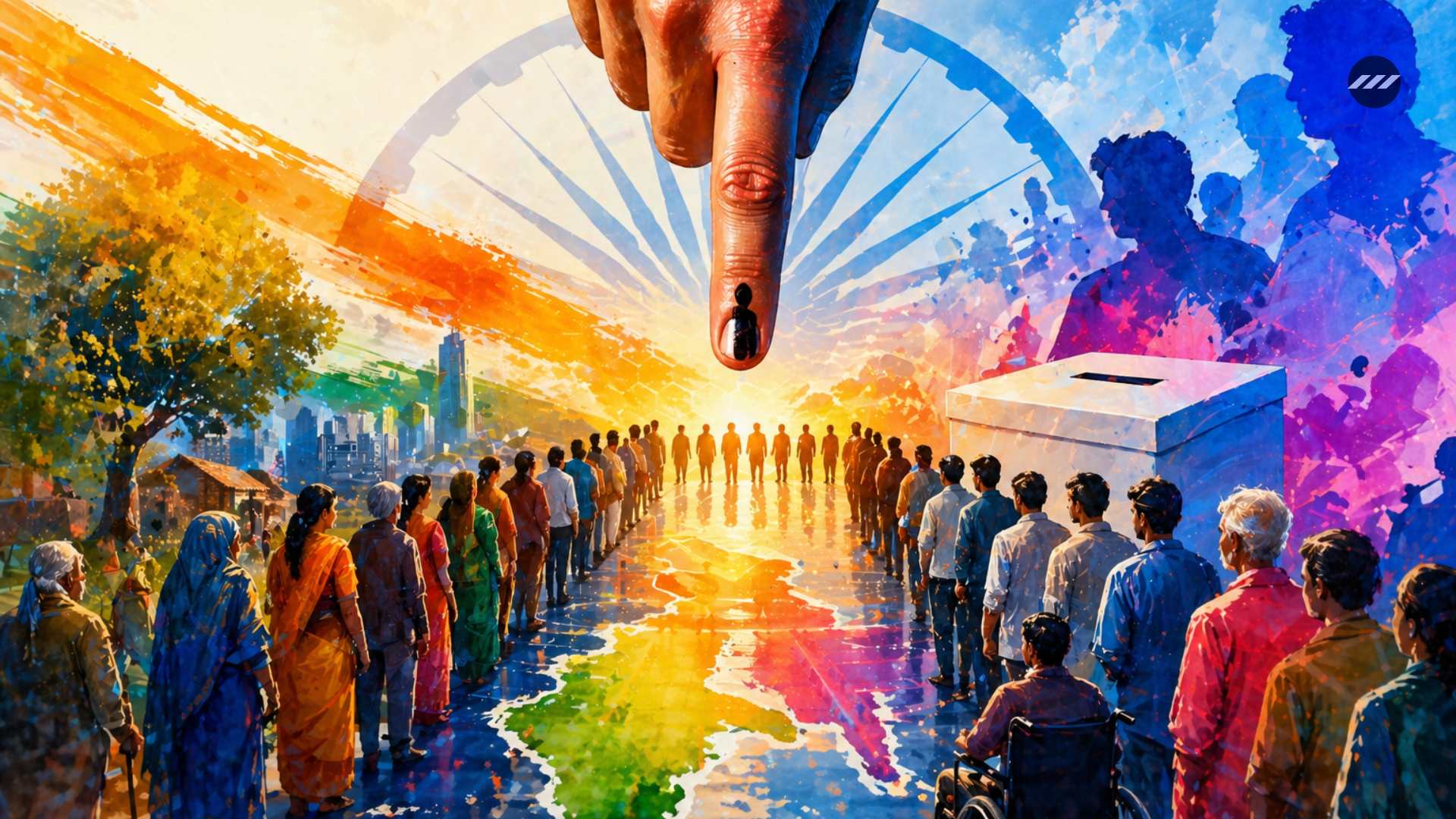
SIR's Impact on India's Billion Electorate and Record Turnout

Introduction
India hosts the world’s largest democracy with ~97 crore registered voters (2024), nearly 70% of its population. However, recent revisions show a decline of ~6 crore voters due to roll purification.
“The credibility of democracy begins with the integrity of the electoral roll.”
Key Data Snapshot
| Indicator | Data |
|---|---|
| Electorate (2024) | ~96.88 crore |
| Post-revision decline | ~6 crore voters |
| Initial electorate (1951) | 17.32 crore |
| Current trend | Possible drop to ~90 crore |
| Turnout (Tamil Nadu 2026) | >85% (record high) |
Background & Context
-
Electoral rolls are revised annually by the Election Commission of India.
-
Special Intensive Revision (SIR) 2025:
- Covered multiple states
- Focused on removal of ineligible voters
-
India’s electorate historically:
- Grew faster than population
- Expanded from 17 crore (1951) → 91+ crore (2021)
Key Concept: Electoral Roll Purification
ASDD Categories
- Absent
- Shifted
- Dead
- Duplicate
👉 Removal of such entries aims to improve accuracy and credibility.
SIR 2025: Key Features
| Feature | Description |
|---|---|
| Scope | 13 States/UTs, 321 districts |
| Reduction | 51 crore → <46 crore (draft stage) |
| Final Adjustment | Partial recovery via new enrolments |
| Process | Document verification, Form-based objections |
| Outcome | Cleaner but smaller electoral rolls |
Analytical Insights
1. Accuracy vs Inclusivity Trade-off
- Positive:
  • Removal of fake/duplicate voters
  • Improved electoral integrity

- Concerns:
  • Risk of exclusion of genuine voters
  • Burden of proof shifted to citizens

--------------------------------------------------

2. Impact on Democratic Participation
- Higher turnout observed:
  • Tamil Nadu: 85%+ turnout

- Suggests:
  • Cleaner rolls may reflect more accurate voter participation

--------------------------------------------------

3. Structural Challenges
- Migration (e.g., UP, Bihar) leads to outdated electoral rolls

- Documentation barriers for:
  • Poor
  • Migrants
  • Marginalised groups

--------------------------------------------------

4. Shift from Expansion to Rationalisation
- Earlier focus:
  • Maximising voter enrolment

- Current focus:
  • Ensuring authenticity and accuracy of electoral rolls
Case Examples
-
Tamil Nadu:
- Roll reduced but turnout increased
-
Uttar Pradesh:
- Significant drop in draft → recovery in final roll
-
West Bengal:
- Political disputes over discrepancies
👉 Shows variation in implementation outcomes.
Implications
Positive
- Strengthens electoral credibility
- Reduces fraud and duplication
- Enhances trust in outcomes
Negative
- Potential disenfranchisement
- Administrative burden on citizens
- Political controversies
Challenges
- Ensuring no eligible voter is excluded
- Transparency in verification process
- Balancing legal rigor with accessibility
- Addressing socio-economic barriers
Way Forward
- Strengthen inclusive enrolment drives (youth, women, migrants).
- Simplify documentation requirements.
- Use technology (Aadhaar-linking with safeguards).
- Enhance grievance redressal mechanisms.
- Increase public awareness and trust-building.
Conclusion
The Special Intensive Revision marks a shift toward quality over quantity in electoral rolls. While purification enhances credibility, democracy ultimately depends on universal inclusion. The challenge for India lies in ensuring that electoral integrity does not come at the cost of citizen disenfranchisement, thereby preserving both the scale and spirit of democracy.
Attribution
Original content sources and authors
_.jpeg)

Syllabus classification
How this article maps to GS papers
Main syllabus
GS2Indian ConstitutionQuick Q&A
What is the Special Intensive Revision (SIR) of electoral rolls, and how does it differ from routine electoral roll revisions in India?
Key features of SIR include:
- Fresh enumeration: Citizens must re-establish their eligibility through forms and documentation
- Removal of ASDD entries: Absent, Shifted, Dead, and Duplicate names are systematically purged
- Higher scrutiny: Non-traceability or non-response can lead to deletion from rolls
For example, the 2025 SIR exercise led to a significant drop in electoral rolls across major States like Uttar Pradesh and Tamil Nadu, indicating large-scale correction of inflated voter lists.
Implications: While SIR enhances the accuracy and credibility of electoral rolls, it also raises concerns about procedural fairness, especially when the burden of proof shifts to citizens. Thus, it represents a trade-off between purification of rolls and potential risks of exclusion.
Why is the accuracy and inclusiveness of electoral rolls considered the foundation of a credible democracy?
Importance can be understood through:
- Legitimacy of outcomes: Elections are accepted only when the voter base is seen as fair and representative
- Prevention of fraud: Removing duplicate or ghost voters reduces scope for manipulation
- Inclusivity: Ensures participation of marginalized groups such as women, migrants, and tribal communities
For instance, India’s global reputation as a robust democracy is partly due to its ability to manage one of the largest electoral rolls in the world with relative credibility.
However, challenges remain: Overemphasis on deletion, as seen during SIR, can risk disenfranchisement. Therefore, a balance must be struck between accuracy (clean rolls) and inclusiveness (no voter left behind). The ultimate test lies in public confidence and acceptance of electoral outcomes.
How has the Special Intensive Revision (SIR) impacted voter turnout and electoral participation in recent State elections?
Mechanism of impact:
- Reduced denominator effect: With fewer registered voters, turnout percentage appears higher
- Cleaner rolls: Removal of ghost voters leads to more accurate turnout calculation
- Mobilisation dynamics: Political parties may focus more on verified voters, increasing participation
For example, Tamil Nadu recorded over 85% turnout after its electorate shrank significantly post-SIR. Similarly, West Bengal witnessed over 90% turnout in a phase of elections.
Critical perspective: While high turnout is often celebrated, it does not automatically imply greater democratic participation. If eligible voters were excluded due to procedural hurdles, the turnout may present a statistical illusion rather than genuine engagement. Therefore, assessing SIR’s impact requires evaluating both quantitative turnout and qualitative inclusiveness.
Critically analyse the benefits and challenges of the SIR exercise in balancing electoral integrity with democratic inclusiveness.
Benefits include:
- Improved accuracy: Removal of ASDD entries enhances reliability of electoral rolls
- Reduced electoral fraud: Limits scope for impersonation and bogus voting
- Administrative clarity: Provides updated and verified voter data for better planning
Challenges include:
- Risk of disenfranchisement: Vulnerable groups may fail to meet documentation requirements
- Burden of proof: Citizens must actively prove eligibility, which may be difficult for migrants and the poor
- Perception issues: Large-scale deletions can lead to political mistrust and allegations of bias
For instance, discrepancies reported in West Bengal highlight how electoral roll revisions can spill over into political contestation.
Conclusion: While SIR is necessary for maintaining electoral integrity, it must be accompanied by robust grievance redressal mechanisms, transparency, and proactive inclusion strategies to ensure that the democratic right to vote is not compromised.
What are the key reasons behind the decline in India’s electorate size despite population growth during the SIR process?
Major reasons include:
- Removal of ASDD entries: Large numbers of absent, shifted, dead, and duplicate voters were eliminated
- Migration patterns: States like Uttar Pradesh and Bihar see frequent mobility, leading to outdated entries
- Non-response and verification failure: Citizens who did not submit enumeration forms or documents were excluded
- Legacy accumulation: Errors built up over decades due to lack of intensive revisions since early 2000s
For example, in Uttar Pradesh, the electorate dropped sharply during the draft stage before partial recovery through new enrolments.
Implications: While the reduction reflects a cleaning of inflated rolls, it also raises concerns about whether all deletions were justified. The decline underscores the need to distinguish between necessary correction and potential exclusion, especially in a country with significant socio-economic disparities affecting documentation and access.
Illustrate with examples how electoral roll revisions can influence political dynamics and public trust in elections.
Illustrative examples:
- Tamil Nadu: A reduced electorate post-SIR coincided with record turnout, which may influence narratives of strong public participation
- West Bengal: Reported discrepancies in rolls led to political controversies and public protests
- Bihar and Uttar Pradesh: Migration-linked deletions have implications for representation of migrant workers
These examples show that electoral roll management is not merely a technical exercise but a politically sensitive process.
Impact on trust:
- Positive: Clean rolls enhance confidence in election results
- Negative: Perceived exclusion or bias can undermine legitimacy
A global parallel can be seen in voter ID debates in the United States, where similar tensions exist between fraud prevention and voter access.
Conclusion: Electoral roll revisions must be conducted with maximum transparency, stakeholder engagement, and accountability to ensure they strengthen rather than weaken democratic trust.
As an election administrator, how would you ensure that future electoral roll revisions maintain both accuracy and inclusiveness?
Key measures include:
- Use of technology: Aadhaar linkage (with safeguards), GIS mapping, and AI tools to detect duplicates without excluding genuine voters
- Door-to-door verification: विशेष focus on vulnerable groups like migrants, elderly, and PVTGs
- Grievance redressal: Fast-track mechanisms for appeals against wrongful deletion
- Awareness campaigns: Encourage citizens to verify and update their details proactively
For example, targeted campaigns in tribal areas have improved voter inclusion in past elections.
Institutional approach: Collaboration with civil society, local bodies, and political parties can enhance transparency and trust.
Conclusion: The goal should not merely be a ‘clean’ electoral roll, but a credible and inclusive one, where every eligible citizen is empowered to vote and no one is excluded due to procedural or systemic barriers.
Practice questions
1 question for mains preparation