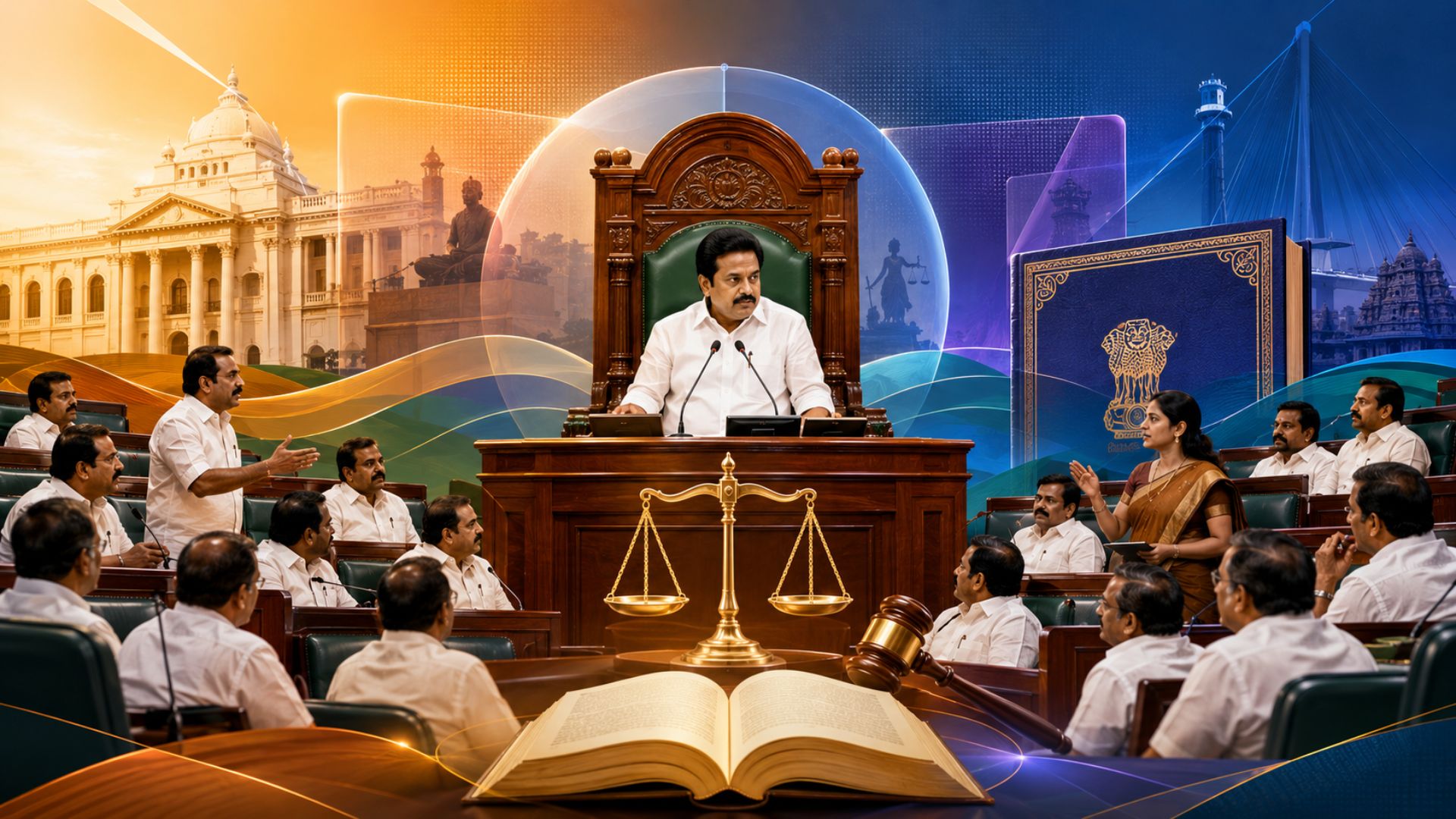
Speaker’s Role, Anti-Defection Law and Constitutional Morality: Lessons from Tamil Nadu
 Dhinesh Balasubramanian
“The success of the anti-defection law depends not only on constitutional provisions but also on the impartiality of the Speaker.”
The recent decision of the Tamil Nadu Legislative Assembly Speaker, J.C.D. Prabhakar, not to proceed with disqualification proceedings against 21 rebel AIADMK MLAs has reignited discussions on the functioning of the Anti-Defection Law, the powers of the Speaker, and the importance of constitutional morality in parliamentary democracy.
Background of the Issue
During a trust vote on May 13, several AIADMK legislators voted in favour of the TVK-led government, defying the party whip.
Sequence of Events
| Event | Details |
|---|---|
| Trust Vote | May 13 |
| AIADMK MLAs who violated whip | 25 |
| MLAs who later resigned | 4 |
| MLAs covered by Speaker's decision | 21 |
| Reconciliation within AIADMK | May 27 |
| Condonation by party leadership | Within 15 days |
AIADMK General Secretary Edappadi K. Palaniswami later condoned the actions of the dissident legislators and formally informed the Speaker.
What Does the Anti-Defection Law Say?
The Tenth Schedule of the Constitution seeks to prevent political defections.
A legislator may face disqualification if:
- They voluntarily give up party membership.
- They vote or abstain contrary to the party whip.
- The party does not condone such action within the prescribed period.
Violation of Party Whip
          ↓
Party Complaint
          ↓
Speaker's Examination
          ↓
Condonation by Party?
      ↙          ↘
    Yes           No
     ↓             ↓
No Disqualification  Possible Disqualification
In this case, the party leadership chose to condone the violation, leading the Speaker to drop proceedings against 21 legislators.
Why Is the Decision Significant?
Upholding Constitutional Morality
The Speaker acted based on:
- Party condonation.
- Constitutional provisions.
- Assembly disqualification rules.
This avoided the use of disqualification proceedings as a political tool.
Demonstration of Impartiality
The Speaker had earlier assured that his decision would reflect neutrality.
Given that:
- AIADMK is politically opposed to the ruling TVK.
- Tamil Nadu has witnessed allegations of partisan Speaker decisions in the past.
The decision has been viewed as a demonstration of institutional fairness.
Historical Concerns Regarding Speaker's Powers
The office of the Speaker occupies a critical constitutional position.
However, concerns have emerged over the years regarding:
- Delay in deciding disqualification petitions.
- Political considerations influencing decisions.
- Broad discretionary powers under the Tenth Schedule.
A frequently cited example is former Speaker P.H. Pandian's assertion that the Speaker possessed "sky-high powers".
Tenth Schedule
       ↓
Discretionary Powers
       ↓
Need for Neutrality
       ↓
Protection of Democratic Principles
The present case is viewed as a departure from such controversies.
The Issue of the Four Resigned MLAs
While proceedings against 21 legislators were dropped, questions remain regarding four MLAs who resigned after violating the whip.
Argument Raised
Some constitutional observers argue that:
- Disqualification proceedings should have been initiated first.
- Resignation should have been considered thereafter.
This is because resignation may otherwise allow legislators to avoid scrutiny under anti-defection provisions.
Practical Limitation
However:
- Their seats have already been declared vacant.
- Election authorities have begun the process for by-elections.
- The practical impact is limited.
Resignation
      ↓
Vacancy Notification
      ↓
By-Election Process

Disqualification
      ↓
Restriction on Becoming Minister
Until Re-elected
Thus, the remaining proceedings may largely be technical in nature.
Broader Constitutional Lessons
The episode highlights:
- Importance of party condonation provisions.
- Need for impartial Speakers.
- Proper application of the Tenth Schedule.
- Balance between party discipline and legislative autonomy.
- Significance of constitutional morality over political expediency.
Way Forward
- Ensure time-bound decisions on disqualification petitions.
- Strengthen institutional neutrality of Speakers.
- Establish clearer guidelines for handling resignation during pending defection cases.
- Promote greater transparency in anti-defection proceedings.
- Revisit recommendations for independent adjudication of defection cases.
Conclusion
The Tamil Nadu Speaker's decision demonstrates the importance of impartial constitutional functioning in a parliamentary democracy. By respecting the condonation provided under the Tenth Schedule and avoiding politically motivated action, the Speaker has reinforced constitutional morality and democratic fairness. The episode also highlights the continuing need to refine the anti-defection framework to ensure both accountability and institutional neutrality.
Attribution
Original content sources and authors

Syllabus classification
How this article maps to GS papers
Main syllabus
GS2Indian ConstitutionQuick Q&A
What is the anti-defection law under the Tenth Schedule and what is its significance in India's parliamentary democracy?
Why is the role of the Speaker in disqualification proceedings considered crucial and controversial in Indian constitutional practice?
How does the process of disqualification under the Tenth Schedule operate and what role does party condonation play in such cases?
Critically analyse the strengths and limitations of the anti-defection law in preserving democratic stability and constitutional morality.
What lessons regarding constitutional morality and institutional impartiality emerge from the recent Tamil Nadu Assembly episode?
What are the reasons behind recurring demands for reforms in the anti-defection framework and the powers of the Speaker?
Practice questions
1 question for mains preparation