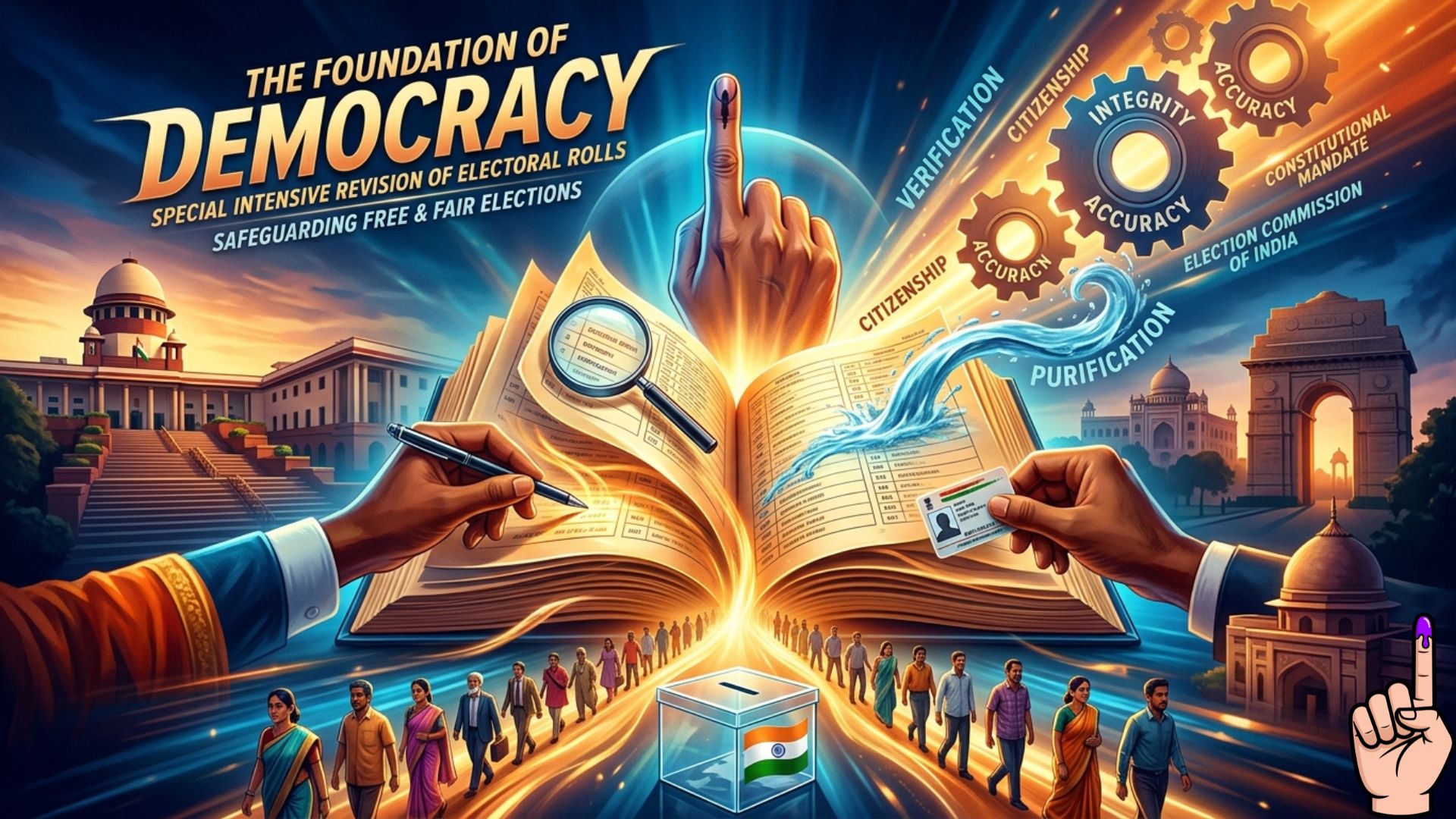
Supreme Court's Landmark Decision on Electoral Roll Revision

On May 27, 2026, the Supreme Court upheld the Special Intensive Revision (SIR) of electoral rolls as an exercise carried out by the Election Commission of India (ECI) in furtherance of its constitutional obligation to conduct free and fair elections.
The judgment, authored by Chief Justice Surya Kant, anchors electoral integrity not merely in the act of voting but in the foundation that precedes it—the electoral roll itself.
"Before any representative government can count votes, it must first know whose votes may be counted. The story of democracy is therefore not only a story of voting, but also of identifying the persons entitled to participate in the choice of government."
Why the Verdict Matters
The ruling, affirming the constitutionality of the Bihar SIR, carries consequences well beyond one State:
- The second phase of the SIR—covering 51 crore voters across 12 States and UTs, including West Bengal and Tamil Nadu—had already commenced while the Bihar challenge was pending.
- The bench of CJI Surya Kant and Justice Joymalya Bagchi located the exercise within the constitutional scheme, holding that free and fair elections depend on the integrity, accuracy and purity of the electoral roll.
The Core Question: Was SIR a "Backdoor" Citizenship Screening?
The petitioners argued that the SIR was a disguised citizenship screening exercise—purging the rolls of "aliens" under the cover of purification. The Court rejected this:
- The EC was within its authority to verify citizenship, but only to the limited extent of determining inclusion or exclusion from the roll.
- As CJI Kant observed, citizenship is a "condition precedent for enrolment", and the EC is empowered to examine questions bearing upon it while revising rolls.
To balance this power, the Court built in a corrective mechanism:
THE CITIZENSHIP REFERRAL DIRECTION
• Within 4 weeks, the EC must refer to the Centre the
  names of electors who were on the 2003 roll but
  purged in the Bihar SIR as non-citizens.
• A competent authority under the Citizenship Act must
  decide their cases before the next Vidhan Sabha /
  local body elections.
• Names to be RESTORED if found to be citizens.
Persons wrongly deleted on grounds of absence, death, duplication or shifting were also given the right to challenge the EC's decision before the courts.
BIHAR ELECTORAL ROLL: THE NUMBERS
  When SIR notified (June 24, 2025)  →  7.89 crore
  Final roll (Sept 30 last year)     →  7.42 crore
  Excluded electors (list published) →  ~65 lakh
The Constitutional Basis
The Court clarified that the SIR did not override existing law—rather, it gave effect to constitutional intent:
- It did not supplant the Representation of the People (RP) Act or the Registration of Electors Rules, 1960.
- Instead, it "breathed life into" Article 324—the EC's power to conduct and supervise elections.
- This supervisory authority was described as a "continuous wellspring of power", covering every stage of the electoral machinery.
- Section 21(3) of the RP Act gave the Commission a "flexible and enabling power" to depart from ordinary revision whenever circumstances warranted.
Cogent Justifications
The Court rejected the claim that SIR lacked empirical foundation, accepting the EC's reasons as matters of "common administrative experience":
- Over two decades had passed since the last intensive revision.
- Large-scale additions and deletions over that period.
- Rapid urbanisation and migration, creating repeated or defective entries.
- Non-reporting of deaths and duplication of entries.
The electoral roll, the Court held, is not a static document and must evolve with changes in population, residence and eligibility. A systemic problem of cumulative inaccuracy, it reasoned, "does not readily admit of piecemeal solutions."
Safeguards Against Hardship
The Court refused to accept that the SIR caused suffering, pointing to safeguards in place:
- Inclusion of Aadhaar as the 12th "indicative" document for citizenship verification.
- A direction to publish the complete list of ~65 lakh excluded electors.
- Active assistance by booth-level agents of political parties at the grassroots.
On the contention under Rule 21A—that names were deleted without notice or hearing—the Court held that "core safeguards" were followed:
- Deleted electors were issued notice.
- An enquiry was undertaken.
- A "reasoned determination" was made on inclusion or exclusion.
A mere prior entry, it added, cannot preclude a fresh enquiry by the EC.
Way Forward
The verdict settles the legality of SIR but leaves the burden of fair execution on the institutions involved:
- Time-bound citizenship adjudication: The Centre must ensure the competent authority decides referred cases swiftly, so genuine citizens are not disenfranchised before elections.
- Transparency at scale: As the exercise extends to 51 crore voters, publishing exclusion lists and ensuring grassroots assistance must be consistent across all 12 States and UTs.
- Accessible grievance redress: The right to challenge wrongful deletion must translate into easy, affordable remedies, especially for the poor and migrants.
- Guarding against arbitrariness: The strength of Rule 21A safeguards—notice, enquiry, reasoned order—must be uniformly upheld, not reduced to a formality.
Conclusion
The judgment reframes electoral integrity as a question of who is entitled to vote as much as how votes are cast. By upholding the SIR while attaching safeguards and a citizenship-adjudication mechanism, the Court sought to balance two imperatives: the EC's duty to maintain a pure electoral roll, and the citizen's fundamental stake in not being wrongly excluded. The real test now lies in execution—ensuring that the pursuit of an accurate roll across the country strengthens, rather than narrows, the democratic franchise.
Attribution
Original content sources and authors


Syllabus classification
How this article maps to GS papers
Main syllabus
GS2Indian ConstitutionQuick Q&A
What is the Special Intensive Revision (SIR) of electoral rolls, and why did the Supreme Court uphold its constitutional validity?
The Supreme Court upheld the constitutional validity of the SIR by emphasizing that free and fair elections are impossible without accurate electoral rolls. The Bench observed that democracy is not confined merely to voting mechanics; it also requires a reliable identification of eligible voters. Therefore, the Court held that the SIR bears a “direct nexus” with the constitutional mandate under Article 324, which empowers the Election Commission to supervise and conduct elections.
The Court clarified that citizenship verification in this context is limited and incidental. Since only citizens can vote under Indian law, the ECI is empowered to examine citizenship-related issues for electoral inclusion or exclusion. However, the Court also ensured safeguards by directing disputed cases to be adjudicated under the Citizenship Act by competent authorities.
Importantly, the judgment reinforces institutional autonomy of the Election Commission. It recognizes that electoral rolls are dynamic documents affected by migration, urbanisation, deaths, and demographic changes. The Court therefore accepted the ECI’s argument that a large-scale revision was administratively necessary after two decades.
From a constitutional perspective, the judgment strengthens procedural democracy while balancing individual rights with electoral integrity. It demonstrates judicial support for institutional mechanisms aimed at preserving the sanctity of elections.
Why are accurate and updated electoral rolls considered essential for the functioning of a constitutional democracy?
The Supreme Court emphasized that democracy is not merely about counting votes but also about identifying whose votes may legitimately be counted. If electoral rolls contain deceased persons, duplicate registrations, or ineligible entries, the credibility of the electoral process can be compromised. Similarly, wrongful exclusion of genuine voters undermines the constitutional principle of universal adult franchise under Article 326.
India’s socio-economic realities make periodic revision especially important. Rapid urbanisation, migration, inter-state mobility, and demographic changes continuously alter voter distribution. For instance, migrant workers shifting cities may remain registered in multiple constituencies, creating duplication risks. Similarly, non-reporting of deaths can inflate voter rolls.
Accurate electoral rolls also strengthen governance and political accountability. Clean voter databases help ensure fair constituency representation and reduce allegations of electoral malpractice. Political parties and candidates rely on credible electoral rolls for campaign planning and voter outreach.
However, the process must balance electoral integrity with individual rights. Excessively aggressive revision exercises may risk exclusion of marginalized populations such as migrant workers, elderly citizens, homeless persons, or those lacking documentation. Therefore, procedural safeguards like notice, hearing, and appeal mechanisms are essential.
Globally, electoral roll accuracy is considered a key democratic indicator. Democracies such as Canada, Australia, and the United Kingdom periodically revise voter rolls using technological and administrative tools. India’s SIR exercise reflects a similar attempt to modernize and purify electoral administration while preserving democratic legitimacy.
How does Article 324 empower the Election Commission of India, and what was the Supreme Court’s interpretation in the SIR judgment?
In the SIR judgment, the Supreme Court interpreted Article 324 as a “continuous wellspring of power”. The Court observed that the ECI’s powers are not limited to conducting polling alone but extend to every stage of the electoral process, including preparation and revision of electoral rolls. This interpretation broadens the functional scope of the Commission in safeguarding electoral integrity.
The Court also linked Article 324 with the Representation of the People Act and the Registration of Electors Rules, 1960. It clarified that the SIR did not override statutory provisions but rather operationalized them to fulfill constitutional objectives. Section 21(3) of the RP Act was interpreted as giving the Commission flexibility to undertake extraordinary revisions whenever circumstances require.
This judgment has important constitutional implications. It strengthens institutional autonomy and recognizes the ECI as an active constitutional authority rather than a passive administrative body. The Court accepted that issues such as migration, duplication, and outdated records justified a comprehensive revision exercise.
At the same time, judicial oversight remained visible. The Court insisted on procedural safeguards such as notice, inquiry, and reasoned decisions before deletion of names. It also directed that disputed citizenship cases be adjudicated under the Citizenship Act rather than by the ECI alone.
Therefore, the judgment establishes a balance between institutional empowerment and constitutional accountability. It demonstrates that Article 324 is both a source of broad electoral authority and a mechanism constrained by principles of fairness, due process, and democratic inclusion.
Critically analyse the concerns associated with the Special Intensive Revision (SIR) exercise despite the Supreme Court’s endorsement.
One major concern relates to wrongful exclusion. Electoral participation is a constitutional right linked to democratic citizenship. Errors during verification could deprive genuine citizens of voting rights. In Bihar, the electoral roll reportedly declined from 7.89 crore to 7.42 crore electors after the SIR process, raising apprehensions regarding the scale of deletions.
Another issue involves the overlap between electoral verification and citizenship determination. Although the Court clarified that the ECI’s role is limited to voter eligibility, critics fear that such exercises could indirectly resemble citizenship screening. This concern is particularly sensitive in regions with migration-related political debates.
Administrative capacity is another challenge. Conducting intensive revision exercises involving crores of voters requires trained staff, technological infrastructure, and robust grievance redressal mechanisms. Inadequate implementation may result in arbitrary decisions or inconsistencies across districts.
However, supporters argue that electoral integrity requires periodic cleansing of voter rolls. Duplicate entries, non-reporting of deaths, and multiple registrations undermine public confidence in elections. The Court accepted these concerns as matters of “common administrative experience.”
The safeguards introduced by the Court are therefore crucial. These include notice before deletion, opportunities for hearing, publication of excluded lists, Aadhaar inclusion as an indicative document, and judicial remedies for aggrieved persons. Such procedural protections attempt to balance electoral purity with democratic inclusion.
Ultimately, the success of the SIR will depend not merely on legal validity but on fair implementation. A democratic system must ensure both clean electoral rolls and maximum voter inclusion. Electoral integrity and democratic participation should reinforce—not undermine—each other.
What were the major reasons cited by the Election Commission and accepted by the Supreme Court for conducting the SIR exercise?
One major reason was the passage of time since the last intensive revision. Electoral rolls are dynamic documents that must reflect current demographic realities. Since the previous intensive revision occurred over two decades ago, large-scale inaccuracies were likely to have accumulated over time.
Migration and urbanisation were also identified as critical factors. India has witnessed rapid internal migration due to economic opportunities, urban expansion, and social mobility. Migrant populations may remain registered in previous constituencies while simultaneously registering in new locations, creating duplication risks.
Another important concern involved non-reporting of deaths and defective entries. Administrative records often fail to capture all demographic changes in real time. As a result, electoral rolls may contain names of deceased persons or individuals no longer residing in a constituency.
The Court emphasized that these concerns did not require extraordinary empirical proof. Chief Justice Surya Kant observed that such issues are matters of “common administrative experience.” Therefore, the Commission was justified in undertaking a systemic rather than piecemeal solution.
The Court also relied on Section 21(3) of the Representation of the People Act. This provision allows the Election Commission flexibility to revise electoral rolls “in any manner as it may deem fit” when circumstances demand special intervention.
From a broader governance perspective, the reasons reflect the challenge of managing electoral systems in a large and mobile democracy like India. With over 90 crore voters, ensuring electoral accuracy requires continuous updating and technological adaptation.
Thus, the SIR was viewed not as an extraordinary deviation but as a necessary institutional response to evolving demographic and administrative realities.
As a District Election Officer, how would you ensure that an intensive electoral roll revision exercise maintains both electoral integrity and democratic inclusion?
The first step would involve strengthening transparency and public awareness. Citizens must clearly understand the purpose of the revision, required documentation, deadlines, and grievance mechanisms. Awareness campaigns through local media, Panchayati Raj Institutions, schools, and civil society organizations would reduce confusion and misinformation.
Special attention should be given to vulnerable groups. Migrant labourers, elderly citizens, persons with disabilities, homeless individuals, and women lacking documentation often face exclusion risks. Mobile verification camps, simplified procedures, and multilingual assistance can help ensure inclusivity.
Technology and data integration should be carefully utilized. Digital voter databases, Aadhaar-based indicative verification, and GIS mapping can reduce duplication and improve accuracy. However, technological systems must not become exclusionary due to digital illiteracy or connectivity issues.
Procedural fairness is equally important. Before deleting any voter’s name, proper notice, hearing opportunities, and reasoned decisions should be mandatory. Booth-level officers and booth-level agents from political parties should participate transparently to enhance credibility.
A robust grievance redressal mechanism is essential. Fast-track appeal systems, helplines, online portals, and local facilitation centres should be established so that aggrieved citizens can quickly challenge wrongful deletions.
Finally, coordination with local administration is crucial. Death registration departments, municipal bodies, and migration records can help maintain updated voter databases. Continuous revision rather than sudden large-scale correction exercises may also reduce administrative disruption.
In essence, electoral administration in a democracy is not merely a technical exercise but a constitutional responsibility. The credibility of elections depends equally on preventing fraudulent entries and ensuring that every eligible citizen can participate without unreasonable barriers.
Practice questions
1 question for mains preparation