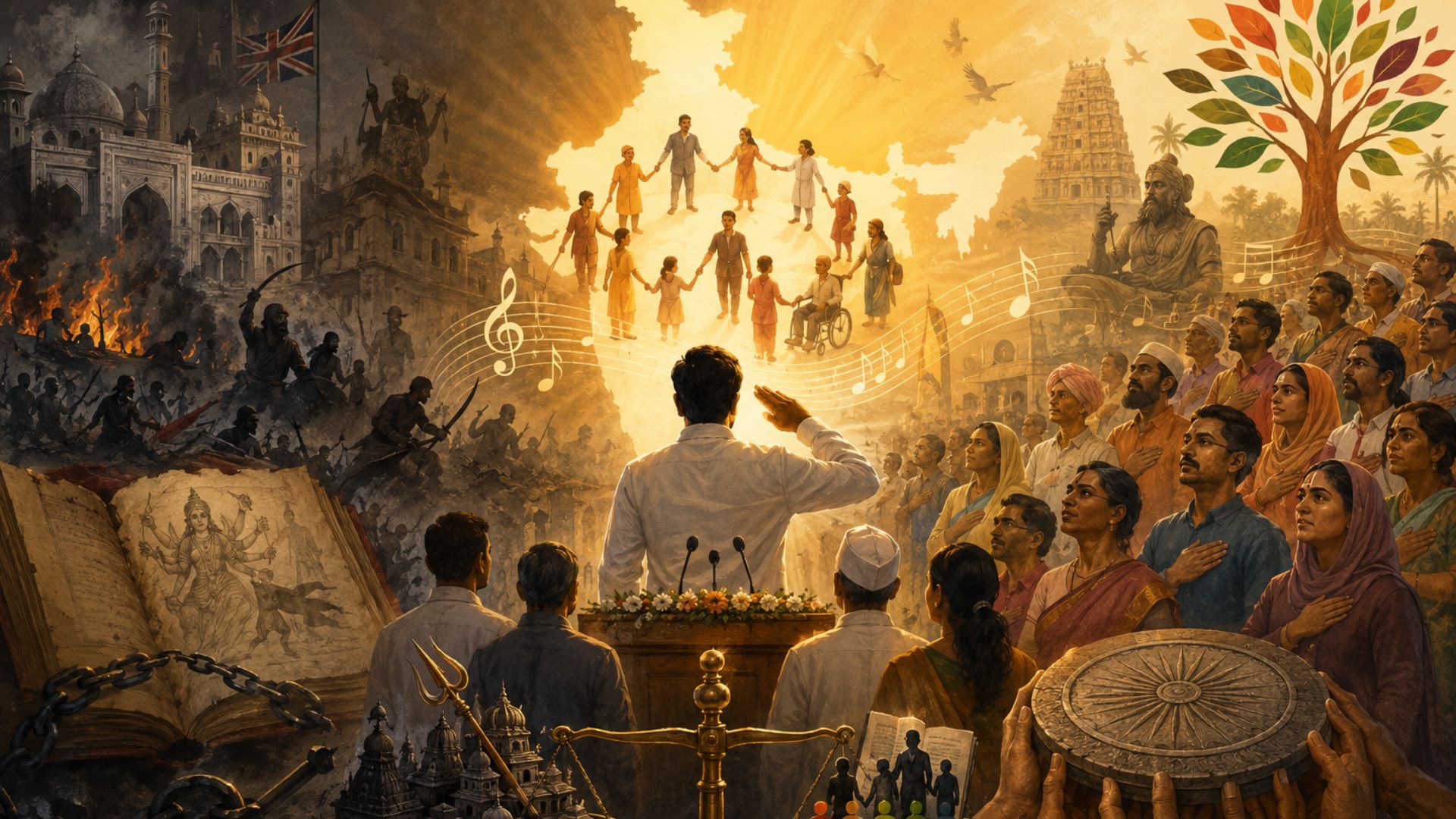
Vande Mataram's Role in Multicultural Nationalism Debate

"An idea or a text derives its meaning from the context in which it emerges; without that context, it becomes a mere ritual."
The Trigger
The oath-taking of C. Joseph Vijay as Tamil Nadu's 13th Chief Minister (May 10) saw three anthems played in sequence — Vande Mataram, Jana Gana Mana, and Tamil Thai Vaazhthu. This single ceremonial moment surfaced a debate that has never been fully resolved: can a song with demonstrable communal origins serve as a secular national symbol?
The Tamil Anthem: A Useful Contrast
Before examining Vande Mataram, the Tamil anthem offers an instructive parallel on how state symbols and their mandatory use become contested:
- Tamil Thai Vaazhthu — written 1871, sung at Tamil Nadu government events since 1970 on Karunanidhi's order
- Explicitly secular — praises Tamil language and culture, invokes no religion
- 2018: Controversy when the Kanchi Pontiff refused to stand during its singing
- 2021: Madras HC ruled it carried no statutory obligation to stand
- DMK response: Declared it the official State song, mandated standing, placed it before the national anthem
The contrast is telling — a song with zero religious content still generated contestation over mandatory respect. The Vande Mataram question runs far deeper.
The Song and Its Source
Novel:   Anandamath (1882) — Bankim Chandra Chatterji
Context: Sannyasi rebellion against Muslim rule
Stance:  Welcomed British rule as transformative for India
Song:    Vande Mataram ("Hail to the Mother")
Two translations — two very different pictures:
| Translation | Year | Nature |
|---|---|---|
| Abbey of Bliss — Nares Chandra Sen-Gupta | 1906 | Original context intact |
| Basanta Koomar Roy | 1941 | Communal content removed for independence movement use |
The 1941 version is what most Indians know. It is a sanitised text. The original 1906 translator, Sen-Gupta, himself flagged in his prefatory note:
- "Morbid dislike of Mussulmans" as a defining feature of the novel
- An attempt to "rehabilitate the Hindu Pantheon with new-fangled patriotic gods and goddesses"
- Heroes of the novel openly hostile to Muslims
What the original novel contains:
✗ Explicit glorification of Hinduism
✗ Anger that caste system was unprotected under Muslim rulers
✗ Calls to burn Muslim homes and pillage them
✗ Frames British rule as desirable for reviving true Hinduism
Professor William J. Jackson (Indiana University) noted that Bankim Chandra himself would not have approved of the omissions made in the 1941 translation — the version that entered the nationalist mainstream.
How the Freedom Movement Handled It
The founding generation engaged with this complexity honestly:
- Nehru read the original 1906 Abbey of Bliss translation — acknowledged it would irritate Muslims
- 1937 Congress resolution: Only first two stanzas to be sung — praising the motherland's natural beauty and abundance — later stanzas excluded for religious glorification
- Constituent Assembly: Despite praise from Bengali members including Syama Prasad Mookerjee — Jana Gana Mana was adopted as national anthem
- The first two stanzas were thus given consensual nationalist legitimacy; the rest were set aside by informed, deliberate choice
This was not rejection — it was contextual wisdom.
The Core Constitutional Question
The 2026 government mandate to sing the full song — not just the first two stanzas — at all government events reopens what the founding generation had carefully settled:
- Later stanzas explicitly invoke Hindu religion — incompatible with a constitutionally secular state's official ceremonies
- A secular republic's government events must be religiously neutral by design
- The first two stanzas carry legitimate nationalist sentiment — their use has broad historical consensus
- Mandating the full song conflates cultural nationalism with religious identity — a distinction the Constitution draws clearly
First two stanzas  →  Celebrate motherland's nature, abundance, beauty
                   →  Historically accepted across communities
                   →  Consistent with secular public ceremonies

Later stanzas      →  Explicitly invoke Hindu goddesses and religion
                   →  Excluded by Congress in 1937 for good reason
                   →  Incompatible with secular government functions
Way Forward
- Retain the first two stanzas at national events — they carry literary excellence, nationalist history, and community consensus
- Restore the 1937 framework — a considered, informed position arrived at by leaders who had read the original source
- Contextual education — Vande Mataram's full literary and historical background must be part of civic curricula; reverence without context produces ritual, not nationalism
- Distinguish cultural pride from state imposition — a song can be celebrated as literature and history without being mandated as a secular state symbol in its entirety
- Strengthen the multicultural constitutional framework — Indian nationalism is plural by design, not by accident
Conclusion
Vande Mataram is a text of genuine literary power and historical significance in India's freedom struggle. But it is also a text with a specific, documented origin that its own first translator found deeply troubling. The freedom movement's leaders — having read the original — made a careful, principled decision: the first two stanzas yes, the full song no. That decision was not timidity. It was constitutional foresight. A secular, multicultural republic must build its shared symbols on the widest possible common ground — not on texts that sections of its own citizenry have legitimate, historically grounded reasons to find exclusionary.
Attribution
Original content sources and authors


Syllabus classification
How this article maps to GS papers
Main syllabus
GS2Indian ConstitutionQuick Q&A
What is the constitutional and cultural significance of Vande Mataram and Tamil Thai Vaazhthu in the context of Indian federalism?
From a constitutional perspective, India accommodates both national unity and cultural diversity. The Constitution does not designate Vande Mataram as the national anthem, but recognises its historic role. Tamil Thai Vaazhthu functions as a State song, reflecting the principle of cooperative federalism. Tamil Nadu’s decision to institutionalise it demonstrates how States can preserve linguistic heritage without undermining national identity.
Example: Similar regional symbols exist across India, such as state songs and emblems, which coexist with national symbols. This balance reflects the constitutional vision of unity in diversity, where local identities enrich rather than weaken the national framework.
Why has the mandatory singing of the full verses of Vande Mataram generated political and constitutional controversy?
The original setting of the song in Anandamath reveals anti-Muslim and exclusionary themes. Critics argue that making the full version mandatory transforms a literary work into a state-imposed ideological statement. In a diverse country, compulsory symbolic acts can alienate communities who may perceive them as privileging one cultural narrative over others.
Case: In 1937, the Congress itself restricted public singing to the first two stanzas after concerns from Muslim leaders. This demonstrates that the issue predates current politics and reflects long-standing constitutional sensitivity toward communal inclusiveness.
How does the historical context of Anandamath shape contemporary debates on nationalism and secularism?
Contemporary secularism in India is based on equal respect for all faiths. When a text rooted in communal narratives is elevated to official ceremonies, questions arise about whether the state is endorsing a majoritarian identity. The historical background complicates its role as a neutral national symbol.
Example: Jawaharlal Nehru studied the original English translation before supporting only selective usage. This demonstrates how historical understanding informed constitutional decision-making during the freedom struggle.
Critically analyse whether compulsory patriotic rituals strengthen national unity or risk symbolic exclusion.
However, when participation is enforced, especially in a culturally diverse society, rituals may become coercive rather than unifying. Constitutional patriotism is based on shared values like liberty, equality, and fraternity — not mere symbolic compliance. Forced participation may marginalise minorities who associate certain symbols with exclusionary politics.
Evaluation: The Supreme Court has repeatedly emphasised that patriotism cannot be reduced to ritual acts alone. True national integration depends more on justice, inclusion, and equal citizenship than on mandated performances.
What explains the continued relevance of debates around national symbols in modern India?
In India, where diversity is foundational, disputes over symbols often mirror deeper debates over secularism, federalism, and minority rights. The revival of historical symbols during politically polarised times may reflect attempts to reshape nationalism around a dominant cultural identity.
Example: Debates over language policy, Hindi imposition, and state songs show that symbolic issues often become proxies for larger constitutional disputes concerning identity and inclusion.
What lessons does the Tamil Nadu case offer regarding balancing regional identity with national integration?
The legal and political debates surrounding standing for the anthem reveal how democratic institutions mediate symbolic conflicts. Courts, state governments, and civil society all played roles in defining its official status. The process shows that regional symbols gain legitimacy through constitutional procedures, not cultural imposition.
Broader lesson: India’s federal model allows strong sub-national identities. Rather than suppressing regional cultures, national integration is stronger when these identities are respected within the constitutional framework.
Practice questions
1 question for mains preparation