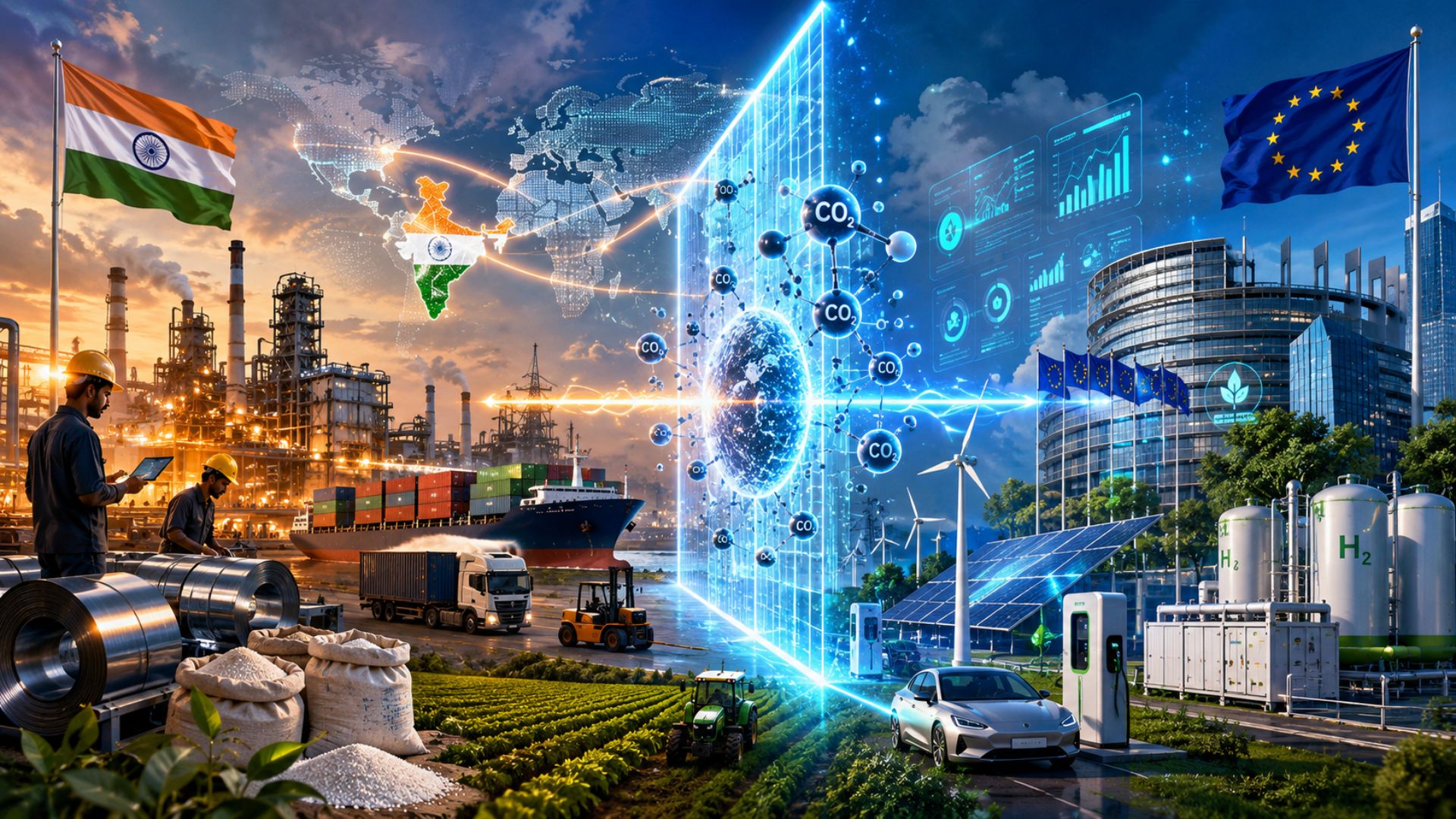
Tariffs on Carbon: Navigating India's Trade Challenges

The European Union's Carbon Border Adjustment Mechanism (CBAM), proposed in July 2021, entered its definitive phase on January 1, 2026. As a climate policy tool, it imposes a carbon-linked charge on imports based on their embedded emissions, seeking to prevent carbon leakage—the shifting of production to countries with laxer climate norms. While CBAM may encourage wider carbon-pricing adoption and help reduce global emissions, it poses significant challenges for developing economies like India.
"Market access and export growth are no longer determined by tariffs alone."
This marks a structural shift: comparative advantage now depends not only on production efficiency and pricing, but also on the carbon efficiency of production processes.
Why CBAM Matters for India
Even as India pursues bilateral trade negotiations with the EU, CBAM will still apply, making carbon-intensive exports costlier. Market access is increasingly shaped not only by tariffs but by compliance with carbon-emission standards. Crucially, the products in CBAM's net are ones where India has export stakes:
CBAM-COVERED SECTORS
• Steel        • Cement      • Aluminium
• Fertilizers  • Electricity • Hydrogen
Sectors Under Pressure
Steel and aluminium face the most immediate impact, given their dependence on European markets and carbon-intensive production. Though the levy is formally paid by EU importers, part of the burden is likely to shift to exporters:
- As European buyers prefer low-emission suppliers, Indian exporters may absorb additional costs to stay competitive—or invest in cleaner technologies to retain access.
- In the short run, compliance costs could shrink profit margins and hurt export competitiveness, despite ongoing FTA negotiations.
The effects extend beyond direct trade. As a major net importer of fertilizers, India faces indirect price pressures through global price transmission:
THE FERTILIZER CHANNEL
Egypt, Russia, Morocco, China
  → major fertilizer exporters to the EU
  → also major suppliers to India
  → face higher carbon-compliance costs
  → pass burden via higher global prices
  → India's import bill rises
  → strains farm profitability + food prices
More broadly, CBAM signals that other developed countries may adopt similar carbon-tariff policies, potentially constraining market access for developing nations.
How CBAM Differs from Traditional Barriers
CBAM is structurally distinct from conventional non-tariff measures (NTMs) such as product standards:
- NTMs are largely qualitative, affecting access through compliance requirements with scope for interpretation.
- CBAM is price-based and quantifiable, directly linking market access for carbon-intensive products to their carbon emissions.
The implication is sharp: even if exporters comply with product-quality standards in destination markets, the carbon intensity of production can raise export costs and constrain access. Worse, transitioning toward carbon-neutral production is significantly more expensive than meeting conventional quality standards, especially in the short run.
Way Forward
India must adopt a two-pronged strategy of domestic reform and effective international negotiation.
Domestically:
- Greater investment in clean energy and stricter implementation of carbon policies to improve firms' carbon efficiency.
- Reduce fertilizer-import dependence through higher domestic production, better implementation of the Soil Health Cards Scheme, and promotion of balanced, need-based fertilizer application.
Internationally:
- Negotiate for equitable treatment of developing countries, so short-run compliance costs are eased through a phased transition.
- Seek transitional support and technology transfer to ensure a level playing field in trade agreements with developed nations.
Conclusion
CBAM reflects a deeper transformation in the architecture of global trade, where carbon efficiency is becoming as decisive as price and quality. For India, the challenge is not merely adapting to a carbon-constrained trade regime, but ensuring that the transition does not undermine growth and sustainability. Keeping India's "carbon money" at home—through domestic decarbonisation and assertive negotiation—will determine whether the country turns this disruption into a competitive advantage or absorbs it as a lasting cost.
Attribution
Original content sources and authors


Syllabus classification
How this article maps to GS papers
Main syllabus
GS2International RelationsAlso covers
Quick Q&A
What is the European Union’s Carbon Border Adjustment Mechanism (CBAM), and how does it differ from traditional trade barriers?
CBAM differs significantly from traditional non-tariff measures (NTMs). Conventional NTMs generally involve qualitative compliance standards such as safety rules, product certifications or technical specifications. CBAM, however, is price-based and directly links market access to the carbon intensity of production. Thus, exporters may meet all quality standards but still face additional costs if their production processes generate higher emissions.
The mechanism reflects a broader transformation in global trade governance. Earlier, comparative advantage depended largely on labor costs, productivity and pricing efficiency. Under CBAM-like regimes, carbon efficiency becomes an equally important determinant of competitiveness. Therefore, countries with cleaner production systems gain greater market access advantages.
For India and other developing economies, this creates both opportunities and challenges. While CBAM may encourage cleaner industrial practices and global climate accountability, it can also increase compliance costs for industries lacking access to affordable green technologies. Critics argue that such mechanisms may function as disguised protectionism because developed countries possess greater financial and technological capacity to transition toward low-carbon production.
Therefore, CBAM is not merely an environmental measure but also a geopolitical and economic instrument. Its long-term implications extend to international trade negotiations, industrial policy, climate justice and the future architecture of global economic governance.
Why does the EU’s CBAM pose significant challenges for developing countries such as India?
The challenge is particularly severe because many developing countries lack equal access to green technologies and climate finance. Developed economies have greater financial capacity to subsidize clean energy transitions, invest in low-carbon manufacturing and adopt advanced technologies. In contrast, countries such as India still face developmental priorities including poverty reduction, industrialization and energy access. Therefore, rapid carbon transition imposes a disproportionate burden on emerging economies.
CBAM may also indirectly affect India’s agricultural and industrial sectors. The article highlights that India imports fertilizers from countries such as Russia, Egypt, Morocco and China. Since these suppliers also export to the EU, higher carbon-compliance costs may increase global fertilizer prices. Consequently, India’s fertilizer import bill may rise, affecting farm profitability and food inflation.
Another concern is the possibility of carbon protectionism. Although CBAM is presented as a climate policy, critics argue that it may function as a trade barrier favoring developed-country industries. Smaller exporters may lose competitiveness because compliance with carbon accounting systems and cleaner production technologies requires substantial investment.
At the same time, CBAM signals a structural transformation in global trade. Market access is increasingly linked not only to price competitiveness but also to carbon efficiency. Therefore, India cannot ignore these developments. The challenge lies in balancing climate commitments, industrial growth and developmental equity while ensuring that environmental regulations do not become instruments of unequal economic pressure.
How can India respond strategically to the challenges posed by carbon-linked trade measures such as CBAM?
Strengthening domestic carbon governance mechanisms is equally important. India may gradually expand carbon pricing mechanisms, emissions trading systems and green industrial incentives to encourage cleaner production. Policies promoting energy efficiency, waste recycling and sustainable manufacturing can reduce the carbon footprint of Indian exports. Simultaneously, the government should support industries through technology upgrades, concessional finance and research incentives.
Internationally, India must negotiate for climate justice and equitable transition frameworks. Developing countries have historically contributed less to global emissions compared to industrialized economies. Therefore, India should advocate differentiated responsibilities under international climate negotiations. India can seek transitional support, technology transfer arrangements and climate finance assistance within trade agreements and multilateral forums.
Reducing dependence on vulnerable imports is another important strategy. Since CBAM may increase global fertilizer prices, India should improve domestic fertilizer production and strengthen schemes such as the Soil Health Cards Scheme to promote balanced fertilizer usage. Efficient agricultural practices can reduce import dependence and lower long-term vulnerabilities.
Ultimately, India’s response must integrate sustainability with economic growth. Instead of viewing CBAM solely as a threat, India can treat it as an opportunity to modernize industrial systems and become a competitive supplier in the emerging green economy. A carefully managed transition can improve long-term resilience, export competitiveness and environmental sustainability.
Critically analyse whether CBAM represents a genuine climate policy or a form of green protectionism.
From an environmental perspective, CBAM creates incentives for cleaner production worldwide. By linking market access to carbon efficiency, it encourages industries across countries to adopt sustainable technologies and reduce emissions. In theory, such mechanisms can accelerate global climate action and contribute to international commitments under the Paris Agreement.
However, critics contend that CBAM may function as a disguised trade barrier. Developed countries possess greater technological capabilities, financial resources and institutional capacity to comply with stringent carbon standards. Developing economies such as India face higher transition costs because they continue to depend on coal-based industrialization and affordable energy systems to support economic growth and employment.
The issue of climate justice further complicates the debate. Historically, industrialized countries contributed the largest share of greenhouse gas emissions during their development process. Imposing carbon-linked trade barriers on developing countries without adequate financial and technological support may appear inequitable. Smaller exporters may struggle to comply with complex reporting requirements and expensive green transitions.
At the same time, dismissing CBAM entirely as protectionism may be inadequate. Climate change is a global crisis requiring collective responsibility. Therefore, the challenge lies in designing carbon-related trade measures that are transparent, non-discriminatory and sensitive to developmental inequalities.
A balanced approach would involve phased implementation, technology transfer and climate finance support. Such measures can ensure that climate policies achieve environmental objectives without deepening global economic inequalities.
Why are India’s steel, aluminium and fertilizer sectors particularly vulnerable under the CBAM framework?
These sectors are also deeply integrated into global trade networks. Europe remains an important export destination for Indian steel and aluminium products. Although the formal carbon levy is paid by EU importers, market pressures are likely to shift part of the burden onto Indian exporters through stricter supplier standards, lower purchasing prices and reduced competitiveness. Companies may therefore need to invest heavily in cleaner technologies to maintain market access.
The fertilizer sector faces a different but equally significant vulnerability. India imports substantial quantities of fertilizers from countries such as Russia, Egypt, Morocco and China. Since these suppliers themselves face CBAM-related compliance costs while exporting to Europe, global fertilizer prices may rise through international price transmission mechanisms.
Higher fertilizer prices can create multiple economic consequences for India. Increased import costs may raise subsidy burdens for the government, reduce farm profitability and contribute to food inflation. Since agriculture remains a critical livelihood sector in India, rising fertilizer prices may indirectly affect rural incomes and food security.
The vulnerability of these sectors reflects a broader structural issue. In the emerging global trade environment, competitiveness depends not only on production efficiency but also on environmental sustainability. Industries unable to transition toward low-carbon production may gradually lose market access in developed economies.
Therefore, India’s industrial strategy must increasingly integrate climate adaptation with trade competitiveness. Investments in renewable energy, green manufacturing and technological modernization are essential to reduce long-term exposure to carbon-related trade barriers.
Suppose you are an economic advisor to the Government of India. What policy recommendations would you propose to protect India’s export competitiveness under carbon-constrained global trade regimes?
A strong domestic carbon governance framework is equally important. India may gradually develop carbon markets, emissions trading systems and green taxation mechanisms while ensuring that industries receive sufficient transition support. Financial assistance, concessional loans and research subsidies can help firms adapt without suffering sudden competitiveness losses.
Trade diplomacy must form the second pillar of India’s strategy. India should actively negotiate within bilateral and multilateral forums for fair treatment of developing economies.
- Demand phased implementation of carbon-border measures
- Seek technology transfer and climate finance support
- Advocate the principle of common but differentiated responsibilities
- Ensure that climate policies do not become disguised protectionism
Reducing import dependence is also necessary. In the fertilizer sector, India should improve domestic production capacities and promote balanced nutrient use through initiatives such as the Soil Health Cards Scheme. This would reduce vulnerability to global price fluctuations caused by carbon-linked policies.
Capacity-building and innovation should receive long-term focus. Indian industries need better carbon accounting systems, sustainability certifications and technological expertise to compete in emerging green markets. Public-private partnerships and collaboration with academic institutions can strengthen innovation ecosystems.
Ultimately, India’s objective should not merely be defensive adaptation but strategic transformation. If managed effectively, the global transition toward low-carbon trade can become an opportunity for India to emerge as a leader in sustainable manufacturing, green technology and climate-resilient economic growth.
Practice questions
1 question for mains preparation