GS2 International Relations

India–Seychelles deepen maritime partnership for an ‘Ocean of Opportunity'

India–Seychelles Relations: Advancing Maritime Security and the Blue Economy in the Indian Ocean

PM Modi emphasizes maritime security and economic prosperity during talks with Seychelles President Herminie to strengthen bilateral ties.
Gopi Gopi
4 mins read

"The Indian Ocean is our shared home; its security, sustainability and prosperity are our shared responsibility." — Prime Minister Narendra Modi

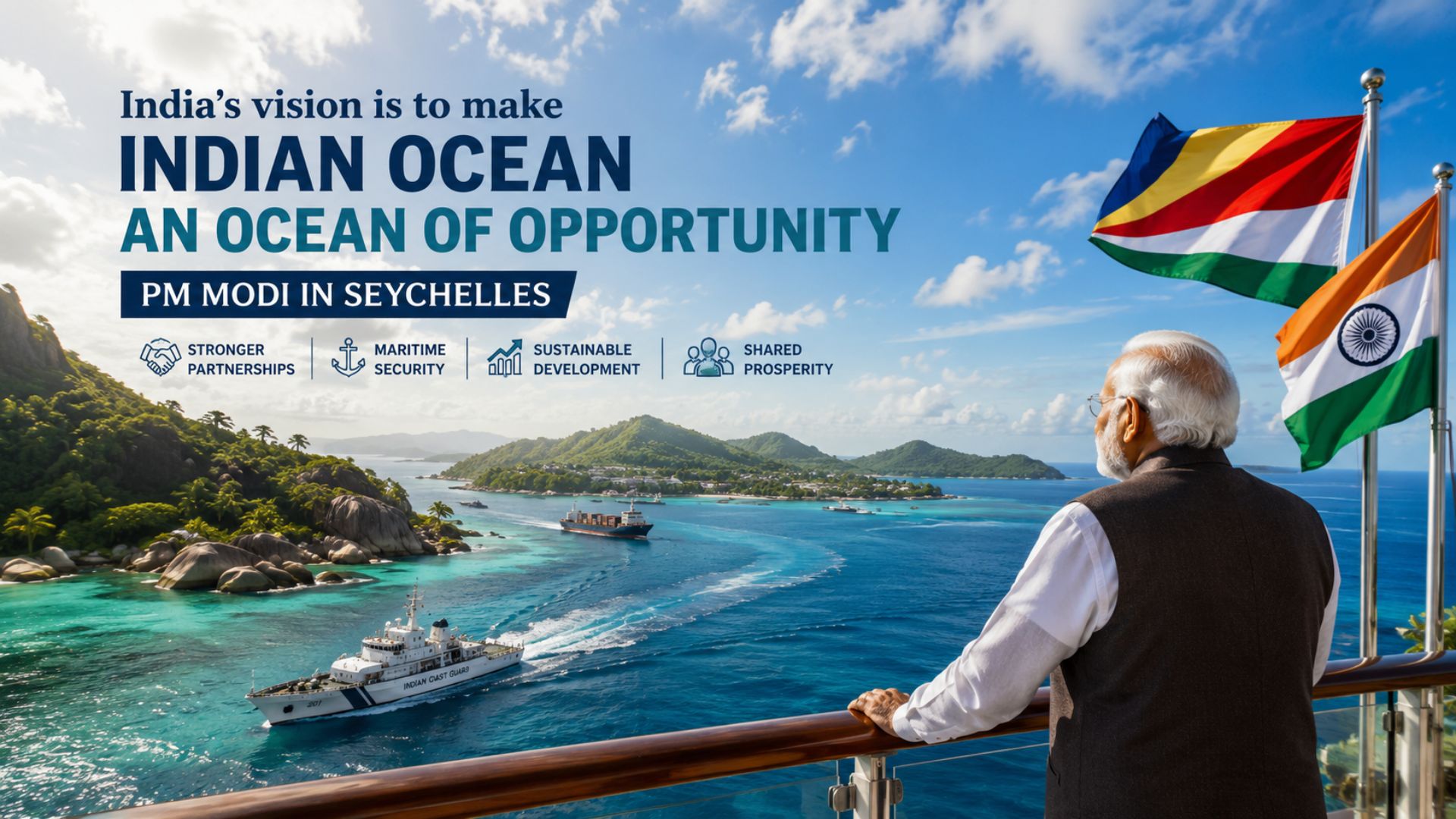
Prime Minister Narendra Modi's State Visit to Seychelles (June 27–29, 2026) reaffirmed India's commitment to a free, secure and prosperous Indian Ocean Region (IOR). The visit strengthened bilateral cooperation in maritime security, defence, digital public infrastructure, connectivity and the Blue Economy, reflecting India's broader vision of the Indian Ocean as an "Ocean of Opportunity."

Why is Seychelles important to India?

Seychelles occupies a strategically significant position in the western Indian Ocean.

Its importance includes:

  • Location along vital Sea Lines of Communication (SLOCs).
  • Large Exclusive Economic Zone (EEZ).
  • Key partner in India's maritime security architecture.
  • Strategic role in the Indo-Pacific and Indian Ocean Region.

India considers the security of Seychelles closely linked to its own maritime security.

Key outcomes of the visit

AreaOutcome
Maritime SecurityStrengthened defence cooperation and EEZ surveillance
Digital CooperationIndia to share its Digital Public Infrastructure (DPI) experience
Economic PartnershipExploration of new industrial and investment opportunities
ConnectivityCommitment to improve bilateral connectivity
Regional CooperationShared vision for a secure and sustainable Indian Ocean

The leaders also reviewed the entire spectrum of bilateral cooperation and exchanged views on regional and global developments.

Strengthening maritime security

A major highlight of the visit was India's assistance to strengthen Seychelles' maritime capabilities.

India handed over:

  • Fast Patrol Vessel (FPV) PS LESPWAR (Made in India).
  • Six ambulances.
  • Ten utility vehicles.
  • Five laser-guided boats.

The patrol vessel, manufactured by Goa Shipyard Limited, will enhance:

  • Maritime surveillance.
  • EEZ patrolling.
  • Coastal security.
  • Maritime law enforcement.
Indian Assistance
         ↓
Enhanced EEZ Surveillance
         ↓
Maritime Security
         ↓
Safe Sea Lanes
         ↓
Regional Stability

India's vision for the Indian Ocean

The visit reinforced India's maritime doctrine based on:

  • Security.
  • Sustainability.
  • Shared prosperity.
  • Mutual respect.
  • Equal partnerships irrespective of national size.

"Partnership is not based on size, but on mutual respect and trust."

This aligns with India's approach of promoting cooperative security and inclusive regional development.

Blue Economy cooperation

The discussions also focused on strengthening cooperation in the Blue Economy, which includes:

  • Sustainable fisheries.
  • Marine resource management.
  • Ocean-based economic activities.
  • Environmental sustainability.

The participation of Seychelles' Minister for Fisheries, Agriculture and the Blue Economy highlighted the growing importance of this sector in bilateral relations.

Digital Public Infrastructure (DPI)

India offered to share its successful experience in Digital Public Infrastructure, including:

  • Digital governance.
  • Public service delivery.
  • Financial inclusion.
  • Digital transformation.

This reflects India's growing role as a provider of digital public goods to partner countries.

Symbolism and diplomatic significance

During the visit:

  • Prime Minister Modi was conferred Seychelles' highest presidential distinction, "Guardian of the Blue Horizon."
  • He dedicated the honour to countries working to address climate change.
  • He participated as the Guest of Honour in Seychelles' Golden Jubilee National Day celebrations, marking 50 years of independence (1976–2026).

The visit also included cultural and environmental engagements, including a visit to the Seychelles National Botanical Garden.

Maritime Partnership
          ↓
Security Cooperation
          ↓
Economic Connectivity
          ↓
Blue Economy
          ↓
Regional Prosperity

Broader significance

The visit reinforces India's strategic priorities by:

  • Strengthening its presence in the Indian Ocean Region.
  • Supporting capacity-building of island nations.
  • Promoting indigenous defence exports.
  • Expanding Digital Public Infrastructure diplomacy.
  • Deepening South-South cooperation.
  • Advancing a rules-based and secure maritime order.

Way Forward

  • Expand maritime domain awareness and information-sharing mechanisms.
  • Strengthen defence training and joint maritime exercises.
  • Enhance cooperation in the Blue Economy and climate resilience.
  • Promote greater connectivity, trade and investment.
  • Scale up Digital Public Infrastructure partnerships with Indian Ocean island nations.
  • Deepen collaboration under India's Indo-Pacific and neighbourhood initiatives.

Conclusion

The India–Seychelles partnership has evolved beyond traditional diplomacy into a comprehensive strategic relationship centred on maritime security, sustainable development and regional stability. By combining defence cooperation, digital innovation, Blue Economy initiatives and capacity-building, both countries contribute to India's vision of transforming the Indian Ocean into an "Ocean of Opportunity" founded on trust, mutual respect and shared prosperity.

Attribution

Original content sources and authors

The Hindu Bureau Author The Hindu Bureau The Hindu Source The Hindu

Syllabus classification

How this article maps to GS papers

Main syllabus

GS2International Relations

Also covers

GS2Bilateral Relations

Quick Q&A

What does India's vision of making the Indian Ocean an 'Ocean of Opportunity' signify, and how does it shape the country's foreign policy and regional strategic outlook?
India's vision of transforming the Indian Ocean into an 'Ocean of Opportunity' reflects a comprehensive strategic approach that integrates maritime security, sustainable development, economic connectivity, climate resilience, and inclusive regional cooperation. Articulated by Prime Minister Narendra Modi during his June 2026 visit to Seychelles, this vision emphasizes that the Indian Ocean is a shared space where security, prosperity, and sustainability are collective responsibilities rather than arenas of geopolitical competition. It builds upon India's earlier initiatives such as SAGAR (Security and Growth for All in the Region), announced in 2015, and complements the Indo-Pacific Oceans Initiative launched in 2019. The approach seeks to ensure freedom of navigation, secure sea lines of communication, disaster preparedness, blue economy cooperation, digital connectivity, and capacity building among island and coastal states. Nearly 80% of global maritime oil trade and a significant share of world commerce pass through the Indian Ocean, making stability in the region vital for global economic security. India's partnerships with countries such as Seychelles, Mauritius, Maldives, Sri Lanka, and other Indian Ocean Rim Association (IORA) members strengthen maritime domain awareness, humanitarian assistance, and anti-piracy operations. The handover of a Made in India Fast Patrol Vessel to Seychelles exemplifies India's emphasis on capacity building rather than military dominance. From a UPSC perspective, the concept links GS2 (International Relations), GS3 (Security and Blue Economy), and Essay topics concerning regional cooperation, sustainable development, climate governance, and India's role as a responsible maritime power. It also illustrates India's preference for mutually respectful partnerships over coercive geopolitical competition.
Why is the India-Seychelles strategic partnership becoming increasingly important in the context of maritime security, Indo-Pacific geopolitics, and regional development?
The India-Seychelles strategic partnership has acquired growing significance because Seychelles occupies a strategically important location in the western Indian Ocean, close to major international shipping lanes that connect Asia, Africa, and Europe. As global geopolitical competition in the Indo-Pacific intensifies, India's engagement with Seychelles strengthens regional stability while promoting cooperative security based on mutual trust and shared interests. Seychelles possesses a vast Exclusive Economic Zone (EEZ) relative to its land area, making maritime surveillance and coastal security essential for combating piracy, illegal fishing, narcotics trafficking, and transnational crimes. India's assistance through patrol vessels, coastal surveillance systems, training of defence personnel, hydrographic cooperation, and humanitarian support enhances Seychelles' maritime capabilities without undermining its sovereignty. During Prime Minister Modi's June 2026 visit, the transfer of a Fast Patrol Vessel, laser-guided boats, ambulances, and utility vehicles highlighted India's capacity-building approach. Beyond security, cooperation extends to the Blue Economy, renewable energy, climate resilience, Digital Public Infrastructure, healthcare, education, and connectivity. The relationship also supports India's SAGAR doctrine and complements broader multilateral frameworks such as the Indian Ocean Rim Association and the Colombo Security Conclave. From an international relations perspective, the partnership demonstrates India's model of development cooperation, contrasting with infrastructure-led strategic competition witnessed elsewhere in the Indo-Pacific. UPSC aspirants should understand that such bilateral relationships contribute to India's energy security, protection of sea lines of communication, regional influence, and leadership among developing countries. The partnership therefore intersects with GS2 (Foreign Policy), GS3 (Internal Security and Maritime Security), environmental governance through the Blue Economy, and current debates on balancing strategic competition with developmental cooperation.
How do maritime security cooperation and defence capacity building strengthen India's strategic interests while promoting regional peace and stability in the Indian Ocean Region?
Maritime security cooperation enables India to protect its national interests while simultaneously contributing to regional stability through collaborative rather than confrontational means. India's strategic location makes the security of the Indian Ocean indispensable for safeguarding energy imports, overseas trade, fisheries, and undersea communication infrastructure. Defence capacity building with partner countries such as Seychelles involves supplying patrol vessels, conducting joint naval exercises, training personnel, sharing intelligence, hydrographic surveys, and enhancing maritime domain awareness. These initiatives improve the ability of partner states to monitor their Exclusive Economic Zones, prevent piracy, illegal fishing, arms smuggling, human trafficking, and maritime terrorism. The delivery of the Made in India Fast Patrol Vessel PS LESPWAR during Prime Minister Modi's 2026 visit is a practical illustration of India's emphasis on strengthening local capacities instead of establishing military dependence. Such cooperation also facilitates Humanitarian Assistance and Disaster Relief (HADR), search-and-rescue operations, and coordinated responses to cyclones, oil spills, and climate-induced emergencies. Economically, secure sea lanes reduce shipping risks and support uninterrupted global trade. Strategically, India's partnerships reinforce its SAGAR vision, Indo-Pacific Oceans Initiative, and commitment to a rules-based maritime order consistent with the United Nations Convention on the Law of the Sea (UNCLOS). However, challenges remain, including increasing strategic competition among major powers, resource constraints of small island states, and balancing security cooperation with respect for sovereignty. For UPSC preparation, this topic connects GS2 (International Relations), GS3 (Security), Disaster Management, Blue Economy, and questions relating to India's emergence as a net security provider in the Indian Ocean Region.
Critically examine India's evolving engagement with Small Island Developing States such as Seychelles as an instrument of diplomacy, sustainable development, and geopolitical balancing.
India's engagement with Small Island Developing States (SIDS) like Seychelles has evolved from conventional diplomatic relations into multidimensional strategic partnerships encompassing defence, climate action, digital governance, healthcare, education, renewable energy, and maritime cooperation. Such partnerships strengthen India's image as a responsible regional power that prioritizes mutual respect and capacity building over coercive influence. The June 2026 visit of Prime Minister Narendra Modi demonstrated this approach through defence assistance, Digital Public Infrastructure cooperation, environmental engagement, and participation in Seychelles' Golden Jubilee celebrations. India's emphasis on the Blue Economy aligns with the developmental priorities of island nations that depend heavily on marine resources for livelihoods and economic growth. Climate change has made these relationships even more significant because rising sea levels, coastal erosion, and extreme weather disproportionately affect SIDS. Nevertheless, India's engagement faces several challenges. The Indian Ocean has become an arena of strategic competition involving major powers, requiring India to carefully balance developmental cooperation with geopolitical realities. Resource limitations, project implementation delays, and competition from large-scale infrastructure financing offered by other countries can affect India's influence. Domestic political changes within partner countries may also alter bilateral priorities. Critics argue that India's maritime ambitions must be matched with sustained financial commitments and timely execution of promised projects. Supporters contend that India's transparent, demand-driven, and people-centric approach generates long-term trust and avoids debt-related concerns. For UPSC, the issue is relevant to GS2 (International Relations), GS3 (Environment and Security), and Essay themes relating to neighbourhood diplomacy, climate justice, South-South cooperation, and India's aspiration to become a leading voice of the Global South.
How can Prime Minister Narendra Modi's 2026 Seychelles visit be analysed as a case study of India's contemporary foreign policy priorities and strategic diplomacy in the Indian Ocean Region?
Prime Minister Narendra Modi's June 2026 State Visit to Seychelles serves as an important case study demonstrating the evolution of India's foreign policy towards integrated strategic partnerships. The visit combined diplomacy, defence cooperation, development assistance, climate engagement, cultural outreach, and technological collaboration within a single framework. During delegation-level discussions with President Patrick Herminie, both countries reaffirmed cooperation in maritime security, Digital Public Infrastructure, connectivity, the Blue Economy, and regional peace. India transferred the Made in India Fast Patrol Vessel PS LESPWAR, along with laser-guided boats, ambulances, and utility vehicles, strengthening Seychelles' maritime surveillance and Exclusive Economic Zone patrol capabilities. The conferring of the 'Guardian of the Blue Horizon' distinction upon the Prime Minister symbolized recognition of India's contribution to regional sustainability and climate action. The visit also highlighted India's soft power through participation in Seychelles' Golden Jubilee celebrations, cultural exchanges, and environmental engagements at the National Botanical Garden. Strategically, the visit reinforced the SAGAR doctrine by emphasizing shared security rather than power politics. Economically, it promoted connectivity and future industrial cooperation. Technologically, India's offer to share Digital Public Infrastructure reflected its growing role as a provider of digital public goods. The case demonstrates how India integrates hard power, such as maritime security assistance, with soft power, developmental partnerships, and people-centric diplomacy. It also illustrates India's effort to position itself as a reliable partner for the Global South and the Indian Ocean Region. For UPSC aspirants, this case study is relevant to GS2 (Foreign Policy), GS3 (Security and Technology), Governance, climate diplomacy, and interview discussions on India's expanding strategic role in the Indo-Pacific.

Practice questions

1 question for mains preparation

The Indian Ocean has been a vital link connecting countries through trade, culture and strategic interactions. In the context of India's relations with island nations, examine the significance of maritime cooperation in promoting security, sustainable development and India's strategic interests in the Indian Ocean Region.

10 marks · 150 words · 8 mins
