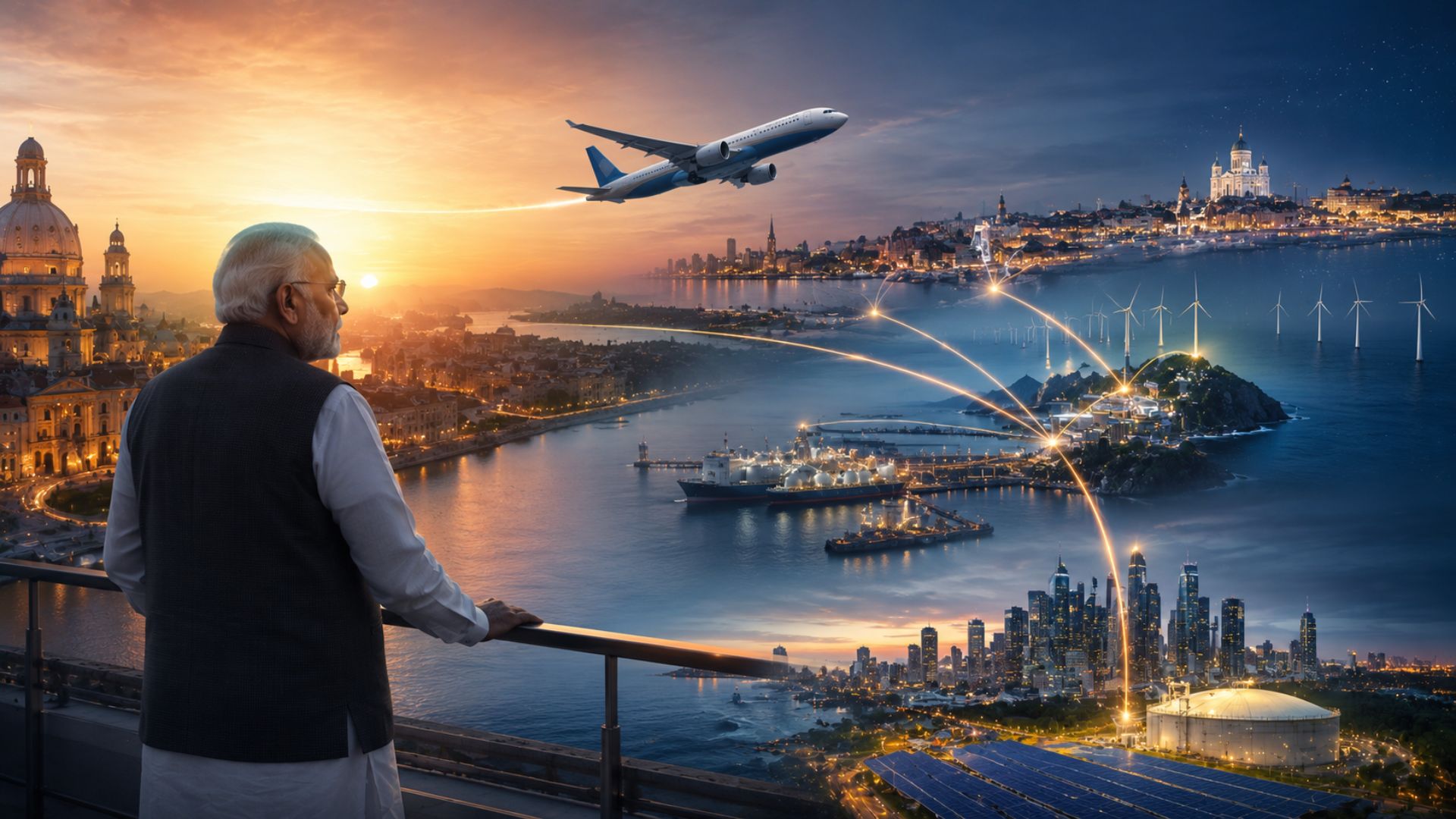
Prime Minister Modi's Diplomatic Tour: Path to Energy Security
Prime Minister Narendra Modi's recent visit to the UAE, the Netherlands, Sweden, Norway, and Italy carried a multi-pronged agenda — trade diversification, energy security, and deepening India-Europe ties at a moment when the international rules-based order faces stress from multiple directions simultaneously.
Why This Visit, Why Now
The tour came against a backdrop of compounding global disruptions:
- Russia's ongoing attacks on Ukraine
- U.S.-Israel conflict with Iran
- China's coercive economic measures
Each of these challenges the rules-based international order that both India and Europe have a stake in preserving. The visit — partly rescheduled after being cancelled following the 2025 Pahalgam attack — reflected a deliberate push by both sides to forge deeper strategic alignment at a time of superpower unpredictability.
The Trade and Economic Dimension
A central pillar of the visit was economic diversification. Bilateral trade between India and the Nordic countries remains below $20 billion — a figure both sides recognise as well below potential.
Key trade developments framing the visit:
- India-EFTA Trade Agreement — came into force last year, signalling a new phase of economic engagement with non-EU European economies.
- India-EU FTA — expected to be ratified and signed later this year, with Brussels likely hosting Modi for the formal signing.
- Supply chain diversification — shared desire among Nordic and European partners to reduce dependence on China-dominated supply chains, with India positioned as an alternative manufacturing and sourcing hub.
Energy Security: A Defining Theme
The visit came days after Modi's domestic push for foreign currency and energy conservation austerity. Energy security consequently featured prominently across all stops.
- UAE: Discussions on long-term Strategic Petroleum Reserves — securing India's energy supply against global price volatility.
- Europe and Nordic Summit: Focus on Green Strategic Partnerships — collaboration on renewable energy, clean technology, and the energy transition.
The Nordic countries — particularly Norway and Sweden — bring significant expertise in offshore energy, green hydrogen, and sustainable maritime technology, making them natural partners for India's energy diversification goals.
Emerging Domains: AI, Critical Minerals, Arctic
Beyond trade and energy, the visit opened conversations on frontier areas:
- AI Governance — bilateral and multilateral discussions on responsible AI frameworks, where India and Europe share broadly convergent positions.
- Critical Minerals — securing supply chains for minerals essential to electronics, defence, and clean energy technology.
- Arctic Cooperation — Nordic countries placed particular emphasis on maritime cooperation and scientific collaboration in the Arctic, a region being rapidly reshaped by climate change and opening new strategic corridors.
The Democratic Accountability Fault Line
The visit was not without friction. In the Netherlands and Norway, journalists openly questioned their own leaders — and Modi — over the absence of any press conferences during the tour.
"Shared commitment to democracy, the rule of law, and multilateralism made them natural partners," Modi said at the India-Nordic Summit in Oslo.
Yet the refusal to take press questions — a norm across European democracies — stood in visible contrast to that stated commitment. Modi has not held a press conference in India since 2014. While press engagement is a leader's prerogative and may draw no response in some countries, in the transparency-conscious democracies of northern Europe, the omission was conspicuous.
The article's pointed observation is worth noting: that commitment to transparency and accountability must be manifest internally first, and not because of any objections raised abroad.
Way Forward
- Translate bonhomie into binding commitments — the visit yielded goodwill but few concrete trade deals; the India-EU FTA signing must be followed by effective implementation mechanisms.
- Fast-track Green Strategic Partnerships with Nordic countries to channel expertise into India's renewable energy and offshore wind sectors.
- Deepen critical mineral diplomacy with Europe as a hedge against China's dominance of global mineral supply chains.
- Leverage the G-7 outreach summit in France (June) and the bilateral Slovakia visit to build on momentum from this tour.
- Domestically, strengthen democratic accountability norms — engaging with the press is not a concession to foreign pressure but a foundational democratic practice.
Conclusion
Modi's Europe-UAE tour was strategically well-timed and substantively wide-ranging — energy security, trade diversification, AI governance, Arctic cooperation, and conflict diplomacy all featured on the agenda. The architecture of a deeper India-Europe partnership is being built, and the upcoming India-EU FTA signing will be its most concrete expression yet. But as Modi invoked shared democratic values in Oslo, the expectation that those values manifest in domestic practice — including transparency and press accountability — is not an external imposition. It is the internal logic of the very partnership India seeks to build.
Attribution
Original content sources and authors
Syllabus classification
How this article maps to GS papers
Main syllabus
GS2International RelationsQuick Q&A
What is the strategic significance of Prime Minister Narendra Modi’s recent outreach to the UAE and European countries?
One of the major objectives of the visit was to deepen India-Europe economic integration. The implementation of the India-EFTA Trade Agreement and the anticipated India-EU Free Trade Agreement indicate a shared desire to diversify global supply chains and reduce excessive dependence on any one region, particularly China. Nordic countries, despite relatively low bilateral trade with India, are seen as important partners in areas such as green technologies, innovation, clean energy, and advanced manufacturing.
The strategic significance of the visit can be understood through multiple dimensions:
- Strengthening India’s role in a rules-based international order
- Enhancing energy security through cooperation with the UAE and Europe
- Expanding collaboration in AI governance and critical minerals
- Deepening scientific and maritime cooperation in the Arctic region
- Building resilient supply chains and technology partnerships
The visit also highlighted India’s balancing diplomacy. India maintained discussions on major geopolitical crises while avoiding alignment with any single bloc. This reflects India’s broader strategy of strategic autonomy.
Another significant aspect was the emphasis on “Green Strategic Partnerships.” Nordic countries are global leaders in sustainability, renewable energy, and climate adaptation. Collaboration with them can support India’s energy transition and climate commitments.
Overall, the visit symbolised India’s growing engagement with Europe as a key strategic partner in trade, technology, climate governance, and global diplomacy. It also demonstrated India’s attempt to position itself as a credible and responsible power in an increasingly fragmented international system.
Why are India-Europe relations gaining importance in the contemporary global geopolitical environment?
In this context, India and Europe see each other as reliable partners for economic diversification, technological collaboration, and strategic stability. Europe is seeking alternatives to overdependence on China for manufacturing and supply chains, while India seeks investment, advanced technology, and greater market access. The India-EFTA Trade Agreement and the proposed India-EU FTA reflect this convergence of interests.
Several factors explain the growing importance of India-Europe relations:
- The need to diversify supply chains and reduce strategic vulnerabilities
- Shared commitment to democratic values and multilateralism
- Collaboration on climate change and green energy transitions
- Partnerships in emerging technologies such as AI and semiconductors
- Maritime security cooperation in the Indo-Pacific and Arctic regions
Europe also increasingly recognises India as a major economic and geopolitical actor in the Indo-Pacific. India’s growing market size, technological capabilities, and strategic location make it an attractive long-term partner.
From India’s perspective, stronger ties with Europe help reduce excessive dependence on any single power bloc while supporting India’s strategic autonomy. Europe provides opportunities for investment, advanced manufacturing, renewable energy cooperation, and critical mineral partnerships necessary for India’s green transition.
However, the relationship also faces challenges. Differences over trade regulations, data governance, carbon border taxes, and geopolitical positions occasionally create friction. Human rights and democratic accountability issues are also sometimes raised by European countries.
Despite these challenges, the broader strategic convergence remains strong because both India and Europe seek a stable multipolar order. Their partnership is increasingly driven not only by economic interests but also by the shared need to address emerging global challenges such as climate change, technological disruptions, and geopolitical instability.
How can India’s partnerships with the UAE and Nordic countries contribute to energy security and sustainable development?
The article highlights discussions in the UAE regarding long-term Strategic Petroleum Reserves (SPRs). The UAE is one of India’s key energy suppliers, and deeper cooperation in oil storage and energy infrastructure can help India manage supply disruptions and price volatility in global energy markets. This becomes especially important amid geopolitical tensions in West Asia and fluctuations in crude oil prices.
Nordic countries contribute in a different but equally important way:
- They are global leaders in renewable energy technologies
- They possess expertise in green hydrogen and sustainable infrastructure
- They support innovation in climate-friendly industrial systems
- They collaborate in Arctic research and climate science
The “Green Strategic Partnerships” discussed during the Nordic-India Summit reflect India’s effort to accelerate its clean energy transition. Collaboration with Nordic countries can help India improve energy efficiency, adopt advanced green technologies, and strengthen climate resilience.
Another important area is critical minerals cooperation. Minerals such as lithium, cobalt, and rare earth elements are essential for electric vehicles, renewable energy systems, and battery storage technologies. Partnerships with Europe can help India diversify its access to these resources and reduce dependence on China-dominated supply chains.
The cooperation also extends to AI governance and sustainable innovation. Nordic countries are known for combining technological advancement with strong environmental and social standards. India can benefit from such models while pursuing digital transformation.
However, challenges remain. Green technologies are often expensive, and technology transfer issues may arise. India must also balance developmental priorities with climate obligations.
Overall, partnerships with the UAE and Nordic countries strengthen India’s long-term energy resilience, support sustainable economic growth, and contribute to India’s broader objective of becoming a green and technologically advanced economy.
Critically analyse the role of transparency and democratic accountability in international diplomacy, with reference to the controversies during Prime Minister Modi’s Europe visit.
The article notes that journalists in countries such as the Netherlands and Norway questioned both their leaders and Prime Minister Modi regarding the absence of open press interactions. In many European democracies, press conferences during state visits are considered a normal part of democratic practice because they allow public scrutiny and transparency in diplomatic engagements.
Supporters of greater transparency argue:
- Press conferences strengthen democratic accountability
- Media engagement improves public trust in governance
- Open questioning reflects confidence in democratic institutions
- Transparency enhances the credibility of claims regarding shared democratic values
The issue becomes particularly significant because India and European countries frequently emphasise common commitments to democracy, rule of law, and multilateralism. Critics argue that democratic values should be demonstrated internally through open engagement and institutional accountability.
However, another perspective is that diplomatic protocols and media interactions remain the prerogative of political leaders. Governments may choose controlled communication formats to avoid diplomatic controversies, misinformation, or politically sensitive situations. In an era of instant media amplification, leaders may prioritise carefully managed messaging.
From a broader diplomatic perspective, public diplomacy has become increasingly important. International image, democratic credibility, and communication style now influence soft power and global perceptions. Countries projecting themselves as democratic leaders are often expected to uphold standards of openness and transparency.
The debate also reflects differences in political culture between countries. European democracies generally maintain strong traditions of media questioning and public accountability, whereas political communication styles vary across nations.
Ultimately, the controversy underscores that modern diplomacy is no longer confined to closed-door negotiations. Public perception, media engagement, and democratic legitimacy have become integral aspects of international relations. Therefore, transparency and accountability are increasingly viewed not merely as domestic political concerns but as components of global diplomatic credibility.
How do trade agreements such as the India-EFTA agreement and the proposed India-EU FTA reflect changing global economic realities?
Traditionally, globalisation was driven primarily by economic efficiency and market integration. However, recent events such as the COVID-19 pandemic, the Russia-Ukraine war, and China’s coercive trade practices have highlighted the risks of excessive dependence on concentrated supply chains. Countries are now increasingly pursuing “friend-shoring” and diversification strategies to enhance economic resilience.
The India-EFTA and India-EU agreements reflect several important trends:
- Diversification of global supply chains away from overdependence on China
- Greater emphasis on resilient and trusted trade partnerships
- Integration of trade with technology, sustainability, and strategic cooperation
- Expansion of collaboration in clean energy and critical minerals
For India, these agreements provide opportunities for increased exports, investment inflows, technological cooperation, and integration into global value chains. European countries offer advanced technology, innovation ecosystems, and access to high-value markets.
For Europe, India represents a rapidly growing economy, a large consumer market, and a democratic partner in the Indo-Pacific. Strengthening trade ties with India also supports Europe’s objective of reducing strategic dependence on authoritarian regimes for manufacturing and raw materials.
The agreements are not limited to tariff reductions alone. Modern FTAs increasingly include areas such as:
- Digital trade and data governance
- Environmental standards and sustainability
- Labour and regulatory cooperation
- Technology transfer and innovation partnerships
However, negotiations also face challenges. India has concerns regarding strict environmental standards, intellectual property rules, and carbon border adjustment mechanisms proposed by Europe. Balancing domestic industry protection with global integration remains a complex task.
Overall, these agreements reflect a broader shift from purely economic globalisation toward strategically aligned economic partnerships. Trade today is increasingly linked with geopolitics, technological security, and sustainable development, making such agreements central to the emerging multipolar economic order.
How does the India-Nordic partnership illustrate the growing role of climate diplomacy and technological cooperation in international relations?
The article highlights that discussions during the India-Nordic Summit focused on green strategic partnerships, maritime cooperation, Arctic scientific collaboration, AI governance, and critical minerals. These issues demonstrate that contemporary diplomacy increasingly revolves around shared technological and environmental challenges rather than only traditional military or political concerns.
The partnership has several strategic dimensions:
- Collaboration in renewable energy and green hydrogen technologies
- Joint research on climate change and Arctic ecosystems
- Cooperation in AI governance and digital innovation
- Maritime security and sustainable shipping initiatives
The Arctic dimension is particularly important. Climate change is rapidly altering Arctic geopolitics by opening new shipping routes and increasing competition for natural resources. Nordic countries possess advanced expertise in Arctic research, while India has growing scientific and strategic interests in the region.
For India, the partnership supports its long-term development goals. Nordic expertise in clean technologies, waste management, sustainable urban planning, and circular economies can assist India in achieving climate commitments under the Paris Agreement.
The partnership also reflects the changing nature of global power. Technological capability, innovation, and sustainability are increasingly becoming sources of strategic influence. Countries that lead in green technologies and digital governance are gaining greater diplomatic relevance.
However, challenges remain. Technology transfer, funding constraints, and differences in development priorities can affect cooperation. India must also ensure that sustainability measures do not undermine developmental needs and economic growth.
Nevertheless, the India-Nordic partnership demonstrates how modern diplomacy is evolving beyond conventional geopolitics. Climate resilience, technological innovation, and sustainable development are now key components of international engagement. This partnership therefore represents an important model for future global cooperation in an era shaped by climate change and technological transformation.
What are the broader geopolitical implications of India’s increasing engagement with Europe and the Nordic region?
One major implication is the strengthening of alternatives to excessive dependence on any single power centre. Europe seeks trusted democratic partners amid concerns over China’s economic coercion and supply chain vulnerabilities, while India seeks diversified economic and technological partnerships that preserve its strategic autonomy.
The geopolitical significance can be understood in several ways:
- India’s role in balancing China’s growing global influence
- Expansion of Europe’s engagement in the Indo-Pacific region
- Creation of resilient supply chains and technology ecosystems
- Cooperation on climate governance and critical minerals
India’s engagement with Nordic countries is particularly important in emerging strategic areas such as the Arctic, green technology, and AI governance. These sectors are likely to shape future geopolitical competition as much as traditional military power.
Another important implication is the strengthening of middle-power cooperation. Countries such as India and European states increasingly seek to preserve a rules-based international order without becoming fully dependent on either the U.S. or China. This supports the evolution of a more flexible multipolar system.
The relationship also has implications for global governance. India and Europe often cooperate in multilateral institutions on issues such as climate change, maritime security, counterterrorism, and sustainable development.
However, differences remain. Europe sometimes raises concerns regarding human rights, democratic accountability, and environmental standards, while India prioritises developmental flexibility and strategic independence. Managing these differences will be essential for sustaining long-term cooperation.
Overall, India’s expanding engagement with Europe and the Nordic region reflects a broader transformation in international politics where trade, technology, sustainability, and strategic partnerships are increasingly interconnected. These relationships will likely play an important role in shaping the future global balance of power.
Practice questions
1 question for mains preparation