GS2 International Relations

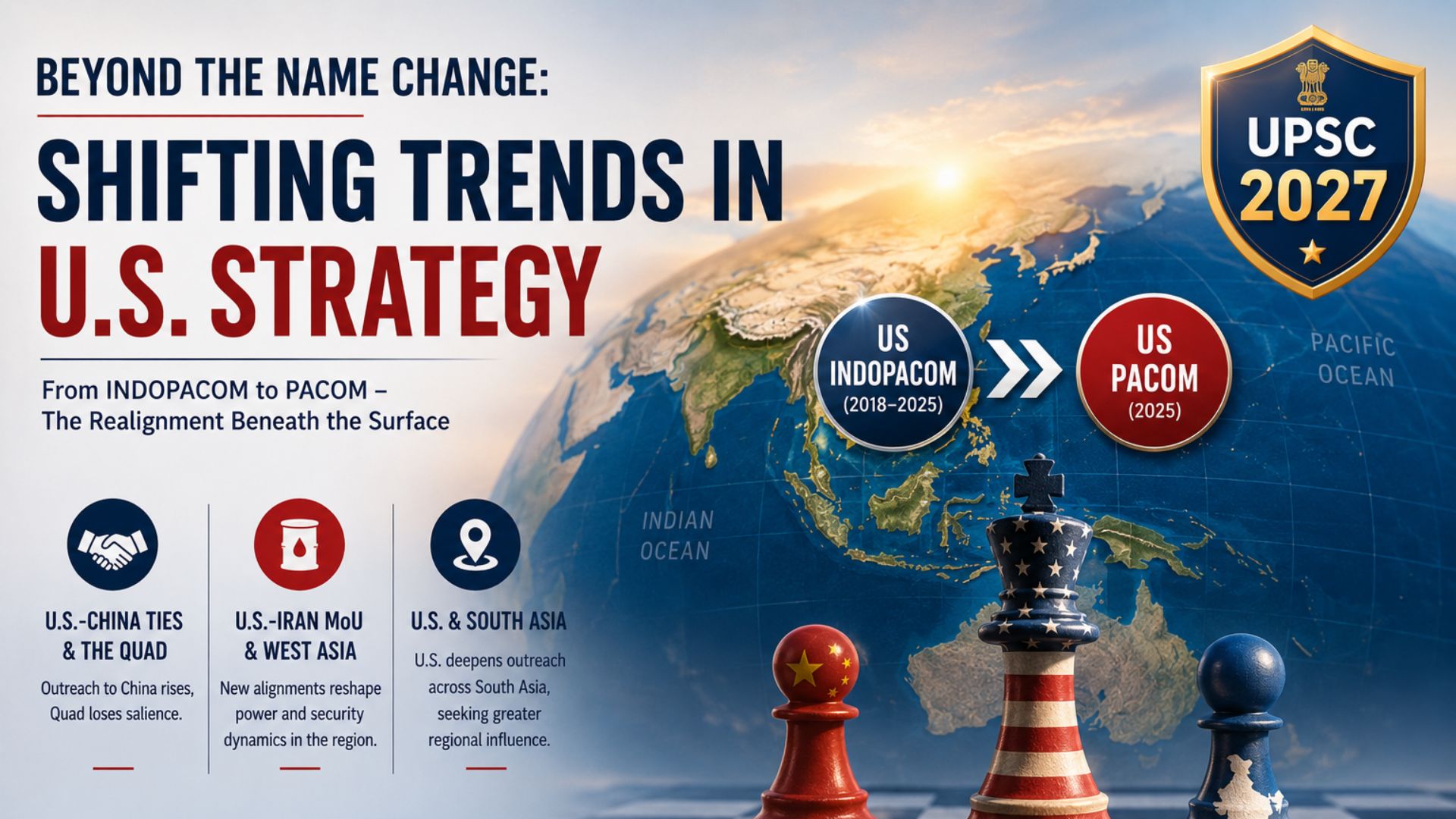
Image Caption:U.S. Strategic Shift: Beyond the INDOPACOM Name Change

Shifting U.S. Strategic Priorities and Their Implications for India's Foreign Policy

The U.S. military's shift from INDOPACOM back to PACOM reveals deeper strategic imperatives in its Indo-Pacific policy.
Gopi Gopi
4 mins read

"In international relations, strategic signals often matter more than symbolic gestures."

The United States' decision to rename its military command from US Indo-Pacific Command (INDOPACOM) back to US Pacific Command (PACOM) may appear symbolic, but it reflects deeper shifts in American strategic priorities. Along with evolving U.S. policies towards China, West Asia and South Asia, these developments require India to reassess its foreign policy and regional strategy.

Why the Name Change Matters

Earlier (2018)Present (2026)
US Pacific Command renamed as Indo-Pacific CommandReverted to US Pacific Command
Recognised growing importance of the Indian Ocean and IndiaSignals reduced emphasis on the Indo-Pacific concept
Indo-Pacific became central to India's strategic thinkingRaises questions about future U.S. regional priorities

The command's geographical responsibility remains unchanged, but the shift indicates a possible change in U.S. strategic focus.

Three Strategic Geographies Affecting India

1. U.S.-China Relations and the Future of the Quad

Recent developments suggest that the U.S. seeks temporary strategic accommodation with China despite long-term rivalry.

Key indicators include:

  • High-level exchanges between U.S. and Chinese leadership.
  • Reduced emphasis on Taiwan.
  • References to a possible "G-2" world order.
  • Declining strategic importance of the Quad.

The Quad appears to be narrowing its agenda.

Earlier ObjectivePresent Focus
Strategic balancing of ChinaMaritime security
Broad Indo-Pacific cooperationEconomic prosperity
Security cooperationCritical minerals and emerging technologies
Strategic coordinationDisaster response

Challenges include:

  • Limited progress on Artificial Intelligence cooperation.
  • Restrictions on access to advanced U.S. AI technologies.
  • Uncertainty regarding future Quad summits.
Example:
If the Quad gradually shifts from
a strategic security grouping
to a limited functional partnership,
India may need to strengthen
alternative arrangements such as
the Australia-India-Japan trilateral.

2. Changing Dynamics in West Asia

The post-conflict understanding between the U.S. and Iran indicates changing regional power equations.

Major developments include:

  • U.S. commitment to reduce military presence near Iran.
  • Greater Iranian influence over the Strait of Hormuz.
  • Large-scale reconstruction assistance for Iran.
  • Increasing diplomatic importance of Oman and Qatar.
  • Gulf countries exploring new security partnerships.

These developments alter India's carefully balanced West Asia policy.

Areas requiring reassessment include:

  • Dependence on Israel and the UAE.
  • Compliance with U.S. sanctions on Iranian oil.
  • Future of the Chabahar Port project.

3. Growing U.S. Engagement in South Asia

The appointment of a combined U.S. Ambassador to India and Special Envoy for South and Central Asia reflects expanding American regional engagement.

Recent diplomatic outreach includes visits to:

  • Nepal
  • Bhutan
  • Bangladesh
  • Sri Lanka
  • Maldives

This suggests increasing competition between the U.S. and China for influence in South Asia.

At the same time:

  • SAARC remains largely inactive.
  • BIMSTEC faces political constraints.
  • China continues expanding alternative regional mechanisms.
Example:
If regional institutions remain weak,
external powers gain greater opportunities
to shape South Asian geopolitics,
reducing India's traditional regional influence.

Implications for India

The evolving U.S. strategy presents multiple challenges.

  • Reduced centrality of the Indo-Pacific concept.
  • Possible weakening of the Quad as a strategic platform.
  • Shifting balance of power in West Asia.
  • Greater external competition in South Asia.
  • Need for greater strategic autonomy in foreign policy.

India must avoid overdependence on any single strategic framework while preserving its regional leadership.

Way Forward

  • Continue pursuing a policy of strategic autonomy.
  • Strengthen alternative maritime partnerships such as the Australia-India-Japan trilateral.
  • Revitalise regional institutions including SAARC and BIMSTEC.
  • Reassess India's West Asia policy in light of evolving geopolitical realities.
  • Enhance engagement with Indian Ocean regional organisations.
  • Deepen bilateral partnerships across Southeast Asia, the Gulf and Africa.
  • Maintain balanced relations with both major powers while safeguarding national interests.

Conclusion

The renaming of the U.S. military command is less significant than the broader strategic shifts it represents. Changes in U.S. relations with China, West Asia and South Asia indicate an evolving geopolitical landscape that directly affects India's security and foreign policy. To protect its long-term interests, India must reinforce strategic autonomy, strengthen regional institutions and proactively shape the evolving regional order rather than merely responding to external realignments.

Attribution

Original content sources and authors
Suhasini Haidar Author Suhasini Haidar The Hindu Source The Hindu

Syllabus classification

How this article maps to GS papers

Main syllabus

GS2International Relations

Quick Q&A

What is the Indo-Pacific strategic concept, and how do recent changes in United States strategic signalling affect India's foreign policy and maritime interests?
The Indo-Pacific is a geopolitical and strategic construct that integrates the Indian Ocean and the Pacific Ocean into a single theatre of economic, security and geopolitical importance. Unlike the earlier 'Asia-Pacific' concept, the Indo-Pacific recognises India's central role in regional security, maritime connectivity, supply chains and the maintenance of a rules-based international order. The term gained prominence after 2017, with countries such as India, the United States, Japan and Australia incorporating it into their strategic doctrines. In 2018, the United States renamed its Pacific Command as the Indo-Pacific Command (INDOPACOM), symbolically acknowledging the growing importance of the Indian Ocean and India's strategic relevance. The 2026 decision to revert to 'Pacific Command' has generated debate over whether Washington is recalibrating its regional priorities. Although the command's geographical area remains unchanged, strategic terminology often reflects policy orientation. For India, the Indo-Pacific is closely linked with SAGAR (Security and Growth for All in the Region), the Indo-Pacific Oceans Initiative (IPOI), the Quad, maritime domain awareness, and freedom of navigation. Nearly 95% of India's trade by volume and about 68% by value is transported by sea, making maritime stability crucial for economic security. The concept also intersects with India's Act East Policy, Blue Economy, and engagement with ASEAN. From a UPSC perspective, this topic spans GS-II (International Relations), GS-III (Security and Maritime Affairs), and Geography. The debate also reflects competing visions of regional order—India's support for a multipolar Indo-Pacific versus concerns about major-power rivalry or sphere-of-influence politics. Thus, India's approach must combine strategic autonomy, multilateral engagement and enhanced naval capabilities while avoiding overdependence on any single external partner.
Critically analyse how changing United States-China relations could reshape the Quad and influence India's strategic autonomy in the Indo-Pacific region.
The trajectory of United States-China relations has a direct bearing on the future of the Quad because the grouping emerged as a consultative mechanism among four democracies—India, the United States, Japan and Australia—to promote a free, open and inclusive Indo-Pacific amid China's growing assertiveness. The article suggests that recent diplomatic outreach between Washington and Beijing, including high-level visits and reduced emphasis on the Indo-Pacific narrative, may indicate a temporary strategic accommodation. If major powers seek to establish informal spheres of influence, India's vision of a multipolar Asia could face challenges. The reported absence of references to the Quad in recent U.S. strategic documents and uncertainty surrounding future Quad summits have further intensified this debate. Nevertheless, the Quad has evolved beyond security issues into cooperation on maritime domain awareness, critical technologies, disaster relief, resilient supply chains, vaccines and climate initiatives. Therefore, its relevance cannot be judged solely through the lens of military balancing. For India, strategic autonomy remains the guiding principle of foreign policy. Since Independence, India has avoided formal military alliances while pursuing issue-based partnerships. Consequently, India must strengthen the Quad without becoming strategically dependent on it. Simultaneously, it should deepen engagement with ASEAN, IORA, BIMSTEC, the India-France-UAE trilateral and other minilateral arrangements. UPSC aspirants should connect this discussion with concepts such as realism, balance of power, hedging, multipolarity and strategic autonomy under GS-II International Relations. Critics argue that excessive reliance on the Quad may provoke regional tensions, while supporters believe it provides stability against unilateral actions. India's optimal strategy lies in maintaining diversified partnerships, strengthening indigenous defence capabilities and preserving diplomatic flexibility regardless of fluctuations in U.S.-China relations.
How should India recalibrate its foreign policy towards West Asia in light of evolving geopolitical alignments involving the United States, Iran, Israel and Gulf countries?
West Asia occupies a central place in India's foreign policy because of its significance for energy security, maritime trade, diaspora welfare, counter-terrorism cooperation and strategic connectivity. India imports a substantial proportion of its crude oil from the region, while nearly nine million Indians reside and work across Gulf countries, contributing billions of dollars annually in remittances. The evolving geopolitical environment, including changing U.S.-Iran engagement, shifting Gulf security arrangements and emerging regional alignments, requires India to carefully recalibrate its diplomacy. The article highlights developments such as the reported U.S.-Iran understanding, discussions regarding the Strait of Hormuz, reconstruction commitments and changing relations among Gulf countries. These developments directly affect India's interests in Chabahar Port, the International North-South Transport Corridor (INSTC), maritime security and energy imports. India has traditionally followed a policy of strategic balance by maintaining cordial relations simultaneously with Israel, Iran, Saudi Arabia, the United Arab Emirates and other regional actors. This balanced approach should continue while adapting to new realities. India should diversify energy sources, strengthen naval deployments in the Arabian Sea, expand economic diplomacy, promote investment partnerships and enhance cooperation in food security, renewable energy and digital infrastructure. From a UPSC perspective, the issue links GS-II (International Relations), GS-III (Energy Security, Maritime Security) and Economic Development. Different viewpoints exist regarding sanctions compliance and engagement with Iran, requiring India to carefully balance international obligations with national interests. Ultimately, India's West Asia policy should remain guided by strategic autonomy, issue-based cooperation, protection of overseas Indians and long-term economic interests rather than alignment with competing geopolitical blocs.
What are the major reasons behind increasing geopolitical competition in South Asia, and how should India respond to preserve its regional leadership?
South Asia has emerged as one of the most competitive geopolitical regions due to its strategic location, growing markets, maritime connectivity, demographic potential and proximity to the Indian Ocean. The article highlights increasing diplomatic engagement by both the United States and China across countries such as Nepal, Bangladesh, Bhutan, Sri Lanka and the Maldives. China's influence has expanded through the Belt and Road Initiative (BRI), infrastructure financing, port development and development assistance, while the United States has strengthened diplomatic engagement and regional initiatives. Simultaneously, regional institutions such as SAARC have remained largely inactive because of political tensions, particularly between India and Pakistan, while BIMSTEC continues to evolve gradually. This institutional vacuum creates opportunities for extra-regional powers to expand their influence. India must respond through comprehensive regional engagement rather than viewing competition solely through a security lens. Priority areas include accelerating cross-border connectivity, trade facilitation, digital public infrastructure, disaster management cooperation, climate resilience, educational exchanges and capacity building. India should also revitalise BIMSTEC, strengthen IORA, support Colombo Security Conclave initiatives and explore conditions for eventual revival of SAARC where feasible. Economic diplomacy, development partnerships and people-to-people ties remain India's strongest comparative advantages. UPSC aspirants should relate this issue to GS-II International Relations, regionalism, neighbourhood diplomacy and India's 'Neighbourhood First' policy. While strategic competition is inevitable, India can reinforce its leadership through inclusive development, respect for sovereignty and mutually beneficial partnerships rather than coercive approaches. Sustainable regional leadership ultimately depends on trust, economic integration and institutional cooperation rather than merely countering external influence.
Using recent shifts in United States strategic priorities as a case study, explain how India can strengthen its strategic autonomy while adapting to an increasingly multipolar world order.
India's response to evolving United States strategic priorities provides an excellent case study of the practical application of strategic autonomy in contemporary international relations. Strategic autonomy refers to the ability of a country to pursue independent foreign policy decisions based on national interests without becoming excessively dependent on any major power or alliance. Since the Cold War era, India has evolved from the policy of Non-Alignment to a more flexible framework of multi-alignment, engaging simultaneously with the United States, Russia, Europe, Japan, ASEAN, West Asia and the Global South. The article illustrates how shifts in U.S. policy—reduced emphasis on the Indo-Pacific narrative, evolving U.S.-China engagement, uncertainties surrounding the Quad, changing West Asia priorities and expanded American interest in South Asia—require India to reassess its external engagements. Rather than reacting defensively, India should diversify strategic partnerships, modernise its armed forces, enhance domestic defence manufacturing under Atmanirbhar Bharat, strengthen maritime capabilities, expand economic diplomacy and deepen engagement with multilateral institutions such as BIMSTEC, IORA, BRICS, SCO and the G20. Simultaneously, India should continue issue-based cooperation with the United States in areas such as critical technologies, clean energy, defence innovation and supply-chain resilience while preserving policy independence. From the UPSC perspective, this case links GS-II International Relations, GS-III Internal Security and Economic Development, and contemporary theories of multipolarity and balance of power. Critics sometimes argue that strategic autonomy may dilute alliance commitments, whereas supporters believe it maximises diplomatic flexibility in an uncertain international system. For India, strategic autonomy remains not a policy of neutrality but a dynamic framework that enables constructive engagement with multiple partners while safeguarding sovereignty, security and long-term national interests.

Practice questions

2 questions for mains preparation

Examine how the evolving strategic priorities of the United States are reshaping India's foreign policy choices. Discuss the importance of strategic autonomy in safeguarding India's interests amid changing regional and global geopolitical dynamics.

10 marks · 150 words · 8 mins

Examine how evolving U.S. geopolitical priorities across the Indo-Pacific, West Asia and South Asia pose new strategic challenges for India's foreign policy

10 marks · 150 words · 8 mins
