GS2 International Relations

U.S.–Iran Deal Signals End to Conflict and Strait Blockade

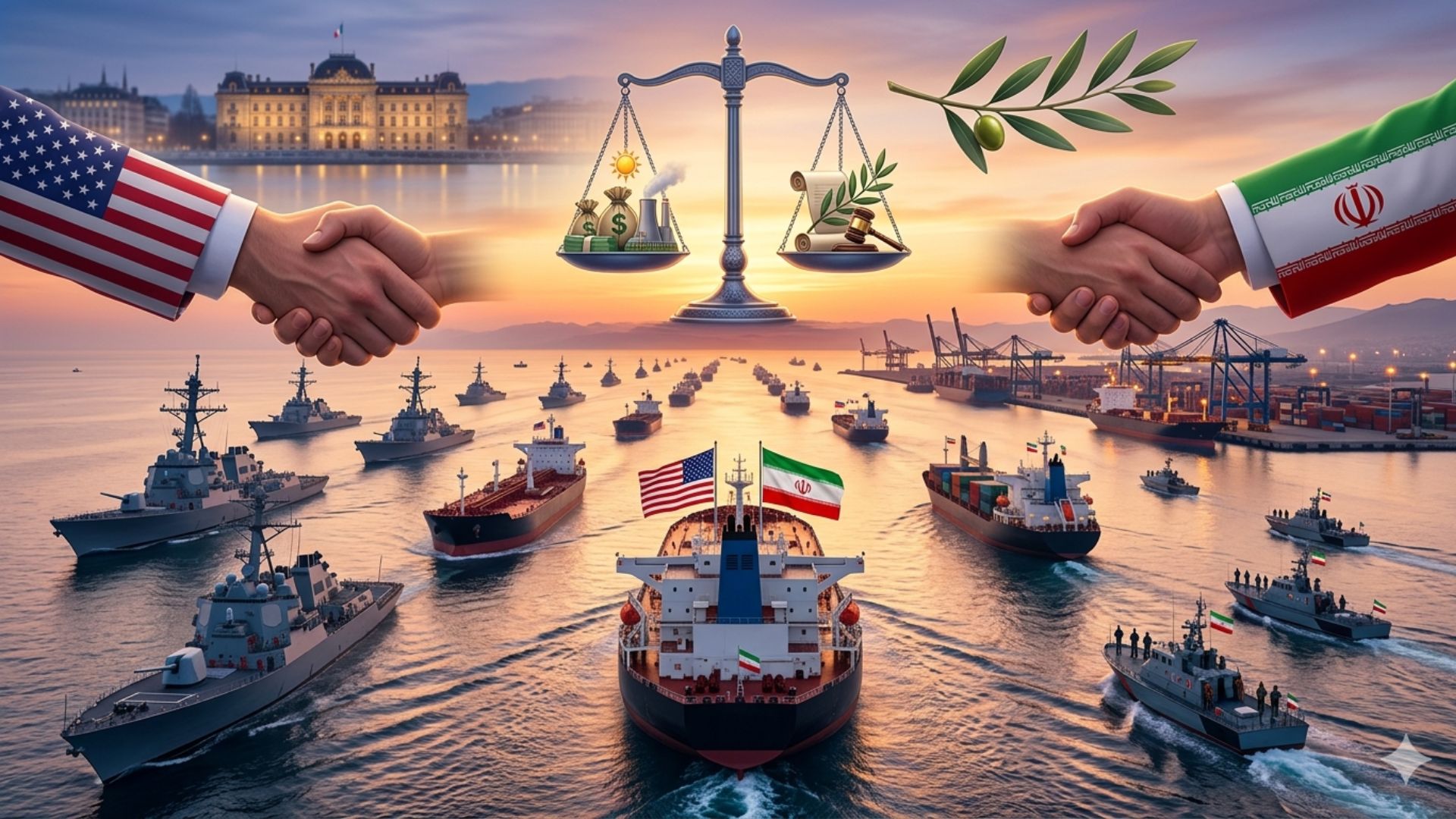
U.S.-Iran Peace Deal: Opening the Strait of Hormuz

Historic agreement ends conflict, lifts blockades, and promotes nuclear negotiations between the U.S. and Iran.
Gopi Gopi
4 mins read

Why in News?

The United States and Iran have reached a preliminary agreement to end the war that began in February 2026, remove maritime restrictions in the Gulf region, and initiate negotiations on Iran's nuclear programme and Western sanctions.

The agreement was digitally signed on June 14, 2026, while an in-person signing ceremony is scheduled in Geneva on June 19, 2026.

“The Deal with the Islamic Republic of Iran is now complete… Ships of the World, start your engines. Let the oil flow!” — U.S. President Donald Trump


Background to the Conflict

Timeline of Key Events

DateDevelopment
February 28, 2026U.S. and Israel launched military operations against Iran
Post-war periodIran took control of the Strait of Hormuz
April 12, 2026U.S. imposed naval blockade on Iranian ports in the Gulf of Oman
June 14, 2026Digital signing of preliminary peace agreement
June 19, 2026Proposed formal signing ceremony in Geneva

The blockade followed failed direct negotiations between Washington and Tehran in Islamabad.


Major Provisions of the Agreement

Security and Military Measures

Both sides agreed to:

  • Immediate and permanent termination of military operations.
  • End hostilities across all fronts.
  • Remove the U.S. naval blockade against Iran.
  • Extend the ceasefire for a 60-day period while negotiations continue.

Iran's Supreme National Security Council stated:

“The war and military operations on all fronts, including Lebanon, are ended immediately and permanently.”


Strait of Hormuz: Strategic Importance

The Strait of Hormuz connects:

  • Persian Gulf
  • Gulf of Oman
  • Arabian Sea

It is among the world's most important energy chokepoints.

Persian Gulf
      ↓
Strait of Hormuz
      ↓
Gulf of Oman
      ↓
Arabian Sea
      ↓
Global Energy Markets

Developments

  • Iran had assumed control over the Strait after the outbreak of war.
  • The U.S. announced removal of its naval blockade.
  • Trump stated that oil shipments had already begun moving through the waterway.

“Ships are starting to move, many loaded up with oil, out of the Strait of Hormuz.”

Transit Arrangements

Iran clarified:

  • No transit tolls would be imposed.

  • Charges may apply for:

    • Navigation services
    • Environmental protection
    • Ship insurance
    • Maritime support services

Economic and Financial Dimensions

A major component of the understanding involves Iranian financial assets frozen abroad.

Iranian Position

Iran insists that:

  • Release of frozen assets is essential.
  • Compensation for war-related damages must be addressed.

“The release of the frozen Iranian assets as well as the reparations for damages are two essential points.”

Divergent Claims

IssueIranian PositionU.S. Position
Frozen assetsRelease requiredNo immediate cash payment promised
ReparationsEssential componentNo detailed commitment publicly disclosed
Asset release reportsMehr reported $24 billion releaseU.S. officials have not confirmed

According to Iranian media reports, final negotiations may begin only after partial asset release and complete lifting of restrictions.


Nuclear Programme and Sanctions Negotiations

The preliminary agreement does not settle core disputes.

Instead, it creates conditions for future talks on:

  • Iran's nuclear programme
  • Western sanctions
  • Long-term regional security arrangements

Negotiation Framework

  • Ceasefire to remain in force for 60 days.
  • Technical discussions to occur during this period.
  • Core negotiations will proceed after implementation of initial commitments.
Ceasefire
      ↓
Implementation of Commitments
      ↓
Technical Meetings
      ↓
Nuclear & Sanctions Talks
      ↓
Final Agreement

Role of Pakistan as Mediator

Pakistan played a central diplomatic role in facilitating negotiations.

Prime Minister Shehbaz Sharif confirmed:

  • Immediate cessation of military operations.
  • Ongoing mediation efforts.
  • Organization of pre-implementation meetings before formal signing.

This highlights Pakistan's emergence as an important intermediary in regional diplomacy.


The Lebanon Dimension

Iran considers developments in Lebanon inseparable from the broader agreement.

According to Tehran:

  • Ending the conflict in Lebanon is part of the understanding.
  • The U.S. must ensure Israeli compliance with commitments.

However, significant differences remain.

Israeli Position

Israeli Defence Minister Israel Katz stated:

  • Israeli troops would remain in occupied areas of southern Lebanon.
  • Any Iranian attack would be met with force.

Domestic Debate in Israel

Opposition leader Yair Lapid criticized the government's handling of the conflict, arguing that Israel had suffered a diplomatic setback on the Iranian front.


Key Challenges Ahead

  • Verification of ceasefire implementation.
  • Removal of naval restrictions.
  • Release of frozen Iranian assets.
  • Agreement on war reparations.
  • Future of Iran's nuclear programme.
  • Israeli-Iranian tensions regarding Lebanon.
  • Building trust during the 60-day negotiation window.

Way Forward

  • Ensure transparent implementation of ceasefire commitments.
  • Establish independent monitoring mechanisms.
  • Facilitate phased negotiations on sanctions and nuclear issues.
  • Maintain uninterrupted maritime security in the Strait of Hormuz.
  • Address humanitarian, economic, and reconstruction concerns.
  • Encourage sustained multilateral diplomatic engagement.

Conclusion

The preliminary U.S.–Iran agreement marks a significant de-escalation in a conflict that threatened regional stability and global energy security. While the reopening of maritime routes and cessation of hostilities provide immediate relief, critical issues—including sanctions, nuclear negotiations, frozen assets, reparations, and the Lebanon question—remain unresolved. The success of the agreement will ultimately depend on implementation, mutual trust, and sustained diplomatic engagement.

Attribution

Original content sources and authors

Stanly Johny Author Stanly Johny The Hindu Source The Hindu

Syllabus classification

How this article maps to GS papers

Main syllabus

GS2International Relations

Quick Q&A

What is the significance of the preliminary United States-Iran peace agreement and its implications for regional stability and global energy security?
The preliminary peace agreement reached between the United States and Iran in June 2026 represents an important development in contemporary international relations. It seeks to end military operations, remove the U.S. naval blockade, reopen the Strait of Hormuz, and initiate negotiations on Iran's nuclear programme and sanctions. Historically, tensions between Washington and Tehran have shaped West Asian geopolitics since the 1979 Iranian Revolution and have influenced global oil markets. The Strait of Hormuz is one of the world's most critical maritime chokepoints, through which nearly one-fifth of global oil trade passes. Any disruption in this region affects energy prices, inflation, and supply chains across the world. Therefore, the reopening of the strait has significance far beyond the Middle East. The agreement also includes issues such as the release of frozen Iranian assets, discussions on war reparations, and a 60-day ceasefire period for substantive negotiations. However, differences remain regarding implementation and Israeli security concerns. From the UPSC perspective, the development is relevant to GS Paper II (International Relations) and GS Paper III (Energy Security). It highlights concepts such as conflict resolution, diplomacy, sanctions, maritime security, and strategic waterways. It also demonstrates the importance of multilateral mediation, with Pakistan playing a facilitating role. The agreement reflects how geopolitical rivalries increasingly require diplomatic solutions rather than prolonged military confrontation. Its success or failure could influence regional peace, nuclear non-proliferation efforts, and the stability of international energy markets.
Why is the reopening of the Strait of Hormuz considered strategically important for global trade and energy markets?
The Strait of Hormuz is among the most strategically significant maritime passages in the world. Located between Iran and Oman, it connects the Persian Gulf with the Arabian Sea and serves as a crucial route for crude oil and liquefied natural gas exports. Approximately 20% of globally traded petroleum moves through this narrow waterway, making it indispensable to the international economy. The reopening of the Strait under the U.S.-Iran agreement has implications for energy security, inflation control, and supply chain stability. Any blockade or military conflict in the region leads to spikes in oil prices, affecting importing nations such as India, China, Japan, and European countries. Rising oil prices can increase transportation costs, inflation, and fiscal burdens on developing economies. Historically, disruptions in the Gulf region have influenced global markets, as seen during the Iran-Iraq War and several recent geopolitical crises. Therefore, maintaining freedom of navigation remains a key objective of major powers. For India, which imports nearly 85% of its crude oil requirements, stability in the Strait of Hormuz is directly linked to economic growth and energy security. Consequently, India advocates peaceful resolution of disputes and adherence to international maritime law. From a UPSC perspective, the issue connects GS Paper II (International Relations), GS Paper III (Economy and Energy Security), and Geography. It also raises broader themes of strategic chokepoints, maritime diplomacy, and the interdependence of geopolitics and economics. Hence, the Strait of Hormuz remains a central element in global policy discussions.
How do sanctions, frozen assets, and nuclear negotiations influence the diplomatic relationship between the United States and Iran?
Sanctions, frozen assets, and nuclear negotiations constitute the core issues shaping U.S.-Iran relations. Economic sanctions have been imposed by the United States and Western powers to restrict Iran's nuclear ambitions and regional activities. These measures have affected Iran's economy by limiting oil exports, financial transactions, and access to international markets. Frozen assets refer to Iranian funds held abroad that remain inaccessible because of sanctions. According to reports associated with the 2026 agreement, discussions involve the release of approximately $24 billion in assets and questions regarding war reparations. Such issues are highly sensitive and influence the trust deficit between the two countries. Nuclear negotiations have a long history, especially since the Joint Comprehensive Plan of Action (JCPOA) signed in 2015. Although subsequent political developments weakened the agreement, diplomatic efforts have continued. The current understanding proposes a 60-day ceasefire period during which substantive talks on nuclear activities and sanctions are expected. Different perspectives exist. Iran insists on economic relief and guarantees, while the United States emphasizes non-proliferation and regional security. Israel has also expressed concerns about the agreement's implications. For UPSC aspirants, this issue is relevant to GS Paper II under International Relations and global governance. It illustrates the role of sanctions as foreign policy tools and demonstrates how economic measures are increasingly intertwined with strategic objectives. The episode highlights that sustainable diplomacy requires balancing security concerns with economic incentives, confidence-building mechanisms, and international monitoring frameworks.
What are the major reasons behind the involvement of mediators such as Pakistan in the United States-Iran peace process?
Third-party mediation has emerged as a significant instrument in international conflict resolution. In the 2026 U.S.-Iran peace process, Pakistan played an important facilitating role by hosting negotiations and coordinating diplomatic engagement. Such mediation becomes necessary when direct talks fail or when mutual distrust prevents meaningful dialogue. One major reason is the existence of a long-standing history of hostility between Washington and Tehran. Political differences over Iran's nuclear programme, sanctions, regional influence, and support for allied groups have repeatedly complicated bilateral relations. Mediators can provide neutral platforms, build confidence, and reduce misunderstandings. Pakistan's involvement also reflects its strategic location and growing diplomatic ambitions. Successful mediation enhances a country's international standing and demonstrates its ability to contribute to regional peace. Historically, countries such as Norway, Qatar, Oman, and Switzerland have played similar roles in conflict management. Another reason is the desire of the international community to prevent escalation in West Asia. Prolonged conflicts threaten oil supplies, maritime security, and broader geopolitical stability. Therefore, mediation serves both regional and global interests. From a UPSC perspective, the issue is relevant to GS Paper II under International Relations and concepts of preventive diplomacy and peaceful settlement of disputes under the United Nations Charter. It also illustrates how middle powers can influence global affairs. However, mediators face challenges, including competing interests, lack of trust among stakeholders, and difficulties in ensuring compliance. Therefore, successful mediation requires sustained engagement, credibility, and support from major powers.
What are the major challenges and controversies surrounding the implementation of the United States-Iran peace agreement?
Despite the announcement of a preliminary agreement, several challenges and controversies could affect its successful implementation. One major issue concerns differing interpretations regarding the release of frozen Iranian assets and the question of war reparations. Reports from Iranian media and statements from American leaders reveal discrepancies regarding financial commitments. Another challenge involves the nuclear negotiations themselves. Previous agreements, particularly the 2015 JCPOA, faced setbacks because of changing political priorities and lack of mutual trust. Similar concerns remain relevant in the current context. Israel's position constitutes another significant source of uncertainty. Israeli leaders have expressed reservations and indicated that military deployments in southern Lebanon would continue. Such statements demonstrate that regional security concerns remain unresolved. Iran, meanwhile, insists that ending hostilities in Lebanon forms an inseparable part of the understanding. Domestic political opposition also influences diplomacy. Opposition figures in Israel have criticized their government, while political divisions in the United States and Iran could affect long-term commitments. Furthermore, verification mechanisms and sequencing of obligations remain unresolved. From the UPSC perspective, this issue relates to GS Paper II and themes of diplomacy, regional conflicts, and global governance. Analysts offer differing viewpoints. Optimists argue that the agreement could stabilize West Asia and reduce tensions, while critics warn that unresolved disputes may undermine the process. Therefore, the agreement represents both an opportunity and a test. Its success depends on confidence-building measures, credible implementation mechanisms, and the willingness of all stakeholders to prioritize diplomacy over confrontation.
What practical examples and historical precedents demonstrate the importance of diplomacy in resolving international conflicts?
International history provides numerous examples showing that diplomacy often offers more durable solutions than military confrontation. The 2026 U.S.-Iran understanding itself illustrates how prolonged conflicts can eventually lead to negotiations involving ceasefires, economic concessions, and confidence-building measures. A prominent precedent is the Joint Comprehensive Plan of Action (JCPOA) signed in 2015 between Iran and the P5+1 countries. The agreement aimed to limit Iran's nuclear programme in exchange for sanctions relief and demonstrated the effectiveness of multilateral diplomacy. Another example is the Camp David Accords of 1978, which facilitated peace between Egypt and Israel. Similarly, the Good Friday Agreement of 1998 helped end decades of violence in Northern Ireland. The Dayton Agreement of 1995 contributed to ending the Bosnian conflict. In Asia, diplomatic engagement between India and Bangladesh resulted in the 2015 Land Boundary Agreement, resolving a decades-old dispute peacefully. Such examples underline the importance of negotiations, trust-building, and institutional mechanisms. These cases reveal common elements: involvement of mediators, phased implementation, mutual concessions, and international guarantees. They also show that diplomacy is often a gradual process rather than a single event. For UPSC aspirants, these examples are useful in GS Paper II and essay papers dealing with peace, international cooperation, and global governance. They provide practical illustrations for interview answers. Overall, diplomatic settlements contribute to stability, economic development, and human security, highlighting the enduring relevance of dialogue in managing complex geopolitical disputes.
How can the 2026 United States-Iran agreement be analysed as a case study in conflict resolution and international diplomacy?
The 2026 United States-Iran agreement provides an important contemporary case study in conflict resolution and international diplomacy. The conflict began with military escalation and economic measures, including the blockade of Iranian ports and tensions over the Strait of Hormuz. After direct negotiations failed, mediation and sustained diplomatic engagement created conditions for a ceasefire and a framework for further discussions. The agreement incorporates several components commonly found in peace processes. These include immediate cessation of hostilities, reopening of strategic trade routes, discussions on economic issues such as frozen assets, and phased negotiations on contentious subjects like the nuclear programme. An important feature of this case is the role of mediators, particularly Pakistan, in facilitating dialogue. It demonstrates how regional actors can contribute to global peace. Another aspect is the interconnected nature of modern conflicts, where military, economic, and geopolitical dimensions are deeply linked. However, the case also highlights limitations. Mutual distrust, unresolved questions regarding sanctions and reparations, and divergent positions of stakeholders such as Israel create uncertainties. Implementation challenges and verification mechanisms remain critical issues. From a UPSC perspective, this case study is relevant to GS Paper II and topics such as international organizations, conflict resolution, and strategic affairs. It also offers insights into concepts of maritime security and energy diplomacy covered under GS Paper III. The broader lesson is that sustainable peace requires not merely ending violence but creating institutions and mechanisms that address underlying grievances. Thus, the agreement illustrates both the opportunities and complexities inherent in contemporary diplomacy.

Practice questions

1 question for mains preparation

Critically analyse the strategic significance of the Strait of Hormuz in shaping geopolitical relations and global energy security. In the context of the recent U.S.–Iran agreement, examine how control over critical maritime chokepoints influences regional stability and international diplomacy.

10 marks · 150 words · 8 mins
