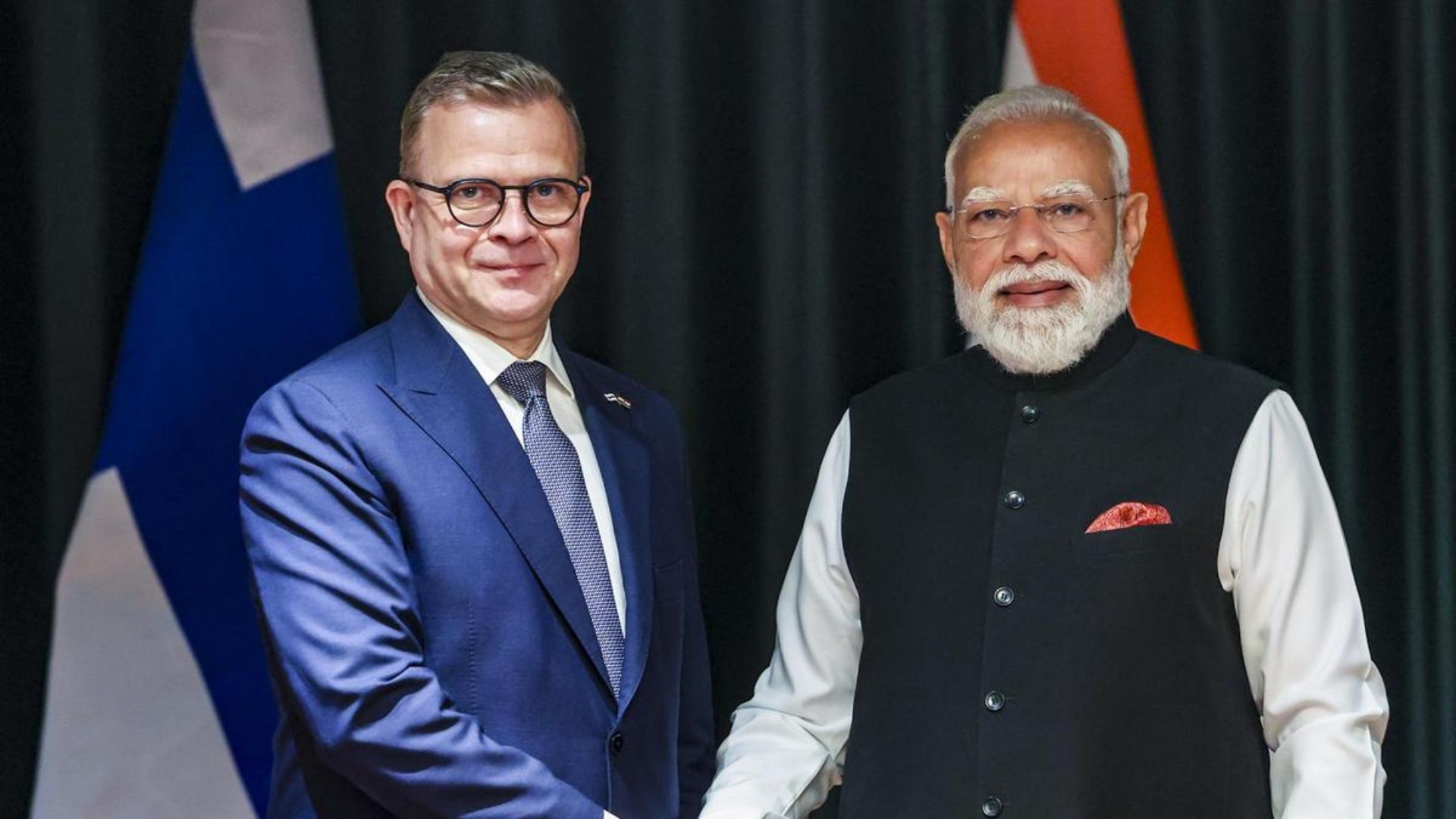
Why Europe Is Suddenly Central to India's Foreign Policy

Context: Why Europe Is Suddenly Central to India's Foreign Policy
In a significant shift in diplomatic tempo, Prime Minister Narendra Modi completed a four-nation European tour — Netherlands, Sweden, Norway, and Italy — in May 2026, and is scheduled to return to Europe in June for the G-7 Summit, a bilateral visit to France, and a visit to Slovakia. Later in 2026, a trip to Brussels is expected for the signing of the India-EU Free Trade Agreement.
This is not incidental. India is recalibrating its European engagement at a moment when the continent is grappling with its most serious security crisis since World War II, and when global trade architecture is being redrawn under the pressure of American protectionism and China's economic assertiveness.
The India-Finland Axis: Small Country, Big Footprint
Finland's engagement with India has been disproportionately active relative to its size. Within just three months:
- Finnish PM Petteri Orpo was hosted in Delhi during the AI Summit
- Finnish President Alexander Stubb was chief guest at the Raisina Dialogue in March 2026
- Modi and Orpo met bilaterally again in Oslo
- Both leaders engaged at the Nordic-India Summit
Current India-Finland bilateral trade stands at a modest $1.5 billion — but both sides have committed to more than doubling it, with focus areas including:
- Digitalisation — Finland's technology sector and India's IT capabilities offer natural complementarities
- Sustainability — clean energy transition, green technology
- Arctic cooperation — scientific research and climate study in a geopolitically sensitive region
The India-EU FTA: A Historic Agreement Within Reach
The India-EU Free Trade Agreement — years in the making — is now closer to reality than ever. Finland was a key driver of the negotiations. On its status, PM Orpo said:
"The European Council — all the leaders — were very happy and satisfied with this agreement. I am sure that we want to finalise it as soon as possible."
India-EU FTA: Key Markers
──────────────────────────────────────────────────
Stage                        Status (May 2026)
──────────────────────────────────────────────────
Negotiations                 Concluded
EU Council approval          Positive
Ratification (27 countries)  Underway
Expected signing venue       Brussels
Expected timeline            Late 2026
──────────────────────────────────────────────────
Orpo noted that EU member states have already begun identifying trade opportunities with Indian companies — suggesting that commercial momentum is building ahead of formal ratification.
The Ukraine Question: India's Tightrope Role
The most geopolitically sensitive dimension of the Nordic-India summit was the Russia-Ukraine conflict. Finland shares a long border with Russia and was among the last European countries to join NATO, doing so in 2023 — a decision directly triggered by Russia's invasion of Ukraine.
Finland's expectations of India are clear:
- Use New Delhi's unique access to both Moscow and Kyiv to push both sides toward negotiations
- Maintain pressure on Russia through sanctions, including on oil exports
On Russian oil, Orpo was direct: "Oil export is part of Putin's war machine... we are not satisfied that they are exporting oil, and at the same time countries pumping money to the war machine."
This is an implicit reference to India's continued purchase of discounted Russian crude — a point of friction with European partners, though raised here diplomatically.
Modi's position, as conveyed to Orpo: he has engaged both Putin and Zelenskyy and urged them toward the negotiating table. Orpo expressed genuine appreciation — "I really respect this, and I think that the Prime Minister has good relations with both of them."
On NATO's internal coherence amid President Trump's unpredictable posture, Orpo was firm: "Finland is very committed to the NATO membership... I believe NATO will continue its work, and it's very important to keep the U.S. committed."
The Arctic Dimension
India holds permanent observer status at the Arctic Council — a body whose geopolitical significance is rising as climate change opens new shipping routes and resource frontiers. Finland sees India as a meaningful partner here, particularly for scientific cooperation and joint climate research.
Way Forward
- Expedite India-EU FTA ratification — 27-country ratification is procedurally complex; India must maintain diplomatic engagement with key holdouts
- Deepen Nordic partnerships beyond trade — defence technology, green hydrogen, and digital governance are natural next steps
- Calibrate the Russia position carefully — India's mediator credibility depends on neither being seen as Moscow's apologist nor abandoning strategic autonomy under Western pressure
- Arctic policy institutionalisation — India's observer status must translate into active scientific and strategic engagement, not passive presence
Conclusion
India's Nordic outreach signals a maturing of its European diplomacy — moving beyond transactional engagements to structured partnerships across trade, technology, climate, and security. The Finland relationship, in particular, illustrates how a mid-sized European democracy can serve as both a bridge to the EU and a candid interlocutor on difficult questions. As the India-EU FTA approaches signature and the Ukraine war drags into its fourth year, New Delhi's ability to sustain relationships on both sides of the geopolitical divide will be its most consequential diplomatic asset.
Attribution
Original content sources and authors

Syllabus classification
How this article maps to GS papers
Main syllabus
GS2International RelationsQuick Q&A
What is the strategic significance of India’s growing engagement with Nordic countries, particularly Finland?
Finland holds special importance in India’s European outreach because of its expertise in digitalisation and sustainability. Finland is a leader in areas such as 5G technologies, clean energy solutions, circular economy models and education systems. India, which aims to become a technology-driven and sustainable economy, can benefit significantly from Finnish innovation. The discussions between Prime Minister Narendra Modi and Finnish leaders on doubling bilateral trade and expanding cooperation in AI and sustainability indicate a shift from traditional trade relations towards knowledge-based strategic partnerships.
From a geopolitical perspective, Nordic engagement also strengthens India’s role in Europe. As Europe faces security challenges arising from the Russia-Ukraine conflict and energy disruptions, India’s balanced diplomacy and economic importance make it an attractive partner. Nordic countries view India not only as a major market but also as a responsible global actor capable of contributing to peace and stability. India’s participation in the Arctic Council as an observer further enhances the strategic depth of these relations by opening avenues for scientific cooperation, climate research and maritime engagement.
Why is the India-European Union Free Trade Agreement (FTA) strategically important for both India and the EU?
For India, the FTA aligns with broader economic goals such as export diversification, supply chain integration and technological advancement. Access to European markets can boost Indian industries, create employment opportunities and support initiatives like “Make in India.” Additionally, closer trade ties with the EU reduce overdependence on any single market and strengthen India’s strategic autonomy. The agreement may also facilitate collaboration in clean technologies, semiconductors, AI and sustainable infrastructure.
For the European Union, India represents a critical economic and geopolitical partner. Europe seeks to diversify supply chains away from excessive dependence on China and strengthen relations with trusted democratic partners. The FTA also reflects Europe’s Indo-Pacific strategy, where India plays a central role in maintaining a rules-based international order. However, challenges remain regarding issues such as intellectual property rights, digital regulations, labour standards and agricultural access. Therefore, the successful implementation of the FTA will require balancing economic interests with regulatory and strategic concerns.
Critically analyse India’s balancing approach towards the Russia-Ukraine conflict in the context of its relations with Europe and Russia.
At the same time, India has actively engaged with European nations and Ukraine, reflecting its policy of strategic autonomy. Prime Minister Narendra Modi’s interactions with both President Putin and President Zelenskyy demonstrate India’s attempt to position itself as a responsible global actor capable of facilitating dialogue. European leaders, including Finland’s Prime Minister, have expressed hope that India can use its diplomatic influence to encourage negotiations. India has also provided humanitarian assistance to Ukraine while maintaining economic ties with Russia, especially in oil imports.
However, this balancing strategy has attracted both praise and criticism. Supporters argue that India’s neutral stance protects national interests and preserves diplomatic flexibility. Critics, however, contend that continued Russian oil imports indirectly weaken sanctions imposed by Western countries. India responds by emphasising its developmental needs and the principle that Europe itself continued economic engagement with Russia for long periods. Ultimately, India’s approach reflects a pragmatic foreign policy that prioritises national interest while attempting to maintain credibility with multiple global power centres.
How does climate change and Arctic geopolitics create opportunities for cooperation between India and Finland?
Climate research is one of the most important areas of collaboration. The Arctic has a direct influence on global weather systems, including the Indian monsoon. Changes in Arctic temperatures can affect rainfall patterns, agriculture and food security in India. Cooperation with Finland in polar research, sustainable technologies and environmental monitoring can help India improve climate adaptation strategies. Finland’s expertise in green technologies and sustainable infrastructure also complements India’s renewable energy and climate resilience goals.
Arctic geopolitics additionally has strategic and economic dimensions. Emerging sea routes may alter global trade dynamics and reduce shipping distances between Europe and Asia. India’s growing interest in Arctic affairs reflects its aspiration to participate in future global governance structures. However, environmental concerns and geopolitical rivalries among Arctic powers remain challenges. Therefore, India’s engagement must emphasise scientific cooperation, sustainability and peaceful governance rather than resource competition.
What are the reasons behind Finland’s decision to join NATO, and what implications does it have for European security?
The decision was also influenced by collective defence considerations. NATO membership provides Finland protection under Article 5, which treats an attack on one member as an attack on all. For a relatively small country neighbouring Russia, this security guarantee is highly significant. Finland also possesses advanced military capabilities and strategic geographic importance in Northern Europe, making its inclusion beneficial for NATO as well.
The implications for European security are far-reaching. Finland’s accession strengthens NATO’s northern flank and increases pressure on Russia in the Baltic and Arctic regions. At the same time, it deepens geopolitical polarisation between Russia and the West. While Finland views NATO as essential for deterrence and stability, Russia perceives NATO expansion as a strategic threat. Thus, Finland’s membership reflects the broader transformation of Europe’s security architecture following the Ukraine conflict.
How can India and Finland collaborate in emerging technologies such as Artificial Intelligence and digital governance?
One major area of collaboration is AI-driven public service delivery. India’s experience with large-scale digital platforms such as Aadhaar, UPI and Digital India can combine with Finland’s expertise in cybersecurity, ethical AI and smart governance. Joint research initiatives between universities, startups and technology firms can support advancements in healthcare, education, climate modelling and urban planning. Finland’s strengths in 5G and telecommunications technology also align with India’s push for digital connectivity and technological self-reliance.
However, technological cooperation must also address regulatory and ethical concerns. Issues such as data privacy, AI bias, cybersecurity threats and digital sovereignty require robust frameworks. India and Finland can work together in developing global norms for responsible AI governance. Their cooperation also reflects a larger trend where technology partnerships increasingly shape international relations and economic competitiveness in the 21st century.
Suppose India is asked by European nations to mediate in a major international conflict involving one of its strategic partners. What challenges and opportunities would such mediation present for India?
However, mediation also involves significant risks. India must avoid perceptions of bias while balancing its economic, strategic and security interests. If mediation efforts fail, India’s diplomatic credibility could suffer. Additionally, external pressure from rival powers may complicate India’s neutral position. Domestic considerations, including energy security and defence dependencies, may further limit India’s flexibility in negotiations.
Despite these challenges, mediation aligns with India’s broader foreign policy philosophy of promoting dialogue and peaceful coexistence. India’s civilisational emphasis on diplomacy, combined with its growing global influence, enables it to contribute constructively to conflict resolution. Effective mediation would require patience, neutrality, multilateral coordination and sustained diplomatic engagement rather than immediate political gains.
Practice questions
1 question for mains preparation