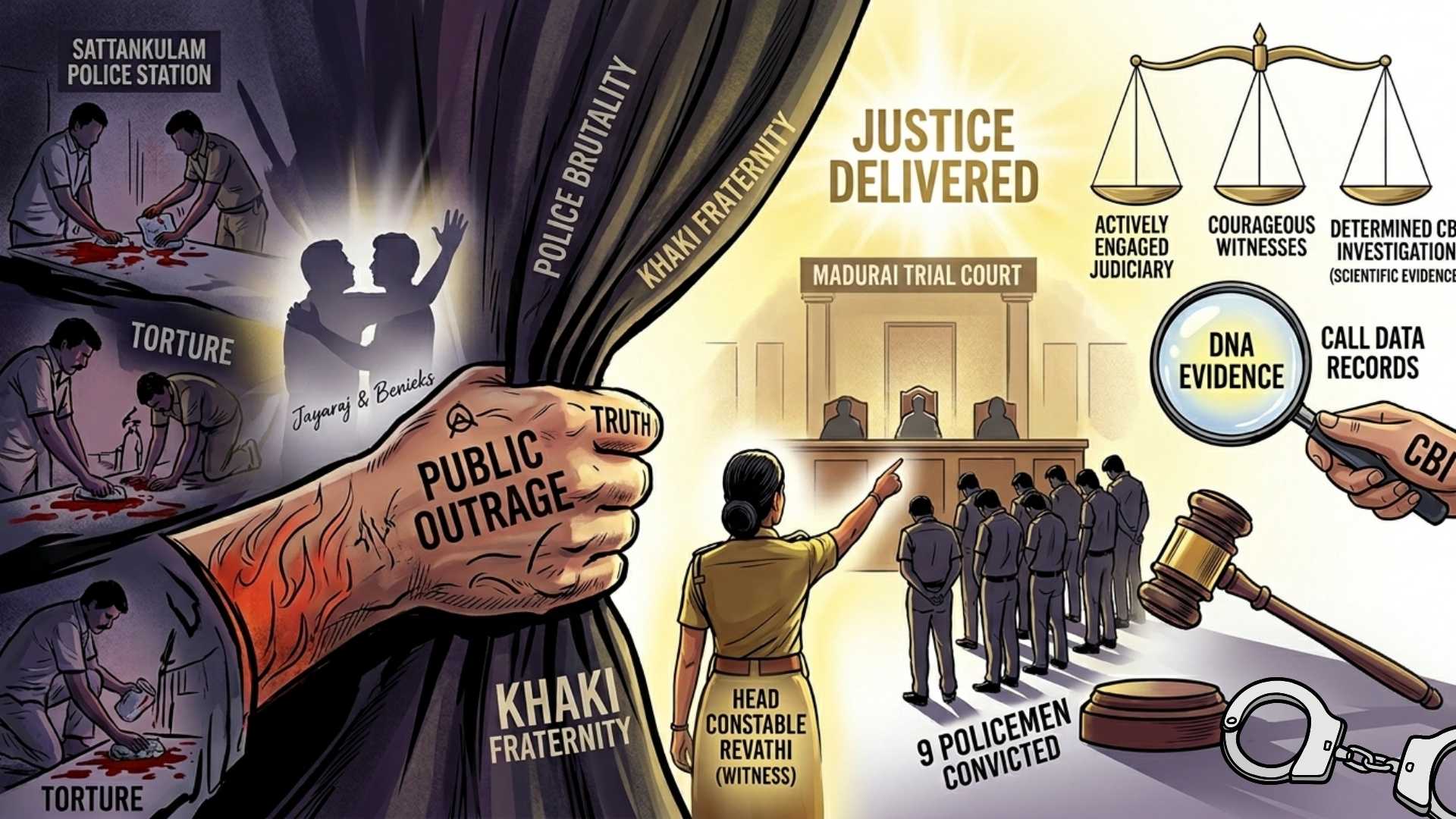

The conviction of nine policemen in the Jayaraj-Benicks custodial killing case is a landmark assertion that the khaki uniform confers no licence to brutalise — but it also exposes the systemic rot that makes such convictions the exception, not the rule. Six years, a CBI investigation, DNA evidence, and extraordinary judicial intervention were needed to deliver what should have been routine accountability.
| Indicator | Data/Detail |
|---|---|
| Victims | P. Jayaraj (trader) and his son J. Benicks |
| Location | Sattankulam Police Station, Thoothukudi, Tamil Nadu |
| Year of incident | 2020 (during COVID-19 lockdown) |
| Number convicted | 9 policemen (10th died of COVID-19) |
| Investigating agency | CBI |
| Sentence awarded | Death penalty (by Madurai trial court) |
| Key evidence | DNA match of blood samples + call data records |
| Key witness | Head Constable Revathi (testified against colleagues) |
| Judicial intervention | Suo motu cognisance — Madras HC Madurai Bench |
| Rajiv Gandhi case precedent | SC upheld death penalty for 4 of 26 convicted by TADA court (1999) |
Background & Context
Custodial deaths represent the most egregious abuse of state power — the State, which holds a person in its custody and control, becomes the agent of that person's death. India's legal framework prohibits torture and custodial violence through multiple instruments:
- Article 21 of the Constitution — Right to Life and Personal Liberty
- Article 22 — Protection against arbitrary arrest and detention
- Section 176 CrPC — Mandatory magistrate inquiry into custodial deaths
- NHRC Guidelines — Mandatory reporting of custodial deaths within 24 hours
Yet custodial violence persists systematically, enabled by institutional solidarity within police forces, weak forensic practices, compliant medical officers, and a culture of impunity.
The Jayaraj-Benicks Case: A Timeline of Abuse and Accountability
| Stage | What Happened |
|---|---|
| Arrest | Jayaraj picked up on false charges of violating COVID-19 lockdown norms |
| Detention | Benicks detained when he confronted police for assaulting his father |
| Torture | Both stripped, beaten overnight; forced to clean their own blood |
| Medical complicity | Government doctor issued "fit for remand" certificate despite visible injuries |
| Judicial failure | Jurisdictional magistrate mechanically remanded both to judicial custody |
| Deaths | Both died in judicial custody from torture injuries |
| Evidence destruction | Early attempts made to destroy forensic evidence at the station |
| Judicial intervention | Madras HC (suo motu) directed revenue officials to take charge of station to preserve evidence |
| CBI investigation | DNA match of blood samples; call data records placed accused at scene |
| Key witness | Head Constable Revathi testified against her colleagues — rare act of institutional courage |
| Conviction | All 9 accused convicted; death penalty awarded by trial court |
Three Pillars That Delivered Justice in This Case
This case succeeded where most custodial death cases fail — because all three conditions for justice aligned simultaneously:
| Pillar | Role in This Case |
|---|---|
| Active judiciary | Madras HC took suo motu cognisance; directed extraordinary evidence preservation measure |
| Courage of witnesses | Head Constable Revathi broke the "blue wall of silence" — testified against colleagues |
| Irrefutable forensic evidence | CBI: DNA blood match + call data records created a scientific, tamper-resistant evidentiary chain |
The absence of any one of these three would likely have resulted in the case being closed as a "suspicious death."
Systemic Failures This Case Exposes
1. Police Institutional Culture
- Sense of entitlement — Judicial Magistrate found atmosphere at station "intimidating" and hostile
- Khaki fraternity — institutional solidarity that suppresses whistleblowing and evidence
- False FIR registration used to legalise illegal detention
2. Medical Complicity
- Government doctor issued "fit for remand" certificate for visibly tortured men
- Forensic medical examination reduced to a bureaucratic formality rather than an independent check
3. Judicial Passivity at First Instance
- Jurisdictional magistrate mechanically remanded the victims without examining their physical condition
- Remand hearings must be a substantive safeguard — not a rubber stamp
4. Evidence Vulnerability
- Initial attempts to destroy evidence at the station nearly succeeded
- Without extraordinary judicial intervention (revenue officials taking charge), forensic evidence may have been lost
The Death Penalty Debate
The trial court's award of the death penalty to all nine convicts raises important jurisprudential questions:
| Perspective | Argument |
|---|---|
| For death penalty | Sends a strong deterrent signal; abuse of state power in custody is among the gravest crimes |
| Against death penalty | Militates against rehabilitative justice; uniform sentencing across all nine ignores differential culpability |
| Proportionality concern | Supreme Court in Rajiv Gandhi assassination case (1999) upheld death penalty for only 4 of 26 convicted — differential culpability must be assessed |
| Higher court scrutiny | Uniform death sentences for all nine likely to face challenge in Madras HC and Supreme Court |
Policy and Governance Implications
- India has not ratified the UN Convention Against Torture (UNCAT) — a significant gap in its international human rights commitments
- Police Reforms: Supreme Court in Prakash Singh vs. Union of India (2006) directed institutional reforms — including State Security Commissions and Police Complaints Authorities — still partially unimplemented across states
- Mandatory video recording of interrogations and custodial proceedings — a reform long recommended but not uniformly adopted
- Independent prosecution of custodial deaths — cases should not be investigated by the same police force
- Medical officer accountability — "fit for remand" certificates issued without genuine examination must attract professional and criminal liability
- Witness protection — Head Constable Revathi's courage was exceptional; a robust witness protection framework is needed to institutionalise such testimony
Conclusion
The conviction in the Jayaraj-Benicks case is a hard-won victory for constitutional values — but it should not be mistaken for systemic reform. Six years, a CBI probe, extraordinary judicial activism, and an exceptional police whistleblower were needed to produce a result that Article 21 demands as a matter of routine. India's answer to custodial violence cannot depend on exceptional circumstances aligning perfectly. It requires structural reform: independent oversight of police, genuine remand hearings, accountable forensic medicine, and an institutional culture in which the rule of law binds those who enforce it as firmly as those they enforce it against.
Attribution
Original content sources and authors


Syllabus classification
How this article maps to GS papers
Main syllabus
GS2JudiciaryQuick Q&A
What does the Sattankulam custodial death case reveal about systemic issues in policing and criminal justice in India?
Key systemic issues include:
- Police excesses and custodial violence: The use of torture as a tool of coercion reflects a colonial legacy of policing
- Breakdown of institutional safeguards: Medical officers and magistrates failed to question visible injuries and instead facilitated remand
- Culture of impunity: Police personnel often believe they are shielded from consequences
For instance, the victims were falsely charged, brutally assaulted, and declared "fit for remand" despite severe injuries. This demonstrates how multiple institutions failed simultaneously.
The case underscores the urgent need for police reforms, independent oversight mechanisms, and judicial vigilance. It also shows that justice is possible only when evidence, public pressure, and institutional intervention align.
Why is judicial intervention crucial in cases of custodial violence and police brutality?
Importance of judicial intervention:
- Checks executive excesses: Courts act as a safeguard against abuse of power by law enforcement agencies
- Ensures evidence preservation: The High Court’s directive to hand over the police station to revenue officials prevented destruction of crucial evidence
- Restores public confidence: Judicial activism reassures citizens that justice mechanisms are functional
In this case, the judiciary stepped in when local authorities appeared compromised or ineffective. Without such intervention, the case could have been dismissed as a routine custodial death.
Thus, an active and independent judiciary is indispensable for upholding the rule of law, particularly in situations where state actors themselves are accused of wrongdoing.
How did investigative processes and evidence contribute to securing conviction in the Sattankulam case?
Key investigative contributions include:
- Forensic evidence: Blood samples collected from the police station matched the DNA of the victims
- Digital evidence: Call data records confirmed the presence of both victims and accused at the scene
- Witness testimony: A head constable, Revathi, courageously testified against her colleagues
Despite efforts to destroy evidence, these scientific methods ensured objectivity and credibility. This highlights the growing importance of technology-driven investigations in criminal justice.
The case demonstrates that robust evidence collection and independent agencies are essential for securing convictions, particularly in cases involving powerful state actors. It also underlines the need to protect whistleblowers who play a crucial role in exposing wrongdoing.
What are the reasons behind the persistence of custodial violence in India despite legal safeguards?
Major reasons include:
- Colonial policing mindset: Police often rely on coercion rather than investigation
- Lack of accountability: Weak enforcement of laws and rare convictions embolden perpetrators
- Judicial and administrative lapses: Magistrates and medical officers sometimes fail to act as independent checks
In the Sattankulam case, both the doctor and magistrate failed to question the victims’ condition, allowing the abuse to continue unchecked. This reflects systemic complacency.
Additionally, victims often lack the resources or courage to challenge police actions, and there is a fear of retaliation. Low awareness of rights further aggravates the problem.
Thus, custodial violence is not merely an aberration but a structural issue requiring comprehensive reforms in policing, legal processes, and accountability mechanisms.
Critically analyse the use of the death penalty in cases of custodial violence in light of principles of justice.
Arguments in favour:
- Deterrence: Severe punishment may discourage future instances of police brutality
- Public confidence: It signals that the state does not tolerate abuse of power
Arguments against:
- Contradicts rehabilitative justice: Modern criminal jurisprudence emphasises reform over retribution
- Risk of disproportionate punishment: Uniform sentencing may not account for varying degrees of culpability
For example, in the Rajiv Gandhi assassination case, the Supreme Court reduced the number of death sentences, recognising differences in individual roles. Similarly, in custodial violence cases, not all accused may bear equal responsibility.
Therefore, while harsh punishment may be justified to uphold accountability, it must be balanced with principles of proportionality and fairness. A nuanced approach is essential to ensure justice is both effective and equitable.
What lessons can be drawn from the Sattankulam case for improving police accountability and preventing custodial deaths in India?
Key lessons include:
- Need for independent oversight: External agencies like the CBI ensured impartial investigation
- Importance of whistleblowers: Testimony by insiders such as head constable Revathi was crucial
- Role of judiciary: Timely intervention prevented evidence tampering
Additionally, the case highlights the importance of forensic evidence and digital records in establishing facts beyond doubt. Public outrage and media attention also played a role in ensuring accountability.
Reform measures:
- Installation of CCTV cameras in police stations with independent monitoring
- Mandatory medical examinations with accountability for doctors
- Training police personnel in human rights and ethical practices
Ultimately, preventing custodial violence requires a combination of legal reforms, institutional accountability, and societal vigilance. The Sattankulam case demonstrates that justice is achievable, but only through sustained and collective effort.
Practice questions
2 questions for mains preparation