Introduction
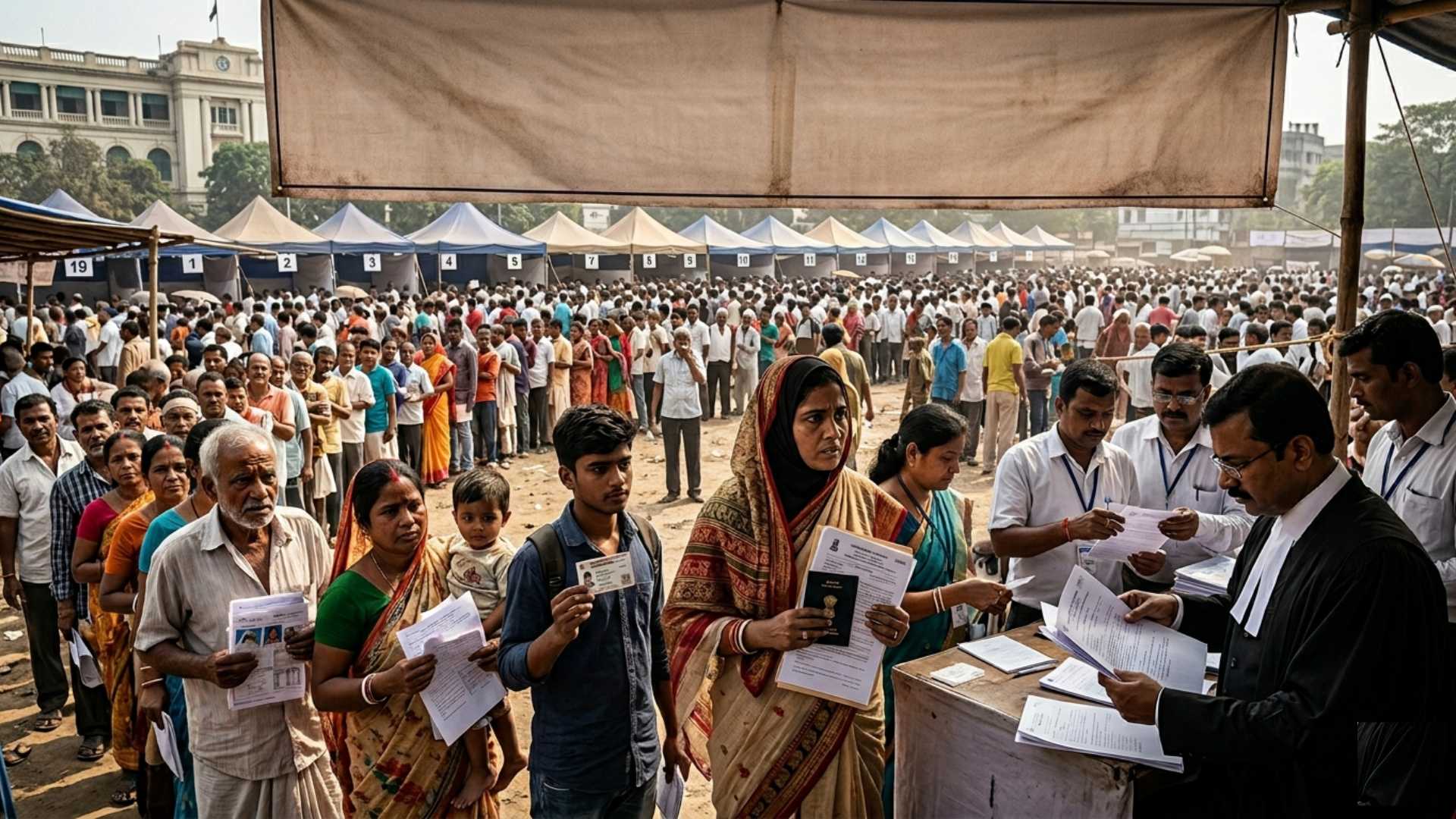
Free and fair elections are the cornerstone of Indian democracy, yet the integrity of the electoral roll — the foundational document of democratic participation — has emerged as a contested terrain. The Supreme Court's intervention in the West Bengal Special Intensive Revision (SIR) controversy, with 34 lakh voter appeals pending before 19 Appellate Tribunals barely 10 days before Assembly elections, exposes a critical tension: between the Election Commission's constitutional mandate to purify electoral rolls and the fundamental right of citizens to vote. The episode raises enduring questions about due process, institutional overreach, and the limits of administrative power in a democracy.
"The right to remain on the electoral roll, the right to vote in the country you are born in is not only constitutional but sentimental — it is the biggest expression of nationality and patriotism." — Justice Joymalya Bagchi, Supreme Court of India
Key Concepts
Special Intensive Revision (SIR) — A process by which the Election Commission systematically reviews and updates electoral rolls, removing ineligible voters and adding eligible ones. Governed by the Registration of Electors Rules, 1960.
Logical Discrepancy — A category introduced during West Bengal's SIR flagging voters whose identity details showed inconsistencies. Notably absent in other states' SIR exercises including Bihar's — raising questions of selective application.
Appellate Tribunal — A quasi-judicial body designated to hear appeals from voters whose names were excluded from electoral rolls during revision exercises.
Due Process — The constitutional principle that state action affecting individual rights must follow fair, transparent, and reasoned procedures. Central to Articles 14 and 21.
Background & Context
- The Election Commission conducted a SIR for West Bengal ahead of Assembly elections (April 23 and 29, 2026).
- The original SIR notification stated voters in the 2002 electoral roll would not be touched — the 2002 roll as benchmark meant established voters needed no fresh verification.
- The introduction of "logical discrepancy" as a category deviated from this benchmark, subjecting 2002-roll voters to fresh document verification.
- The EC froze the electoral roll on April 9, leaving a narrow window for 34 lakh excluded voters to appeal.
- The Supreme Court deployed judicial officers to hear objections — an extraordinary judicial intervention in an electoral administrative process.
Constitutional Framework
| Provision | Relevance |
|---|---|
| Article 324 | Election Commission's superintendence, direction, and control of elections |
| Article 326 | Universal adult suffrage — right to vote as constitutional guarantee |
| Article 14 | Equality before law — arbitrary exclusion violates equal treatment |
| Article 21 | Right to life and personal liberty — due process in deprivation of rights |
| Article 19(1)(a) | Free expression — voting as political expression |
The "Logical Discrepancy" Problem
The Supreme Court's sharpest criticism centred on this category:
- Bihar SIR (conducted earlier, used as precedent): EC itself argued before the court that a person in the 2002 voter list "does not have to prove anything — no uploading of documents required."
- West Bengal SIR: EC deviated from this position, requiring document verification for voters flagged for logical discrepancy.
- The court found no instance of "logical discrepancy" flagging in Bihar — suggesting the category was selectively applied to West Bengal alone.
- A mapped voter with Indian passport and Aadhaar (Quraisha Yeasmin) was still excluded without reasons — exposing the arbitrariness of the verification process.
Judicial Observations — Key Principles Articulated
1. Means must be reasonable, not just ends "We are not on 'ends justifying means'. We are on 'means subjecting themselves to reasonableness and fairness.'"
2. Voting as sentiment, not just right The court elevated voting beyond a legal entitlement to an expression of national belonging — reinforcing its non-negotiable character.
3. Suo motu exclusion requires robust appeal Since the EC unilaterally purged names without individual hearings, the appellate process must compensate with full due process — it cannot be hurried.
4. Citizens sandwiched between constitutional bodies The court refused to treat the dispute as EC vs. West Bengal government — recentring the voter as the party whose rights were at stake.
Implications & Challenges
Democratic Integrity Mass exclusions close to election dates suppress voter turnout among the most vulnerable — those least equipped to navigate appeal bureaucracy in 10 days.
Institutional Accountability The EC's deviation from its own Bihar-precedent position raises questions about consistency, transparency, and equal treatment across states.
Federal Dimension The EC cited non-cooperation from the West Bengal government as a resource constraint — but the court correctly refused to let inter-institutional conflict become a justification for voter disenfranchisement.
Judicial Role The Supreme Court's deployment of judicial officers and continuous monitoring represents an unusual degree of electoral process supervision — reflecting institutional distrust but also raising questions about the separation of election administration and judicial oversight.
UPSC Relevance
| GS Paper | Linkage |
|---|---|
| GS II — Polity | Election Commission, electoral rolls, judicial review, fundamental rights |
| GS II — Governance | Due process, administrative fairness, constitutional bodies |
| GS IV — Ethics | Institutional integrity, means vs. ends, fairness in public administration |
Conclusion
The West Bengal SIR controversy is not merely an administrative dispute — it is a stress test of India's democratic infrastructure. When the body entrusted with conducting free and fair elections becomes the subject of a Supreme Court calling-out for procedural unfairness, it signals an institutional credibility deficit that transcends any single election. The principle Justice Bagchi articulated — that means must subject themselves to reasonableness and fairness — is not a legal technicality but the moral foundation of democratic governance. Robust electoral rolls matter; so does the process by which they are built.
Attribution
Original content sources and authors
Syllabus classification
How this article maps to GS papers
Main syllabus
GS2JudiciaryQuick Q&A
What is the significance of the Supreme Court’s observation that the right to vote is both constitutional and sentimental?
The term ‘sentimental’ reflects the emotional and symbolic importance of voting as an expression of citizenship, identity, and belonging. Voting is not just a procedural act but a manifestation of national participation, where individuals contribute to shaping governance. This interpretation aligns with the idea that democracy is sustained not only by laws but also by public trust and participation.
Key implications include:
- Enhanced protection: Any restriction on voting rights must meet higher standards of fairness and reasonableness.
- Recognition of dignity: Exclusion from voting can affect an individual’s sense of belonging and citizenship.
- Strengthening democracy: Emphasizes participatory governance as a core democratic value.
For instance, in the case of excluded voters in West Bengal, the Court’s observation underscores that disenfranchisement is not merely administrative but affects citizen-state relations.
Thus, this interpretation broadens the scope of electoral rights, making them central to both constitutional morality and democratic legitimacy.
Why did the Supreme Court raise concerns about the use of 'logical discrepancy' in electoral roll revision?
Key concerns include:
- Absence of uniformity: The Court noted that such a category was not used in other states like Bihar, raising questions about selective application.
- Violation of due process: Voters may be excluded without clear reasoning or adequate opportunity to respond.
- Potential for misuse: Vague criteria can disproportionately affect certain groups, leading to allegations of bias.
For example, the petitioner Quraisha Yeasmin, despite possessing valid documents like Aadhaar and passport, was excluded without a reasoned order. This illustrates how undefined criteria can lead to unjust outcomes.
The Court’s concern reflects a broader principle of rule of law, which requires that administrative actions be transparent, predictable, and accountable. Arbitrary categories undermine these principles and weaken institutional credibility.
Thus, the issue is not merely technical but relates to fairness, equality, and non-arbitrariness in electoral governance.
How does the concept of due process apply to electoral roll revisions and voter exclusion?
Key elements of due process include:
- Notice: Affected individuals must be informed about potential exclusion.
- Opportunity to be heard: Voters should have a chance to present evidence and defend their inclusion.
- Reasoned decision: Authorities must provide clear justification for their actions.
- Right to appeal: A robust appellate mechanism must be available.
In the West Bengal case, the Court highlighted that the SIR process involved “suo motu” deletions followed by verification rather than a proper hearing, raising concerns about procedural fairness.
For instance, the large number of pending appeals (over 34 lakh) indicates that many voters were excluded without adequate initial scrutiny. This creates a backlog and delays justice, effectively denying the right to vote in time-sensitive elections.
Thus, due process is essential to ensure that electoral integrity does not come at the cost of individual rights and democratic participation. Without it, even well-intentioned reforms can lead to unjust outcomes.
Critically analyze the balance between electoral roll purification and voter inclusion in a democracy.
Arguments in favour of purification:
- Prevents electoral fraud: Ensures only eligible voters participate.
- Improves credibility: Accurate rolls enhance trust in election outcomes.
Concerns regarding over-purification:
- Risk of exclusion: Genuine voters may be wrongly removed due to procedural errors.
- Administrative overreach: Excessive scrutiny can create barriers to participation.
- Timing issues: Conducting such exercises close to elections disrupts democratic processes.
The West Bengal SIR case highlights this tension. While the Election Commission aimed to ‘purify’ the rolls, the large-scale exclusions and pending appeals suggest that inclusion may have been compromised.
A democratic system must prioritize “no voter left behind” over absolute perfection in rolls. Even a small number of wrongful exclusions can undermine legitimacy.
Thus, the balance lies in adopting a proportionate approach—ensuring accuracy without compromising accessibility, supported by strong safeguards like transparency, accountability, and judicial oversight.
Examine the West Bengal SIR controversy as a case study of institutional challenges in electoral governance.
Key features of the case:
- Large-scale exclusions: Around 34 lakh voters filed appeals after being removed from electoral rolls.
- Ambiguous criteria: Use of ‘logical discrepancy’ as a basis for exclusion.
- Timing concerns: The exercise was conducted close to assembly elections.
The case also revealed institutional tensions between the Election Commission, the judiciary, and the state government. The Court emphasized that voters were being “sandwiched” between authorities, highlighting governance challenges.
A specific example is the petitioner who was excluded despite valid documentation, illustrating gaps in verification processes.
Lessons from the case:
- Need for clarity: Criteria for inclusion/exclusion must be well-defined.
- Importance of timing: Major revisions should not coincide with elections.
- Strengthening appellate mechanisms: Efficient grievance redressal is crucial.
Thus, the case underscores that electoral governance requires not just institutional authority but also procedural fairness and public trust.
What are the reasons behind the judicial insistence on a robust appellate mechanism in electoral disputes?
Key reasons include:
- Protection against arbitrariness: Appeals provide a check on administrative decisions.
- Ensuring natural justice: Individuals must have the opportunity to challenge adverse decisions.
- Time-sensitive nature: Voting rights are linked to specific election timelines, requiring speedy resolution.
In the West Bengal case, the presence of over a lakh appeals per tribunal highlights the inadequacy of the existing system. Without efficient mechanisms, many voters may not be able to exercise their rights in time.
Additionally, since the initial deletions were suo motu, the burden shifts to the individual to prove eligibility, making appellate safeguards even more critical.
Thus, a robust appellate system ensures that errors are corrected, rights are protected, and public confidence is maintained. It is an essential component of a fair and credible electoral process.
How can electoral institutions ensure fairness and transparency while conducting large-scale revisions like SIR?
Key measures include:
- Clear guidelines: Define criteria such as discrepancies in objective and verifiable terms.
- Advance notice: Inform voters well before any action is taken.
- Decentralized verification: Use local officials for ground-level validation.
- Digital transparency: Publish lists and reasons for exclusion online.
For example, using technology for cross-verification (e.g., Aadhaar linkage with safeguards) can reduce errors while maintaining efficiency.
Institutional reforms:
- Independent oversight: Judicial or third-party monitoring of large exercises.
- Strengthened grievance redressal: Fast-track tribunals for timely resolution.
- Avoiding election proximity: Conduct revisions well before election schedules.
Ultimately, the credibility of elections depends on public trust. By prioritizing transparency, accountability, and inclusiveness, electoral institutions can ensure that reforms strengthen rather than weaken democracy.
Practice questions
2 questions for mains preparation