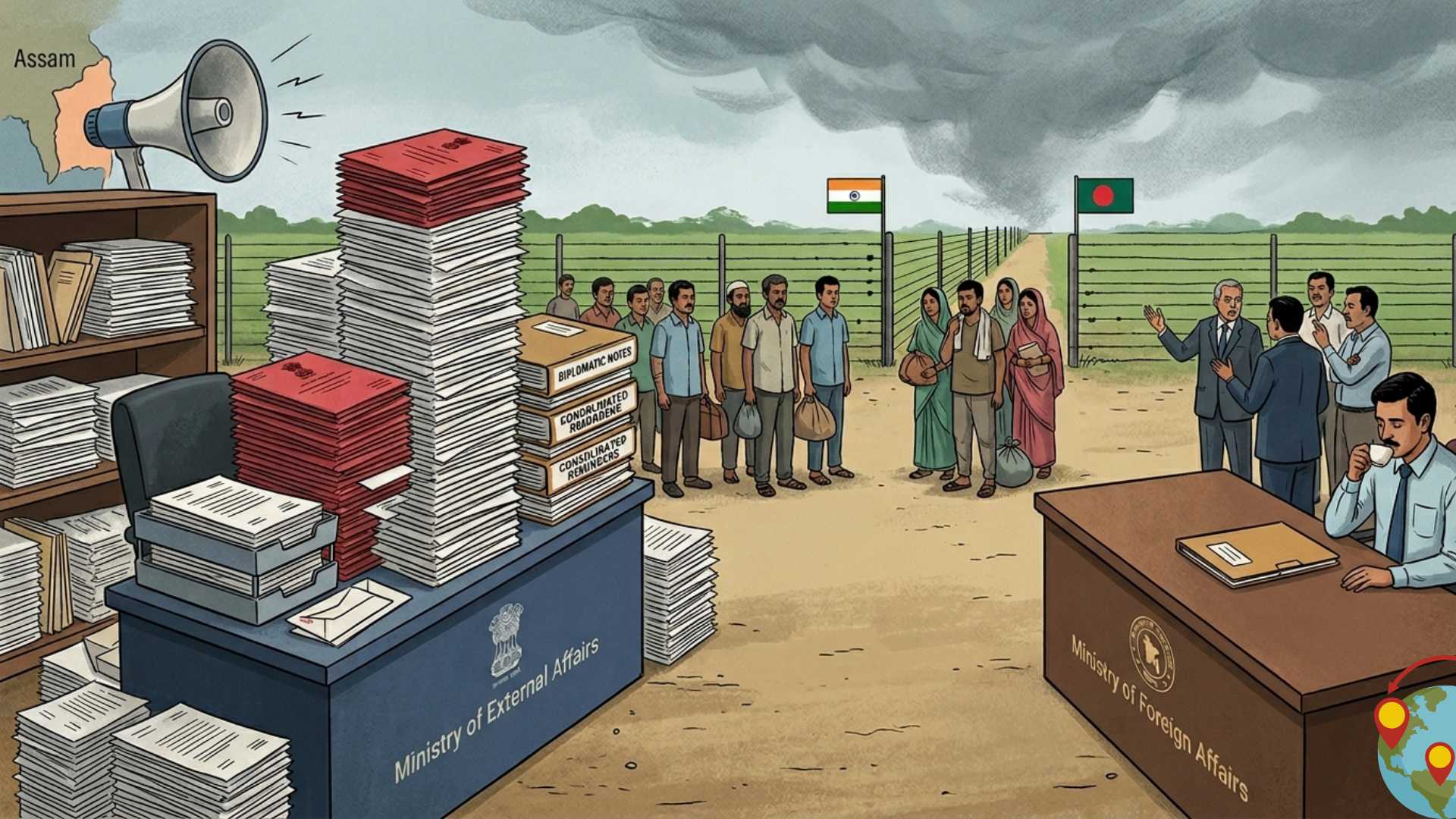
Bangladesh's Lack of Action on Indian Diplomatic Notes

Illegal immigration — the entry and residence of foreign nationals without documentation or legal authorisation — is simultaneously a sovereignty question, an internal security challenge, and a humanitarian concern.
For India, the Bangladesh border presents a unique complexity:
- At 4,156 km, it is India's longest land border with any single country
- It passes through West Bengal, Assam, Meghalaya, Tripura, and Mizoram — states with ethnically and linguistically mixed populations where distinguishing citizens from illegal immigrants is administratively difficult
- Decades of undocumented migration have created demographic, economic, and political pressures — strain on local resources, electoral roll distortions, and in worst cases, links to cross-border criminal and insurgent networks
From an internal security lens, illegal immigration is not simply about population — it is about ungoverned human movement that weakens the state's ability to know who is within its territory, a foundational requirement of national security.
Right. The article never answers the most basic question — who are these people, where did they come from, and why did they leave. That context is essential for UPSC. Add this as a new section right after the opening "Core Problem" section:
Who Are These Immigrants and Why Did They Come?
The illegal immigrants at the centre of this dispute are predominantly Bengali-speaking Muslims from Bangladesh, though the demographic is not monolithic. Their movement into India is driven by a layered set of push and pull factors:
Push factors from Bangladesh:
- Chronic poverty and landlessness, particularly in char (riverine island) regions prone to flooding
- Climate vulnerability — Bangladesh loses significant habitable land annually to riverbank erosion and sea-level rise, displacing millions internally and externally
- Communal violence and political instability in certain periods driving minority and majority communities alike across the border
Pull factors in India:
- Porous, poorly fenced stretches of the 4,156 km border
- Linguistic and cultural continuity with West Bengal — making assimilation easy and detection difficult
- Demand for low-wage informal labour in agriculture, construction, and domestic work in border states
Over decades, many have acquired forged Aadhaar cards, voter IDs, and ration cards — making them administratively invisible as illegal immigrants and legally difficult to distinguish from Indian citizens. This is precisely why nationality verification by Bangladesh is the irreplaceable step — India cannot unilaterally deport someone whose citizenship is disputed without the receiving country's confirmation.
Why Repatriation Matters: The Legal Framework
India's response to illegal immigration has two instruments:
- Detection and detention — under the Foreigners Act, 1946 and Passport Entry into India Act, 1920
- Deportation and repatriation — returning detected individuals to their country of origin
The critical bottleneck is here. International law requires the receiving country to verify and accept its nationals before deportation can proceed. Without Bangladesh confirming nationality, detained individuals cannot be legally removed — they exist in a legal and humanitarian limbo at India's administrative and financial cost.
This is the structural asymmetry Bangladesh's silence exploits — within the rules-based diplomatic framework, non-response is an effective instrument of obstruction.
Five Years, Zero Response
Since September 2020:
1,137   Notes Verbale seeking nationality verification
  456   Consolidated reminders sent to Dhaka
2,862   Pending nationality verification cases
    0   Actionable responses received
"A majority of these communications have not received an actionable response." — MEA Note Verbale, April 30, 2026
A Note Verbale is the standard formal government-to-government diplomatic communication tool. Over 1,100 such notes without response is not administrative backlog — it is deliberate policy non-engagement.
What Triggered the Current Confrontation
Bangladesh summoned the Indian envoy to protest remarks by Assam CM Himanta Biswa Sarma, who claimed Indian border guards were "pushing in" suspected Bangladeshi nationals through unguarded border stretches.
India's response pivoted immediately — rather than addressing the push-in allegation, the MEA pointed to the five-year non-cooperation record:
"All measures undertaken by the Government of India are in adherence to Indian laws and procedures, in tandem with established bilateral arrangements."
The phrase "core issue" then appeared in both the April 30 note verbale and MEA spokesperson Randhir Jaiswal's May 7 press briefing — a deliberate escalation, placing repatriation on par with trade, water-sharing, and connectivity in bilateral priority.
The Domestic Politics Complication
Bangladesh's Foreign and Home Ministers warned of "adequate measures" against push-ins — framing their objection around BJP election victories in West Bengal and Assam, where illegal immigration was an aggressive campaign theme.
This creates a dangerous conflation:
- For India — repatriation is a sovereign legal process, ethnicity and religion irrelevant
- For Bangladesh — it risks being read as political targeting of Bengali Muslims by a Hindu nationalist government
- The result: a legitimate administrative mechanism gets filtered through a communal lens, making resolution structurally harder
Way Forward & Conclusion
Three structural interventions are necessary:
- Bilateral repatriation treaty with legally binding timelines for nationality verification — India's existing arrangement lacks the enforcement architecture that formal extradition treaties carry
- Joint standing verification mechanism — replacing ad hoc note verbale exchanges with an institutionalised bilateral body, modelled on the Joint Rivers Commission
- Diplomatic decoupling from electoral cycles — both governments must prevent domestic political calendars from dictating the pace of an administrative process
The India-Bangladesh relationship remains South Asia's most consequential bilateral partnership — anchored in 1971, deepened through the Ganga Waters Treaty, and expanding through connectivity and trade. That foundation is durable but not unconditional. Repatriation is India's legitimate sovereign concern; nationality verification is Bangladesh's treaty obligation. Allowing a solvable administrative problem to calcify into a permanent diplomatic fault line serves neither country's strategic interest.
Attribution
Original content sources and authors


Syllabus classification
How this article maps to GS papers
Main syllabus
GS2Neighbourhood RelationsQuick Q&A
What is a Note Verbale, and how is it used in diplomatic communication between countries like India and Bangladesh?
In the context of India-Bangladesh relations, India has reportedly sent over 1,137 notes verbale and 456 consolidated reminders since September 2020 seeking nationality verification of suspected illegal Bangladeshi immigrants. These communications indicate the seriousness with which India views the issue of undocumented migration. Such diplomatic exchanges also reflect the preference for institutional and legal mechanisms rather than unilateral action.
Importance in diplomacy:
- Ensures official documentation of bilateral communication
- Creates diplomatic accountability and traceability
- Acts as evidence during negotiations or disputes
- Allows peaceful management of sensitive cross-border issues
The use of notes verbale demonstrates how modern diplomacy relies heavily on procedural communication before adopting stronger political or legal measures. In South Asia, where borders are porous and migration issues are politically sensitive, diplomatic documentation becomes crucial for maintaining trust and preventing escalation.
Why is illegal migration from Bangladesh considered a ‘core issue’ in India-Bangladesh bilateral relations?
The issue is especially significant in States such as Assam and West Bengal, where concerns regarding demographic change, pressure on land and resources, and identity politics have historically shaped political discourse. The National Register of Citizens (NRC) exercise in Assam and debates around the Citizenship Amendment Act (CAA) illustrate how migration has become intertwined with citizenship and national identity.
Major implications include:
- Security concerns: Potential misuse of porous borders by criminal or extremist networks
- Economic impact: Pressure on public services, jobs, and welfare schemes
- Political consequences: Electoral mobilization around migration-related narratives
- Diplomatic tensions: Accusations such as “push-in” operations can strain bilateral trust
However, the issue must be handled carefully because Bangladesh is also a crucial strategic partner for India in connectivity, trade, counterterrorism, and regional cooperation. Excessive politicization may damage broader regional stability. Therefore, balancing national security concerns with diplomatic sensitivity remains essential for both countries.
How does the process of nationality verification and repatriation of illegal migrants operate under international and bilateral norms?
In India’s case, authorities first identify suspected undocumented migrants through policing, detention procedures, or tribunal mechanisms. India then sends diplomatic communications such as notes verbale to Bangladesh seeking confirmation of nationality. Once verified, arrangements are made for repatriation through designated border checkpoints and administrative coordination between the two governments.
Challenges in implementation include:
- Lack of identity documents among migrants
- Delays in verification by the receiving country
- Human rights concerns regarding detention conditions
- Political sensitivity in acknowledging migrants as nationals
The current dispute highlights these operational difficulties. India claims that over 2,862 verification cases are pending, while Bangladesh has reportedly not provided actionable responses in many instances. Such delays create legal and humanitarian complications because prolonged detention without repatriation raises constitutional and human rights concerns.
A sustainable solution requires institutionalized mechanisms such as joint verification committees, digital identity cooperation, periodic border coordination meetings, and confidence-building measures. Efficient repatriation systems can reduce diplomatic friction while ensuring respect for international norms and human dignity.
Critically analyze the implications of ‘push-back’ or ‘push-in’ allegations between neighboring countries.
From India’s perspective, strong border management is necessary to prevent illegal migration and maintain internal security. Governments may argue that undocumented migrants cannot remain indefinitely if nationality verification confirms foreign origin. However, allegations of informal cross-border pushing without due process can damage India’s image as a law-abiding democratic state.
Negative implications include:
- Diplomatic tensions: Public accusations reduce trust between neighboring countries
- Humanitarian concerns: Migrants may face statelessness or unsafe conditions
- Border instability: Localized tensions may increase along sensitive border regions
- Domestic politicization: Migration issues can be used for electoral mobilization
At the same time, Bangladesh may perceive such allegations as attempts to externalize India’s domestic political challenges. If not handled diplomatically, the issue could affect cooperation in areas like trade, river-water sharing, connectivity, and regional security.
A balanced approach requires adherence to legal procedures, transparency, and bilateral coordination. Instead of unilateral measures, both countries should strengthen border infrastructure, institutional dialogue, and migration management frameworks. This would protect national interests while preserving the broader strategic partnership that has evolved significantly over the last decade.
What are the major reasons behind cross-border migration between India and Bangladesh?
Historically, migration patterns predate the Partition of 1947 and the creation of Bangladesh in 1971. Families, linguistic communities, and cultural networks remain interconnected across borders, especially in West Bengal, Assam, Meghalaya, and Tripura. These social ties continue to facilitate both legal and illegal movement.
Key reasons for migration include:
- Economic opportunities: Migrants often seek better employment and wages in Indian cities and agricultural sectors
- Environmental stress: Flooding, river erosion, and climate change-induced displacement in Bangladesh contribute to migration pressures
- Porous borders: Difficult terrain and extensive boundaries make surveillance challenging
- Political and social factors: Local instability or insecurity may encourage movement
Climate change is emerging as a particularly important factor. Bangladesh is highly vulnerable to sea-level rise and cyclones, which may increase future displacement. Therefore, migration should not be viewed only through a security lens but also as a developmental and humanitarian challenge.
India and Bangladesh must adopt a cooperative framework involving border management, economic development, legal migration pathways, and regional climate resilience. A purely securitized approach may not adequately address the structural causes driving migration.
How does the India-Bangladesh migration issue reflect broader challenges in managing international borders in South Asia?
For example, India shares migration-related concerns not only with Bangladesh but also with Nepal and Myanmar. The Rohingya refugee crisis involving Myanmar demonstrated how humanitarian emergencies can rapidly become regional security and diplomatic issues. Similarly, migration from Nepal to India occurs freely under treaty arrangements, showing the diversity of migration frameworks in the region.
Common regional challenges include:
- Weak documentation and identity systems
- Human trafficking and smuggling networks
- Political exploitation of migration issues
- Balancing humanitarian obligations with security concerns
The India-Bangladesh case is particularly significant because it combines demographic anxieties, electoral politics, border security, and diplomatic engagement simultaneously. Despite tensions, both countries have also demonstrated successful cooperation in counterterrorism, border fencing, and connectivity initiatives.
The broader lesson for South Asia is that migration cannot be solved solely through enforcement measures. Regional cooperation mechanisms, data sharing, economic integration, and climate adaptation strategies are equally important. A cooperative and rules-based migration framework could reduce tensions and contribute to regional stability and human security.
Practice questions
1 question for mains preparation