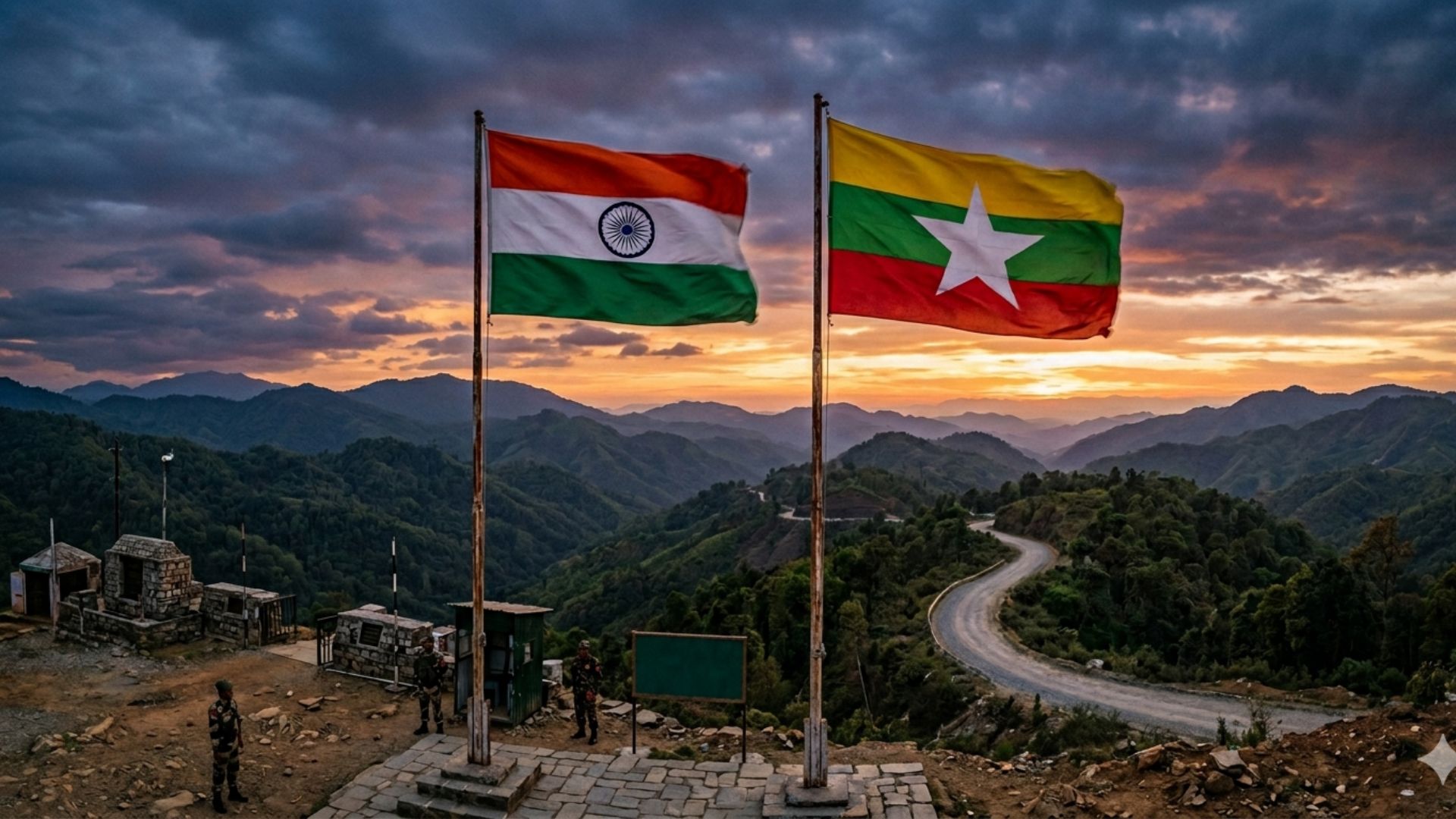
India–Myanmar Engagement Amid Conflict: Balancing Security, Connectivity and Democracy

"India does not believe in disengagement when it comes to Myanmar." — Foreign Secretary Vikram Misri
India's recent engagement with Myanmar President Min Aung Hlaing reflects a pragmatic foreign policy approach that seeks to balance security concerns, regional connectivity, democratic values, and strategic interests. Despite Myanmar's continuing civil conflict since the 2021 military coup, India has chosen sustained engagement rather than isolation.
Security Concerns Along the India–Myanmar Border
A major focus of discussions between Prime Minister Narendra Modi and President Min Aung Hlaing was border security.
Myanmar assured India that:
- Its territory would not be used against India's security interests.
- Cooperation against insurgent groups operating near the border would continue.
- Security coordination between the two countries would be strengthened.
This assurance is particularly significant given the presence of insurgent groups from India's Northeast in areas along the 1,643 km India–Myanmar border.
Example:
Several insurgent groups from Northeast India have historically
used remote areas in Myanmar as safe havens, making security
cooperation essential for both countries.
India's Position on Myanmar's Political Crisis
Myanmar has been witnessing intense conflict since the February 2021 military coup that removed the elected National League for Democracy (NLD) government led by Aung San Suu Kyi.
During discussions:
- India emphasized the need for enduring peace.
- The issue of continued detention of Aung San Suu Kyi was raised.
- India advocated dialogue among all stakeholders.
- India reiterated support for Myanmar's eventual return to democracy.
India clarified that its engagement is not an endorsement of Myanmar's internal political arrangements but is aimed at promoting stability and peace.
Connectivity Projects Facing Major Delays
The conflict in Myanmar has adversely affected critical connectivity initiatives that are central to India's Act East Policy.
Key Projects Discussed
- Kaladan Multimodal Transit Transport Project
- India–Myanmar–Thailand Trilateral Highway (Moreh–Mae Sot Corridor)
These projects aim to:
- Improve access to India's Northeast.
- Enhance trade and regional integration.
- Connect India with Southeast Asia.
However, active hostilities between Myanmar's military and ethnic armed organizations, particularly in Rakhine State, continue to delay implementation.
Importance:
These projects can reduce logistical dependence on the
Siliguri Corridor and improve economic integration
with ASEAN countries.
Expanding Defence Cooperation
The two sides also reviewed defence cooperation, focusing on:
- Military training
- Capacity building
- Institution building
- Training for United Nations Peacekeeping Operations
Such cooperation reflects the growing strategic partnership between the two countries while also contributing to regional stability.
Critical Minerals and Strategic Competition
Myanmar possesses significant deposits of critical minerals, particularly in Kachin State, which borders both India and China.
Discussion on critical minerals highlights:
- Supply chain security concerns.
- Growing global demand for strategic resources.
- Competition for influence in resource-rich regions.
For India, access to critical minerals is increasingly important for sectors such as renewable energy, electronics, batteries, and advanced manufacturing.
Cyber Scam Networks: A New Security Challenge
Another important issue discussed was the existence of cyber scam compounds in southeastern Myanmar near the Thailand border.
India has:
- Airlifted 2,411 workers from such scam centres.
- Continued efforts to repatriate more victims.
- Identified over 150 Indian nationals still trapped in these compounds.
These centres have emerged as hubs of cyber fraud, human trafficking, and forced online scam operations affecting citizens from multiple countries.
Criticism from Myanmar's Exiled Opposition
The visit has attracted criticism from Myanmar's exiled democratic opposition, especially the National Unity Government (NUG).
Their concerns include:
- Fear of international legitimacy being granted to the military-backed government.
- Perception that diplomatic engagement may weaken democratic forces.
Nevertheless, India maintains that engagement remains necessary to address security, connectivity, humanitarian, and regional stability concerns.
Economic Engagement
Apart from official meetings, President Min Aung Hlaing interacted with Indian business representatives.
Reports indicate that:
- Investment opportunities were discussed.
- The Yadanabon City project in Myanmar was promoted to Indian investors.
- Economic cooperation remains a component of bilateral relations despite ongoing instability.
Way Forward
- Strengthen coordinated border management mechanisms.
- Accelerate connectivity projects wherever security conditions permit.
- Encourage inclusive political dialogue among all stakeholders in Myanmar.
- Expand cooperation against cybercrime and human trafficking.
- Deepen engagement on critical minerals and economic development.
- Continue balancing strategic interests with support for democratic transition.
Conclusion
India's approach toward Myanmar reflects strategic realism combined with principled engagement. While security concerns, connectivity projects, critical minerals, and cybercrime necessitate close cooperation, India continues to advocate dialogue, peace, and a return to democracy. The challenge lies in maintaining this delicate balance while safeguarding national interests and contributing to long-term regional stability.
Attribution
Original content sources and authors

Syllabus classification
How this article maps to GS papers
Main syllabus
GS2Neighbourhood RelationsQuick Q&A
What is the strategic significance of Myanmar in India's neighbourhood policy, Act East Policy, and regional security architecture?
Why has India adopted a policy of pragmatic engagement with Myanmar despite concerns regarding democracy and military rule after the 2021 coup?
How do instability and civil conflict in Myanmar affect India's connectivity projects, economic interests, and regional integration objectives?
Critically analyze the challenges and opportunities in India-Myanmar security cooperation along the shared international border.
What does the issue of cyber scam compounds in Myanmar reveal about emerging non-traditional security threats in the region?
What are the major geopolitical and economic reasons behind India's continued interest in Myanmar's critical minerals and strategic resources?
How can India balance its democratic values with strategic interests while shaping its long-term policy toward Myanmar?
Practice questions
2 questions for mains preparation