GS2 Neighbourhood Relations

India–Nepal Boundary Dispute: Towards Pragmatic Dialogue and a Renewed Partnership

India–Nepal Boundary Dispute: Towards a More Mature and Sustainable Partnership

Nepal's PM proposes a balanced approach to the boundary dispute and trade issues, hinting at a fresh perspective in bilateral relations.
Gopi Gopi
4 mins read

Balancing Territorial Concerns, Historical Linkages and Future-Oriented Diplomacy

“In some places, Nepal may also be occupying territory claimed by India. Both countries should examine the facts objectively and resolve the matter amicably as friends.” — Nepal Prime Minister Balendra Shah "Balen"

Why is it in News?

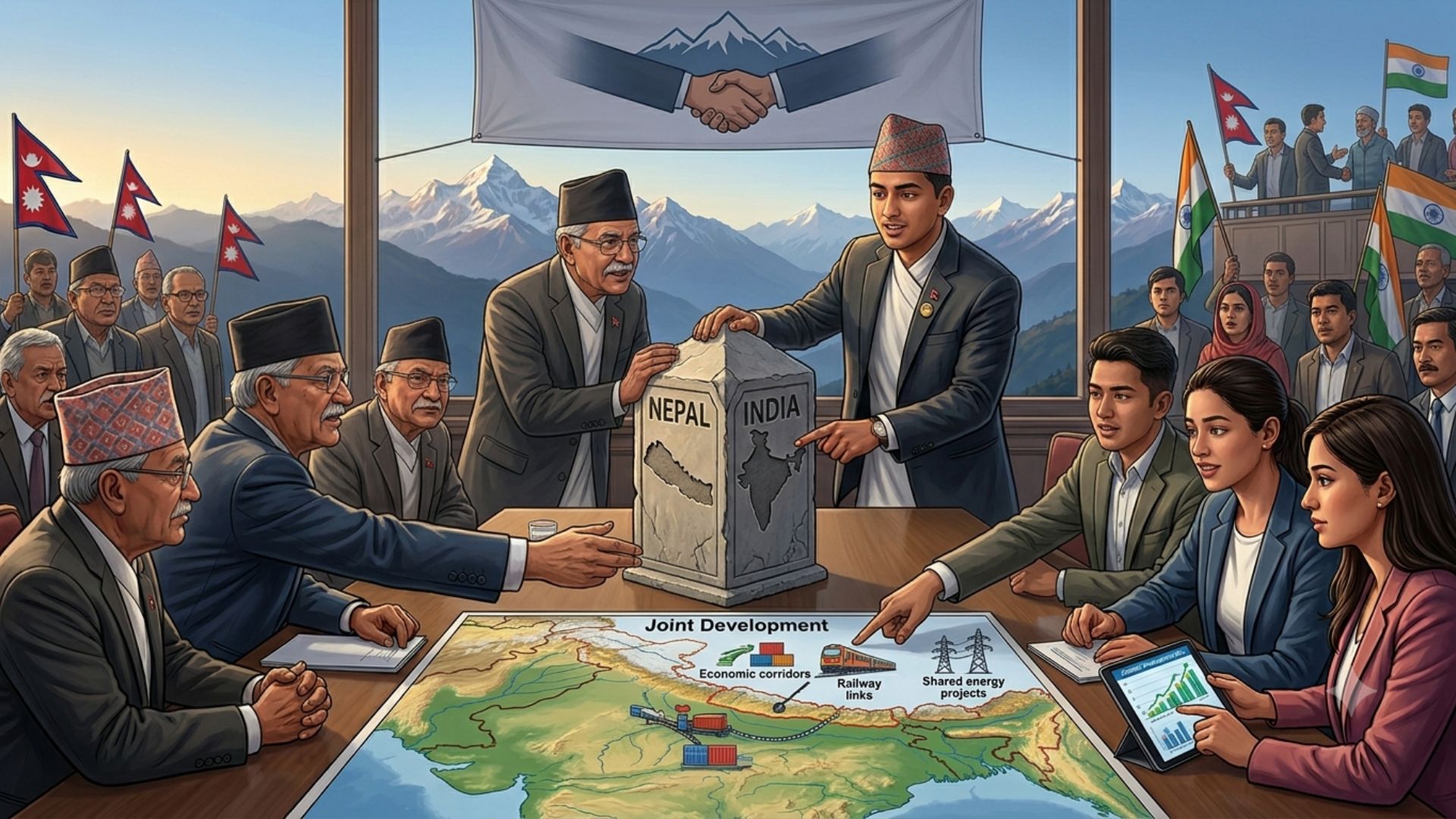
Nepal Prime Minister Balendra Shah (Balen) adopted a relatively conciliatory stance during a parliamentary discussion on the long-standing India–Nepal boundary dispute involving Kalapani, Lipulekh and Limpiyadhura.

His remarks marked a departure from the traditionally one-sided narrative surrounding the dispute and emphasized objective examination and diplomatic resolution.


The Disputed Areas

AreaSignificance
KalapaniStrategically important Himalayan region
Lipulekh PassTrade route and Kailash Mansarovar Yatra corridor
LimpiyadhuraClaimed by Nepal as part of its territory

Core Issue

Both India and Nepal claim parts of these territories based on differing interpretations of historical maps and boundary records.


A Shift in Nepal's Position?

Traditionally, Nepal's political discourse has focused on alleged Indian encroachment.

However, Prime Minister Shah acknowledged that:

  • Territorial claims may not be one-sided.
  • Both countries should objectively verify facts.
  • Diplomatic dialogue remains the preferred route.

Domestic Reaction

His remarks triggered:

  • Criticism inside Parliament.
  • Public protests.
  • Opposition from nationalist sections.

Despite this, the Prime Minister reiterated support for diplomatic engagement.


Lipulekh Pass and Recent Tensions

Nepal has objected to:

  • India-China trade through Lipulekh Pass.
  • Use of the route for Kailash Mansarovar Yatra.

Nepal's Position

  • Sent a diplomatic note to India.
  • Reaffirmed commitment to peaceful resolution.

India's Position

India rejected Nepal's objections and described Kathmandu's territorial claim as:

"Unjustified" and influenced by "unilateral artificial enlargement."


Changing Political Tone in Nepal

A significant feature of recent developments is the emergence of a younger political leadership.

Key Characteristics

  • Focus on future-oriented governance.
  • Emphasis on economic and social development.
  • Opposition to corruption and nepotism.
  • Reduced dependence on ideological politics.

Indicators of the New Approach

  • Objections to activities in disputed territories.
  • Postponement of the Indian Foreign Secretary's visit.
  • Reluctance to extend traditional diplomatic privileges.

These actions suggest that Nepal seeks:

  • Greater diplomatic parity.
  • A more conventional state-to-state relationship.
  • Reduced reliance on the notion of a "special relationship."
Example:

Earlier:
India often enjoyed direct access to Nepal's
top leadership due to close historical ties.

Emerging Trend:
Nepal increasingly seeks engagement based
on sovereign equality and standard diplomatic
protocols.

Why is Resolution Difficult?

Historical Challenges

  • Contradictory British-era maps.
  • Changing cartographic methods over time.
  • Different interpretations of historical evidence.

Competing National Positions

IndiaNepal
Follows boundary inherited in 1947Claims disputed areas based on its interpretation of historical records
Emphasizes strategic security interestsHas incorporated its version of the map into currency notes

Role of China

Prime Minister Shah suggested that:

  • China and the United Kingdom may need consultation for a long-term solution.

Concerns

Such involvement may:

  • Complicate negotiations.
  • Delay settlement.
  • Introduce additional geopolitical considerations.

China's Stated Position

President Xi Jinping's position has been:

Nepal should resolve the issue directly with India.

This remains the most practical approach.


Foundations for a Practical Solution

Several existing strengths can support resolution.

Historical and Social Linkages

  • Centuries-old civilizational ties.
  • Deep cultural and religious connections.
  • Extensive people-to-people interactions.

Open Border Tradition

  • More than 1,700 km of open border.
  • Long history of free movement.
  • Previously extended to disputed regions before 1962.

Military Cooperation

  • Strong institutional relationship between Indian and Nepalese armies.
  • High levels of trust and cooperation.
Example:

The open border allows millions of citizens
to travel, work, study and conduct business
across both countries, making India-Nepal
relations unique in South Asia.

Way Forward

  • Prioritize political dialogue over prolonged technical discussions.
  • Prevent the dispute from dominating bilateral relations.
  • Build trust through economic cooperation and connectivity.
  • Respect changing political realities within Nepal.
  • Utilize military and institutional trust for confidence-building.
  • Resolve differences without externalizing the issue.
  • Promote sovereign equality while preserving historical closeness.

Conclusion

The recent statements by Nepal's Prime Minister offer an opportunity to move beyond rigid nationalist narratives and towards a more balanced understanding of the boundary issue. Rather than allowing territorial disagreements to overshadow a unique relationship built on geography, culture and open borders, India and Nepal can use dialogue, mutual trust and political maturity to build a more sustainable and future-oriented partnership.

Attribution

Original content sources and authors
K.V. Rajan Author K.V. Rajan The Hindu Source The Hindu

Syllabus classification

How this article maps to GS papers

Main syllabus

GS2Neighbourhood Relations

Quick Q&A

What is the nature of the India-Nepal boundary dispute over Kalapani, Lipulekh, and Limpiyadhura, and why is it strategically significant?
The India-Nepal boundary dispute primarily concerns the territories of Kalapani, Lipulekh, and Limpiyadhura located in the western sector of the bilateral boundary. Both countries claim these areas based on differing interpretations of the 1816 Treaty of Sugauli signed between British India and the Kingdom of Nepal. The disagreement revolves around the origin of the Kali River, which serves as the basis for boundary demarcation. Nepal argues that Limpiyadhura is the river's source, whereas India follows maps inherited from British India after 1947. The dispute gained prominence after India inaugurated a road to Lipulekh Pass in 2020 to facilitate the Kailash Mansarovar Yatra and improve connectivity with China. Nepal responded by issuing a revised political map incorporating the disputed territories and subsequently printing this map on its currency notes. India rejected these claims, describing them as unilateral. The issue has significance beyond territorial claims. Lipulekh Pass has strategic importance due to its proximity to the India-China border and its role in trade and pilgrimage. The dispute also affects bilateral trust and public opinion in both countries. For UPSC GS Paper II, the issue falls under India and its neighbourhood relations. It also intersects with GS III topics relating to border management and national security. Historical geography, colonial legacy, and diplomatic mechanisms are equally relevant. Despite periodic tensions, both countries continue to emphasize dialogue and diplomatic engagement, reflecting the broader objective of preserving their unique civilizational and people-to-people relationship.
Why are India-Nepal relations and the management of the boundary dispute important for UPSC aspirants and India's foreign policy?
India-Nepal relations occupy a central place in India's Neighbourhood First policy and are highly relevant for UPSC aspirants because they combine elements of diplomacy, security, economics, and cultural ties. Nepal shares an open border of over 1,700 kilometres with India, facilitating the movement of people, trade, and employment opportunities. Millions of Nepalese citizens work in India, while deep religious and historical connections bind the two countries. The boundary dispute involving Kalapani, Lipulekh, and Limpiyadhura highlights the complexity of managing historical claims in South Asia. It demonstrates how colonial-era treaties and maps continue to influence contemporary geopolitics. The issue also intersects with India's strategic concerns regarding China, especially after the 1962 India-China War and growing Chinese influence in Nepal. For UPSC GS Paper II, India-Nepal ties illustrate themes such as bilateral relations, regional diplomacy, and conflict resolution. Questions related to the Neighbourhood First policy, SAARC, BIMSTEC, and border management frequently appear in examinations and interviews. Current developments under Prime Minister Balendra Shah 'Balen' indicate a more pragmatic and balanced approach. His acknowledgment that territorial claims may not be one-sided reflects a departure from purely nationalist narratives. Such developments underscore the importance of diplomacy over confrontation. From a policy perspective, stable relations with Nepal are essential for hydropower cooperation, connectivity projects, trade corridors, disaster management, and regional integration. Therefore, understanding India-Nepal relations provides valuable insights into broader themes of cooperative federalism, strategic autonomy, and sustainable regional partnerships.
How can India and Nepal adopt a practical and mutually acceptable approach to resolve the boundary dispute without harming bilateral relations?
India and Nepal can adopt a pragmatic approach by ensuring that the boundary dispute does not overshadow their broader and historically unique relationship. Both countries have repeatedly emphasized diplomatic channels as the preferred mechanism for conflict resolution, and this remains the most viable option. One important step is strengthening joint technical and diplomatic mechanisms to examine historical records, maps, and geographical evidence. Since British-era maps themselves contain contradictions owing to periodic revisions, reliance on a single historical document may not provide a definitive solution. Therefore, a combination of historical, geographical, and practical considerations is necessary. Another approach involves drawing inspiration from the long tradition of open borders and extensive people-to-people interactions. Prior to the 1962 India-China War, communities in the disputed areas coexisted with minimal restrictions. Maintaining this spirit can reduce tensions while negotiations continue. Institutional cooperation between the Indian Army and the Nepal Army also provides a valuable confidence-building mechanism. Their longstanding relationship has traditionally contributed to strategic trust and can facilitate practical arrangements. Economically, expanding cooperation in hydropower, trade, tourism, and connectivity projects can create positive interdependence. Such cooperation reduces incentives for confrontation. For UPSC GS Paper II, this issue demonstrates the importance of confidence-building measures, Track-II diplomacy, and regional cooperation. It also reflects the principles of peaceful dispute settlement under international law. Ultimately, both countries must avoid excessive nationalism and recognize that perceived encroachments are products of historical complexities rather than deliberate aggression. A forward-looking and enlightened approach can transform a contentious issue into an opportunity for deeper partnership.
What is the critical analysis of the changing political tone in Nepal and its implications for India's traditional special relationship with Kathmandu?
The emergence of a younger political leadership in Nepal represents an important shift in the country's domestic and foreign policy orientation. Prime Minister Balendra Shah 'Balen' and other contemporary leaders appear to prioritize governance reforms, anti-corruption measures, and economic development over ideological politics. This changing political environment has implications for India's historically privileged position in Nepal. Traditionally, India enjoyed extensive access and influence in Nepal under the framework of a 'special relationship.' However, recent developments indicate that Kathmandu increasingly seeks to engage India on the basis of sovereign equality rather than exceptional treatment. Examples include protocol-related differences, objections regarding the Lipulekh route, and postponement of high-level visits. From one perspective, these developments may appear as signs of growing nationalism and strategic diversification. Some observers worry that reducing India's influence could provide greater space for China in Nepal's strategic landscape. Others, however, view the shift positively, arguing that mature relations should be based on mutual respect rather than dependence. Prime Minister Shah's statement acknowledging that territorial issues may not be entirely one-sided reflects political maturity and a willingness to avoid populist narratives. Such pragmatism could create conditions for more sustainable engagement. For UPSC GS Paper II, this debate highlights concepts such as strategic autonomy, asymmetrical relationships, and changing regional geopolitics. It also demonstrates how domestic political transitions influence foreign policy. India's measured response to recent developments indicates recognition that Nepal's evolving political identity should be respected. Long-term bilateral stability depends on adapting to these changes and building partnerships based on equality, trust, and shared developmental goals rather than historical assumptions.
What are the historical and geopolitical reasons behind the persistence of the India-Nepal boundary dispute despite repeated diplomatic efforts?
Several historical and geopolitical factors explain why the India-Nepal boundary dispute has remained unresolved for decades. The origins of the dispute lie in the Treaty of Sugauli signed in 1816 following the Anglo-Nepalese War. The treaty established the Kali River as a reference point for demarcation, but ambiguity regarding the river's source later gave rise to competing interpretations. British India periodically revised maps with improvements in surveying technology. Consequently, different versions of maps exist, creating contradictions in historical evidence. India inherited the boundaries maintained by British India in 1947, while Nepal has increasingly emphasized alternative interpretations supporting its claims. Geopolitics further complicates the issue. Lipulekh Pass possesses strategic importance because it lies close to the tri-junction involving India, Nepal, and China. The region also serves as an important route for trade and the Kailash Mansarovar pilgrimage. Since the 1962 India-China War, India has attached considerable security significance to maintaining the status quo. Domestic politics and nationalist sentiments have periodically intensified the dispute. Political actors in both countries sometimes use territorial issues to mobilize public support, making compromise politically sensitive. The increasing role of China in South Asia has added another dimension. However, Chinese President Xi Jinping reportedly maintained that Nepal and India should resolve the matter bilaterally. For UPSC GS Papers II and III, the dispute illustrates the interaction between history, geography, security, and diplomacy. It also demonstrates how colonial legacies continue to influence modern international relations. Therefore, the persistence of the issue reflects not merely territorial disagreements but also strategic concerns, domestic politics, and competing historical narratives.

Practice questions

1 question for mains preparation

India’s relations with its neighbours are shaped as much by historical and cultural linkages as by contemporary strategic and territorial concerns. In the context of India–Nepal relations, examine how diplomatic engagement can help manage boundary disputes while preserving regional cooperation and mutual trust.

10 marks · 150 words · 8 mins