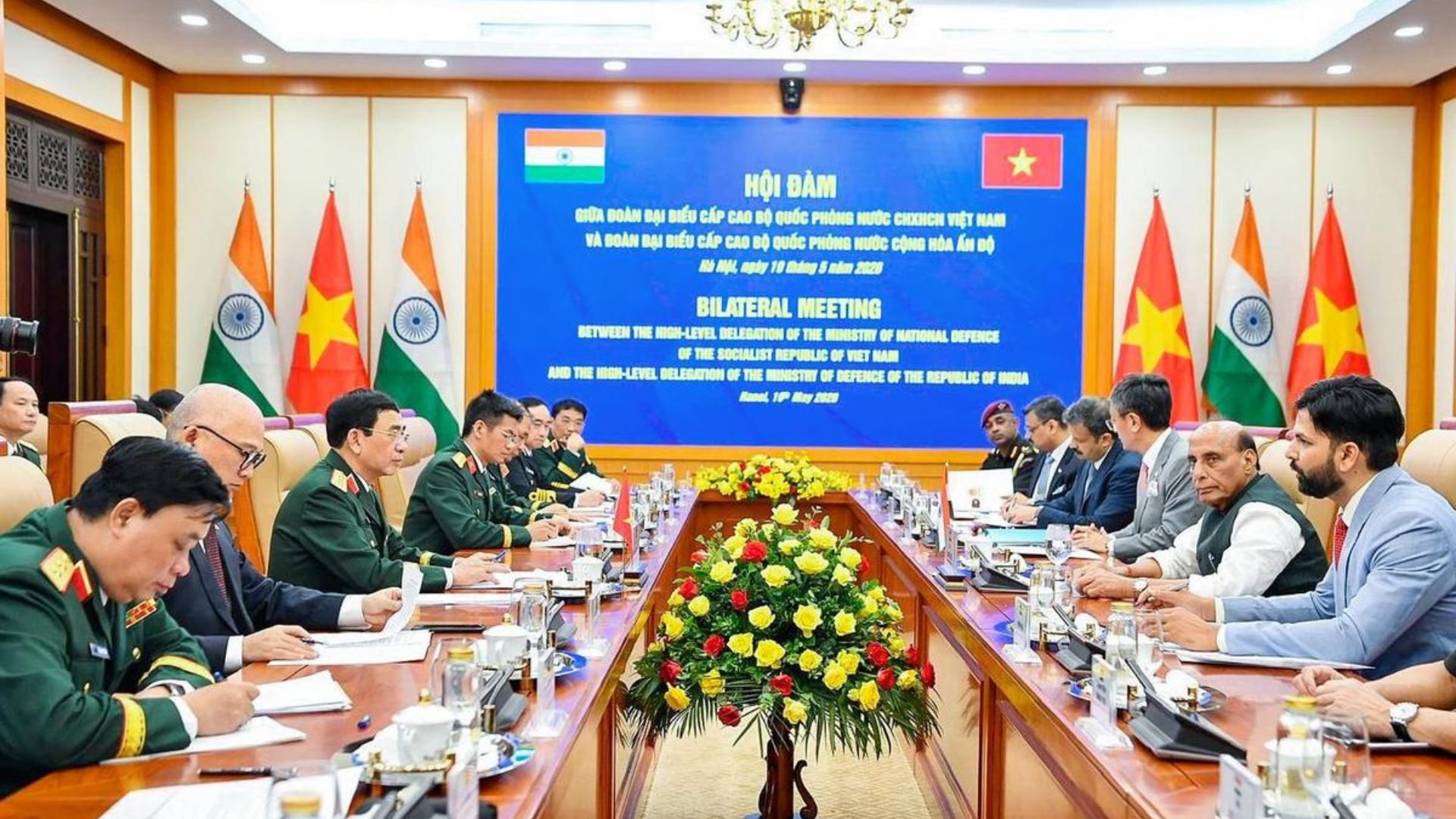
India and Vietnam Strengthen Defence Ties for Maritime Security

Defence Minister Rajnath Singh's visit to Hanoi on May 19, 2026, for bilateral talks with Vietnam's Deputy Prime Minister and Defence Minister General Phan Van Giang, marked a significant step in consolidating what is now a Comprehensive Strategic Partnership between the two nations — with a sharp focus on Indo-Pacific stability, defence modernisation, and emerging technology cooperation.
The Strategic Context
India and Vietnam share a natural convergence of interests. Both are maritime nations with stakes in the South China Sea, both are wary of unilateral assertions of dominance in the Indo-Pacific, and both are deepening defence ties with like-minded partners. The Hanoi talks placed this relationship squarely within that larger strategic framework.
Discussions covered a wide spectrum:
- Maritime security and freedom of navigation
- Defence industry collaboration
- Military training and exchange programmes
- Cyber security and capacity building
- Regional stability in the Indo-Pacific
Both sides reaffirmed the importance of peace, stability, safety and freedom of navigation in the region — language that carries pointed significance given the contested waters of the South China Sea.
Defence Modernisation: India as a Partner
A central theme of the visit was India's role in supporting Vietnam's defence modernisation. Rajnath Singh explicitly reiterated India's commitment to this under the bilateral defence cooperation framework — signalling that India is not merely a diplomatic partner but an active capacity-builder.
India's Support to Vietnam
──────────────────────────────────────────────
Language Lab       →  Air Force Officers' College, Vietnam
AI Lab             →  Telecommunications University, Nha Trang
MoU Signed         →  AI & Quantum Technology cooperation
                      (India's MCTE + Vietnam's Telecom University)
The language lab at the Air Force Officers' College — virtually inaugurated during the visit — reflects soft power integration at the institutional level, building human capital for long-term defence interoperability.
The AI lab at Nha Trang and the MoU on Artificial Intelligence and Quantum Technology are particularly significant. Defence modernisation today is not just about hardware — it is about cognitive and technological warfare readiness, and India is positioning itself as a credible partner in this emerging domain.
Institutional Mechanisms for Sustained Engagement
Beyond the high-level optics, both countries agreed on concrete mechanisms:
- Regular dialogues to maintain strategic communication
- Joint military exercises to build operational interoperability
- Exchange programmes between armed forces for professional development
These are not new ideas, but their reaffirmation signals a deliberate effort to institutionalise the partnership — moving it from event-driven diplomacy to structured, recurring engagement.
The Human Dimension
Rajnath Singh's tribute to former Vietnamese President Ho Chi Minh on his 136th birth anniversary was a carefully chosen diplomatic gesture — acknowledging Vietnam's revolutionary heritage and the historical warmth between the two peoples. Singh described Ho Chi Minh as a leader "whose vision and commitment continue to inspire generations and strengthen India-Vietnam friendship."
This people-to-people dimension was reinforced when Singh called on President and General Secretary To Lam, conveying greetings from India's President and Prime Minister, and both leaders reaffirmed commitment to deepening cooperation across defence, trade, connectivity, maritime cooperation, and people-to-people ties.
Way Forward
- India should leverage the AI and Quantum MoU to co-develop dual-use technologies, strengthening both countries' defence-industrial ecosystems.
- Joint maritime patrols in the Indo-Pacific, building on existing exercises, would give operational substance to the freedom of navigation commitments.
- Expanding the defence modernisation framework to include transfer of technology — not just training — would deepen strategic trust.
- India must use the Vietnam partnership as part of a broader ASEAN engagement strategy, reinforcing its Act East Policy with credible defence deliverables.
Conclusion
The Hanoi visit demonstrates that India's defence diplomacy is maturing — moving from declarations to deliverables. Language labs, AI institutions, and quantum technology MoUs are not merely symbolic; they are the building blocks of long-term strategic interoperability. As the Indo-Pacific emerges as the defining theatre of 21st century geopolitics, India's partnership with Vietnam — a frontline state in contested waters — is not optional. It is essential.
Attribution
Original content sources and authors


Syllabus classification
How this article maps to GS papers
Main syllabus
GS2Neighbourhood RelationsQuick Q&A
What is the strategic significance of India-Vietnam defence cooperation in the Indo-Pacific region?
The partnership reflects convergence of strategic interests. Both countries support freedom of navigation, peaceful dispute resolution, and adherence to international law such as UNCLOS. Vietnam's proximity to contested South China Sea zones makes it a key regional partner for India in balancing geopolitical competition.
From a practical perspective, defence cooperation includes:
- Joint military exercises and training
- Defence industry collaboration
- Maritime domain awareness
- Cyber security and capacity building
Why is maritime security central to India-Vietnam strategic relations?
Vietnam's strategic location makes it a valuable maritime partner. It lies close to disputed territories in the South China Sea and plays an active role in ASEAN's regional security architecture. India, as a major Indo-Pacific stakeholder, seeks to ensure freedom of navigation and prevent unilateral domination in these waters.
For India, maritime cooperation with Vietnam serves larger objectives:
- Enhancing naval interoperability
- Strengthening presence in Southeast Asia
- Supporting international maritime law
- Ensuring sea lane security
How do emerging technologies like Artificial Intelligence and Quantum Technology shape modern defence partnerships?
The establishment of AI and language laboratories demonstrates technology diplomacy. Such initiatives improve training, communication, and operational efficiency. AI can support predictive maintenance, intelligence analysis, and unmanned systems, while quantum technology strengthens secure communications and cryptographic resilience.
Globally, similar trends are visible in QUAD and NATO collaborations. India's cooperation with Vietnam indicates that defence partnerships increasingly include research ecosystems, academic institutions, and innovation networks. This broadens bilateral ties beyond conventional military assistance into long-term strategic technological integration.
Critically analyse the role of India-Vietnam ties in balancing power dynamics in the Indo-Pacific.
One perspective views this cooperation as balancing China's assertiveness in the South China Sea. Defence engagement, maritime collaboration, and institutional dialogues provide Vietnam strategic options and enable India to increase regional relevance. However, India avoids overt military containment policies.
A critical assessment shows both strengths and limitations.
- Strength: Shared strategic trust and complementary interests
- Strength: Defence training and institutional partnerships
- Limitation: Absence of formal military alliance
- Limitation: Resource constraints compared to major powers
What does India-Vietnam defence cooperation reveal about India's Act East Policy in practice?
Examples from the current visit include:
- AI lab establishment
- Language lab inauguration
- Military education partnerships
- Joint exercises and defence dialogues
This mirrors India's engagement with countries like Indonesia, Singapore, and the Philippines. Through infrastructure, security, and educational partnerships, India seeks to build trusted relationships that support both economic integration and regional security.
As a case study, how can India-Vietnam defence cooperation strengthen India's long-term strategic objectives?
Strategically, this supports India in three ways:
- Access to a key Indo-Pacific partner near major maritime routes
- Enhanced defence diplomacy and regional credibility
- Promotion of indigenous defence exports and training
In the long term, the relationship supports India's aspiration to become a net security provider. By assisting Vietnam's defence modernisation, India builds trust-based partnerships. Similar models with Mauritius, Maldives, and ASEAN countries illustrate how defence diplomacy supports India's global strategic rise.
Practice questions
1 question for mains preparation