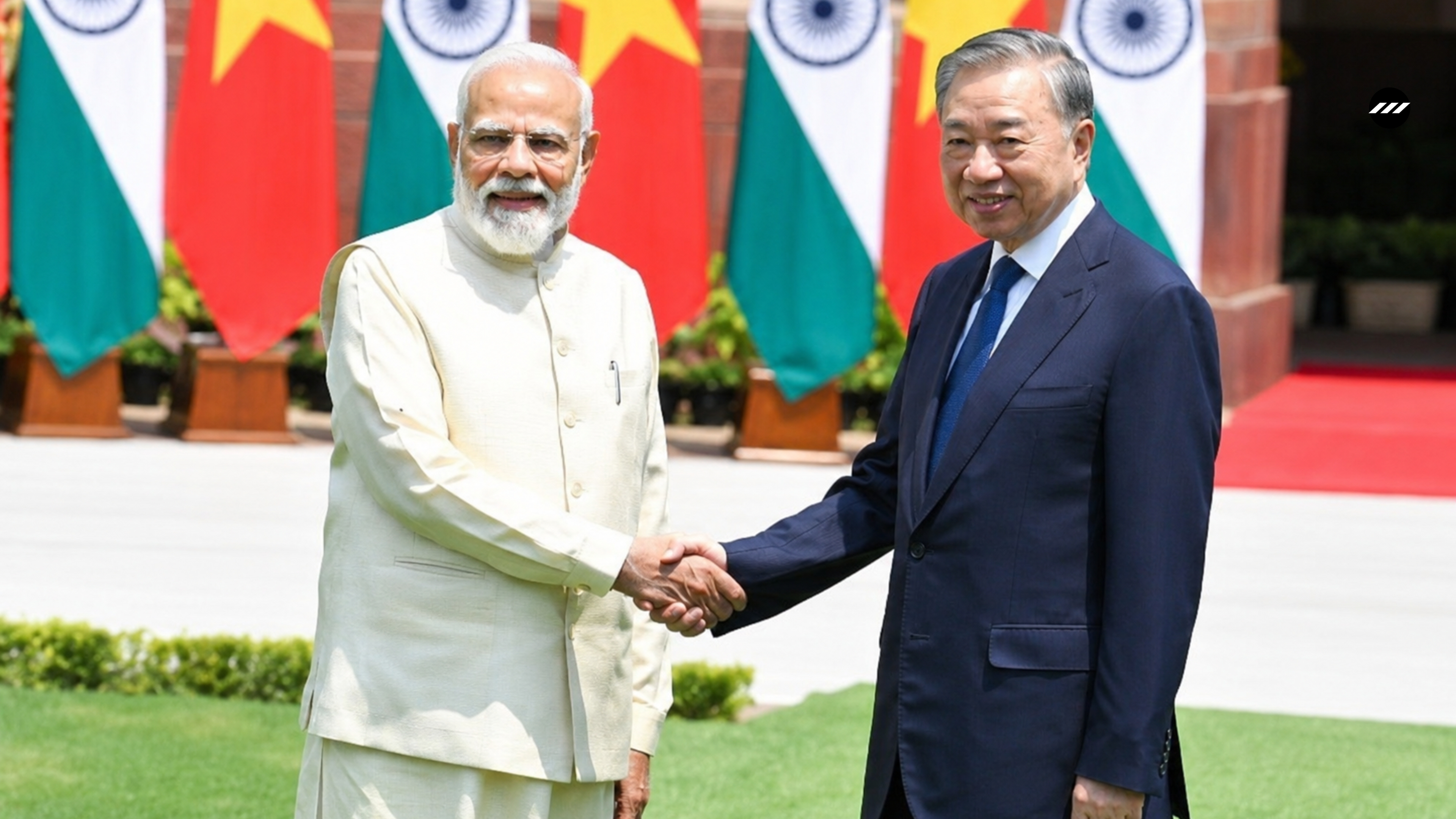
India-Vietnam Strategic Partnership: A New Phase in Ties

The Landmark Visit
Vietnamese President Tô Lâm's state visit to India (May 5–7, 2026) marks a qualitative shift — not merely incremental progress — in bilateral ties. The centrepiece of the visit was the elevation of relations to an Enhanced Comprehensive Strategic Partnership, accompanied by agreements spanning:
- Defence and maritime cooperation
- Technology and emerging sectors
- Finance and digital payments
- Energy and critical minerals
Strategic Context: Why Now?
The visit comes amid heightened geopolitical flux in the Indo-Pacific, driven by two converging imperatives:
- Vietnam is navigating an increasingly assertive China in the South China Sea
- India is consolidating its Act East Policy into a more security-oriented Indo-Pacific strategy
Shared threat perceptions:
Maritime coercion | Supply chain vulnerabilities | Strategic autonomy
This convergence has provided a durable structural foundation for bilateral engagement — not merely transactional diplomacy.
Evolution of Ties at a Glance
- Look East Policy → initial impetus for India-Vietnam engagement
- 2016 → elevated to Comprehensive Strategic Partnership; institutionalised defence cooperation
- 2023 → transfer of missile corvette INS Kirpan to Vietnam
- 2026 → Enhanced Comprehensive Strategic Partnership
The Defence Pillar
Defence cooperation has emerged as the backbone of the partnership:
- India has offered Vietnam finance lines, training assistance, and maritime cooperation structures
- The ongoing debate around BrahMos supersonic cruise missile exports signals a shift in the relationship — from mere capacity-building to capability enhancement
- This represents a change in the deterrence calculus in the South China Sea itself
Economic Ties: Rising Salience
While historically less prominent, economic ties are now acquiring greater strategic weight:
- Bilateral trade has crossed 25 billion by 2030
- Key focus areas: supply chain resilience, rare earth collaboration, digital payment integration
- Vietnam, as an ASEAN manufacturing powerhouse, is critical to India's strategy of diversifying away from China-centric supply chains
Regional Ramifications
1. Minilateral Balancing in the Indo-Pacific
India and Vietnam — alongside Japan, Australia, and the United States — contribute to a wider network of strategic partnerships aimed at maintaining a rules-based maritime order. The explicit mention of "rule of law, peace, and stability" in joint statements reflects a common normative framework against unilateralism in the South China Sea.
2. ASEAN Centrality in India's Indo-Pacific Vision
Vietnam is one of ASEAN's most geopolitically assertive and strategically consequential members. It serves as a linchpin for India's deeper Southeast Asia engagement. Notably, Vietnam's own foreign policy — built on diversification and strategic hedging — naturally complements India's multipronged partnership approach.
3. Critical Minerals and Emerging Technologies
Cooperation in critical minerals and emerging technologies points to the evolving nature of strategic competition — where economic architecture itself becomes a security instrument. Both countries are working toward alternative supply chain frameworks as global chains become increasingly securitised.
Structural Challenges Ahead
Despite strong political alignment, implementation gaps remain:
- Defence exports like BrahMos require navigating scientific, financial, and geopolitical obstacles
- Trade targets demand resolution of logistics bottlenecks, legal frameworks, and greater private sector involvement
- Connectivity gaps between India and Southeast Asia remain structurally unresolved
Way Forward
- Translate strategic intent into operational outcomes — the partnership's credibility depends on delivery, not just declarations
- Deepen defence industrial cooperation beyond transfer of platforms toward co-production
- Leverage Vietnam's ASEAN positioning to anchor India's Indo-Pacific architecture more firmly in Southeast Asia
- Build people-to-people and institutional linkages to give the partnership societal depth beyond government-to-government frameworks
Conclusion
President Tô Lâm's visit is less a diplomatic milestone and more a marker of maturation. India-Vietnam ties have evolved from a Look East gesture into a multidimensional strategic partnership anchored in shared threat perceptions, complementary foreign policy doctrines, and mutual economic interest. As great power competition intensifies in the Indo-Pacific, partnerships that combine functional cooperation with deep strategic trust — as India and Vietnam are building — will define the region's emerging security architecture.
Attribution
Original content sources and authors

Syllabus classification
How this article maps to GS papers
Main syllabus
GS2Neighbourhood RelationsQuick Q&A
What is the strategic significance of elevating India-Vietnam ties to an Enhanced Comprehensive Strategic Partnership?
The partnership expands cooperation beyond traditional diplomacy into defence, technology, finance, energy, and supply chains. It creates institutional frameworks for regular high-level dialogues, defence exchanges, and joint capacity-building. Such strategic partnerships are no longer symbolic; they serve as instruments of balancing regional power.
For UPSC perspective: this reflects how middle powers like India and Vietnam are adopting issue-based coalitions to preserve strategic autonomy. It also demonstrates India’s approach of strengthening trusted bilateral partnerships without entering formal military alliances. The partnership therefore supports India’s broader objective of ensuring a free, open, and rules-based Indo-Pacific order.
Why has defence cooperation emerged as the central pillar of India-Vietnam relations?
India’s transfer of INS Kirpan, training of Vietnamese personnel, defence credit lines, and possible BrahMos missile exports indicate a shift from symbolic engagement to operational defence support. The proposed BrahMos deal is particularly important because it enhances Vietnam’s deterrent capability, not merely its defensive capacity.
Example: Similar defence outreach is visible in India’s cooperation with the Philippines through BrahMos exports. This shows India emerging as a defence supplier in Southeast Asia. Such moves enhance India’s strategic footprint and reinforce regional balancing against coercive behaviour while preserving partner nations’ strategic autonomy.
How does India-Vietnam cooperation contribute to the broader Indo-Pacific strategic architecture?
The partnership aligns with broader strategic networks involving Japan, Australia, and the United States. It complements mechanisms like the Quad by creating regional resilience through multiple partnerships. This distributed network model reduces dependence on one alliance and strengthens collective deterrence.
From a governance perspective, such partnerships illustrate the evolution of the Indo-Pacific from a military concept to a geo-economic and strategic framework. India-Vietnam ties now include critical minerals, semiconductor supply chains, and digital payments. These show that strategic competition increasingly extends beyond naval power to technology and economic security.
What factors explain the growing economic importance of India-Vietnam relations?
India sees Vietnam as a strategic partner in achieving supply chain resilience, especially in sectors like rare earths, electronics, critical minerals, and digital integration. Bilateral trade crossing $16 billion and the target of $25 billion by 2030 indicate untapped potential. The emphasis is shifting from traditional trade to economic security partnerships.
Example: As global firms diversify production from China under the “China+1” strategy, Vietnam has benefited significantly. India seeks to integrate into this trend through partnerships rather than competition. This supports India’s manufacturing ambitions under initiatives like Make in India and Production Linked Incentive schemes.
Critically analyse the opportunities and challenges in India-Vietnam strategic partnership.
Challenges remain substantial:
- Implementation gaps in trade and connectivity
- Regulatory barriers and legal frameworks
- Private sector hesitation
- Technical and geopolitical complexities in defence exports such as BrahMos
A critical point is that strategic partnerships require sustained institutional capacity. Without logistics corridors, customs facilitation, and industrial integration, agreements may remain declaratory. Thus, the success of this relationship will depend on converting political trust into concrete economic and security outcomes.
How does the India-Vietnam relationship illustrate ASEAN’s role in India’s Act East policy?
India uses Vietnam as a gateway to deepen engagement with Southeast Asia in security, trade, and connectivity. This complements broader ties with ASEAN institutions such as the East Asia Summit and ASEAN Regional Forum. Vietnam’s foreign policy of diversification aligns naturally with India’s multipolar diplomatic strategy.
Case example: India’s naval exercises, port visits, and capacity-building projects with Vietnam show how bilateral partnerships strengthen multilateral regional engagement. This reflects ASEAN centrality in India’s Indo-Pacific vision while ensuring that regional order remains inclusive rather than dominated by major powers.
If great power competition intensifies in the Indo-Pacific, how can India-Vietnam ties evolve as a case study of middle-power diplomacy?
If Indo-Pacific tensions intensify, the partnership could expand into joint maritime surveillance, defence production, critical technology cooperation, and resilient trade corridors. Their cooperation would help create regional alternatives to dependence on dominant powers.
UPSC relevance: this shows how countries can protect sovereignty without direct confrontation. India-Vietnam demonstrates the growing importance of issue-based coalitions, where states cooperate selectively on defence, economics, and technology while retaining independent foreign policies. This may become the dominant diplomatic model in a fragmented multipolar world.
Practice questions
2 questions for mains preparation