GS2 Neighbourhood Relations

India deepens Myanmar ties amid shifting regional geopolitics

India's Strategic Engagement with Myanmar: A Diplomatic Journey

Understanding the complexities of India-Myanmar relations in light of security, connectivity, and China's influence in the region
Dhinesh Balasubramanian Dhinesh Balasubramanian
4 mins read

“India’s policy is not intended to be a commentary on the internal political arrangements in Myanmar.” — Foreign Secretary Vikram Misri

Why is it in News?

Myanmar President Min Aung Hlaing visited India from May 30 to June 3, 2026, marking his first visit to India as President.

Before arriving in New Delhi, he visited the Mahabodhi Temple at Bodh Gaya, highlighting the civilisational and Buddhist linkages between the two countries.

The visit signals the growing strategic importance of India–Myanmar relations amid evolving regional geopolitics.


Why is Myanmar Important for India?

Geographic Significance

AspectImportance
Shared Border1,643 km
Indian States ConnectedArunachal Pradesh, Nagaland, Manipur, Mizoram
Regional RoleGateway to Southeast Asia

Myanmar occupies a central position in:

  • Act East Policy
  • Neighbourhood First Policy
  • Indo-Pacific engagement
  • Northeast connectivity strategy
Example:

Any instability in Myanmar directly affects
India's northeastern region through
cross-border security, migration and
connectivity challenges.

Why is India Engaging Myanmar?

Following the 2021 military coup, many Western countries:

  • Imposed sanctions.
  • Reduced diplomatic engagement.
  • Attempted to isolate the military regime.

India has adopted a different approach.

India's Rationale

  • Border security concerns.
  • Connectivity interests.
  • Regional stability.
  • Need to prevent strategic vacuum.
  • Managing China's growing influence.

Engagement, rather than isolation, is viewed as the more practical option.


The China Factor

China has significantly expanded its role in Myanmar after the coup through:

  • Infrastructure investments.
  • Arms supplies.
  • Diplomatic support.

India's Concern

Allowing Myanmar to drift entirely into China's strategic orbit could undermine India's interests in:

  • Northeast India
  • Bay of Bengal
  • Southeast Asian connectivity
  • Regional influence

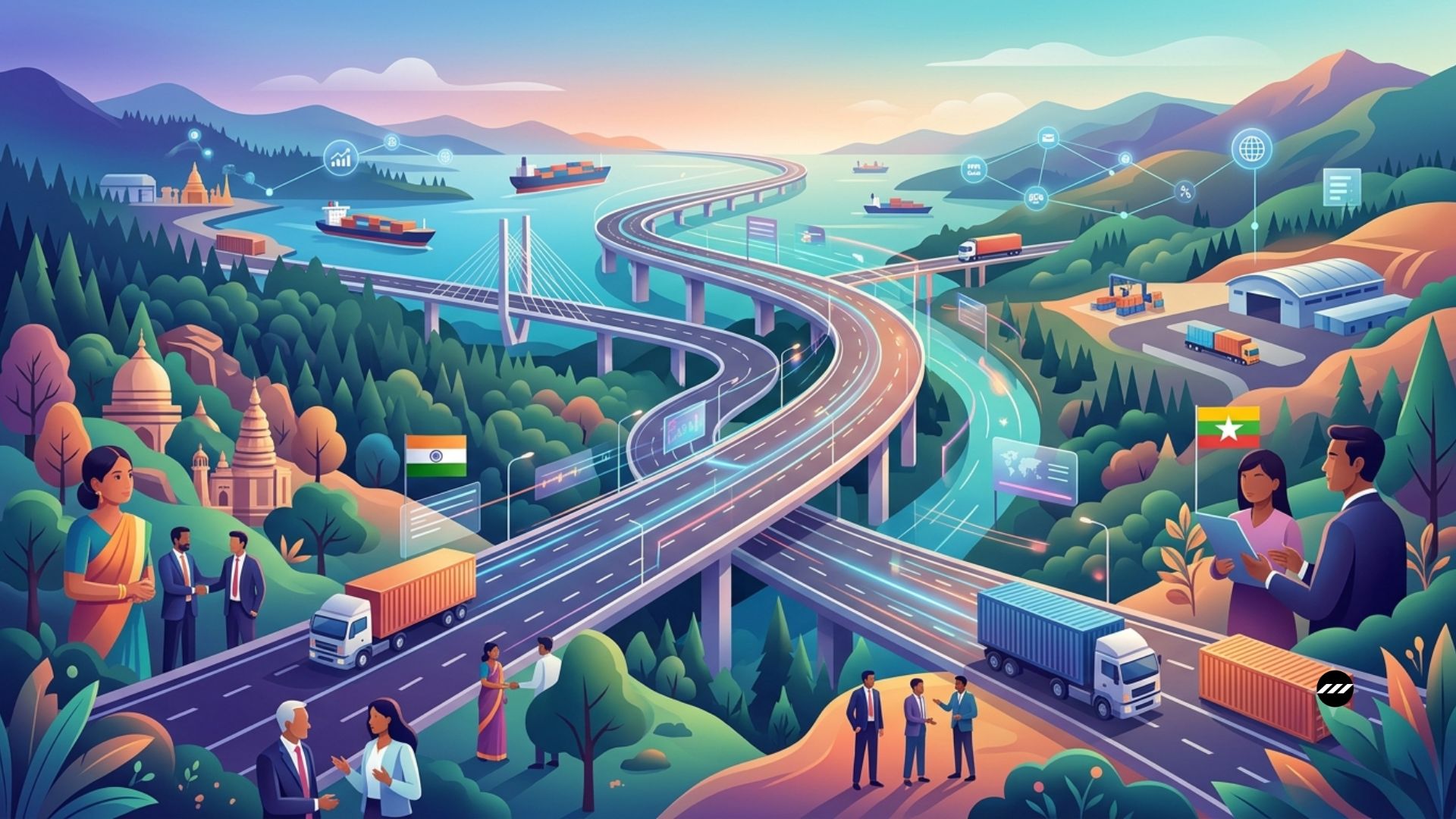
Key Connectivity Projects

1. Kaladan Multi-Modal Transit Transport Project

ComponentStatus
Kolkata–Sittwe Sea RouteOperational
Kaladan River ConnectivityOperational
Paletwa–Zorinpui Road (109 km)Incomplete
Target Completion2027

Strategic Importance

  • Connects India's east coast with Mizoram.
  • Reduces dependence on the Siliguri Corridor.
  • Enhances access to the Northeast.
Example:

Goods can move from Kolkata to Sittwe
port by sea, travel inland through the
Kaladan River and eventually reach
Mizoram through road connectivity.

2. India–Myanmar–Thailand Trilateral Highway

FeatureDetails
Length~1,360 km
RouteMoreh (India) to Mae Sot (Thailand)
Planned ExtensionsCambodia, Lao PDR, Vietnam
Original Deadline2019
Current StatusDelayed

Expected Benefits

  • Strengthen ASEAN connectivity.
  • Boost trade and tourism.
  • Transform Northeast India into a regional gateway.

Key Challenge

Myanmar's internal conflict and armed group presence have delayed implementation.


Economic Cooperation

Bilateral Trade

IndicatorValue
Trade Volume (2025-26)$1.95 billion

Areas of Cooperation

  • Rupee-Kyat settlement mechanism.
  • Critical minerals.
  • Rare-earth resources.
  • Investment promotion.

Myanmar views these projects as important components of the broader ASEAN–India Economic Corridor.


Security Cooperation

Security remained a major focus during the visit.

Key Assurances

Myanmar reiterated that:

  • Its territory would not be used against India's interests.

This is significant because of:

  • Historical presence of Indian insurgent groups.
  • Cybercrime and scam centres in border regions.

Cooperation Outcomes

  • More than 2,400 Indian nationals rescued from scam centres during the last 18 months through bilateral cooperation.

Educational and Cultural Linkages

India announced:

Increased ICCR Scholarships

SchemeEarlierRevised
Mekong-Ganga Scholarships36100 annually

Effective from 2026.

Cultural Significance

The visit to the Mahabodhi Temple highlighted:

  • Shared Buddhist heritage.
  • Civilisational ties.
  • People-to-people connections.

Larger Strategic Implications

For India

  • Recognition of political realities in Myanmar.
  • Pursuit of pragmatic diplomacy.
  • Protection of strategic and security interests.

For Myanmar

  • Opportunity to diversify external partnerships.
  • Reduce excessive dependence on China.
  • Gain diplomatic and economic engagement.

Pragmatic engagement is increasingly replacing isolation as a preferred regional approach.


Way Forward

  • Accelerate completion of connectivity corridors.
  • Deepen border security cooperation.
  • Expand trade and investment ties.
  • Enhance educational and cultural exchanges.
  • Strengthen ASEAN-linked connectivity initiatives.
  • Balance strategic engagement with support for long-term stability in Myanmar.

Conclusion

The visit of President Min Aung Hlaing reflects a pragmatic phase in India–Myanmar relations driven by geography, connectivity and security considerations. As Myanmar remains a critical bridge between South and Southeast Asia, sustained engagement offers India an opportunity to strengthen regional connectivity, counter strategic challenges and advance its Act East vision while preserving stability in its immediate neighbourhood.

Attribution

Original content sources and authors
Harsh V. Pant Author Harsh V. Pant The Hindu Source The Hindu

Syllabus classification

How this article maps to GS papers

Main syllabus

GS2Neighbourhood Relations

Quick Q&A

What is the strategic significance of India-Myanmar relations and why do they occupy a central place in India’s Act East and Neighbourhood First policies?
India-Myanmar relations constitute one of the most important pillars of India’s external engagement with Southeast Asia. Myanmar is the only ASEAN country that shares a land boundary with India, with a 1,643-km border touching Arunachal Pradesh, Nagaland, Manipur and Mizoram. Because of this unique geography, Myanmar acts as a bridge between South Asia and Southeast Asia and occupies a crucial position in India’s Act East Policy and Neighbourhood First approach. Historically, India and Myanmar share deep civilisational and Buddhist connections. President U Min Aung Hlaing’s visit to the Mahabodhi Temple in Bodh Gaya in May 2026 highlighted these cultural linkages. Economically, Myanmar offers India access to ASEAN markets and supports the integration of the Northeast with regional value chains. Strategically, Myanmar is important because instability there directly affects India’s security. Cross-border insurgency, trafficking, cybercrime networks and refugee flows have implications for the northeastern States. Moreover, China’s growing influence through infrastructure investments, arms supplies and diplomatic support has made Myanmar a significant arena of geopolitical competition. From the perspective of UPSC GS-II, the relationship illustrates themes of neighbourhood diplomacy, strategic autonomy and regional connectivity. Bilateral trade stood at approximately $1.95 billion in 2025-26, and both countries are exploring rupee-kyat settlement mechanisms and cooperation in critical minerals. Thus, India-Myanmar ties are not merely bilateral; they represent a broader effort to balance security, economic integration and geopolitical interests in the Indo-Pacific region.
Why has India adopted a policy of pragmatic engagement with Myanmar despite international criticism after the 2021 military coup?
India’s policy towards Myanmar after the February 2021 military coup reflects the principles of strategic realism and pragmatic diplomacy. While many Western democracies imposed sanctions and sought to isolate the military regime after the overthrow of Aung San Suu Kyi’s elected government, India chose engagement rather than isolation. Foreign Secretary Vikram Misri emphasized that India’s approach is not intended as a judgment on Myanmar’s internal political arrangements. Several factors explain this policy. First, geography makes disengagement impractical. Instability in Myanmar directly affects India’s northeastern States through issues relating to insurgency, illegal migration and transnational crime. Maintaining communication with those in power is therefore necessary for border management and security cooperation. Second, China has substantially increased its influence in Myanmar since 2021 by providing financial assistance, infrastructure investments and diplomatic backing. If India were to withdraw, it would leave strategic space entirely to Beijing, undermining India’s interests in the Bay of Bengal and Indo-Pacific. Third, India’s major connectivity initiatives, including the Kaladan Multi-Modal Transit Transport Project and the India-Myanmar-Thailand Trilateral Highway, require cooperation with the existing authorities. Bilateral efforts have also facilitated the rescue of more than 2,400 Indian nationals from cyber scam centres during the last 18 months. Critics argue that engaging the military government may appear to legitimize an undemocratic regime. Supporters counter that diplomacy often requires dealing with existing realities. For UPSC GS-II and International Relations, this debate demonstrates the tension between democratic values and strategic interests, a recurring theme in foreign policy.
How do the Kaladan Multi-Modal Transit Transport Project and the India-Myanmar-Thailand Trilateral Highway strengthen India’s regional connectivity ambitions?
The Kaladan Multi-Modal Transit Transport Project and the India-Myanmar-Thailand Trilateral Highway are among the most ambitious connectivity initiatives undertaken by India under the Act East Policy. Their objective is to improve economic integration, enhance strategic access and transform the northeastern region into a gateway to Southeast Asia. The Kaladan project links Kolkata to Sittwe port in Myanmar by sea, followed by river transport along the Kaladan River to Paletwa and finally a road connection to Zorinpui in Mizoram. The sea and river components have become operational, with the first cargo shipment reaching Sittwe in May 2023. However, the 109-km Paletwa-Zorinpui road segment remains incomplete because of difficult terrain and security challenges in Chin State. Full operationalisation is expected by 2027. The India-Myanmar-Thailand Trilateral Highway seeks to connect Moreh in Manipur to Mae Sot in Thailand across approximately 1,360 km. Future extensions to Cambodia, Laos and Vietnam could create an ASEAN-India economic corridor. Originally targeted for completion in 2019, the project has faced repeated delays due to conflict and instability inside Myanmar. These projects hold immense significance for India’s economic geography. They can reduce transportation costs, promote trade, encourage tourism and strengthen the development of the Northeast. From a strategic standpoint, they offer alternatives to Chinese connectivity initiatives and reinforce India’s Indo-Pacific vision. For UPSC GS-III and GS-II, these projects represent examples of infrastructure diplomacy, regional integration and the relationship between connectivity and national security.
What are the major reasons behind delays in India-Myanmar connectivity projects and what challenges do they reveal about regional development?
The prolonged delays affecting the Kaladan Multi-Modal Transit Transport Project and the India-Myanmar-Thailand Trilateral Highway highlight the complex interplay between security, geography and governance in infrastructure development. Although these projects were designed to deepen India’s engagement with Southeast Asia, implementation has faced numerous obstacles. One major factor is Myanmar’s internal conflict. Since the 2021 coup, armed resistance groups and ethnic militias have gained control over large territories. Many project routes pass through conflict-prone regions such as Chin State, making construction difficult and increasing security risks. Political instability has also complicated administrative coordination and execution. Second, the terrain itself presents challenges. Mountainous landscapes, heavy rainfall and flood-prone areas raise engineering costs and prolong project timelines. The 109-km Paletwa-Zorinpui road segment under the Kaladan project is a notable example. Third, bureaucratic inefficiencies, contractual issues and cost escalations have contributed to delays. Similar problems have affected infrastructure projects elsewhere in South Asia. Furthermore, changing geopolitical conditions have added uncertainties. These delays reveal broader lessons about regional development. Connectivity projects are not merely engineering exercises; they require political stability, local participation and effective institutions. Delays also affect India’s strategic credibility and provide opportunities for competing powers, particularly China, to expand influence. From a UPSC perspective, the issue links GS-II and GS-III themes such as infrastructure development, border management, internal security and regional cooperation. It also demonstrates how geopolitics and domestic instability can influence economic outcomes. Therefore, strengthening implementation mechanisms and enhancing security cooperation remain essential for the success of these projects.
What are the key strategic opportunities and ethical dilemmas involved in India’s engagement with Myanmar’s present leadership?
India’s engagement with Myanmar’s current leadership presents both significant strategic opportunities and complex ethical dilemmas. The visit of President U Min Aung Hlaing to India in May-June 2026 signalled New Delhi’s willingness to work with the authorities in power, even while maintaining that engagement does not imply endorsement. From a strategic perspective, the benefits are considerable. Myanmar plays a vital role in India’s Act East Policy and serves as a buffer between South Asia and Southeast Asia. Cooperation helps address cross-border insurgency, cybercrime networks and trafficking. Economic opportunities include trade expansion, rupee-kyat settlements and collaboration in critical minerals and rare earths. Myanmar also provides India with a means to balance China’s growing influence in the region. However, ethical concerns remain. The military regime emerged after the February 2021 coup, which was widely criticized by democratic countries. Human rights organizations have raised concerns about political repression and violence. Critics argue that engaging with the regime risks legitimizing military rule and undermining India’s image as the world’s largest democracy. Supporters of India’s policy contend that diplomacy must be guided by national interests and practical realities. Historical experience suggests that isolation does not necessarily produce democratic outcomes. Instead, sustained engagement may create opportunities for constructive influence. For UPSC GS-II and Ethics papers, this issue highlights the balance between values and interests in foreign policy. It raises fundamental questions regarding strategic autonomy, democratic principles and responsible statecraft. The debate illustrates how international relations often involve navigating competing priorities rather than choosing between absolute moral positions.

Practice questions

1 question for mains preparation

Examine the strategic significance of Myanmar in India's Act East Policy. How can connectivity projects and pragmatic diplomatic engagement strengthen India's security and regional integration objectives?

10 marks · 150 words · 8 mins
