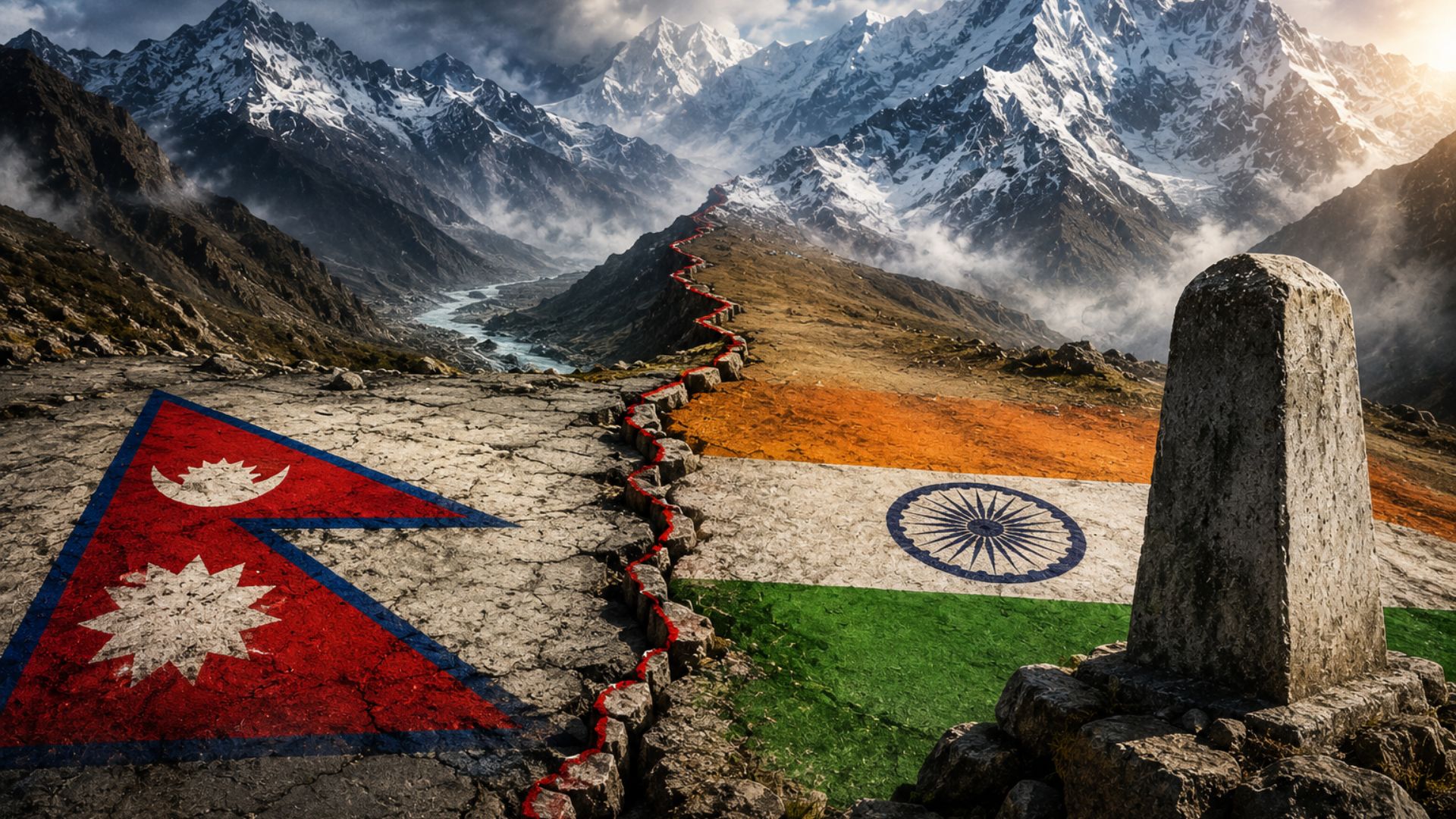
Nepal-India Border Dispute: New Questions Amid an Old Territorial Issue

A Controversial Statement
Nepal Prime Minister Balendra Shah recently triggered political controversy after stating in Parliament that Nepal, too, has encroached upon certain Indian territories.
The statement was significant because it is considered the first public acknowledgment by a Nepali head of government that cross-border occupation may not be one-sided.
The remarks immediately drew strong objections from opposition lawmakers, who demanded clarification and sought removal of the comments from parliamentary records.
"It's not just India but Nepal too has encroached upon Indian territories in many places."
The statement sparked concerns about its implications for national sovereignty and Nepal's official position on border disputes.
The Kalapani-Lipulekh-Limpiyadhura Dispute
The controversy emerged during discussions on the disputed Kalapani region.
The dispute primarily involves:
- Kalapani
- Lipulekh
- Limpiyadhura
Both India and Nepal claim sovereignty over these areas.
Disputed Region

Limpiyadhura
      ↓
Kalapani
      ↓
Lipulekh Pass

Claimed by:
✓ India
✓ Nepal
The issue remains one of the most sensitive bilateral disputes between the two neighbours.
Historical Background
The dispute gained renewed attention in recent years.
India's Position
- India considers Lipulekh a historic trade and pilgrimage route.
- It regards the area as part of its territory.
- The route is used for the Kailash Manasarovar Yatra.
Nepal's Position
-
Nepal claims the territory based on historical maps and treaties.
-
In 2020, Nepal amended its Constitution and official map to include:
- Lipulekh
- Limpiyadhura
- Kalapani
2019 → India releases new political map

2020 → Nepal amends official map

Result:
Border dispute intensifies
Why Did the Statement Create a Political Storm?
Opposition leaders argued that a Prime Minister publicly admitting encroachment into another country's territory could have serious diplomatic consequences.
Concerns raised included:
- Impact on national integrity.
- Lack of factual basis.
- Potential weakening of Nepal's negotiating position.
Several lawmakers questioned whether such remarks should be made without supporting evidence.
Government Clarification
Following the uproar, Nepal's Ministry of Foreign Affairs issued a clarification.
The Ministry explained that the Prime Minister was referring primarily to:
- Dasgaja (no-man's land) areas.
- Cross-border occupation.
- Technical boundary irregularities.
According to the Ministry, studies by technical committees have shown that in some locations:
- Citizens of Nepal occupy or cultivate land technically located within India.
- Similarly, Indian citizens may occupy land falling within Nepal.
This situation arises partly because of the Fixed Boundary Principle adopted in river-border regions.
Boundary Reality

Official Border
       ↓
River Course Changes
       ↓
Cross-Border Cultivation
       ↓
Technical Encroachments
The Ministry stressed that these are technical boundary-management issues rather than deliberate territorial expansion.
The Diplomatic Dimension
Prime Minister Shah emphasized that disputes should be resolved through dialogue.
He stated that Nepal has communicated with:
- India
- China
- The United Kingdom
The reference to the United Kingdom stems from Nepal's view that the origins of the dispute trace back to boundary arrangements inherited from the colonial period.
"All these issues should be resolved through dialogue and diplomatic table talks."
This reflects Nepal's preference for diplomatic engagement rather than confrontation.
Balendra Shah's Foreign Policy Approach
Balendra Shah, who became Prime Minister in March 2026 after serving as Kathmandu's Mayor, has cultivated an image of assertive nationalism.
Examples include:
- Displaying a "Greater Nepal" map during his mayoral tenure.
- Taking a more independent diplomatic posture.
- Avoiding one-on-one meetings with several foreign officials.
His comments came shortly before the visit of Rastriya Swatantra Party leader Rabi Lamichhane to New Delhi, adding further attention to the issue.
What Do Border Experts Say?
Border experts have largely argued that the claim that Nepal has encroached upon Indian territory lacks strong factual support.
However, they acknowledge the existence of:
- Technical boundary anomalies.
- Cross-border occupation.
- River-induced boundary complications.
These issues require careful demarcation and joint verification rather than political rhetoric.
Way Forward
- Strengthen bilateral diplomatic dialogue.
- Expedite the work of joint boundary mechanisms.
- Use historical treaties, maps, and technical surveys for resolution.
- Enhance cooperation on border management.
- Prevent political statements from escalating sensitive disputes.
- Promote people-to-people trust in border regions.
Conclusion
The controversy surrounding Prime Minister Balendra Shah's remarks highlights the complexity of the India-Nepal border question. While the Kalapani-Lipulekh-Limpiyadhura dispute remains unresolved, both countries continue to emphasize dialogue as the preferred path forward. The episode also demonstrates how technical boundary issues, historical claims, and domestic politics can intersect in shaping bilateral relations between two close neighbours.
Attribution
Original content sources and authors

Syllabus classification
How this article maps to GS papers
Main syllabus
GS2Neighbourhood RelationsAlso covers
Quick Q&A
What is the India-Nepal Kalapani-Lipulekh-Limpiyadhura border dispute and why has it remained significant in bilateral relations?
Why is the India-Nepal border issue important for UPSC aspirants studying neighbourhood relations and regional diplomacy?
How can India and Nepal resolve their border disputes through diplomatic mechanisms while preserving their historically close relationship?
What are the major historical, geographical, political, and strategic reasons behind the persistence of the India-Nepal border dispute?
Critically analyze the implications of Prime Minister Balendra Shah’s remarks regarding Nepal’s alleged encroachment on Indian territory.
How does the India-Nepal border dispute serve as a case study for understanding the relationship between domestic politics and foreign policy in South Asia?
Practice questions
1 question for mains preparation