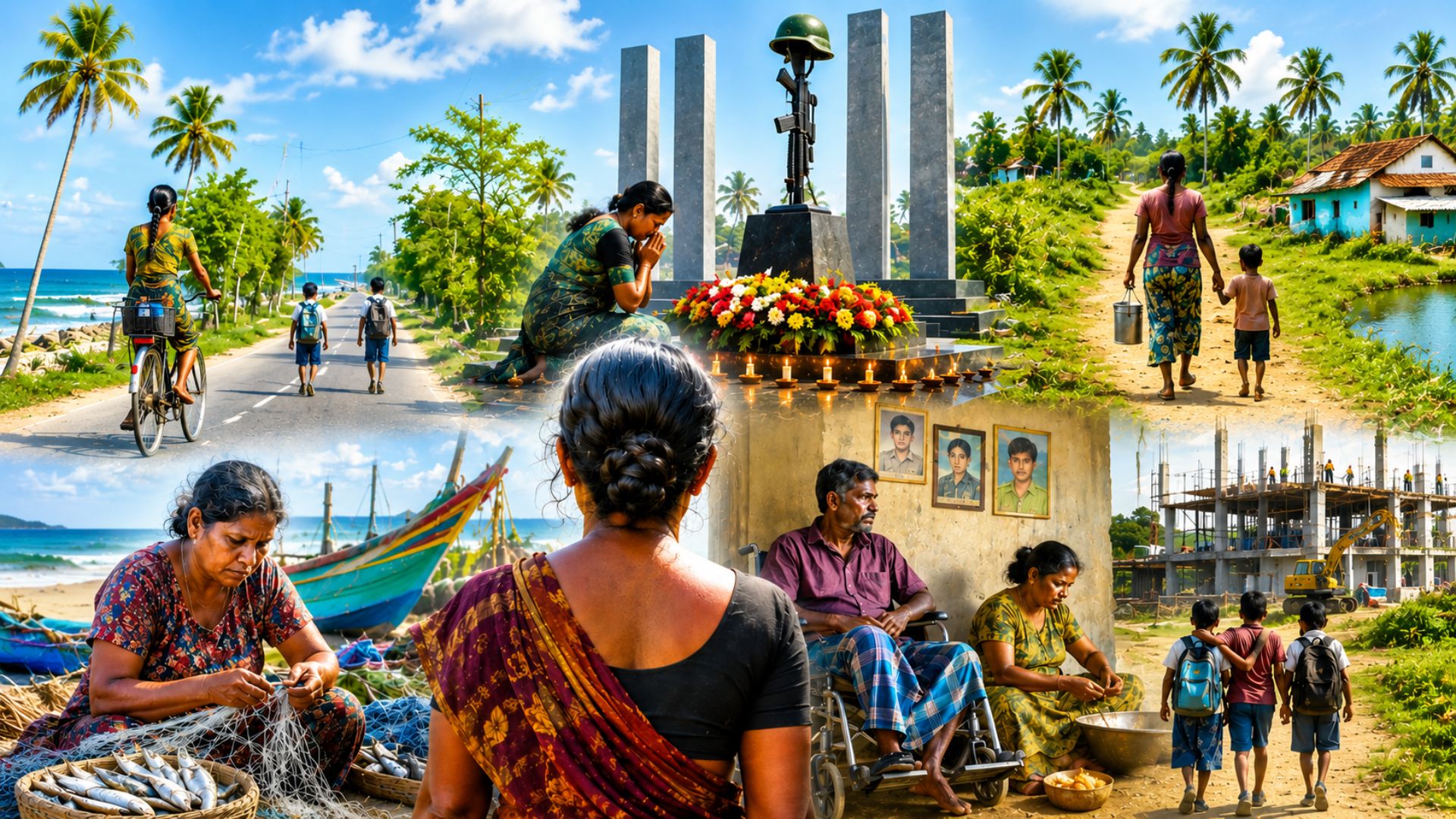
Sri Lankan Tamils: Struggles 17 Years After Civil War

17 Years of "Peace": Why Sri Lanka's Tamils Say Survival Is Harder Than War
May 18 marks 17 years since the end of Sri Lanka's civil war. For Tamils in the north and east, the silence of guns has not meant the arrival of peace — only a different, slower kind of suffering.
The Paradox of Post-War Life
"It was very tough and risky during those years. We kept moving around, ate whatever was available, washed clothes with palm fruit, and lived in constant fear of shelling. But life now seems even harder." — Natarasa Padmaleela, 54, Mullaitivu
This is not nostalgia for war. It is a damning verdict on what "peace" has delivered. Tamils in the north and east — Mullaitivu, Kilinochchi, Vavuniya, Batticaloa — are among the most multidimensionally vulnerable districts in Sri Lanka, according to a 2022–23 UN-led study measuring education, health, living standards, unemployment, and indebtedness.
The Political-Economic Disconnect
Tamil political leadership has largely focused on wartime accountability issues — enforced disappearances, detention under anti-terror laws, land grabs, power devolution, and provincial council elections. These are legitimate and unresolved grievances. But they have come at the cost of a glaring silence on:
- Poverty and rural unemployment
- Soaring living costs
- Strain on farming and fisheries livelihoods
- Widespread hopelessness among ordinary people
A Kilinochchi fisherman, Perumal Pradeepan, 32, captures the disconnect precisely:
"Tamil politicians are fighting for our rights. The Centre should take care of our sustenance."
But he immediately contradicts his own framing:
"I have over 15 lakh in debt after borrowing to buy nets. I struggle every day so my family does not go hungry. It is humiliating to face the lender."
Dignity and survival are not separate struggles — they are the same one.
The Land Question
Land remains the most combustible unresolved issue — and it operates on multiple fronts:
- Military land holdings: A Jaffna road closed for 34 years for "security concerns" was only reopened in April 2025
- State agency encroachment: The Archaeology and Forest Departments are staking claims over private land, especially in Mullaitivu
- Demographic anxiety: Buddhist shrines being built over Hindu worship sites; agricultural land taken in the name of forest conservation
"Building Buddhist shrines where Hindus traditionally prayed, and taking over people's agricultural lands in the name of forest conservation are huge concerns. We see these planned settlements of Sinhalese in the north and east as a way of altering the demography of the region." — Thurairasa Ravikaran, ITAK MP, Mullaitivu
"Let's not forget that contestations over land are what trigger big conflicts."
The Dissanayake government has been more responsive on infrastructure — roads, bridges — but appears "unable or unwilling" to address state land grabs, per Ravikaran.
The Employment Crisis
With most livelihoods tied to farming and fisheries, restricted land access directly translates to income collapse. Formal job opportunities outside public services are scarce. Official unemployment figures understate the crisis because the heavy reliance on informal rural livelihoods distorts the data.
The government's current initiatives — revival of the Elephant Pass saltern, the Paranthan chemical factory reconstruction, and three new industrial zones planned at Paranthan, Mankulam, and Kankesanthurai — are promising in intent. Cold storage and value-addition for agricultural exports are also being explored. But these projects are years away from generating meaningful employment. Meanwhile, Batticaloa has recorded the highest number of migrant worker departures in Sri Lanka over the last two years — mostly women leaving as domestic workers and caregivers to West Asian countries.
"Everyone is desperate to leave. You know there is a crisis when a coastal community foregoes fish in their meals." — Arunasalam Elangeswary, Suriya Women's Development Centre, Batticaloa
Compounding Crises
The Tamil north and east have absorbed blow after blow with no structural cushion:
1983–2009   →   Civil war
2004        →   Tsunami
2019        →   Easter bombings
2020–21     →   COVID-19 pandemic
2022        →   Sri Lanka's worst economic crisis (IMF austerity)
2024–25     →   West Asia war (remittance and trade disruption)
Ongoing     →   Cyclone Ditwah impact (Batticaloa)
IMF fiscal adjustment — ongoing — compounds austerity on communities that have never recovered from the previous shock.
The Forgotten Combatants
Perhaps the most painful dimension of this story is the fate of former LTTE cadre — now civilians — who find themselves doubly abandoned: by the political system and by the movement's own memory-keepers.
Padmaleela, a former combatant, lives in Mullaitivu with her husband — a wheelchair user from war injuries — and three children. The family survives on her farm labour wages, a government disability allowance, and the Aswesuma cash transfer scheme.
"We were bound by purpose and idealism, and I felt cared for as an individual. But now, I feel abandoned. That is why I say this struggle is harder."
Sivarasa Yogeswari — called "Inbam" (joy) during her time in the movement — now borrows money for basic provisions.
"My heart sank when I saw another former combatant selling peanuts at a bus stop. He had been a captain. This is our life."
Both women note that Tamil political leaders reliably appear at Maveerar Naal (Martyrs' Day) and the Mullivaikkal commemoration — but have no idea how survivors live the other 363 days of the year.
Surveillance Without End
Seventeen years after the war's end, former cadre and community leaders continue to face active surveillance by the CID and TID.
R. Jagadeeswaran, 35, a fisher association leader who was briefly with the LTTE toward the war's end, has dozens of CID/TID numbers saved on his phone.
"They call all the time and ask about our whereabouts. I am sure I will get a call once you leave asking who visited me."
Yogeswari was summoned last year and asked whether the LTTE would be revived.
"I told them it was all over — that I was simply trying to live and raise my children."
The Political Shift — and Its Limits
Tamils, wary of President Anura Kumara Dissanayake ahead of the September 2024 presidential election, switched decisively in the November 2024 parliamentary polls — his NPP won three of six seats in Jaffna and led in all Tamil-majority areas except Batticaloa. The draw: his promises to return military-held lands, revive industries, and build an equal-citizenship state.
Early signals have been mixed — infrastructure responsiveness has improved, but structural issues of land, surveillance, and economic planning remain largely unaddressed.
Way Forward
- Comprehensive economic plan for the north and east — not one-off entrepreneurship schemes, but a sustained regional development vision with clear timelines
- Collective land allocation, especially for women, to enable cooperative cultivation — individual business support has repeatedly proved fragile in a weak local economy
- Broad-based social security rather than narrow targeted transfers — to absorb the repeated shocks that Tamil communities disproportionately face
- Accelerate land restitution — both military-held and state-agency-held land, with a fixed implementation deadline
- End punitive surveillance of former cadre — 17 years on, it serves no security purpose and actively prevents economic and psychological rehabilitation
- Fast-track industrial zones at Paranthan, Mankulam, and Kankesanthurai — with private sector participation to reduce the years-long lag before employment materialises
Conclusion
The civil war ended on May 18, 2009. What has not ended is the condition that made it possible — the structural marginalisation of Tamils in the north and east. The political conversation has been dominated by accountability and devolution; the economic conversation has been largely absent. For Padmaleela, Yogeswari, Pradeepan, and Elangeswary, peace is not the absence of war — it is the presence of a dignified livelihood, an unencumbered future for their children, and the freedom to live without a CID number flashing on their phone. Seventeen years on, that peace remains undelivered.
Attribution
Original content sources and authors

Syllabus classification
How this article maps to GS papers
Main syllabus
GS2Neighbourhood RelationsQuick Q&A
What are the key post-conflict challenges faced by Tamils in Sri Lanka’s Northern and Eastern Provinces even 17 years after the civil war?
The major challenge is economic deprivation. Districts such as Mullaitivu, Kilinochchi, Vavuniya, and Batticaloa rank among Sri Lanka’s most vulnerable according to multidimensional poverty indicators. Communities dependent on fisheries and agriculture face land restrictions, shrinking incomes, debt, and lack of industries. Many former combatants and civilians are trapped in precarious livelihoods, while youth migration to West Asia reflects local employment scarcity.
Key dimensions:
- Land dispossession: Military and state agencies continue to control private land.
- Surveillance: Former combatants are monitored by intelligence agencies.
- Trauma: Psychological scars remain across generations.
- Social exclusion: War survivors often remain politically symbolic but economically neglected.
This case shows that post-conflict peace requires more than ceasefire—it requires justice, rehabilitation, livelihoods, and dignity. Without these, conflict leaves a long afterlife.
Why is economic rehabilitation as important as political reconciliation in post-conflict societies such as Sri Lanka?
The article illustrates this through the lived experiences of fisherfolk, widows, and former combatants. Many face crushing debt, unstable incomes, and dependence on welfare transfers. Such deprivation weakens trust in institutions and can deepen feelings of exclusion. In post-conflict societies, unresolved economic grievances may perpetuate instability even when formal hostilities end.
Importance of economic rehabilitation:
- Restores livelihoods and self-respect.
- Reduces migration and social fragmentation.
- Prevents renewed radicalization among youth.
- Strengthens trust in democratic governance.
The Sri Lankan case shows that reconciliation is incomplete if citizens continue to face hunger, debt, and unemployment. Peace must be measured not only by the absence of violence but also by the presence of opportunities.
Critically analyze the relationship between land rights and ethnic conflict in Sri Lanka.
This creates perceptions of demographic engineering, especially when Buddhist structures appear in traditionally Tamil-Hindu areas such as Kurunthurmalai. Such actions are interpreted not merely as administrative measures but as attempts to alter ethnic composition and historical narratives. These contestations revive mistrust and deepen post-war alienation.
Critical dimensions:
- Economic: Farmers and fishers lose productive resources.
- Cultural: Sacred sites become contested.
- Political: Land control reinforces state authority.
- Conflict trigger: Territorial disputes can reignite communal tensions.
Thus, land is not a routine property issue but a core question of identity and federal accommodation. Without transparent land restitution, post-war peace remains fragile.
How can post-conflict governance address both security concerns and civil liberties in regions like Northern Sri Lanka?
A balanced approach requires shifting from military oversight to civilian administration. Intelligence operations should be narrowly targeted, subject to judicial oversight, and transparent. Excessive surveillance of civilians—such as frequent questioning of former combatants years after the war—creates psychological insecurity and signals incomplete reconciliation.
Required measures:
- Gradual demilitarization of civilian spaces.
- Independent oversight of intelligence agencies.
- Strengthening local elected institutions.
- Community-based rehabilitation programmes.
Examples from post-conflict societies such as Northern Ireland show that trust-building requires reducing securitized governance and enabling democratic participation.
As a policymaker, how would you design a comprehensive development strategy for Sri Lanka’s war-affected Tamil regions?
The first step is restoring land ownership and resolving disputes. Without secure land, agricultural and fisheries revival is impossible. The second step is industrial development linked to local strengths such as salterns, agro-processing, fisheries, and cold storage. Public investment must create jobs before migration drains the workforce.
Policy framework:
- Land: Fast-track restitution and legal safeguards.
- Industry: Agro-processing and fisheries-based clusters.
- Social security: Universal support for vulnerable households.
- Women’s cooperatives: Collective farming and rural enterprises.
This approach should integrate rehabilitation with dignity. Development cannot succeed if war survivors remain excluded from planning.
Why do many post-war communities continue to feel marginalized despite democratic transitions and electoral change?
Marginalization persists because structural issues—poverty, trauma, land disputes, and underdevelopment—cannot be resolved solely through elections. Bureaucratic inertia, fiscal crises, and national political constraints often slow delivery. Communities then perceive political change as symbolic rather than transformative.
Reasons:
- Institutional delays in policy implementation.
- Deep-rooted mistrust from historical discrimination.
- Economic crisis limiting state capacity.
- Persistent surveillance and militarization.
The lesson is that political transitions must be backed by visible socio-economic improvements; otherwise disillusionment may deepen.
What lessons does Sri Lanka’s Tamil experience offer for post-conflict reconstruction globally?
Examples from former LTTE members in the article show how survivors often move from battlefield trauma to economic hardship. Similar patterns are seen in post-war contexts such as Bosnia or Nepal, where former combatants struggled to reintegrate into civilian economies. Social neglect of ex-combatants can undermine broader reconciliation.
Global lessons:
- Peace requires livelihoods, not just ceasefire.
- Land rights are crucial for identity and stability.
- Social protection prevents renewed vulnerability.
- Inclusive memory and justice strengthen legitimacy.
The central lesson is that sustainable peace depends on creating a future where ordinary citizens can live with dignity, opportunity, and equal rights.
Practice questions
2 questions for mains preparation