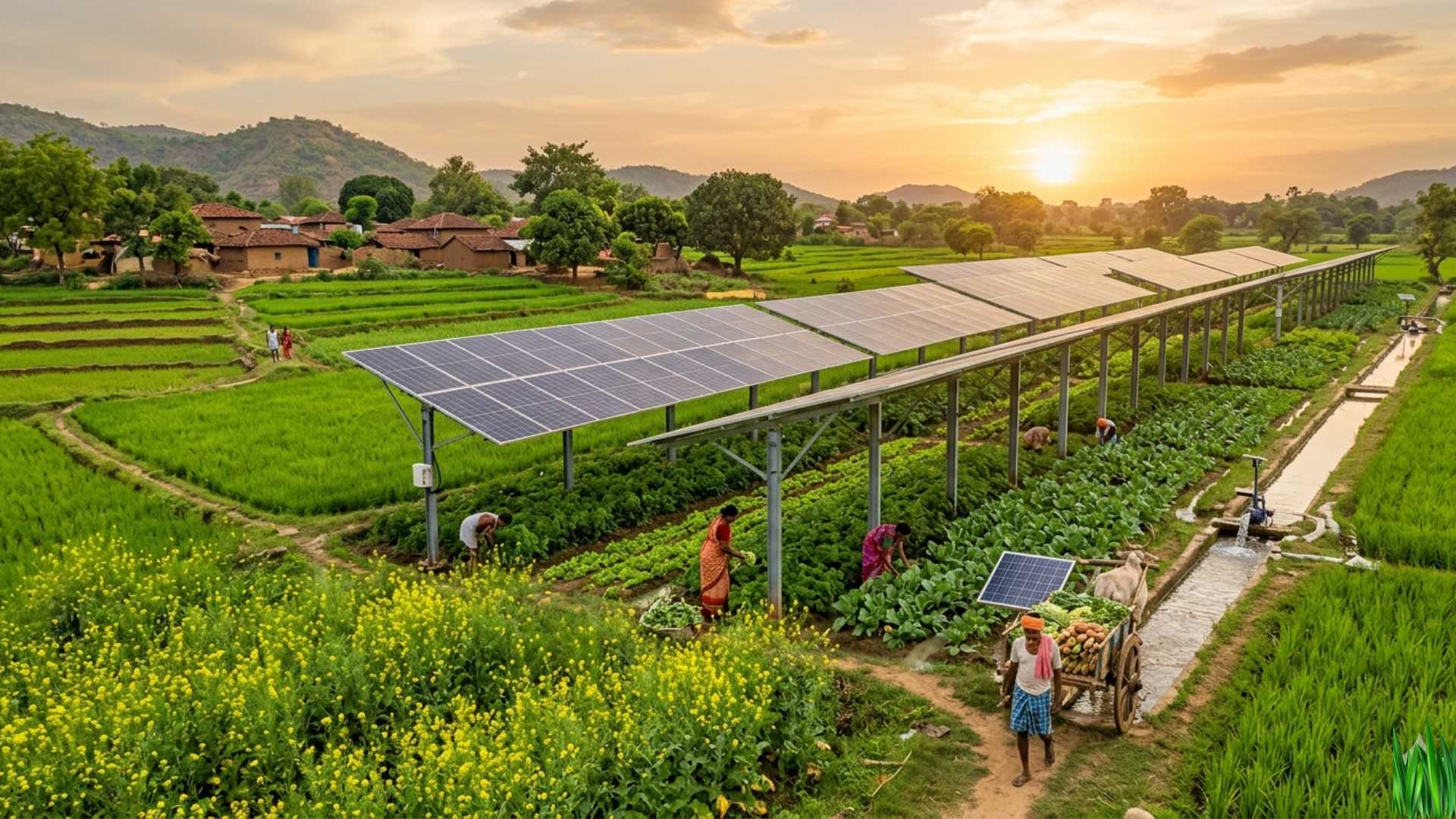
Transforming India's Farms: The Promise of Agri-photovoltaics
INTRODUCTION
India’s target of 300 GW solar capacity by 2030 and its commitment to net-zero by 2070 have intensified pressure on land resources. With over 50% of land under agriculture, balancing energy expansion with food security is a critical policy challenge. The PM-KUSUM scheme (₹5,000 crore in 2026–27) reflects a renewed push toward decentralised solarisation. In this context, Agri-Photovoltaics (AgriPV) emerges as an innovative solution enabling dual use of land for both farming and energy generation.
BACKGROUND: PM-KUSUM SCHEME
The PM-KUSUM scheme aims to promote solar energy in the agricultural sector through decentralised interventions.
- Provides solar pumps and decentralised solar plants
- Enhances farmer income through sale of surplus electricity
- Reduces dependence on diesel and grid electricity
- Promotes energy access and sustainability in rural areas
CONCEPT OF AGRI-PHOTOVOLTAICS (AgriPV)
AgriPV refers to the integration of solar photovoltaic systems with agricultural activities on the same land.
- Solar panels are mounted above or between crops
- Enables simultaneous crop production and electricity generation
- Optimises land use efficiency
Quote: “AgriPV represents a shift from land-use competition to land-use synergy” — IRENA
TYPES OF AGRI-PV SYSTEMS
| Type | Description | Suitability |
|---|---|---|
| Elevated Systems | Panels mounted at height above crops | Suitable for mechanised farming |
| Row-based Systems | Panels placed between crop rows | Suitable for mixed cropping |
| Vertical Systems | Upright panels capturing sunlight from both sides | Suitable for arid regions |
| Greenhouse-integrated | Panels integrated with greenhouse structures | Suitable for horticulture |
CROP SELECTION AND AGRO-CLIMATIC SUITABILITY
Crop selection is crucial due to variation in sunlight availability under solar panels.
- Shade-tolerant crops perform well under panels
- Sunlight-intensive crops grow better between panel rows
- Requires region-specific planning based on climate and irrigation
| Region | Suitable Crops |
|---|---|
| Madhya Pradesh | Tomato, onion, garlic, turmeric, tulsi |
| Karnataka & Maharashtra | Ragi, jowar, grapes, banana, brinjal |
SIGNIFICANCE OF AGRI-PV IN INDIA
AgriPV offers multiple economic, environmental, and developmental benefits.
- Enhances farmer income through diversified revenue streams
- Reduces land-use conflict between agriculture and solar projects
- Improves water-use efficiency by reducing evapotranspiration
- Protects crops from extreme weather conditions
- Supports rural infrastructure like cold storage and food processing
- Contributes to decarbonisation of the farm sector
BUSINESS MODELS IN AGRI-PV
Various institutional arrangements can support AgriPV deployment.
- Farmer-owned systems enabling self-consumption and power sales
- Cooperative/FPO-based aggregation improving access to finance
- Developer-led models based on leasing and revenue sharing
- State-led models supporting local energy needs
CURRENT STATUS IN INDIA
AgriPV is currently in a nascent stage with limited large-scale deployment.
- Around 50 pilot projects across different states
- Ongoing evaluation of crop compatibility and economic feasibility
- Lack of large-scale replication due to limited empirical evidence
CHALLENGES IN SCALING AGRI-PV
Several economic, technical, and regulatory barriers hinder widespread adoption.
- High capital costs due to specialised structures
- Uncertainty in crop yield under shaded conditions
- Lack of standardised design and technical benchmarks
- Regulatory ambiguity in land classification and tariffs
- Issues related to land ownership and revenue-sharing agreements
- Limited access to finance and institutional support
POLICY MEASURES AND WAY FORWARD
Scaling AgriPV requires targeted policy interventions and institutional support.
- Inclusion under PM-KUSUM 2.0 framework
- Proposal for National Agri-Photovoltaics Mission (10 GW target)
- Provision of viability gap funding (VGF)
- Clear regulatory frameworks for land use and tariffs
- Promotion of cluster-based development models
- Capacity building through farmer training and extension services
COMPARISON: TRADITIONAL SOLAR VS AGRI-PV
| Parameter | Traditional Solar | Agri-PV |
|---|---|---|
| Land Use | Single-purpose | Dual-purpose |
| Farmer Role | Passive | Active |
| Income | Limited | Diversified |
| Environmental Impact | Neutral | Positive |
CONCLUSION
AgriPV presents a viable pathway to reconcile India’s competing demands of energy expansion and food security. With robust policy support, financial incentives, and region-specific planning, it can evolve from pilot projects into a scalable model. Its integration into PM-KUSUM 2.0 can strengthen rural livelihoods while advancing India’s clean energy transition.
UPSC MAINS QUESTION (15 MARKS)
“Agri-photovoltaics (AgriPV) offers a sustainable solution to the land-use conflict between agriculture and renewable energy expansion in India.” Critically examine.
Attribution
Original content sources and authors
Syllabus classification
How this article maps to GS papers
Main syllabus
GS3AgricultureQuick Q&A
What is Agri-Photovoltaics (AgriPV), and how does it reconcile the conflict between energy generation and agriculture?
Resolving Land-Use Conflict: One of the major challenges in India’s energy transition is the competition between land for solar projects and agricultural use. AgriPV offers a dual-use solution, allowing farmers to grow crops while generating renewable energy. For example, shade-tolerant crops like turmeric or leafy vegetables can thrive under panels, while sun-loving crops can be grown between rows.
Broader Significance: This model supports India’s twin goals of energy security and food security. It enables farmers to diversify income through electricity generation while maintaining agricultural productivity. Thus, AgriPV represents an innovative approach to sustainable development by optimising scarce land resources.
Why is AgriPV becoming increasingly important in the context of India’s energy transition and agricultural challenges?
Agricultural and Economic Benefits: The technology provides farmers with additional income streams through selling surplus electricity or leasing land. It also enhances resilience by protecting crops from extreme weather conditions such as heatwaves and heavy rainfall. For instance, partial shading can reduce evapotranspiration, improving water-use efficiency in drought-prone areas.
Strategic Importance: In a country where over half the population depends on agriculture, AgriPV aligns with goals of rural development, climate resilience, and sustainable livelihoods. It not only supports clean energy generation but also strengthens rural economies through value-added activities like cold storage and food processing.
How does crop selection and system design influence the success of AgriPV systems?
Design Considerations: Different system designs—such as elevated panels or vertical installations—affect light distribution, irrigation, and farming practices. For example, elevated systems allow tractors and farm equipment to operate below panels, while greenhouse-integrated systems enable controlled environments for high-value crops.
Regional Variations: India’s diverse agro-climatic zones require region-specific planning. Crops like ragi and jowar may be suitable in semi-arid regions, while vegetables like tomato and onion may thrive in others. Poor design or inappropriate crop selection can reduce yields, highlighting the need for scientific planning and local adaptation.
Critically analyze the challenges and limitations associated with scaling up AgriPV in India.
Regulatory and Institutional Issues: अस्पष्ट regulations regarding land classification, grid connectivity, tariffs, and ownership models create uncertainty for investors and farmers. For instance, disputes may arise over revenue-sharing arrangements between developers and landowners, especially in long-term projects.
Technical and Social Constraints: Crop responses to shading are not uniform, and poorly designed systems may reduce agricultural productivity. Additionally, lack of standardised benchmarks and limited empirical data from pilot projects hinder large-scale adoption. Conclusion: While AgriPV holds immense potential, overcoming these barriers requires coordinated policy support, technological innovation, and stakeholder awareness.
What are some practical models and examples of implementing AgriPV systems in India?
Collective and Cooperative Models: Farmer Producer Organisations (FPOs) can aggregate land and develop larger projects, improving access to finance and bargaining power. For example, groups of farmers in states like Maharashtra have explored cooperative solar projects under PM-KUSUM.
Private and Public Participation: Private developers may lease farmland and share revenues, while state agencies can develop projects for local energy needs. Around 50 pilot projects across India are currently testing different crop-panel combinations. These examples highlight the flexibility of AgriPV models, though scaling them requires robust financial and policy support.
Consider a scenario where a state integrates AgriPV under PM-KUSUM 2.0. What outcomes can be expected for farmers and the energy sector?
Expected Outcomes:
- Income Diversification: Farmers earn from electricity sales in addition to crop income.
- Energy Security: Reliable power supply for irrigation reduces dependence on grid or diesel.
- Climate Resilience: Crops benefit from partial shading and reduced water loss.
Broader Impact: The state could achieve higher renewable energy capacity without acquiring additional land, while rural economies benefit from allied services like cold storage and food processing. However, success depends on clear policies, financial support, and farmer training. This scenario illustrates how AgriPV can become a transformative tool for sustainable development.
What policy measures are required to promote large-scale adoption of AgriPV in India?
Regulatory Clarity: Clear guidelines on land use, ownership models, tariffs, and grid connectivity are essential to reduce investor uncertainty. Streamlining approvals and integrating AgriPV into state-level policies can accelerate adoption.
Capacity Building and Research: Expanding pilot projects, generating region-specific data, and training farmers through extension services are crucial. For example, integrating AgriPV into agricultural advisory programmes can improve awareness and adoption. Conclusion: A combination of financial incentives, regulatory reforms, and institutional support is key to scaling AgriPV as a sustainable solution for India’s energy and agricultural challenges.
Practice questions
2 questions for mains preparation