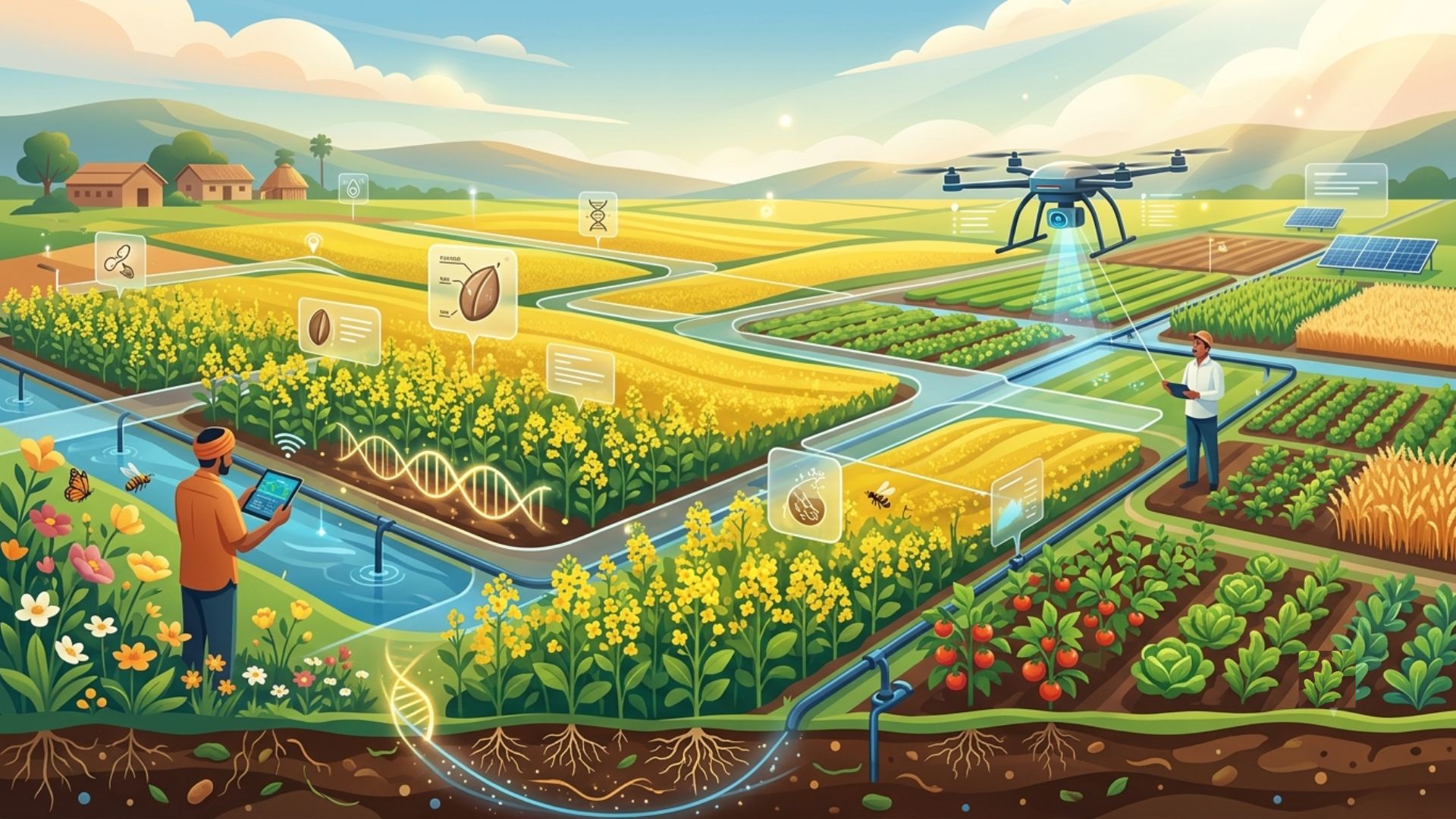
Herbicide-Resistant Mustard Hybrids: A Farming Revolution

“Agricultural sustainability lies not in eliminating challenges, but in managing them intelligently.”
India is preparing for the large-scale cultivation of imidazolinone-resistant (IMI-resistant) mustard hybrids during the 2026-27 rabi season. The technology promises to address one of the most serious constraints affecting mustard productivity — the parasitic weed Orobanche (Phelipanche). While the innovation offers significant benefits for oilseed production and farmer incomes, experts caution that its long-term success will depend on responsible and diversified use.
Why Mustard Matters for India
India continues to face a substantial edible oil deficit.
| Indicator | Status |
|---|---|
| Edible Oil Imports (2024-25) | ~16 million tonnes |
| Import Bill | ~₹1.6 lakh crore |
| Key Domestic Oilseed Crop | Mustard |
Mustard plays a critical role in:
- Edible oil security.
- Farmer incomes in North India.
- Cultivation in arid and semi-arid regions.
However, productivity remains constrained by persistent weed infestations.
The Orobanche Problem
What is Orobanche?
Orobanche (now often called Phelipanche) is a parasitic weed that:
- Attaches itself to mustard roots.
- Extracts water and nutrients from the host plant.
- Reduces crop growth and yield.
- Remains difficult to control through conventional methods.
Mustard Plant
      ↓
Orobanche attaches to roots
      ↓
Nutrient & Water Drainage
      ↓
Reduced Growth and Yield
Since the parasite grows underground, manual removal is often ineffective.
What are IMI-Resistant Mustard Hybrids?
These hybrids have been developed through mutation breeding, not genetic modification.
Mutation Breeding
- Uses naturally occurring mutations.
- Scientists selectively breed plants carrying desirable traits.
- Does not involve insertion of foreign genes.
Difference from GM Crops
| Mutation Breeding | GM Crops |
|---|---|
| Uses natural mutations | Introduces external genes |
| Conventional breeding approach | Genetic engineering |
| No foreign DNA insertion | Foreign DNA may be introduced |
Thus, IMI-resistant mustard is distinct from genetically modified crops.
The Science Behind the Technology
The innovation revolves around an enzyme called:
Acetolactate Synthase (ALS)
- Essential for plant growth.
- Targeted by IMI herbicides.
How Conventional Mustard Responds
- Herbicide blocks ALS activity.
- Plant dies.
How IMI-Resistant Mustard Works
A single DNA mutation alters the ALS enzyme.
Result:
- ALS becomes resistant to the herbicide.
- Mustard survives.
- Weeds are eliminated.
Normal Mustard
ALS + Herbicide
      ↓
Plant Dies

IMI-Resistant Mustard
Modified ALS + Herbicide
      ↓
Mustard Survives
Weeds Die
The herbicide can move through the soil and plant system, reaching Orobanche where manual weeding cannot.
Benefits of the New Hybrids
For Farmers
- Reduced weed pressure.
- Better yield protection.
- Lower dependence on labour.
- Greater convenience during critical weeding periods.
For India
- Improved mustard productivity.
- Reduced edible oil import dependence.
- Enhanced oilseed security.
The technology is therefore being viewed as an important agricultural innovation.
Why Experts Advise Caution
While acknowledging the immediate benefits, experts warn against excessive dependence on a single herbicide system.
According to geneticist Deepak Pental, continuous use of one herbicide can create:
- Strong selection pressure.
- Evolution of herbicide-resistant weeds.
- Reduced herbicide effectiveness over time.
Potential Risk
Repeated Use of Same Herbicide
              ↓
Selection of Resistant Weeds
              ↓
Herbicide Loses Effectiveness
              ↓
Production System Failure
This phenomenon has been observed globally in several cropping systems.
Towards Sustainable Weed Management
Experts argue that IMI-resistant mustard should not become a substitute for all other weed-control practices.
Recommended Strategy
- Crop rotation.
- Use of multiple herbicides with different modes of action.
- Manual removal of surviving weeds.
- Integrated weed management.
- Continuous field monitoring.
This approach reduces the likelihood of resistance development.
Core Principle
“A single herbicide mode of action cannot be the foundation of a sustainable weed management strategy.”
Way Forward
- Promote Integrated Weed Management (IWM).
- Train farmers on responsible herbicide use.
- Encourage crop diversification and rotation.
- Monitor fields for emerging herbicide resistance.
- Invest in research on alternative weed-control technologies.
- Develop long-term stewardship programmes for IMI-resistant crops.
Conclusion
The introduction of IMI-resistant mustard hybrids marks a significant step toward strengthening India's oilseed economy and reducing dependence on edible oil imports. By effectively targeting Orobanche, the technology offers immediate gains in productivity and farm efficiency. However, its long-term success will depend not on the herbicide alone but on an evolutionarily informed and diversified weed-management strategy that balances productivity with sustainability.
Attribution
Original content sources and authors
.jpeg)

Syllabus classification
How this article maps to GS papers
Main syllabus
GS3AgricultureQuick Q&A
What are IMI-resistant mustard hybrids and what is their significance for India's edible oil economy and agricultural productivity?
How do IMI-resistant mustard hybrids function and why are they considered different from genetically modified crops?
Why are IMI-resistant mustard hybrids considered important for addressing India's edible oil imports and agricultural challenges?
What is a critical analysis of the opportunities and ecological concerns associated with IMI-resistant mustard hybrids?
What are the reasons behind experts advocating integrated and diversified weed management strategies in mustard cultivation?
How can the introduction of IMI-resistant mustard hybrids be studied as a case study in sustainable agricultural innovation and food security?
Practice questions
2 questions for mains preparation