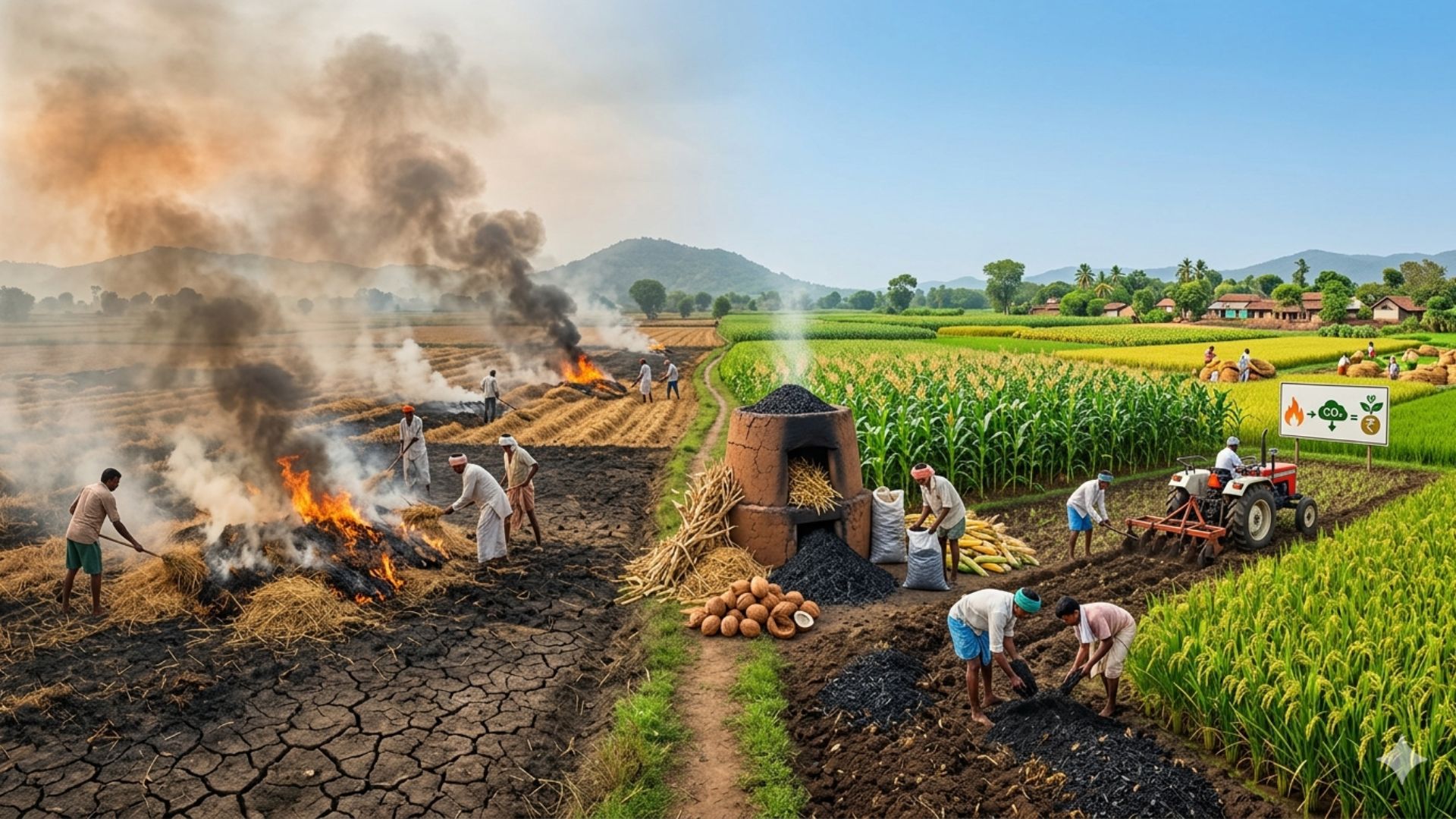
Transforming Agricultural Waste into Black Gold: The Biochar Solution

“India’s crop residues are not a waste-disposal problem; they are an untapped resource for soil restoration, climate mitigation and rural income generation.”
India faces a major agricultural paradox. Every year, more than 20 million tonnes of paddy straw are burned in Punjab and Haryana due to short post-harvest windows and limited alternatives. While this creates severe air pollution and greenhouse gas emissions, agricultural soils across the country simultaneously suffer from declining fertility, low organic carbon and poor water retention.
These challenges reflect a larger failure to recycle biomass efficiently within agricultural systems.
The Twin Challenge
| Problem | Consequence |
|---|---|
| Crop residue burning | Air pollution, GHG emissions, loss of organic matter |
| Low soil organic carbon | Reduced fertility, poor water retention, nutrient depletion |
| Climate variability | Greater vulnerability to droughts and erratic rainfall |
| Dependence on external inputs | Rising cultivation costs |
From the black soils of Maharashtra to the red soils of Kerala, declining soil health is emerging as a major threat to long-term agricultural productivity.
What is Biochar?
Biochar is a carbon-rich material produced by heating agricultural biomass under low-oxygen conditions (pyrolysis).
Key Characteristics
- High carbon content
- Highly porous structure
- Slow decomposition rate
- Enhances microbial activity
- Improves soil aggregation
- Increases water retention
“Biochar acts as both a soil amendment and a long-term carbon storage mechanism.”
Unlike crop residue burning, biochar locks carbon in soils for extended periods while improving soil quality.
Agricultural Benefits of Biochar
Research highlights significant gains in soil health and productivity.
| Benefit | Improvement |
|---|---|
| Crop productivity | 10–30% |
| Water-holding capacity | 10–25% |
| Soil organic carbon | Significant increase |
| Nutrient-use efficiency | Improved |
| Microbial activity | Enhanced |
In Akola (Maharashtra), biochar made
from maize stalks improved soil organic
carbon and fertility in black soils.
In Kerala, biochar produced from
coconut leaf stalks enhanced soil quality
across different cropping systems.
Long-term studies indicate that biochar continues to improve soil health and sustain higher crop yields over time.
Role in Climate-Resilient Agriculture
As climate change intensifies droughts, heat waves and erratic rainfall, healthy soils become critical for food security.
Biochar contributes by:
- Improving moisture retention.
- Enhancing nutrient availability.
- Reducing dependence on chemical inputs.
- Strengthening crop resilience during water stress.
- Supporting sustainable agricultural systems.
This is especially important for small and marginal farmers who are highly vulnerable to climate shocks.
Biochar and Carbon Markets
One of the strongest incentives for large-scale adoption is the growing carbon credit market.
Why Biochar Qualifies
-
Meets long-term carbon sequestration standards.
-
Recognised as a persistent carbon dioxide removal technology.
-
Generates credits from both:
- Avoided residue burning emissions.
- Carbon stored in soils.
| Carbon Credit Potential |
|---|
| 1 tonne certified biochar can generate 2–2.8 tonnes CO₂-equivalent carbon credits |
This creates an additional income source for:
- Farmers
- Cooperatives
- Rural entrepreneurs
- Project developers
The KISAN kiln developed by
IIT-Kharagpur enables small farmers
to convert farm waste into biochar and
participate in carbon markets.
Global Experiences
Several countries demonstrate the scalability of biochar systems.
| Country | Key Outcome |
|---|---|
| Kenya | Rice husk biochar improved soil quality and generated carbon credits |
| Thailand | Integrated biochar into national carbon management systems |
| Brazil | Sugarcane bagasse biochar improved carbon retention and crop yields |
These experiences show that successful biochar programmes require technology, certification and market integration.
Beyond Agricultural Waste
Biochar production is not limited to crop residues.
Potential Feedstocks
- Municipal organic waste
- Sewage sludge
- Crop residues
- Agro-industrial waste
India generates nearly 62 million tonnes
of municipal solid waste annually, with
more than 50% being biodegradable.
Converting such waste into biochar aligns with circular economy principles by diverting organic matter from landfills and reducing methane emissions.
Way Forward
- Promote decentralised and affordable pyrolysis technologies.
- Integrate biochar into natural farming and soil health programmes.
- Link biochar projects with carbon credit markets.
- Develop robust measurement, reporting and verification (MRV) systems.
- Support farmer producer organisations and cooperatives.
- Encourage private investment and rural entrepreneurship.
- Facilitate access to certified biochar at affordable prices.
- Utilise both agricultural and urban organic waste streams.
Conclusion
Biochar offers a unique opportunity to address multiple challenges simultaneously—crop residue burning, soil degradation, waste management and climate change. By transforming agricultural and organic waste into “black gold”, India can improve soil health, strengthen climate resilience, generate rural incomes and contribute to global carbon mitigation efforts. Realising this potential will require an integrated ecosystem combining technology, policy support, carbon finance and farmer participation.
Attribution
Original content sources and authors

Syllabus classification
How this article maps to GS papers
Main syllabus
GS3AgricultureAlso covers
Quick Q&A
What is biochar and how does it address the interconnected challenges of soil degradation, residue burning, and climate change in India?
Why is the promotion of biochar important for sustainable agriculture and climate resilience in India?
How can carbon credit mechanisms and market incentives accelerate the large-scale adoption of biochar technologies among Indian farmers?
What are the major reasons behind continued crop residue burning in India despite its environmental and economic consequences?
What international and Indian case studies demonstrate the potential scalability and benefits of biochar-based agricultural systems?
What is a critical analysis of the opportunities and limitations associated with mainstreaming biochar in India's agricultural ecosystem?
Practice questions
1 question for mains preparation