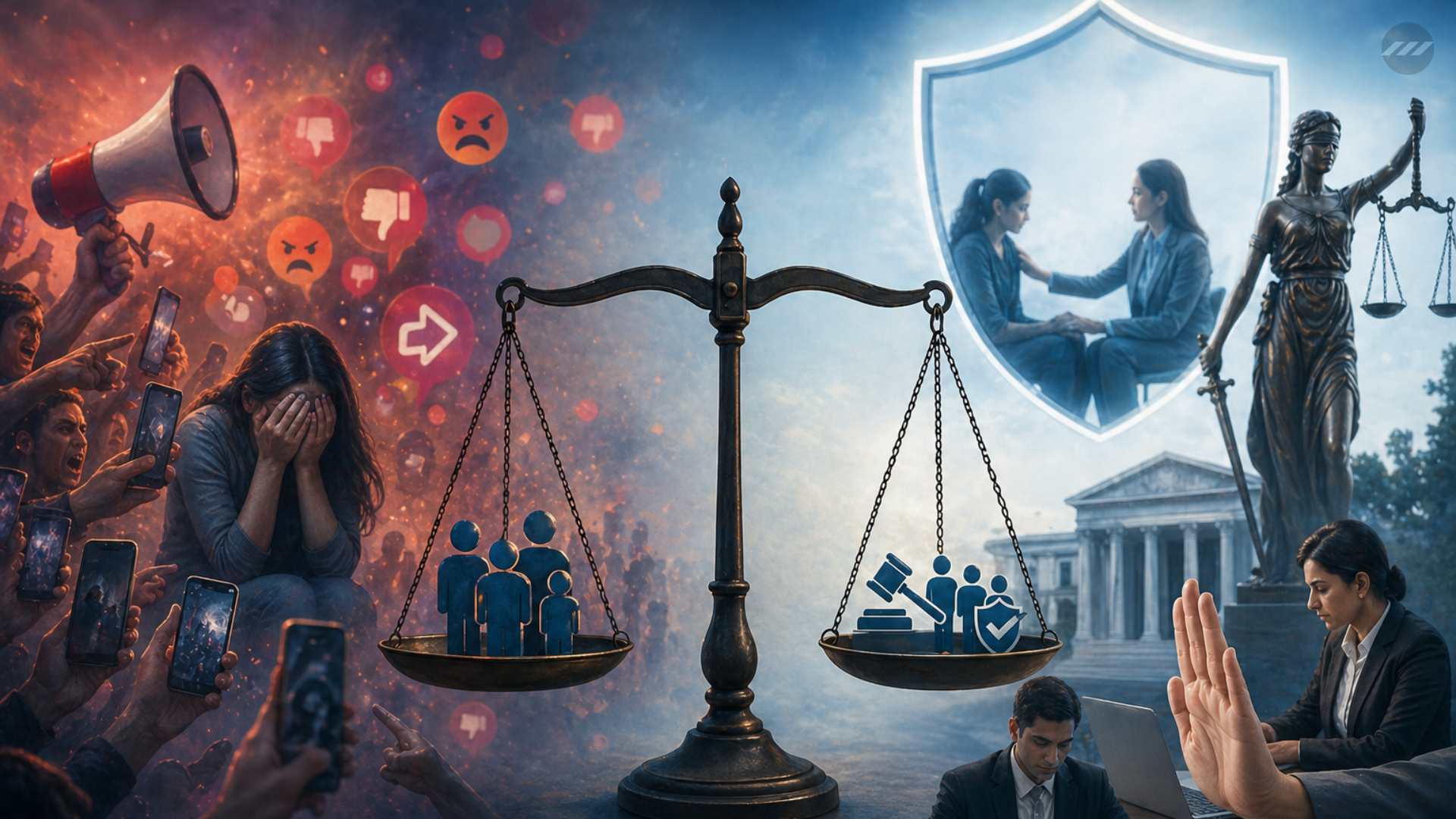
Understanding the Phenomenon of Digital Vigilantism

"When there is a collective failure of processes, then one turns to social media to amplify harassment — this cannot be defined as digital vigilantism." — Prachi Dutta, 2026
The Delhi High Court's observations on "digital vigilantism" have reignited a fundamental governance question: when institutions fail victims of harassment, is social media amplification a symptom of broken systems or a threat to rule of law — and does the terminology we use to describe it matter?
| Dimension | Key Issue |
|---|---|
| Legal context | Delhi HC defamation suit — flight harassment case |
| Core tension | Free expression vs. public shaming vs. institutional failure |
| Global parallel | #MeToo movement, TikTok harassment videos |
| Institutional failure cited | Airlines slow action in November 2022 urination incident |
| Conceptual dispute | Whether social media redress qualifies as "vigilantism" |
Background & Context
India's legal and institutional landscape for addressing sexual harassment combines POSH Act (2013) for workplace grievances, IPC/BNS provisions for criminal harassment, and consumer grievance mechanisms for service-related misconduct. Despite this architecture, victims consistently face slow processes, police apathy, victim-blaming, and institutional inertia — pushing grievance-seeking onto social media platforms as the only available rapid-response channel.
Core Conceptual Argument: Why "Digital Vigilantism" Is a Misnomer
Les Johnston's definition of vigilantism requires:
1. Premeditation by private citizens
2. Voluntary engagement
3. A social movement threatening established order
4. Use or threat of force
5. Assurance of security to participants
Social media harassment posts fail this test:
- No established order is under threat — institutional order has already failed
- No assurance of security — both victim and accused face doxxing risk
- No use of force — amplification is expression, not coercion
- Motivation is redress-seeking, not retributive movement-building
- Calling it "vigilantism" misdiagnoses the cause — framing the victim's response as the problem rather than the institutional failure that necessitated it
- Terminology matters: "vigilantism" invokes criminality and mob justice; "institutional bypass" more accurately describes what is happening
The Institutional Failure Chain
1. Justice System Delays
Long-drawn-out legal processes → belated justice → victim re-traumatisation
Police apathy + victim blaming → complaint deterrence
POSH ICC processes → often slow, employer-controlled, lacking independence
Result: redress process becomes punishment for victim, not perpetrator
2. Service Provider Inaction
November 2022: Man urinated on woman on flight.
Airline slow to act on internal complaint.
Only after public social media exposure → airline took action.
Lesson: Institutional action triggered by reputational threat, not by complaint.
3. Consumer Grievance Contrast
Consumer complaint → customer grievance team responds promptly
Fear of reputational + financial loss = institutional incentive to act
Justice system complaint → often ignored, delayed, or weaponised against complainant
Fear of accountability = absent in justice institutions
- The contrast reveals that institutional responsiveness is incentive-driven — justice systems lack the reputational and financial accountability that drives consumer service responsiveness
Critical Analysis
1. Unverified Amplification Problem
Social media allegations spread without verification mechanism.
Anonymity enables false allegations.
Reputational damage is immediate and irreversible — no correction mechanism.
Natural justice (audi alteram partem) — hear the other side — structurally absent.
- Real harm to falsely accused — the Delhi HC case itself illustrates this
- Platform architecture rewards virality over accuracy — incentives misaligned with justice
2. The False Binary
Court framed it as: free expression vs. public shaming.
Article argues the real frame is: institutional failure vs. social media as last resort.
Reframing matters — it shifts the policy intervention target from regulating speech to fixing institutions.
- Regulating social media amplification without fixing institutions leaves victims with no channel at all
- The policy response must address why people turn to social media, not just that they do
3. Doxxing as Collateral Harm
Both victim and accused can be doxxed once a post goes viral.
Victim's identity — often meant to be protected — gets exposed.
Accused's family members — uninvolved — face harassment.
Social media justice has no proportionality mechanism.
- Absence of proportionality is the genuine harm — not the act of speaking up itself
Way Forward: Strengthening Institutional Processes
| Institution | Required Reform |
|---|---|
| Airlines/transport | Mandatory strict no-fly lists; rapid complaint response protocol |
| Police | Sensitisation training; mandatory FIR registration for harassment complaints |
| POSH ICCs | Independent third-party oversight; time-bound resolution |
| Courts | Fast-track harassment cases; victim-protective procedures |
| Social media platforms | Verified complaint tagging; takedown-with-context mechanism |
Conclusion
The Delhi HC's "digital vigilantism" framing, however well-intentioned, risks inverting the problem — treating the symptom (social media amplification) as the disease while leaving the actual disease (institutional failure) unaddressed. The article's core insight is structurally sound: people do not bypass institutions out of preference for mob justice — they do so because institutions have repeatedly demonstrated that they will not act without external pressure. The solution is not to silence the bypass but to make it unnecessary.
Attribution
Original content sources and authors


Syllabus classification
How this article maps to GS papers
Main syllabus
GS3Communication NetworksQuick Q&A
What is meant by “digital vigilantism”, and how does it differ from the use of social media for grievance redressal?
Distinction from social media redressal: The article argues that many instances of victims sharing their experiences online do not strictly qualify as vigilantism. According to sociological definitions (e.g., Les Johnston), vigilantism involves premeditated, organised action with an intent to enforce norms and provide a sense of security. However, victims posting about harassment are often acting out of helplessness and lack of institutional support, rather than attempting to enforce justice themselves.
Key differences:
- Intent: Vigilantism seeks punishment; social media posts seek attention and redress
- Organisation: Vigilantism is collective and structured; online sharing is often spontaneous
- Outcome: Vigilantism claims to restore order; social media amplification often creates uncertainty and reputational risks
For example, the #MeToo movement involved individuals sharing experiences to expose systemic issues rather than enforcing punishment directly.
Conclusion: Labeling all online exposure as “digital vigilantism” oversimplifies the issue and ignores the systemic failures that push victims toward digital platforms.
Why are victims increasingly turning to social media as a tool for justice in cases of harassment?
Key factors driving this trend:
- Delayed justice: Court proceedings can take years, reducing faith in timely redress
- Institutional apathy: Police and authorities may display insensitivity or victim-blaming attitudes
- Lack of accountability: Organizations may fail to act promptly on complaints
For instance, in the 2022 airline harassment case, action was taken only after the incident gained public attention on social media.
Psychological and social dimensions: Social media provides a sense of collective support and visibility, empowering victims to share their experiences. It also creates pressure on institutions to respond due to reputational concerns.
Conclusion: The rise of social media as a redress tool reflects a gap between legal frameworks and lived realities, highlighting the urgent need for institutional reforms.
How does the use of social media in harassment cases challenge the principles of natural justice and fair trial?
Key challenges:
- Lack of verification: Allegations may spread without fact-checking
- Trial by media: Public opinion may influence or pre-empt judicial outcomes
- Reputational harm: Accused individuals may suffer irreversible damage even if later proven innocent
For example, in the Delhi High Court case, unverified allegations were amplified by media and public figures, raising concerns about defamation.
Impact on victims and accused: While victims may gain visibility, they also risk backlash, trolling, or doxxing. Similarly, the accused may face social ostracism without due process.
Conclusion: While social media can amplify voices, it must be balanced with legal safeguards to ensure fairness and prevent misuse.
What are the systemic failures that lead to the rise of social media-based justice mechanisms?
Key failures include:
- Judicial delays: लंबी प्रक्रियाएँ reduce accessibility and effectiveness
- Weak grievance redressal mechanisms: Lack of internal complaint systems in organizations
- Inadequate enforcement: Failure to implement laws effectively
For instance, airlines often lack robust mechanisms such as no-fly lists or immediate complaint resolution systems, forcing victims to seek public attention.
Comparative perspective: In consumer services, grievance mechanisms are more responsive due to market pressures, whereas justice systems lack similar incentives for prompt action.
Conclusion: The rise of social media justice is not the cause but a symptom of deeper institutional inefficiencies that need urgent reform.
Critically analyze the role of social media in addressing harassment: Is it empowering or problematic?
Positive outcomes:
- Increased awareness and societal dialogue on harassment
- Pressure on institutions to act swiftly
- Support networks for victims
Problematic aspects:
- Risk of misinformation: False or exaggerated claims can spread بسرعة
- Public shaming: Can lead to disproportionate punishment
- Lack of accountability: Anonymous users may misuse platforms
For example, viral posts can damage reputations irreversibly, even if allegations are later disproven.
Balanced view: Social media is a double-edged sword—it empowers victims but also raises ethical and legal concerns.
Conclusion: Its role should complement, not replace, formal justice systems, ensuring both accountability and fairness.
How do real-world incidents illustrate the interplay between social media amplification and institutional response?
Key insights:
- Reputational pressure: Institutions act faster when public scrutiny increases
- Accountability mechanism: सोशल मीडिया exposes failures in real time
- Limitations: Action is often reactive rather than systemic
Similarly, in consumer grievance cases, companies respond promptly to online complaints to avoid brand damage.
Broader implications: While social media can trigger action, it does not guarantee न्याय or systemic reform. It often addresses individual cases without resolving underlying issues.
Conclusion: Real-world examples highlight that social media is an informal accountability tool, but sustainable change requires institutional strengthening.
As a policymaker, how would you design a system to balance freedom of expression, victim protection, and due process in the digital age?
Proposed measures:
- Strengthen institutional mechanisms: Fast-track courts and efficient grievance redressal systems
- Platform regulation: Mandate social media platforms to flag unverified allegations and prevent doxxing
- Legal safeguards: Clear guidelines on defamation and online harassment
- Awareness campaigns: Educate citizens on responsible digital behavior
Example approach: Airlines could implement robust complaint systems and no-fly lists, reducing the need for public escalation.
Balancing rights: Policies must ensure that freedom of expression does not infringe upon the right to reputation and fair trial.
Conclusion: A holistic approach combining institutional reform, legal clarity, and digital governance is essential to address the challenges posed by social media in justice delivery.
Practice questions
3 questions for mains preparation