GS3 Environment & Bio-diversity
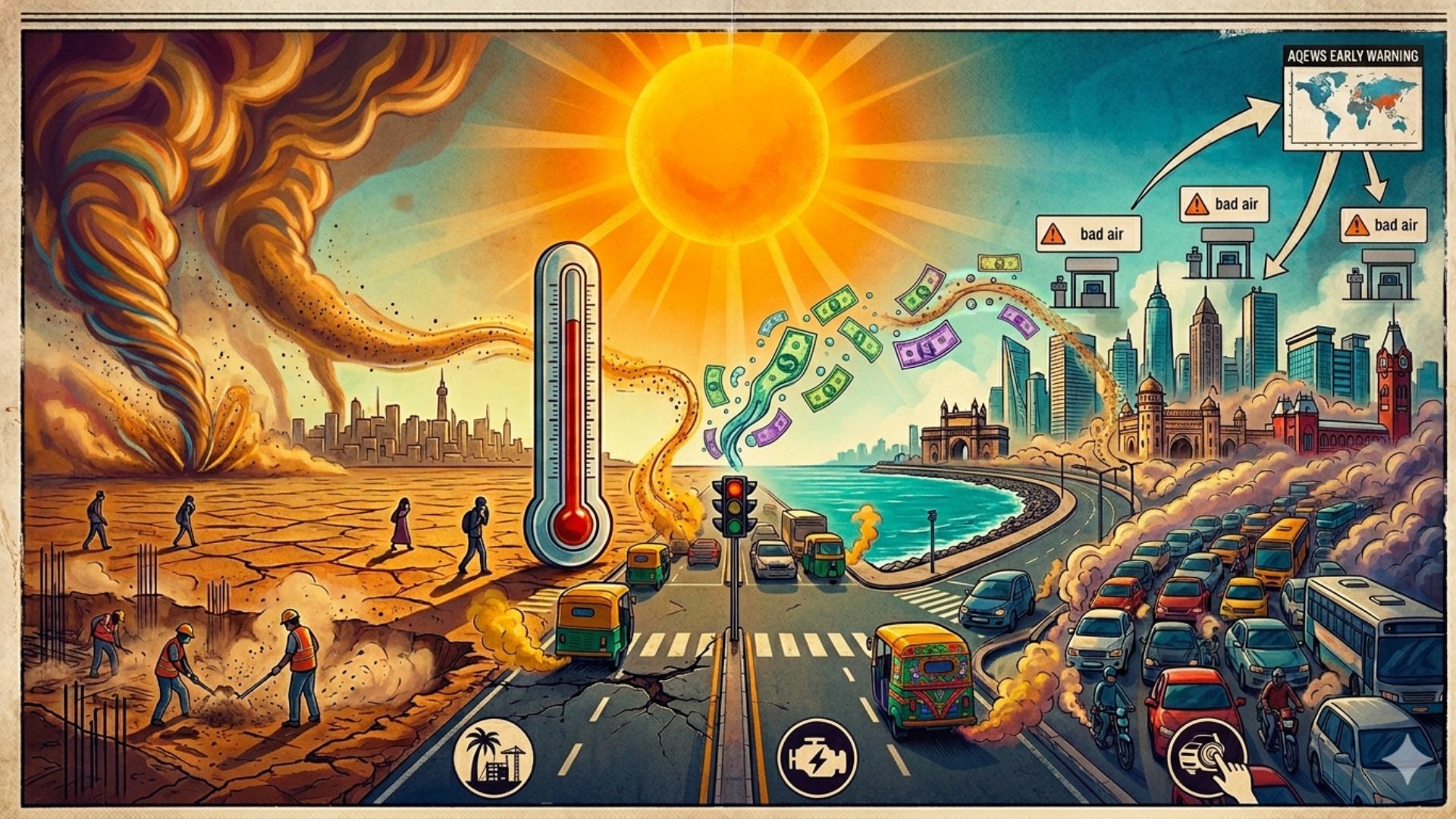
Summer Smog: India’s Emerging Air Pollution Challenge

Beyond Winter Smog: Understanding India's Growing Summer Air Pollution Challenge

Despite stronger winds and clearer skies, Indian cities from Delhi to Chennai are facing rising PM10 and ozone spikes—driven by dust storms, traffic emissions, and sunlight-fuelled chemistry that turns summer into an unexpected pollution season.
Gopi Gopi
4 mins read

"Summer may disperse some pollutants better than winter, but heat and sunlight create their own pollution chemistry."

For years, air pollution in India has been viewed primarily as a winter phenomenon, especially in Delhi and the Indo-Gangetic Plain. However, recent pollution episodes across major Indian cities demonstrate that air quality challenges persist throughout the year, albeit in different forms.

The Emerging Summer Pollution Problem

Traditionally, winter pollution receives greater attention because:

  • Low temperatures trap pollutants near the ground.
  • Weak winds reduce dispersion.
  • Basin-like topography of the Indo-Gangetic Plain limits air movement.

Despite more favorable summer conditions, pollution remains significant.

Key observations from summer 2026 include:

  • Delhi recorded 54 days between April and May when PM10 levels exceeded national standards.
  • Ozone standards were breached on 40 days at one or more monitoring stations.
  • Similar pollution spikes were observed in Mumbai, Chennai, Hyderabad, Bengaluru, and Kolkata.
Examples of local pollution drivers:

Delhi      → Dust, traffic, construction
Mumbai     → Construction activity and traffic
Chennai    → Vehicular emissions and ozone formation
Hyderabad  → Dust from local thunderstorms

How Summer Pollution Differs from Winter Pollution

The nature of pollution changes with the season.

Winter Pollution

  • Dominated by PM2.5 (fine particulate matter).
  • Enhanced by biomass burning for heating.
  • Pollutants remain trapped close to the surface.

Summer Pollution

  • Dominated by PM10 (coarse dust particles).
  • Characterized by rising ozone concentrations.
  • Influenced by dust storms, heat, and intense sunlight.

Although pollution sources remain similar throughout the year, seasonal weather conditions alter the type and severity of pollutants.

The Science Behind Rising Ozone Levels

Unlike particulate matter, ozone is not emitted directly.

It forms when:

  • Nitrogen Oxides (NOx) from vehicles react with
  • Volatile Organic Compounds (VOCs) from industries, paints, fuel combustion, and vehicle exhaust

under strong sunlight.

Why Summer Intensifies Ozone Formation

  • Higher temperatures accelerate chemical reactions.
  • Longer sunshine duration increases photochemical activity.
  • Urban traffic and industrial emissions provide abundant precursors.
NOx + VOCs + Sunlight → Ground-Level Ozone

Elevated ozone levels can worsen respiratory illnesses and reduce overall air quality.

Why PM10 Levels Spike During Summer

Summer dust pollution is driven by both natural and human-induced factors.

Natural Factors

Hot weather creates low-pressure systems over the Indian subcontinent.

This leads to:

  • Dust-laden winds from West Asia.
  • Dust transport from the Thar Desert.
  • Hot winds known as "Loo."
  • Local dust storms called "Andhi."
Loo  → Regional dust transport lasting days

Andhi → Local thunderstorm-driven dust events
         usually lasting a few hours

Severe dust storms, such as those witnessed across North India in 2018, illustrate the scale of this challenge.

Human Contributions

Natural dust is often amplified by:

  • Construction and demolition activities.
  • Poor dust management at work sites.
  • Broken and unpaved roads.
  • Vehicular movement that resuspends loose dust.

As winter restrictions under GRAP are lifted, many of these activities intensify during summer.

Building a Summer Air Quality Strategy

Since natural dust cannot be prevented, prediction and preparedness become essential.

Strengthening Forecasting Systems

India already possesses several forecasting mechanisms:

  • Air Quality Early Warning System (AQEWS)
  • India Meteorological Department (IMD) forecasts
  • Air Quality Decision Support Systems (AQDSS)

These systems provide:

  • Dust storm forecasts
  • Air quality alerts
  • Multi-day pollution predictions

Authorities can use them to issue timely public health advisories.

Managing Dust Sources

Effective interventions include:

  • Continuous monitoring of construction sites.
  • Dust suppression measures.
  • Better road maintenance.
  • Regulation of heavy vehicle movement near construction zones.

Studies have shown that reducing heavy-vehicle movement at construction sites can significantly lower local particulate pollution.

Tackling Ozone Formation

Reducing ozone requires:

  • Lower NOx emissions from vehicles.
  • Better industrial compliance.
  • Cleaner transportation systems.
  • Control of VOC emissions from paints, solvents, and fuel combustion.

Even simple measures can help.

"Red Light On, Gaadi Off"

Switching off engines at traffic signals
reduces idling emissions and ozone precursors.

Way Forward

  • Develop summer-specific air pollution action plans for all major cities.
  • Integrate forecasting with public health advisories.
  • Strengthen construction dust management throughout the year.
  • Improve road infrastructure to reduce dust resuspension.
  • Accelerate transition toward cleaner transport and industrial practices.
  • Expand early warning systems beyond major metropolitan regions.

Conclusion

India's air pollution challenge is no longer confined to winter smog. Summer brings its own combination of dust storms, PM10 pollution, and ozone formation driven by heat and sunlight. Addressing this evolving threat requires year-round planning, stronger enforcement, scientific forecasting, and sustained emission reductions. Air quality management must become a multi-season strategy rather than a winter-only response.

Attribution

Original content sources and authors

Sneha Maria Ignatious Author Sneha Maria Ignatious The Hindu Source The Hindu

Syllabus classification

How this article maps to GS papers

Main syllabus

GS3Environment & Bio-diversity

Also covers

GS1Urbanisation

Quick Q&A

What is summer air pollution in Indian cities, and how does it differ from the traditionally discussed winter pollution episodes?
Summer air pollution refers to the deterioration of air quality during hot weather conditions due to elevated concentrations of pollutants such as PM10 (coarse particulate matter) and ground-level ozone. Traditionally, public discourse in India has focused on winter pollution, especially in Delhi and the Indo-Gangetic Plain, where low temperatures, weak winds, and temperature inversions trap pollutants near the surface, leading to severe PM2.5-dominated smog. However, recent observations indicate that summer pollution is emerging as a significant environmental and public health challenge across major cities including Delhi, Mumbai, Chennai, Bengaluru, Hyderabad, and Kolkata. Unlike winter pollution, which is dominated by fine particles from vehicular emissions, biomass burning, and industrial activities, summer pollution is characterized by higher PM10 concentrations and ozone formation. PM10 levels rise due to dust storms, construction activities, road dust resuspension, and demolition work. Simultaneously, ozone forms through photochemical reactions involving nitrogen oxides (NOx) and volatile organic compounds (VOCs) under intense sunlight and high temperatures. Data from 2026 illustrate this challenge. Delhi recorded 54 days between April and May when PM10 exceeded the National Ambient Air Quality Standard (NAAQS) of 100 µg/m3. Additionally, ozone standards were breached on numerous occasions. These trends demonstrate that favorable meteorological conditions in summer do not necessarily guarantee clean air. For UPSC GS-III, this topic is relevant to environmental pollution, urbanization, public health, climate change, and sustainable development. It highlights the need for year-round air quality management rather than a seasonal approach focused exclusively on winter smog.
How do meteorological conditions, dust storms, and human activities interact to increase PM10 pollution during the summer season?
PM10 pollution during summer results from a complex interaction between natural meteorological processes and anthropogenic activities. PM10 refers to particulate matter with a diameter of 10 micrometers or less, which can penetrate the respiratory system and cause significant health impacts. Meteorologically, intense summer heating over the Indian subcontinent creates low-pressure zones that interact with surrounding high-pressure systems. This interaction generates strong winds capable of transporting large quantities of dust from the Thar Desert and West Asia across northern and central India. Dust-laden hot winds known as 'loo' can elevate PM10 concentrations over large geographical areas for several days. Localized dust storms called 'andhi' are also common and occur when thunderstorm-induced downdrafts strike the ground and lift loose dust into the atmosphere. Human activities significantly amplify this natural dust burden. Construction and demolition activities often increase after winter restrictions under mechanisms such as the Graded Response Action Plan (GRAP) are relaxed. Inadequate dust suppression measures at construction sites contribute substantially to PM10 levels. Additionally, broken roads, unpaved surfaces, and heavy traffic resuspend accumulated dust, especially under dry summer conditions. The severe dust storms of 2018 demonstrated how natural and anthropogenic factors can combine to produce dangerous air quality conditions. Research by institutions such as the Council on Energy, Environment and Water (CEEW) has shown that reducing heavy vehicle movement around construction sites can significantly lower particulate concentrations. For UPSC aspirants, this topic links GS-III themes of environmental pollution, disaster management, urban governance, and climate adaptation. It underscores the importance of integrating meteorological forecasting, infrastructure planning, and pollution control measures to address a growing environmental challenge.
Why is ground-level ozone emerging as a major environmental and public health concern in Indian cities during hot weather conditions?
Ground-level ozone is emerging as a major environmental concern because it is an invisible but highly harmful pollutant whose formation is accelerated by rising temperatures and intense sunlight. Unlike primary pollutants such as particulate matter, ozone is a secondary pollutant. It is not emitted directly from vehicles, factories, or power plants. Instead, it forms through chemical reactions between nitrogen oxides (NOx) and volatile organic compounds (VOCs) in the presence of sunlight. Indian cities are increasingly vulnerable to ozone pollution due to rapid urbanization, rising vehicular ownership, industrial expansion, and hotter climatic conditions. Major sources of NOx include vehicle exhaust and industrial combustion processes, while VOCs originate from industrial emissions, fuel evaporation, paints, solvents, and other chemical products. During summer, high temperatures and strong solar radiation create ideal conditions for ozone formation. The health consequences are significant. Exposure to elevated ozone levels can cause respiratory irritation, reduced lung function, asthma aggravation, chronic respiratory diseases, and increased hospital admissions. Vulnerable groups such as children, elderly citizens, and individuals with pre-existing respiratory conditions face greater risks. The issue is particularly relevant in cities such as Delhi, Mumbai, and Chennai, where increasing temperatures and dense traffic contribute to recurring ozone exceedances. Climate change may further worsen the situation by increasing the frequency and intensity of heatwaves. For UPSC GS-III, ozone pollution connects environmental pollution, public health, climate change, urban planning, and sustainable development. It also raises policy questions regarding cleaner transportation systems, industrial emission standards, fuel quality improvements, and behavioral interventions such as reducing vehicle idling. Addressing ozone pollution requires integrated governance because conventional particulate control measures alone may not be sufficient.
Critically analyze the effectiveness of GRAP and seasonal pollution-control strategies in addressing year-round urban air pollution challenges in India.
The Graded Response Action Plan (GRAP) represents one of India's most significant policy interventions for managing severe air pollution, particularly in the National Capital Region (NCR). It provides a structured framework of escalating measures based on pollution levels, including restrictions on construction, industrial operations, and vehicular movement. While GRAP has contributed to emergency response mechanisms, its effectiveness in addressing year-round pollution remains a subject of debate. One major strength of GRAP is its ability to provide coordinated action during severe pollution episodes. It institutionalizes accountability among agencies and allows rapid interventions during environmental emergencies. However, critics argue that GRAP remains largely reactive rather than preventive. Most measures intensify during winter when pollution reaches crisis levels, while comparatively less attention is given to summer pollution driven by PM10 and ozone. The article highlights that pollution episodes continue even after winter restrictions are lifted. Construction activities often resume without adequate dust-control mechanisms, and ozone-forming emissions from vehicles and industries remain insufficiently regulated. Consequently, cities continue to experience air quality violations despite seasonal interventions. Another limitation is geographical concentration. While Delhi has a relatively advanced pollution-control framework, many Indian cities lack equivalent systems despite facing similar environmental challenges. Moreover, enforcement gaps, institutional fragmentation, and inadequate monitoring reduce policy effectiveness. A more comprehensive approach would involve year-round action plans, predictive air-quality forecasting, public health advisories, construction dust management, road maintenance, cleaner fuels, and industrial compliance mechanisms. For UPSC GS-III, this issue illustrates broader governance challenges involving environmental regulation, cooperative federalism, urban management, and sustainable development. The key lesson is that air pollution should be treated as a continuous environmental challenge rather than a seasonal emergency.
What lessons can Indian cities learn from air-quality forecasting systems and urban pollution management initiatives implemented in Delhi and Mumbai?
Delhi and Mumbai provide important case studies in the evolution of urban air-quality management in India. Both cities have adopted innovative forecasting and monitoring systems to improve pollution governance and reduce public exposure to harmful pollutants. Delhi's Air Quality Early Warning System (AQEWS) was developed following severe smog episodes and dust storms, particularly after the major dust events of 2018. The system uses meteorological and emissions data to forecast pollution levels several days in advance. It provides detailed information on weather conditions and air quality trends, enabling authorities to implement preventive measures rather than relying solely on emergency responses. Similarly, Mumbai's Air Quality Decision Support System (AQDSS), developed in collaboration with the Council on Energy, Environment and Water (CEEW), focuses on monitoring construction activities and identifying pollution hotspots. Since October 2025, it has reportedly facilitated action against more than 1,000 construction sites, demonstrating how data-driven governance can strengthen regulatory enforcement. Several lessons emerge from these initiatives. First, predictive governance is more effective than reactive crisis management. Second, technological tools can enhance transparency, accountability, and evidence-based policymaking. Third, local pollution sources require city-specific solutions rather than uniform national approaches. Fourth, public communication and health advisories are essential components of environmental governance. However, challenges remain, including funding constraints, institutional coordination issues, and uneven implementation across cities. Many urban centers still lack sophisticated forecasting infrastructure and enforcement capacity. For UPSC aspirants, these case studies are relevant to GS-III topics such as environmental pollution, urban governance, technological innovation, and disaster preparedness. They illustrate how scientific forecasting and digital governance can improve environmental management while offering scalable models for other Indian cities facing similar air-quality challenges.
How can Indian cities develop comprehensive summer air pollution action plans to address both PM10 and ozone-related environmental risks?
Developing comprehensive summer air pollution action plans requires a multi-dimensional strategy that addresses both particulate matter (PM10) and ozone pollution. Unlike winter pollution, which is largely associated with smog and PM2.5, summer pollution involves distinct meteorological and chemical processes that require tailored interventions. The first component should be advanced forecasting and early-warning systems. Cities can utilize platforms such as the Air Quality Early Warning System (AQEWS) and India Meteorological Department (IMD) forecasts to predict dust storms, ozone episodes, and pollution hotspots. Timely public advisories can help vulnerable populations reduce exposure. Second, strict construction and demolition regulations are essential. Authorities should mandate dust suppression measures, covering of construction materials, mechanized road sweeping, and regular site inspections. Urban local bodies should prioritize maintenance of roads to reduce dust resuspension. Third, reducing ozone requires controlling precursor emissions. This involves promoting cleaner fuels, strengthening vehicle emission standards, expanding public transport, encouraging electric mobility, and regulating industrial VOC emissions. Measures targeting paints, solvents, and fuel combustion can also reduce ozone formation. Fourth, behavioral interventions can complement regulatory measures. Campaigns such as Delhi's 'Red Light On, Gaadi Off' initiative demonstrate how public participation can reduce idling emissions and improve air quality. Fifth, cities should integrate public health measures into environmental planning by issuing advisories for schools, hospitals, and vulnerable groups during pollution episodes. For UPSC GS-III, this topic connects environmental governance, urban planning, climate adaptation, public health, and sustainable development. Effective summer action plans require coordination among municipal authorities, pollution control boards, meteorological agencies, industries, and citizens. The ultimate objective is to establish year-round air-quality management systems that address seasonal variations while protecting public health and environmental sustainability.

Practice questions

1 question for mains preparation

Air pollution in India is increasingly becoming a year-round challenge rather than a seasonal phenomenon. Examine the causes and impacts of summer air pollution in Indian cities and suggest measures for its mitigation.

10 marks · 150 words · 8 mins
