GS3 Environment & Bio-diversity
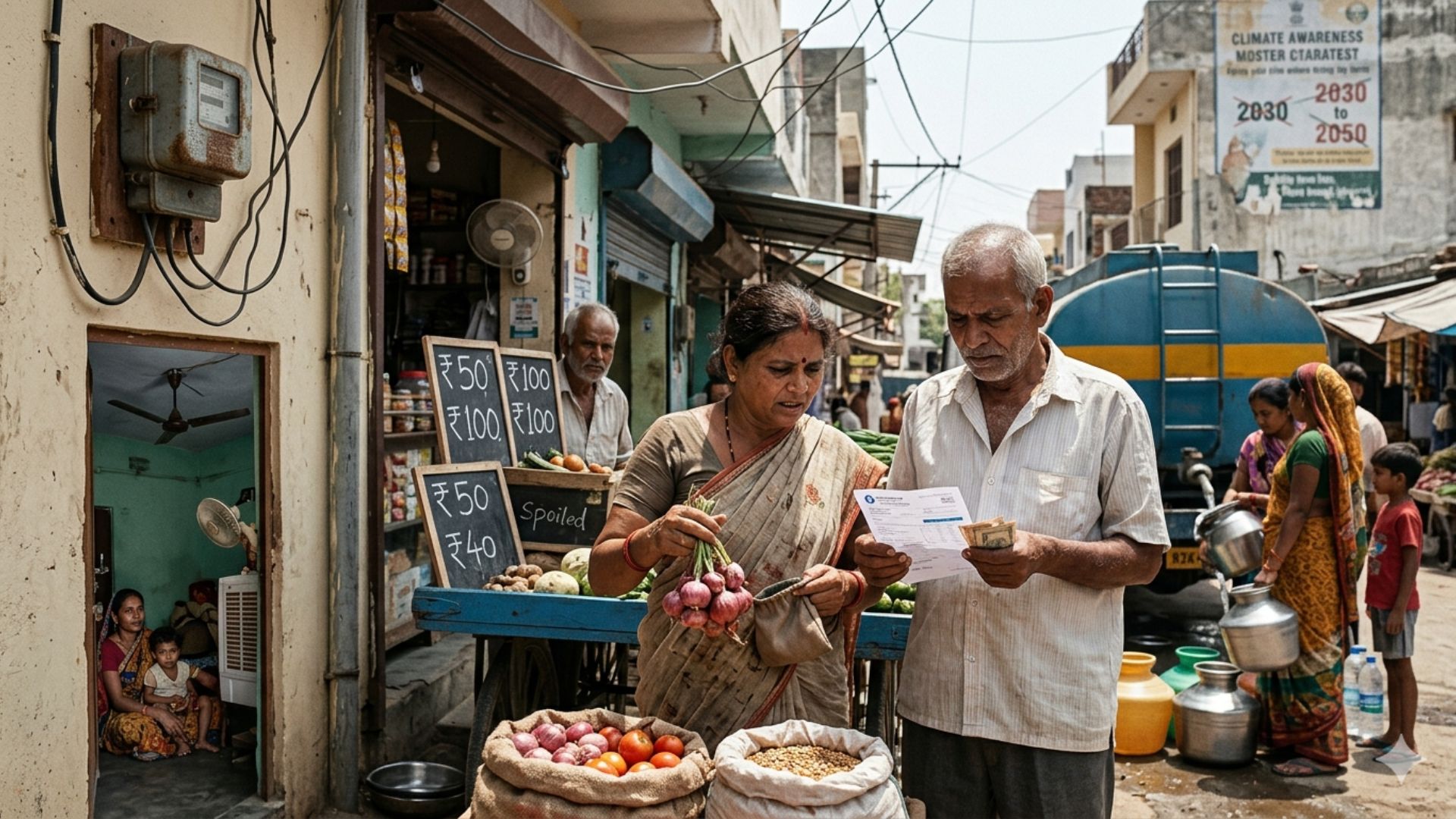
Climate Change and India's Rising Cost of Living
 Gopi
Gopi
“Climate change is no longer a problem of 2070; it is increasingly a problem of the end of every month.”
Climate change is often discussed in terms of future net-zero targets and long-term environmental risks. However, its impacts are already being felt in the form of rising household expenses. From food and electricity to water and healthcare, climate change is quietly increasing the cost of living, particularly for vulnerable sections of society.
How Climate Change Raises Everyday Costs
| Sector | Climate Impact | Household Consequence |
|---|---|---|
| Food | Heatwaves, erratic rainfall, crop losses | Higher food prices |
| Energy | Rising temperatures, increased cooling demand | Higher electricity bills |
| Water | Groundwater depletion, irregular monsoons | Dependence on costly private water supply |
| Health | Heat stress, poor air quality, diseases | Increased medical expenditure |
Climate and Food Inflation
Food remains the largest component of India's Consumer Price Index (CPI), accounting for nearly 46% of the inflation basket.
Climate shocks directly affect agricultural production:
- Delayed or weak monsoons reduce sowing and harvests.
- Extreme heat damages crop yields even when rainfall is adequate.
- Supply disruptions create shortages and price spikes.
2023:
• Monsoon rainfall deficit: ~6%
• Reduced sowing of pulses and oilseeds
• Rice, wheat and pulse prices rose by 6–15% year-on-year
Repeated climate shocks create a chain reaction:
Lower yields → Supply bottlenecks → Hoarding/speculation → Higher food prices
As a result, climate change is becoming a structural driver of food inflation.
Rising Energy Costs
Higher temperatures increase dependence on cooling devices such as fans and air conditioners.
May 2026 Heatwave:
• India's power demand reached a record 270.8 GW
• Cooling requirements became the primary driver
Consequences include:
- Greater strain on electricity grids.
- Increased use of costly coal and imported fuels.
- Higher tariffs and surcharges.
For middle-class households this may be an inconvenience, but for low-income families it often means cutting expenditure on food, education or healthcare.
Water: The Hidden Climate Cost
Climate change is intensifying water insecurity through:
- Erratic rainfall patterns.
- Groundwater depletion.
- More frequent drought conditions.
In urban areas, this has encouraged the growth of a "tanker economy", where households pay private vendors for water.
In rural regions, families spend:
- More time collecting water.
- More money securing reliable access.
Marginalised communities, including Dalits, Adivasis and slum dwellers, bear a disproportionate burden because they already face limited access to basic services.
Health Impacts and Income Loss
Climate-sensitive health risks are increasing:
- Heat-related illnesses.
- Respiratory problems from poor air quality.
- Spread of vector-borne diseases.
The burden extends beyond treatment costs:
- Loss of daily wages due to illness.
- Increased caregiving responsibilities.
- Reduced labour productivity.
Women, particularly in rural areas, face multiple vulnerabilities as they work in hotter conditions, travel longer distances for water and care for affected family members.
Climate Change and Inequality
The impacts are not distributed equally.
Studies show that socially and economically advantaged groups are more capable of adopting climate-adaptive measures such as:
- Irrigation systems.
- Climate-resilient technologies.
- Improved infrastructure.
Meanwhile, small farmers, informal workers and marginalised communities often rely on:
- Debt.
- Distress migration.
- Reduced spending on nutrition and education.
Climate change acts like a "regressive tax"—those who contributed least to the problem often bear the highest costs.
Emerging Economic Risks
The economic consequences extend beyond households.
| Projected Impact | Implication |
|---|---|
| Up to 2.8% reduction in GDP by 2050 | Slower economic growth |
| Nearly half the population affected | Declining living standards |
| Climate hotspots in states such as Maharashtra, Uttar Pradesh, Rajasthan, Madhya Pradesh and Chhattisgarh | Greater agrarian distress and vulnerability |
These regions already face challenges such as low farm incomes, indebtedness and recurring farmer distress.
Way Forward
- Promote climate-resilient agriculture and initiatives such as Andhra Pradesh Community Natural Farming (APCNF).
- Strengthen urban heat action plans and climate-resilient infrastructure.
- Expand affordable public transport to reduce energy dependence.
- Ensure universal access to water, healthcare and social protection.
- Improve climate adaptation support for small and marginal farmers.
- Develop targeted measures for vulnerable communities, including Dalits, Adivasis and informal workers.
- Integrate climate costs into economic and development planning.
Conclusion
Climate change is no longer only an environmental challenge; it is increasingly a cost-of-living crisis. Rising food prices, electricity bills, water costs and healthcare expenses are transforming climate risks into everyday economic burdens. Recognising climate change as a social and economic issue can help shift policy focus from short-term crisis management to long-term resilience, ensuring that the costs of adaptation do not fall disproportionately on the most vulnerable sections of society.
Attribution
Original content sources and authors


Syllabus classification
How this article maps to GS papers
Main syllabus
GS3Environment & Bio-diversityQuick Q&A
What is the concept of climate change as a cost-of-living crisis, and why is it increasingly significant for India?
Why is understanding the economic and social dimensions of climate change important for UPSC aspirants and policy debates?
How do heatwaves, monsoon variability and extreme weather events contribute to inflation and household economic stress in India?
What are the reasons behind the unequal burden of climate change on vulnerable communities and marginalized groups in India?
What practical examples and case studies demonstrate the relationship between climate change and everyday household expenses in India?
What is a critical analysis of India's present policy responses to climate-induced economic challenges and cost-of-living pressures?
What policy measures and case studies can help India build equitable climate resilience while protecting vulnerable populations?
Practice questions
1 question for mains preparation